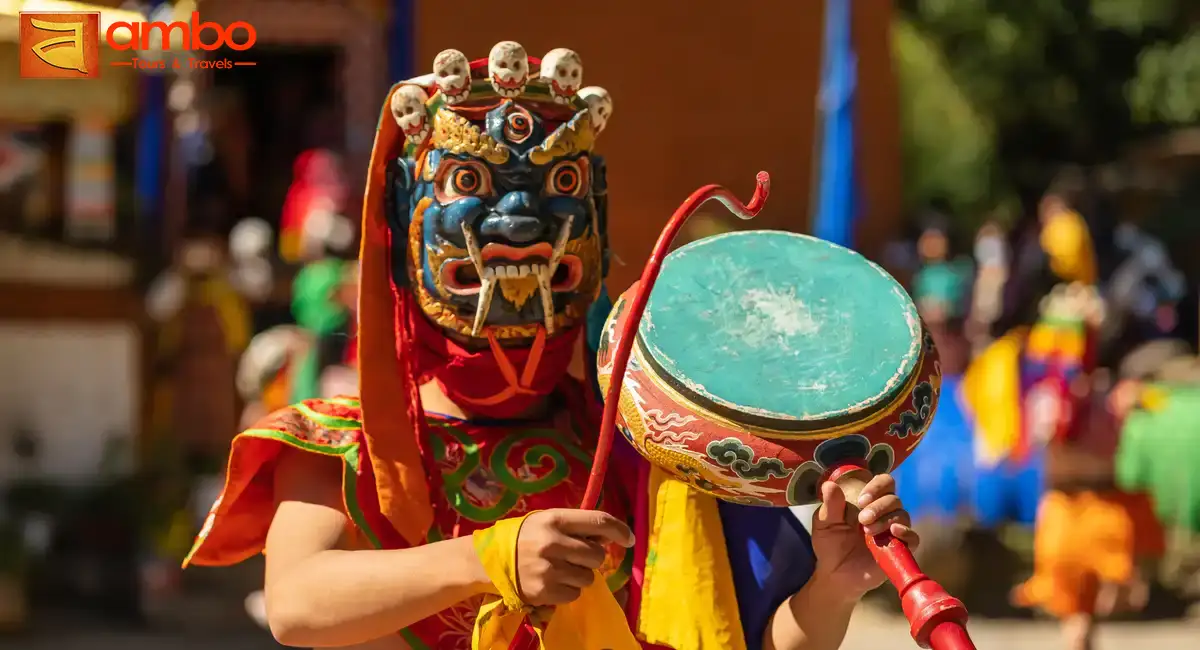
Gangtey Tshechu Festival Tour — Phobjikha Valley, Punakha & Western Bhutan
Paro · Thimphu · Punakha · Phobjikha Valley
Tour Information
- Attend the Gangtey Tshechu at Gangtey Gompa — sacred cham mask dances and Atsara jesters at 3,000m in Phobjikha Valley
- Walk Phobjikha Valley wetlands and observe endangered black-necked cranes on the valley floor
- Visit Gangtey Gompa — the only Nyingmapa monastery in western Bhutan, founded 1613
- Visit Punakha Dzong — the Palace of Great Happiness, built in 1637 at the confluence of two rivers
- Evening hike to Khamsum Yulley Namgyal Choling Monastery above Punakha's rice fields
- Cross Dochula Pass (3,140m) with 108 memorial chortens and Himalayan panoramas including Gangkar Puensum
- Walk across Bhutan's longest suspension bridge (160m) over the Pho Chhu river
- Hike to Taktsang Monastery (Tiger's Nest) — 900m above Paro Valley through blue pine forest
- Visit Wangdue Phodrang Dzong, Changlimithang Archery Ground, and Tamchog Lhakhang iron-bridge monastery
- Fully private and inclusive: SDF, visa, licensed guide, transport, accommodation and all meals
The Gangtey Tshechu is one of Bhutan's most atmospheric religious festivals — held at Gangtey Gompa, the only Nyingmapa monastery in western Bhutan, set on a forested ridge above the glacial bowl of Phobjikha Valley at 3,000 metres. Sacred cham mask dances fill the monastery courtyard over two days, including the Black Hat Dance and the Dance of the Lords of the Cremation Grounds, punctuated by the comedic performances of Atsara jesters. Below the monastery, the wetland floor of the valley hosts some of the rarest birds in Asia — the endangered black-necked cranes, which migrate here from the Tibetan plateau each autumn.
This 9-day private tour is built around the festival day at Gangtey. The journey takes you from Paro to Thimphu for two days of capital culture, across to Punakha via Dochula Pass for the finest dzong in Bhutan, and up into Phobjikha Valley for the festival. The return journey passes through Thimphu and Paro, with the Tiger's Nest hike on Day 8 before departure.
Every detail is arranged by Ambo Tours' licensed team in Thimphu — permits, accommodation, guide, transport, and all meals throughout.
Tour Pricing
9 Days Bhutan Journey — Cost
All prices in USD per personCost includes Sustainable Development Fee (SDF) of US $100 per person per night and Bhutan Visa Fee of US $40 per person. Entrance fees for monuments and festival visits are paid separately.
Detailed Itinerary
Your Gangtey Tshechu Festival Bhutan journey begins with one of commercial aviation's most exhilarating arrivals. The plane banks sharply between Himalayan ridgelines into Paro International Airport — green mountains, prayer flags, and the cleanest air you will breathe all year hit you the moment the door opens. The Ambo Tours guide and driver meet you at arrivals and begin the scenic drive east to Thimphu.
En route, stop at Tamchog Lhakhang — a 15th-century monastery built by the remarkable engineer-saint Thang Tong Gyalpo, known across the Himalayan world as the Iron Bridge Builder. He constructed 108 iron-chain suspension bridges across Tibet and Bhutan — eight of them in Bhutan — and this monastery stands beside one of his most famous surviving structures. It is a Bhutan hidden gem that most itineraries overlook entirely.
Arrive in Thimphu for lunch, then visit three afternoon highlights:
- National Memorial Chorten (built 1974) — a prominent city landmark built in honour of the third King of Bhutan, His Majesty King Jigme Dorji Wangchuck, always busy with Bhutanese of all ages walking evening circumambulations.
- Buddha Dordenma at Kuenselphodrang — at 51.5 metres, one of the tallest seated Buddha statues in the world, made of bronze and gilded in gold, commanding a sweeping panorama of Thimphu valley.
- Craft Bazaar — the best single stop for authentic Bhutanese handicrafts, thangka paintings, hand-woven textiles, and wooden artefacts to take home.
End the day with a visit to Tashichho Dzong — the Fortress of the Glorious Religion, seat of the national government and central monk body, at its most photogenic in the evening light. Dinner and overnight in Thimphu.
Tomorrow brings a full day of deeper Thimphu sightseeing — from ancient hilltop monasteries to traditional arts workshops.
Today Ambo Tours takes you deeper into Thimphu — past the grand landmarks and into the temples, workshops, and local spaces that reveal the living texture of the capital. Each stop adds a layer of cultural context that will enrich everything you see at the Gangtey Tshechu Festival Bhutan later in the week.
- Changangkha Lhakhang — the oldest temple in Thimphu valley, built in the 12th century by Lama Phajo Drugom Shigpo on a ridge above the city. It remains an active place of daily worship, especially by parents seeking blessings for newborns, and offers panoramic views over Thimphu.
- Takin Preserve at Motithang — home to the Takin, Bhutan's national animal, a distinctive bovine-goat hybrid that has baffled zoologists and which the Bhutanese believe was created by the Divine Madman Drukpa Kunley through his Tantric powers.
- Sangaygang Viewpoint — the best hilltop panorama over Thimphu valley, ideal for photography in the clear morning light.
- Dupthop Lhakhang — one of the few surviving active nunneries in Bhutan, a quietly reflective stop that makes this Bhutan cultural tour genuinely different from more mainstream itineraries.
- Simply Bhutan — an immersive living museum where you can taste ara (traditional Bhutanese rice wine), watch folk dances, try on national dress, and experience the warmth of Bhutanese hospitality in a structured cultural setting.
After lunch:
- National Postal Museum — where your own photograph can be printed onto an official Bhutanese postage stamp in minutes, one of the most unique personalised souvenirs available on any Bhutan trip.
- Zorig Chusum Institute (School of 13 Arts and Crafts) — watch apprentice artists practise thangka painting, wood carving, sculpture, and embroidery. These sacred Buddhist art forms have been preserved through this institute for generations.
The evening is free for shopping and photography along Thimphu's main street. Dinner and overnight in Thimphu.
Tomorrow, the road descends to subtropical Punakha via the 108 chortens of Dochula Pass.
The drive from Thimphu to Punakha is one of the most celebrated short road journeys in the Himalayas. Your Ambo Tours driver stops first at Dochula Pass (3,140 m) — where 108 Druk Wangyal chortens crown a hilltop wrapped in prayer flags, and on clear mornings the full sweep of the Greater Himalayan range — including Bhutan's highest mountain, Gangkar Puensum — fills the horizon. It is one of the most iconic Bhutan sightseeing stops in the country.
Descend through lush subtropical forest to Chimi Lhakhang — the fertility temple built in 1499 by Lama Drukpa Kuenley (1455–1529), the Divine Madman, a Tibetan-born saint who travelled across Bhutan and Tibet spreading his unconventional teachings through song, humour, and outrageous behaviour. The temple sits on a round hillock near Sopsokha village, reached by a 20-minute walk through rice paddies. It remains one of the most visited sacred sites on any Bhutan tour package.
After lunch, visit Punakha Dzong (built 1637 by Zhabdrung Ngawang Namgyal) — Bhutan's former capital, positioned dramatically at the confluence of the Pho Chhu and Mo Chhu rivers and the winter residence of Je Khenpo. In spring, jacaranda trees drape the outer walls in purple bloom.
In the evening, hike to Khamsum Yulley Namgyal Choling Monastery — built by Her Majesty Queen Tshering Yangdon Wangchuck, a 45-minute climb through pine forest and rice terraces rewarded with sweeping views of the Punakha valley turning golden at dusk. Dinner and overnight in Punakha.
Tomorrow the route climbs to Gangtey — and the stage is set for the Gangtey Tshechu Festival Bhutan 2026.
The morning begins with a walk across the longest suspension bridge in Bhutan (160 m) — spanning the Pho Chhu river with views of the valley, river, and Punakha Dzong framed perfectly downstream. The bridge serves both locals and visitors, and the mild adrenaline of crossing it on a clear morning is one of the more memorable moments of any Bhutan trip.
Drive north through the Wangdue Phodrang district, stopping to view Wangdue Phodrang Dzong — originally built in 1638 by Zhabdrung Ngawang Namgyal and devastated by fire in 2012, now undergoing careful restoration. Even in its reconstructed state it occupies one of the most commanding dzong positions in the country, overlooking the confluence of two rivers from a high ridge.
Continue to Gangtey and settle into the valley before the festival begins tomorrow. Two afternoon visits prepare the ground:
- Gangtey Gompa (founded 1613 by Gyaltse Pema Thinley, grandson and reincarnation of Pema Lingpa) — the only Nyingmapa monastery in western Bhutan, whose ninth reincarnation abbot, Kunzang Pema Namgyal, presides today. This is the monastery at the heart of the Gangtey Tshechu Festival Bhutan — walking its courtyards and prayer halls the day before the festival creates a powerful sense of anticipation.
- Black-Necked Crane Information Centre — set on the forest edge of Phobjikha Valley, equipped with high-power telescopes for observing the endangered cranes that winter in this glacial bowl, migrating from the Central Asiatic Plateau each autumn.
Dinner and overnight in Gangtey.
Tomorrow — the Gangtey Tshechu 2026 begins.
This is the day your Gangtey Tshechu Festival Bhutan journey has been building toward. The Gangtey Tshechu 2026 is one of the most atmospheric religious festivals in the kingdom — unique among all Bhutanese tshechus for its setting deep in a high glacial valley at 3,000 m, far from any city, with the sacred backdrop of Gangtey Gompa and the sound of black-necked cranes on the wetlands below.
The Ambo Tours guide brings you to the monastery early to secure a good position in the courtyard as the first monks emerge in their elaborate silk brocade costumes and lacquered masks. The festival honours the teachings of Guru Rinpoche and the Nyingma tradition, and its sacred cham mask dances are among the most visually extraordinary in Bhutan.
- Watch the Black Hat Dance — monks in tall black hats and swirling robes performing a ritual that drives out evil forces from the valley.
- Observe the Dance of the Lords of the Cremation Grounds — a solemn performance by monks in skeleton costumes representing the intermediate state between death and rebirth.
- Witness the Atsara jesters weaving irreverent comedy between solemn performances — a beloved Bhutanese tradition that reflects the balance of sacred and playful in Bhutan Buddhist culture.
- Receive a blessing from the presiding lama — an experience your guide will help facilitate and provide cultural context for.
In the late afternoon, walk the Phobjikha Valley floor — one of the most beautiful glacial valley walks in the Himalayas, with black-necked cranes feeding in the wetlands as the light softens. Tip: Wear warm layers — Gangtey at 3,000 m is cool even during festival season. Dinner and overnight in Gangtey.
Tomorrow the drive returns through Dochula Pass to Thimphu for archery and a final evening in the capital.
After the intensity and colour of the Gangtey Tshechu Festival Bhutan, today offers a more relaxed pace — a scenic drive back through the highland road to Thimphu, stopping at Dochula Pass (3,140 m) for a second chance at the 108 chortens and mountain panorama. If yesterday's focus was the festival, today the mountains get your full attention.
Arrive in Thimphu in the early afternoon for two enjoyable stops:
- Changlimithang Archery Ground — watch a local archery match if one is in progress. Bhutan's national sport pits teams with compound bows against targets 145 metres apart, accompanied by ritual singing and celebratory dancing after every hit. The atmosphere is electric and the community spirit on full display — one of the most entertaining spontaneous Bhutan sightseeing moments of the entire tour.
- Thimphu Town Stroll — browse the main commercial street for last-minute handicraft shopping, try ema datshi (Bhutan's national dish of chilli and cheese) at a local restaurant, or simply watch the evening crowds gather around the clock tower square.
Dinner and overnight in Thimphu.
Tomorrow, the drive to Paro begins with the Royal Textile Museum before the final days of Bhutan sightseeing in the Paro valley.
The morning begins in Thimphu with a visit to the Royal Textile Museum — a beautifully curated collection of Bhutanese woven fabrics, royal garments, and textile traditions spanning centuries. Bhutanese weaving is one of the most sophisticated craft traditions in Asia, and this museum provides essential context for the textiles you have seen on festival-goers throughout the week. Browse the Thimphu market nearby before the drive west to Paro.
In Paro, the afternoon covers three significant cultural sites:
- Ta Dzong National Museum (built 1649) — an ancient watchtower converted into a national museum in 1968, housing galleries of fine arts, bronzes, textiles, jewellery, stuffed wildlife, and Bhutan's famous stamp collection including 3-D, silk, embossed, and the iconic triangular yeti stamps.
- Rinpung Dzong (built 1646 by Zhabdrung Ngawang Namgyal) — a commanding fortress-monastery above the Paro valley floor, serving as the administrative centre of Paro district. Its wooden-gallery courtyard is lined with extraordinary Bhutan Buddhist culture murals and remains one of the finest Bhutan dzong interiors in the country.
In the evening, visit a traditional Bhutanese farmhouse — a privately owned working farm where the Ambo Tours guide introduces you to the family, the architecture of a traditional Bhutanese home, and local farm life over butter tea and homemade snacks. It is one of the most genuine human encounters of the entire Bhutan tour package. Dinner and overnight in Paro.
Tomorrow — the defining hike of any Bhutan trip: the climb to Tiger's Nest Monastery.
No Bhutan tour package is complete without this day. The hike to Taktsang Monastery (Tiger's Nest) at 3,120 m is the defining image of Bhutan tourism worldwide — gilded temples clinging impossibly to a sheer cliff face 900 metres above the Paro Valley floor. The primary monastery was built in 1684 by Gyaltse Tenzin Rabgay around the cave where Guru Rinpoche, the founding father of Bhutanese Mahayana Buddhism, meditated after arriving here on the back of a flying tigress in the 8th century.
Drive to Satsam Chorten and begin the two-hour hike up through blue pine forest — a steady climb that rewards at every turn with widening valley views and, halfway up, a teahouse perch with the monastery perfectly framed above. Allow extra time inside the inner sanctuaries — cameras must be left at the entrance gate and the stillness within is extraordinary after the effort of the climb.
After lunch, two afternoon sites complete the Paro sightseeing:
- Drugyal Dzong — built in 1647 by Zhabdrung Ngawang Namgyal as a defence fortress against Tibetan invasion, now a picturesque ruin whose collapsed walls frame a dramatic view of Jhomolhari peak on clear days.
- Kichu Lhakhang (built 659 AD by Tibetan King Srongtsen Gampo) — one of the oldest temples in Bhutan and one of 108 built across the Himalayan region in a single day to pin a mythological earth-demon. Six of these temples are in Bhutan, and Kichu is among the most sacred.
The evening is free for a final stroll through Paro town — browse the painted shopfronts for hand-woven textiles, incense, and wooden crafts. Dinner and overnight in Paro.
Tomorrow, your Gangtey Tshechu Festival Bhutan journey with Ambo Tours comes to a close.
Your Gangtey Tshechu Festival Bhutan tour with Ambo Tours comes to a close after an early breakfast. Your guide and driver transfer you to Paro International Airport as per your flight schedule — and as the plane climbs steeply between the ridgelines, the prayer flags and painted farmhouses of the Paro valley recede below for the last time on this trip.
Nine days have carried you across the western arc of Bhutan: the iron-bridge monastery of Tamchog, the living craft traditions of Thimphu, the river-confluence grandeur of Punakha Dzong, the crane sanctuary of Phobjikha Valley, the sacred cham mask dances of the Gangtey Tshechu 2026 at Gangtey Gompa, the textile heritage of the Royal Museum, and the cliff-face wonder of Tiger's Nest as the unforgettable final chapter.
The Gangtey Tshechu in particular stands apart from all other Bhutanese festivals — held in a high glacial valley surrounded by cranes and forest rather than a city, it delivers an encounter with Bhutan Buddhist culture that is simultaneously more intimate and more dramatic than any other festival in the kingdom. Bhutan's commitment to sustainable tourism and Gross National Happiness (GNH) ensures that what you experienced here was genuine, unhurried, and unspoiled. The entire Ambo Tours team thanks you and hopes to welcome you back to the Land of the Thunder Dragon.
Included / Excluded
- ✔All meals — breakfast, lunch, and dinner
- ✔Accommodation on twin / double sharing basis (single supplement extra)
- ✔All transportation within the kingdom including airport transfers
- ✔Sustainable Development Fee — Government tax (SDF)
- ✔Bhutan visa fee
- ✔English-speaking private local guide
- ✔Sightseeing as per itinerary
- ✔Bottled water throughout the journey
- ✖International flights to and from Paro (PBH)
- ✖Entrance fees for museums and monuments
- ✖Gratuities for guides and drivers
- ✖Travel insurance premiums
- ✖Payments for services provided on a personal basis
- ✖Cost for any services not mentioned under "Cost Includes"
- ✖Cost incurred due to mishaps, strikes, political unrest, etc.
- ✖Personal expenses — laundry, beverages, or personal services
Ambo Tours & the 1% Club
Every tour we run includes a contribution to a Bhutanese NGO of your choice — at no extra cost to you. We call this the 1% Club: a minimum of 1% of your trip's profit, or Nu 5,000, whichever is higher, donated on every single journey. You choose where it goes.
About the Gangtey Tshechu
The Gangtey Tshechu is one of Bhutan's most visually spectacular religious festivals — held annually at Gangtey Gompa on a forested ridge above Phobjikha Valley. As one of Bhutan's few Nyingmapa tshechus (most are Drukpa Kagyu), it draws monks and lay practitioners from across the Nyingmapa tradition for two days of sacred cham mask dances, blessings, and ceremonial performance.
The festival programme includes the Black Hat Dance — monks in tall black hats and elaborate silk costumes driving out evil spirits — and the Dance of the Lords of the Cremation Grounds, performed by monks in skeleton costumes representing the intermediate state between death and rebirth. Atsara jesters provide comedic relief between sacred dances, maintaining a tradition of humour as spiritual counterpoint that runs through all Bhutanese tshechus. The festival closes with a blessing from the presiding lama.
The setting is unlike any other festival in Bhutan: the monastery courtyard opens directly onto the ridge above the valley, with the wide glacial bowl of Phobjikha 300 metres below and the Black Mountains visible beyond. For an overview of all Bhutan's festivals, see our complete guide to Bhutan festivals.
Phobjikha Valley & Gangtey Gompa
Phobjikha is a wide glacial bowl at approximately 3,000 metres, surrounded by the Black Mountains on three sides. It is one of the most ecologically significant valleys in Bhutan — a designated wildlife sanctuary and the primary wintering ground for endangered black-necked cranes, which migrate here from the Tibetan plateau each autumn. The valley's marshy bottomlands, fed by Nakay Chhu river, support a rich diversity of birdlife alongside the cranes, and the surrounding forests of blue pine and fir harbour serow, barking deer, and occasional leopard.
Gangtey Gompa sits on a forested ridge above the valley floor — founded in 1613 by Gyaltse Pema Thinley, the grandson of the great Nyingma treasure discoverer Pema Lingpa. It is the only Nyingmapa monastery in western Bhutan and one of the most architecturally outstanding in the kingdom. The Black-Necked Crane Information Centre on the valley floor provides telescope observation of the cranes and context on the conservation efforts that have helped their population recover.
For a full destination guide, see our Phobjikha Valley guide. For the best season to visit, see our best time to visit Bhutan guide.
Punakha — The Winter Capital
Punakha sits at 1,200 metres — dramatically warmer than Thimphu and Phobjikha — in a subtropical valley where the Pho Chhu and Mo Chhu rivers meet. It served as Bhutan's capital until 1955 and remains the winter residence of the Je Khenpo, Bhutan's chief abbot. The valley's fertility is visible everywhere: terraced rice paddies cover the hillsides, banana trees line the river banks, and the air is noticeably softer after the high passes.
Punakha Dzong — the Palace of Great Happiness — stands at the exact confluence of the two rivers, its white-washed walls reflected in the water. Built in 1637 by Zhabdrung Ngawang Namgyal, it is widely considered the finest dzong in Bhutan: its proportions, its setting, and the quality of its painted interiors set it apart. An evening hike to Khamsum Yulley Namgyal Choling Monastery above the valley offers a panoramic view of the rice fields and river below before sunset.
For more on Punakha's highlights, see our Punakha destination guide. For a full overview of planning your trip, visit our Bhutan travel guide.
Itinerary Map
Map coming soon.
Frequently Asked Questions
Ready to Begin Your Journey?
Our Thimphu team responds within 24 hours. Tell us your dates and we will handle the rest.