Last updated: October 2026 · Written by the Ambo Tours team, Thimphu, Bhutan · Plan your journey →
This Bhutan travel guide covers everything you need to plan a journey to Bhutan — visa requirements, the Sustainable Development Fee (SDF), how to get there, the best time to visit, where to go, what it costs, what to pack, and how to choose a licensed operator. It is written by our team at Ambo Tours, a DOT-licensed private operator based in Thimphu, and reflects how travel to Bhutan works today.
Ready to plan? Tell us your dates, group size and where you are flying from, and our team in Thimphu will send a routing and a quote within 12 hours. Seven-day journeys from USD 1,690 per person, with visa, SDF, all meals and all entrance fees included.
In This Guide
- Why Bhutan Is Different
- Who Can Visit
- Bhutan Visa Requirements
- Sustainable Development Fee
- How to Get to Bhutan
- Best Time to Visit
- Where to Go
- How Much Does Bhutan Cost?
- Choosing a Tour Operator
- Packing List
- Money & Currency
- Health & Vaccinations
- Internet & Connectivity
- Bhutanese Food
- Culture & Etiquette
- Frequently Asked Questions
Why Bhutan Is Different — and Why That Matters
Most countries welcome tourists with open borders and let the market decide how many people arrive. Bhutan takes a different approach. Every international visitor must travel with a licensed Bhutanese guide for the full length of their stay, have accommodation confirmed in advance, and pay a daily Sustainable Development Fee. Open-ended, unguided backpacker travel does not exist here — not because Bhutan is closed, but because it made a deliberate choice to prioritise depth over volume.
Most travellers choose to arrange all of this — flights, visa, guide, accommodation, transport — through a single licensed tour operator, since it is simpler to coordinate as one process. Flights and the visa application itself can also be handled independently if you prefer, though the guide and accommodation requirements remain in place regardless of how you book.
The result is a country that has retained its culture, its forests, its dzong architecture and its unhurried pace in a way that very few places in Asia have managed. Visitors are fewer, but their experiences are consistently richer. If you are planning a journey to Bhutan, that context shapes everything — from how you book, to what you will find when you arrive.
Bhutan is also one of the world’s few carbon-negative countries, a constitutional monarchy, and a nation where Gross National Happiness is written into government policy. It is not a brochure concept — it is visibly real on the ground.
Who Can Visit Bhutan
Bhutan is open to tourists from all countries, with one notable exception: citizens of India travel under a separate bilateral arrangement and are not subject to the standard international tourist requirements. Indian nationals do not need a visa and pay a significantly lower daily fee.
For all other nationalities — including travellers from the UK, USA, Australia, Singapore, Malaysia, the UAE, Europe, and beyond — the standard entry framework applies: a licensed Bhutanese guide for your full stay, accommodation confirmed in advance, and the standard SDF. Most travellers arrange all of this through a licensed operator, who can coordinate your visa, SDF, accommodation, guide and transport as a single package — though you’re also free to book your own flights and submit your own visa application directly if you’d rather handle those parts yourself.
Bhutan Visa Requirements
How the Visa Process Works
Bhutan does not issue tourist visas through embassies or consulates abroad. Visas are issued by the Department of Immigration. You can apply online through its e-visa portal, or a licensed Bhutanese tour operator, hotel or guide can apply on your behalf. Most travellers let their operator handle this as part of a single coordinated process, since the operator already needs your passport and itinerary details to arrange your guide and accommodation.
The process works like this: your tour is confirmed, the SDF for your stay is paid (usually by bank transfer), and your passport details and itinerary are submitted with the visa application. You receive a visa clearance letter by email before you travel. You show this letter, with your passport, at immigration at Paro Airport on arrival. Processing times vary, so apply well ahead of your dates.
The visa fee is USD 40 per person, paid once per journey regardless of how long you stay.
What’s Actually Mandatory
Under Bhutan’s current rules, every international visitor travels with a licensed Bhutanese guide for the full duration of their stay, and has accommodation confirmed in advance. Rules can change, so confirm the current requirements with the Department of Tourism before you book. Most travellers find it simplest to have one licensed operator coordinate the guide, accommodation, transport, and visa and SDF process together as a single point of contact — but flights and the visa application can be handled independently if you prefer.
For a complete step-by-step walkthrough of the entire process — booking flights, applying for your visa, arranging your guide, and what to expect on arrival — see our How to Travel to Bhutan guide.
For the complete visa process including documents required, processing times, and what to do at Paro Airport on arrival, see our detailed Bhutan Visa & Entry Guide.
The Sustainable Development Fee (SDF) — Explained
The SDF is the single most important cost to understand when planning a journey to Bhutan. It is a mandatory daily levy charged to all international visitors, except Indian nationals, who pay a separate, lower rate. Bangladeshi and Maldivian nationals receive a visa on arrival, but they are still subject to the standard SDF rate and the standard guide requirement, the same as visitors from the US, UK, Australia, and elsewhere.
The current SDF rate is USD 100 per person per night. This rate was set in 2023 (reduced from USD 200) and is confirmed at this level until August 31, 2027. For a 7-night journey, you will pay USD 700 per person in SDF alone, in addition to your tour package costs.
The SDF is paid in advance before your visa is issued. It funds free healthcare, free education, and environmental conservation across Bhutan — and it is precisely why the country has remained as intact as it has. Understanding it as a contribution rather than a tax makes the figure considerably easier to process.
The SDF is not subject to the 5% GST introduced in January 2026, and it does not cover your accommodation, meals, guide, or transport. Those are separate costs within your tour package.
| Fee | Amount | When Paid | GST Applies? |
|---|---|---|---|
| Sustainable Development Fee (SDF) | USD 100/person/night | Before visa approval | No |
| Visa fee | USD 40/person/journey | Before visa approval | No |
| Tour package | Varies by level | Per operator terms | Yes — 5% |
How to Get to Bhutan: Flights & Entry Points
Paro International Airport (PBH)
Paro Airport is the only international airport in Bhutan. It is widely considered one of the most dramatic airport approaches in the world — the final descent winds between steep Himalayan ridges, and only a small number of pilots are certified to fly it. Only two airlines operate here: Druk Air (Bhutan’s national carrier) and Bhutan Airlines.
For routes, connecting hubs and what to expect when you land, see our guide to getting to Bhutan.
There are no direct intercontinental flights to Paro. All international routes require a connection at a regional hub. The good news is that connections are short and well-organised.
Best Connection Points for International Travellers
| Hub | Best For | Airline | Approx Flight Time to Paro |
|---|---|---|---|
| Bangkok (BKK/DMK) | Southeast Asia, Europe via BKK | Druk Air | ~3.5 hrs |
| Delhi (DEL) | UK, Europe, Middle East via India | Druk Air / Bhutan Airlines | ~2 hrs |
| Kolkata (CCU) | Eastern India, Bangladesh | Druk Air | ~1 hr |
| Kathmandu (KTM) | Nepal combination journeys | Druk Air | ~1.5 hrs |
| Singapore (SIN) | Southeast Asia | Druk Air via BKK | ~5 hrs total |
| Mumbai (BOM) | Western India | Druk Air | ~2.5 hrs |
Total journey time including the connection ranges from 6 to 16 hours from Asia and the Middle East, and 20 to 30 hours from the USA. Travelling from the United States? Read our guide to travelling to Bhutan from the USA.
Booking Your Flights
Druk Air and Bhutan Airlines seats fill quickly during peak season (March to May, September to November) — particularly around major festival dates. We recommend booking flights at least three months ahead. Our team can advise on the best routing and timing for your specific origin city, and we are happy to coordinate flight booking alongside your tour arrangement.
Overland Entry from India
It is also possible to enter Bhutan by road through two official land border crossings: Phuentsholing (from West Bengal) and Gelephu (from Assam). These are used primarily by Indian nationals and travellers arriving overland through India. International tourists wishing to enter this way must still have their visa and guide/accommodation arrangements in place before arrival at the border.
Best Time to Visit Bhutan — Season by Season
Bhutan has four distinct seasons, each offering a genuinely different experience. There is no universally wrong time to visit — but there are seasons better suited to particular interests, and some that require more planning than others.
Spring (March to May) — Most Popular Season
Spring is the peak travel season and for very good reason. Valley temperatures are mild (10–20°C), rhododendrons bloom in vivid reds and pinks across the hillsides, and the festival calendar is at its most active. The Paro Tshechu — one of Bhutan’s most celebrated masked-dance festivals — falls in this window, typically in March or April. Mountain visibility across the Himalayas is excellent. Expect higher accommodation rates and limited availability; book at least three to four months ahead.
Autumn (September to November) — Best for Photography & Trekking
The second peak season and arguably the best for trekking and landscape photography. Post-monsoon skies are clear and extraordinarily blue, mountain views are at their sharpest, and temperatures are comfortable across all elevations. The Thimphu Tshechu and Punakha Tshechu festivals fall in this window. This is the most popular season for experienced travellers. For routes and permits, see our Trekking in Bhutan guide.
Winter (December to February) — Quiet, Cold & Atmospheric
Winter is the quietest season. Valley temperatures drop to near zero at night but days are often clear and sunny. High passes may be closed, limiting certain trekking routes. What winter offers is exceptional serenity — far fewer visitors, noticeably lower rates, and a stillness to the landscape that feels almost private. Phobjikha Valley hosts the black-necked crane migration from Tibet during this period. An excellent choice for travellers seeking a more contemplative experience.
Monsoon (June to August) — Green & Affordable
The monsoon brings heavy daily rainfall, high humidity, and leeches on the trekking trails. Roads occasionally close. What it also brings is impossibly green landscapes, dramatic cloud formations, very few other tourists, and lower package rates. Not recommended for trekking or mountain views, but an atmospheric time to visit the valleys, dzongs, and monasteries. Some experienced travellers actively prefer it.
| Season | Months | Temp Range | Crowds | Best For |
|---|---|---|---|---|
| Spring | Mar – May | 10–22°C | High | Festivals, flowers, all-round travel |
| Autumn | Sep – Nov | 8–20°C | High | Trekking, photography, clear skies |
| Winter | Dec – Feb | -3–12°C | Low | Quiet experience, cranes, lower rates |
| Monsoon | Jun – Aug | 15–25°C | Very Low | Budget travel, lush scenery, solitude |
For a month-by-month breakdown including exact festival dates, weather by altitude, and what to pack each season, visit our Best Time to Visit Bhutan page.
Where to Go in Bhutan: Key Destinations
Bhutan divides naturally into western, central, and eastern regions. Most first-time visitors focus on the west, where the main towns, most famous sites, and best infrastructure are concentrated. Extending into central and eastern Bhutan rewards those with more time.
Western Bhutan
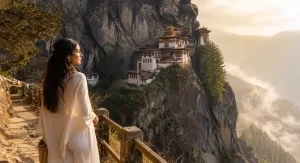
Paro — Your arrival point and one of the most beautiful valleys in the country. Home to Paro Taktsang (Tiger’s Nest Monastery), one of Asia’s most iconic landmarks, built into a cliff face at 3,120 metres. Also here: the Rinpung Dzong, the National Museum, and access to some of Bhutan’s finest short treks. Allow at least two nights.
Thimphu — The capital city and the world’s only capital without a functioning traffic light. Compact, walkable, and full of character. Key sites include the Memorial Chorten, Tashichhoe Dzong, the Folk Heritage Museum, the weekend Centenary Farmers’ Market, and the Buddha Dordenma statue overlooking the valley. One to two nights is typical.
Punakha — A warmer valley roughly an hour from Thimphu via the Dochula Pass (3,100m), where 108 chortens and Himalayan views await on a clear day. Punakha Dzong, situated at the confluence of two rivers, is arguably the most architecturally beautiful building in Bhutan. The hike to the Khamsum Yulley Namgyal Chorten rewards with sweeping paddy field views. One to two nights.
Phobjikha Valley — A wide glacial bowl at 2,900 metres, home to the Gangtey Monastery and the winter migration of black-necked cranes from Tibet (November to February). Exceptionally peaceful. One night minimum.
Central Bhutan
Bumthang — The spiritual heartland of Bhutan. Four connected valleys, ancient temples predating Bhutan’s unification, apple farms, cheese dairies, and a pace of life even slower than the rest of the country. The Jakar Dzong, Kurje Lhakhang, and Jambay Lhakhang are among the most sacred sites in the kingdom. Requires a full day’s drive or a short flight from Paro. Allow two to three nights.
Eastern Bhutan
Less visited and genuinely remote, eastern Bhutan rewards those willing to make the longer journey. The region has distinct weaving traditions (Khoma village is famous for its silk patterns), unique festivals rarely seen by outsiders, and landscapes that feel truly untouched. Trashigang and Lhuentse are the main centres. An east–west crossing of 18 days is one of the most complete journeys you can make in Bhutan — and one of the most memorable.
For detailed destination guides including what to see, where to stay, and how long to spend, visit Places to Visit in Bhutan.
How Much Does a Journey to Bhutan Cost?
Bhutan has a unique cost structure that confuses many first-time planners. Once you understand the three components, budgeting becomes straightforward.
The Three Core Costs
- Sustainable Development Fee (SDF): USD 100 per person per night — mandatory for all international visitors, paid before your visa is issued
- Visa fee: USD 40 per person per journey — one-time, regardless of length of stay
- Tour package: covers your licensed guide, private vehicle, accommodation, and meals — varies by comfort level and group size. With Ambo Tours, all meals and all monument entrance fees are included.
What Tour Packages Cost
Since January 2026, a 5% GST applies to tour package services (accommodation, guiding, transport, meals). The SDF and visa fee are exempt from GST.
| Travel Style | Package/Night (excl. SDF) | GST (5%) | SDF | Total/Night |
|---|---|---|---|---|
| Budget (group, guesthouses) | USD 150–180 | ~USD 9 | USD 100 | ~USD 259–289 |
| Mid-range (couple, 3–4 star) | USD 280–350 | ~USD 15–18 | USD 100 | ~USD 395–468 |
| Luxury (boutique lodges) | USD 600–1,200+ | ~USD 35–70 | USD 100 | ~USD 735–1,370+ |
Real Journey Budget Examples
Mid-range couple, 7 nights: SDF USD 1,400 + visa USD 80 + package USD 4,200 + GST USD 210 = approximately USD 5,890 for two people (USD 2,945 per person)
Solo traveller, 5 nights, mid-range: SDF USD 500 + visa USD 40 + package USD 1,750 + GST USD 88 = approximately USD 2,378 per person
These are general market examples. For Ambo Tours’ own published prices, a 7-day journey (six nights) costs USD 2,240 for a solo traveller, USD 1,830 per person for two, and USD 1,690 per person for three or more, with SDF, visa, all meals and entrance fees included. See the 7-day Bhutan tour.
Solo travellers pay more per head than couples or groups, since guide and vehicle costs are not split. Travelling in a group of two or more meaningfully reduces your per-person cost.
For a full itemised breakdown with more worked examples by group size, travel style, and journey duration — including Indian national pricing — visit our Bhutan Travel Cost Guide.
How to Choose a Licensed Bhutan Tour Operator
Every international visitor currently needs a licensed Bhutanese guide for their full stay and accommodation confirmed in advance — and a DOT-licensed tour operator is how most travellers arrange both, along with transport, meals, the SDF, and (if you choose) your visa application, as a single coordinated package. The operator is your partner for the entire journey.
The difference between a good operator and a poor one is significant, and the consequences of choosing poorly show up fast: guides with limited knowledge, accommodation below what was quoted, no in-country support when plans change, and hidden costs appearing after deposit.
Questions Worth Asking Any Operator Before You Book
- Are you directly licensed by the Department of Tourism (DOT)? What is your license number?
- Are your guides Bhutanese nationals, trained and licensed in Bhutan?
- Is my SDF included in the quoted price, or is it added on top?
- What is your cancellation and amendment policy?
- What happens if I need to change my itinerary once I’m in-country?
- Do you have a physical office in Bhutan with staff available during my journey?
Ambo Tours is a 100% Bhutanese team, DOT-licensed since 2019 (License No. 1053330), based in Thimphu. When you travel with us, you are working directly with people who live here — not a booking engine based overseas, not an aggregator collecting commission. Our guides are Bhutanese nationals. Our vehicles are maintained in Thimphu. When something changes, we answer the phone.
Bhutan Packing List: What to Bring
Bhutan’s altitude and varied microclimates mean the right gear matters more than in most destinations. These are the essentials regardless of season.
Clothing
- Layering system — base layer, mid layer (fleece or down), outer shell. Temperatures fluctuate significantly between valley floors and passes, and between midday and evening.
- Comfortable, sturdy walking shoes — Tiger’s Nest alone is a 2–3 hour uphill hike each way. Most sites involve meaningful walking on uneven ground. Waterproof trail shoes are ideal.
- Modest clothing for religious sites — shoulders and knees must be covered when entering dzongs and monasteries. A lightweight scarf doubles as a cover-up and is useful year-round.
- Rain layer — even outside the monsoon, afternoon showers are common in the hills. A packable waterproof jacket takes up little space.
- Warm hat and gloves — essential in winter, useful in spring and autumn at altitude.
Health & Personal
- Sunscreen SPF 50+ and lip balm — UV intensity at altitude is consistently underestimated
- Personal medications with copies of prescriptions
- Basic first aid kit — plasters, rehydration sachets, altitude sickness tablets (diamox) if advised by your doctor
- Insect repellent — particularly useful during and around monsoon season
Practical Items
- Cash in USD — carry backup cash as ATMs in rural areas can be unreliable
- Power bank — essential for trekking days away from charging points
- Camera with spare memory cards — photography opportunities are exceptional
- Reusable water bottle — Bhutan actively discourages single-use plastic
Check out complete guide on Bhutan packing list
Money & Currency in Bhutan
Bhutan’s currency is the Bhutanese Ngultrum (BTN), pegged 1:1 to the Indian Rupee. Both currencies are accepted at most hotels and larger restaurants.
USD, EUR and GBP are widely accepted at hotels and can be exchanged at banks in Thimphu and Paro. We strongly recommend carrying sufficient USD cash as a backup — ATMs exist in Thimphu and Paro and accept Visa and Mastercard, but they frequently run out of cash or go offline, particularly outside main towns. Rural areas and trekking routes have no ATM access at all.
Credit cards are accepted at larger hotels and some restaurants in Thimphu and Paro. Markets, smaller restaurants, monasteries, and any site outside the main towns are cash-only.
Tipping: Tipping your guide (USD 10–15 per day) and driver (USD 5–8 per day) is customary and genuinely appreciated. Tips are typically given on the last day in an envelope. Your operator may provide guidance on local norms.
Note on Indian Rupees: INR 2,000 notes are not accepted anywhere in Bhutan. Bring smaller denominations if carrying rupees.
Health & Vaccinations for Bhutan
No mandatory vaccinations are required to enter Bhutan for most nationalities. However, the following are widely recommended by travel health professionals:
- Hepatitis A and B
- Typhoid
- Tetanus/Diphtheria (Tdap)
- Rabies (if visiting rural or remote areas)
- COVID-19 (up to date with current guidance)
Altitude: Thimphu sits at 2,334 metres and Paro at 2,250 metres. Most travellers arrive by air from sea level and some experience mild altitude effects — headaches, fatigue, shortness of breath — in the first 24 hours. These typically resolve naturally. Drink plenty of water, avoid strenuous activity on your first day, and limit alcohol. If you are trekking to higher elevations (above 3,500m), speak to your doctor about Diamox (acetazolamide) in advance.
Travel insurance: Comprehensive travel insurance including medical evacuation cover is strongly recommended for all Himalayan travel. Medical facilities in Bhutan are basic outside Thimphu; evacuation to Bangkok or Delhi may be required for serious conditions. Confirm your policy covers high-altitude trekking if your itinerary includes it.
Internet & Connectivity in Bhutan
Mobile data coverage (4G) is available in Thimphu, Paro, and Punakha, and along the main highway corridor. Rural areas, side valleys, and all trekking routes have limited or no signal. WhatsApp and standard messaging apps work normally in coverage areas.
Local SIM cards from Tashi Cell or B-Mobile are available at Paro Airport on arrival and at shops in Thimphu. A local SIM with data is inexpensive and useful for navigation and communication during your stay. Your hotel Wi-Fi will handle most needs in town.
Plan to be partially offline for portions of your journey — many travellers find this one of Bhutan’s unexpected pleasures rather than a frustration.
Bhutanese Food: What to Expect
Bhutanese cuisine is distinctive, warming, and entirely unlike what most visitors expect from an Asian destination. The national dish is Ema Datshi — chillies (not a side dish; the main ingredient) cooked with soft local cheese. It is genuinely spicy and genuinely delicious.
Other dishes you’ll encounter regularly:
- Red rice — nutty and slightly chewy, grown in Paro and Bumthang, served with almost every meal
- Jasha Maru — spiced minced chicken, typically served with red rice
- Phaksha Paa — pork cooked with dried red chillies and radish
- Suja — butter tea, made with tea, butter, and salt; an acquired taste that most visitors try once and remember forever
- Ara — local spirit distilled from rice or wheat, served warm; strong and worth approaching carefully
All Ambo Tours packages include all meals: breakfast and dinner at your hotel, and lunch at a local restaurant chosen by your guide, which is a good opportunity to try authentic Bhutanese food in less formal surroundings. Vegetarian options are always available. Dietary requirements should be communicated to your operator before arrival.
Bhutan Culture & Etiquette for Visitors
Bhutan’s culture is rooted in Vajrayana Buddhism and expressed in almost every aspect of daily life — in the architecture of dzongs and lhakhangs, in the dress code observed by citizens entering government buildings, in the prayer flags strung across every mountain pass, and in the measured pace of social interaction. A little cultural awareness makes a significant difference to how your journey feels.
At Religious Sites
- Remove footwear before entering any temple, monastery, or dzong interior
- Walk clockwise around chortens (stupas) and mani walls
- Always ask before photographing monks, religious ceremonies, or sacred objects — many temples prohibit photography inside
- Avoid pointing at religious images or objects with a single finger — use an open hand or a gesture of the entire arm
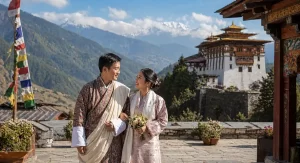
- Dress modestly — shoulders and knees covered. Traditional Bhutanese gho (for men) or kira (for women) is required to enter dzong courtyards; your guide will advise and can usually arrange rental if needed
General Conduct
- Bhutanese people are warm but reserved. A smile and a polite greeting go a long way.
- Bargaining is not standard practice in Bhutan and can cause discomfort. Prices at markets and shops are generally fixed.
- Smoking is heavily restricted — prohibited in public spaces and most outdoor areas. Tobacco purchase by tourists requires a permit and significant import duty.
- Plastic bags are banned. Bring reusable bags and avoid single-use plastic where possible.
For a comprehensive guide to Bhutanese customs, dress codes, festival etiquette, and social norms, visit our Bhutan Culture & Customs page.
Frequently Asked Questions About Visiting Bhutan
Is Bhutan expensive to visit?
Bhutan is a premium destination by design. All international visitors pay a mandatory Sustainable Development Fee of USD 100 per person per night, plus a one-time visa fee of USD 40. Tour packages covering accommodation, guide, transport and meals typically add USD 150–500+ per night depending on comfort level. Ambo Tours’ 7-day journey starts from USD 1,690 per person for groups of three or more, with SDF, visa, all meals and entrance fees included. It is not cheap — but it is deliberately not cheap, and the experience reflects that.
How do I plan a journey to Bhutan?
Most international visitors arrange their journey through a DOT-licensed Bhutanese tour operator, who can handle your visa application, SDF payment, accommodation, guide, and private transport as one coordinated process. You share your travel dates, interests, and budget — the operator builds the itinerary around you. Under current rules, a licensed Bhutanese guide for your full stay and accommodation booked in advance are required; flights and the visa application can also be arranged independently if you would prefer to handle those yourself. Contact a licensed operator (like Ambo Tours) at least two to three months before your intended travel dates.
What is the best month to visit Bhutan?
Spring (March to May) and autumn (September to November) are the two peak seasons and are recommended for first-time visitors. Spring offers the Paro Tshechu festival and rhododendron blooms. Autumn brings crystal-clear mountain views and the Thimphu Tshechu. October is widely considered the single best month for weather, views, and overall experience.
Do I need a guide in Bhutan?
Yes. Under Bhutan’s current rules, international visitors travel with a licensed Bhutanese guide for their full stay, and independent sightseeing without a guide is not permitted. Rules can change, so confirm the current requirements with the Department of Tourism. Your guide is your companion, interpreter, cultural explainer, and logistical coordinator throughout the journey.
Do I need a visa for Bhutan?
Yes. Most international visitors need a Bhutan visa before they travel. Indian nationals enter on a permit, and Bangladeshi and Maldivian nationals receive a visa on arrival. The visa fee is USD 40 and can be applied for online through the Department of Immigration’s e-visa portal, or by a licensed tour operator, hotel or guide on your behalf. You receive a visa clearance letter by email before travel and show it with your passport at immigration at Paro Airport.
How many days do I need in Bhutan?
A minimum of five nights covers the western highlights: Paro, Thimphu, and Punakha. Seven to eight nights is ideal for a first visit and allows for Phobjikha Valley or a short trek. Twelve or more nights opens up central Bhutan (Bumthang) and for the dedicated traveller, eastern Bhutan over 18 days is one of the most complete journeys available anywhere.
Is it safe to travel to Bhutan?
Bhutan is consistently among the safest countries in Asia. Crime is extremely rare, political stability is high, and every international visitor travels with a licensed local guide throughout their stay. The main health consideration is altitude. Standard travel insurance with medical evacuation coverage is recommended for all visitors.
Can I use my credit card in Bhutan?
Credit cards are accepted at larger hotels and some restaurants in Thimphu and Paro. Markets, smaller restaurants, monasteries, and any site outside the main towns are cash-only — carry sufficient USD as backup.
Is tipping expected in Bhutan?
Tipping isn’t compulsory but is customary and genuinely appreciated. Guides typically receive USD 10–15 per day and drivers USD 5–8 per day, usually given on the last day in an envelope.
Plan Your Bhutan Journey with Ambo Tours
Bhutan rewards those who approach it with curiosity and a willingness to slow down. The logistics, once understood, are simpler than they first appear — and once you are on the ground, the country takes care of the rest.
Our team in Thimphu designs private, fully guided journeys tailored to your travel dates, interests, group size, and budget. There is no standard package and no hard sell. Tell us what you are looking for and we will build something around you — at no cost and with no obligation until you are ready to confirm.
Prefer to start with a ready-made itinerary rather than build one from scratch? Our 7-day Bhutan tour is the most popular starting point.
Plan My Journey → or Call us: +975 16 160 000
Written by the Ambo Tours team, Thimphu, Bhutan. Ambo Tours is a DOT-licensed private tour operator. DOT License No. 1053330. Content last reviewed October 2026.
Ready to Experience Bhutan?
Tell us your dates and interests — our team in Thimphu will craft a personalised itinerary within 24 hours, at no cost.