Part of our complete guide to monasteries in Bhutan.
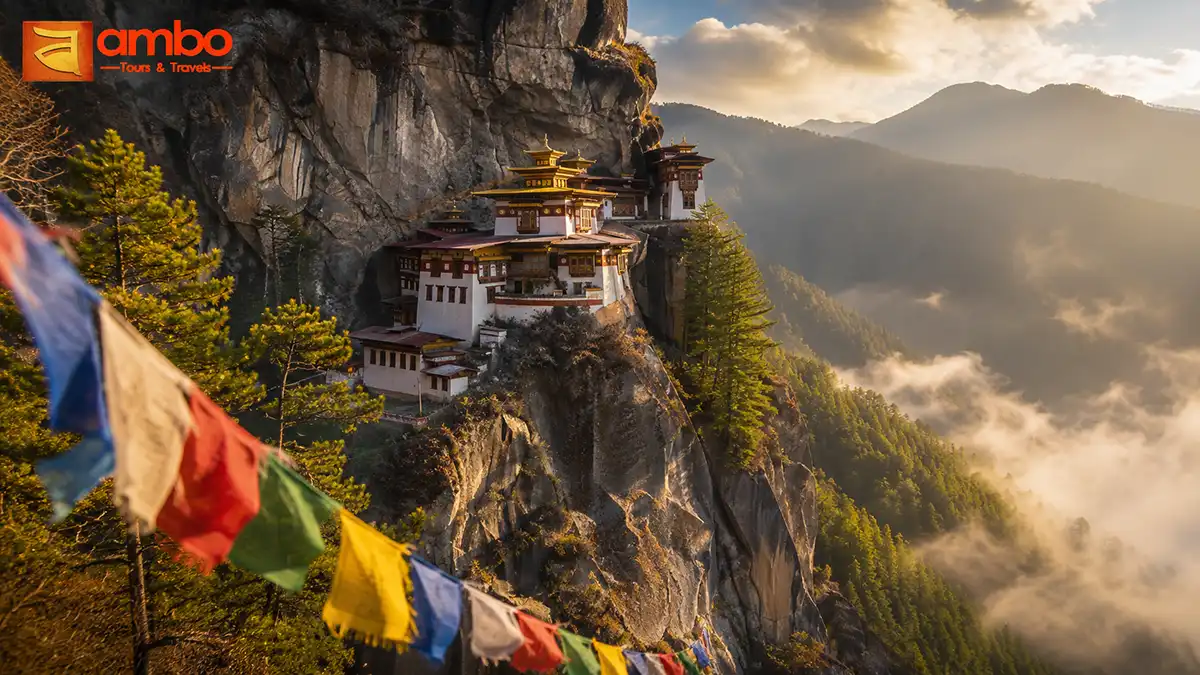
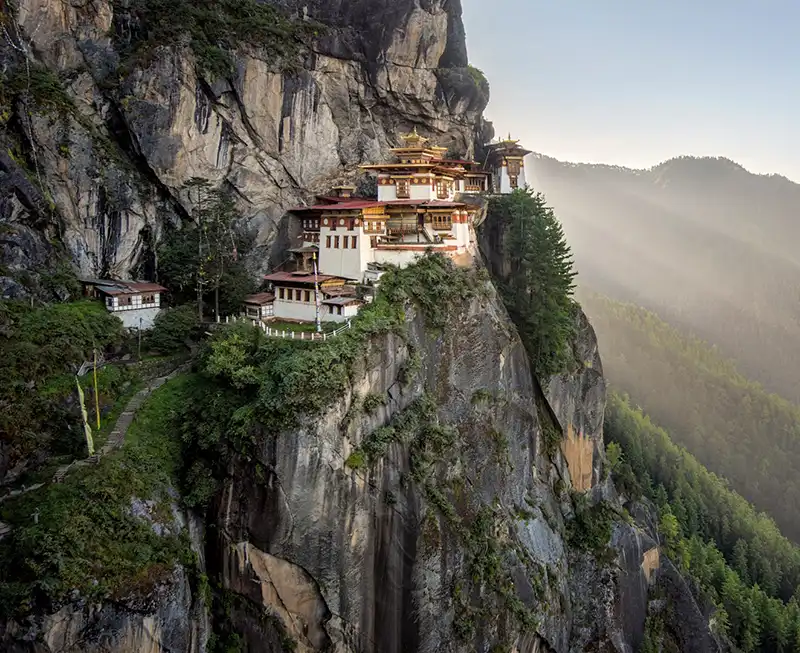
Tiger’s Nest — known formally as Paro Taktsang, or the Taktsang Palphug Monastery — is the single image most people picture when they think of Bhutan: a cluster of white temples fixed impossibly to a sheer granite cliff, 900 metres above the floor of Paro Valley. It’s the country’s most important pilgrimage site, its most photographed landmark, and for the vast majority of visitors, the single hike their entire trip is built around. Here’s everything worth knowing before you go — the legend behind the name, the real history of the buildings you’ll actually see, and a full practical guide to the hike itself.
The Legend: How Tiger’s Nest Got Its Name
The name comes from one of the most important origin stories in Himalayan Buddhism. In the 8th century, Guru Rinpoche (Padmasambhava) — the tantric master credited with bringing Buddhism to Bhutan — is said to have flown to this exact cliff face on the back of a flying tigress, in his wrathful manifestation as Dorje Drolo, to subdue local demons obstructing the spread of the Dharma. According to tradition, the tigress was a transformation of his consort, Yeshe Tsogyal, herself a highly accomplished practitioner. Guru Rinpoche then meditated in a cave at this site — known as the Taktsang Senge Samdup cave — for three months, three weeks, three days, and three hours, before subjugating the local spirits and consecrating the site as sacred ground.
This is the origin of the name: “Taktsang” translates literally as “Tiger’s Lair” or “Tiger’s Nest.” The site is considered one of thirteen “tiger’s nest” caves across the greater Himalayan Buddhist world associated with Guru Rinpoche’s meditation practice — but Paro Taktsang is by far the best known and most visited of them all.
The Real History: From Meditation Cave to Monastery
The cave itself has been a site of pilgrimage since the 8th century, but the monastery complex that stands there today is considerably younger. It was built in 1692 by Gyalse Tenzin Rabgye, the 4th Druk Desi (temporal ruler) of Bhutan — himself believed by many Bhutanese to be a reincarnation of Guru Rinpoche. Tenzin Rabgye ordered the construction of a full monastery around the sacred cave, completing the main structure by around 1694.
The complex has been renovated and expanded several times since — recorded work took place in the 1860s, the early 1960s under the 34th Je Khenpo, and again in the early 1980s and 1990s. But the monastery’s most dramatic chapter came on 19 April 1998, when a fire — most likely started by an overturned butter lamp — tore through the main buildings. Because of the site’s extreme cliffside location, firefighting equipment couldn’t be brought up in time, and the blaze destroyed centuries-old murals, statues, and scriptures; tragically, one monk lost his life. Reconstruction became a genuine national effort — nearly every Bhutanese citizen is said to have contributed something, in cash or in kind — and the rebuilt monastery, faithfully restored to its original 17th-century appearance, was formally reconsecrated on 24 March 2005. The Tiger’s Nest most visitors walk through today is, in that sense, both centuries old and remarkably new — a genuine act of national devotion as much as a historical building.
What’s Actually Inside
The complex is made up of four main temples and several smaller shrines, connected by narrow stone stairways and wooden walkways that cling to the cliff face and are cantilevered out over the 900-metre drop. Among the most significant is the shrine housing a bronze statue known as Guru Sungjonma, which according to legend miraculously spoke aloud and declared it wished to be moved to Taktsang — remarkably, this statue is said to have survived both a 1951 fire and the 1998 fire intact. Another key structure is the two-storey Temple of the Guru with Eight Names, built in 1692 and dedicated to the eight manifestations of Guru Rinpoche, including the wrathful, tiger-riding Dorje Drolo form central to the site’s founding legend.
Traditional Bhutanese building methods were used throughout — earthen walls, hand-carved woodwork, and hand-painted murals, all constructed using wooden scaffolding and iron pegs driven directly into the rock, with every piece of material carried up the mountain on human backs or by pack animal, since no wheeled transport is possible on the trail.
Hiking to Tiger’s Nest: The Practical Guide
The trail begins at a car park at roughly 2,600 metres elevation, on the forested slopes above Paro town. The monastery itself sits at approximately 3,120 metres, meaning the hike involves a genuine, sustained climb of around 500 vertical metres from the trailhead — a round trip of about 7 kilometres, typically taking three to four hours including rest stops.
The route in three stages:
- Forest ascent (0–2.5km): A steady, well-maintained climb through blue pine and rhododendron forest, strung with five-coloured prayer flags. The gradient is consistent but not severe.
- Halfway cafeteria viewpoint (~2,900m): A rest stop offering the first direct sightline to the monastery complex across the valley — many travelers’ first real look at Tiger’s Nest up close, and a popular photo point. Horses are available for hire from the trailhead up to this point for those who need them; horses cannot continue beyond this stage.
- Final descent and climb (final ~2km): The trail drops into a gorge past a waterfall, crosses a bridge, then climbs a final steep flight of stone stairs — famously cited as around 700 steps in some accounts — up to the monastery entrance itself.
Best time to start: Set off no later than 7:30am. This achieves two things — you’ll reach the monastery before the late-morning haze builds over the valley (which can obscure views and photos), and before the bulk of day-tour groups arrive from Thimphu, giving you a quieter, more contemplative visit inside the temples themselves.
Practical Tips
- Wear proper hiking shoes with good grip — the stone steps can be slick, especially after rain.
- Bring at least 1.5 litres of water and dress in layers; temperature and exposure change significantly across the climb.
- Photography is not permitted inside the temples themselves — cameras and phones must typically be left at a designated point before entering, so plan your photos for the approach and viewpoints beforehand.
- Modest dress is required, as at any active religious site in Bhutan — shoulders and knees covered.
- A licensed Bhutanese guide is mandatory for all travel in Bhutan and is genuinely valuable here — able to explain the legends, the architecture, and the significance of each shrine as you move through the complex.
Frequently Asked Questions
Why is it called Tiger’s Nest?
According to legend, Guru Rinpoche flew to this cliff face on the back of a flying tigress — a transformation of his consort, Yeshe Tsogyal — to subdue local demons in the 8th century, giving the site its name, which translates literally as “Tiger’s Lair.”
When was Tiger’s Nest Monastery built?
The sacred cave has been a meditation site since the 8th century, but the monastery complex itself was built in 1692 by Gyalse Tenzin Rabgye, Bhutan’s 4th Druk Desi, and completed by around 1694.
What happened to Tiger’s Nest in 1998?
A fire, likely caused by an overturned butter lamp, destroyed much of the main structure on 19 April 1998, including centuries-old murals and scriptures. The monastery was painstakingly rebuilt using traditional methods and reconsecrated on 24 March 2005.
How long does the hike to Tiger’s Nest take?
The round trip covers approximately 7 kilometres and takes three to four hours including rest stops, with a total elevation gain of around 500 metres from the trailhead to the monastery.
Is the Tiger’s Nest hike difficult?
It’s a sustained, moderate climb rather than a technical one — within the ability of most reasonably fit travelers, though the altitude and final flight of stairs make it more demanding than a casual walk.
This monastery is one of many sacred sites covered in our complete guide to monasteries in Bhutan — dzongs, lhakhangs, goembas, chortens and sacred sites explained.
Planning your Bhutan trip? See our 7-day Bhutan itinerary or explore our 4-day Paro & Thimphu tour, both built around the Tiger’s Nest hike.
Ready to Experience Bhutan?
Tell us your dates and interests — our team in Thimphu will craft a personalised itinerary within 24 hours, at no cost.