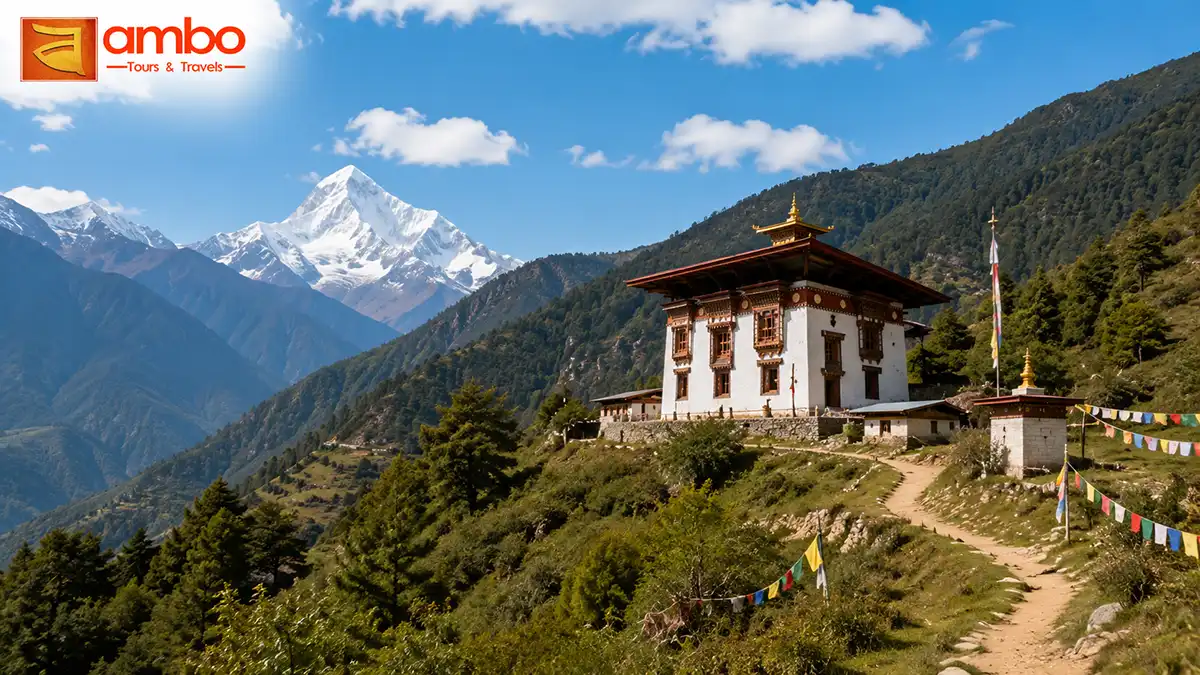
Takchu Gompa sits on a ridge above Dumcho village in Haa Valley, and its single biggest draw is the view: an unbroken, close-up sightline to Mount Jomolhari, one of Bhutan’s most sacred and dramatic peaks. Reachable on foot or by a rough bike track, it’s one of the “prominent gompas of Haa” — a working monastery with real local significance, rebuilt after Bhutan’s 2009 earthquake and still holding one of the valley’s most important annual ceremonies.
Where Takchu Gompa Is and How to Reach It
The route to Takchu Gompa begins at Dumcho village, the same starting point used for several other Haa Valley hikes. From there, visitors have two options: a hike up to the monastery, or — a genuinely popular local alternative — a bike ride along the unpaved track leading up to it. It’s one of the few Haa Valley sites where cycling is a real, commonly recommended way in, rather than an afterthought.
Takchu Gompa is also one of four major monasteries of upper Haa strung along the longer Haa Panorama Trail, alongside Yangthang, Katsho, and Dranadingkha Goembas — an 11-kilometre, roughly five-hour route for travelers who want to see all four in a single, fuller day rather than visiting Takchu on its own.
History and Architecture
Accounts of Takchu Gompa’s origins carry an interesting layer of complexity worth being upfront about. Some sources describe it as constructed in the 14th century as a defensive bastion, built to guard against threats from the north — a role many of Bhutan’s early hilltop religious structures originally served before being consecrated purely as monasteries. Other local tradition attributes its founding as a monastery specifically to Lama Thinley Gyatsho, a disciple of the 17th-century master Lama Drakpa Gyatsho. The likely explanation, consistent with the history of several Bhutanese sites, is that an earlier defensive structure on the site was later formally established or substantially rebuilt as a monastery under Lama Thinley Gyatsho — rather than one account being simply wrong. We’re noting both threads here rather than picking one, since neither can be verified with full certainty from available sources.
What’s more consistently documented is the building itself: a two-storeyed structure, with an Avalokiteshvara (Chenrezig, the Bodhisattva of Compassion) shrine on the lower level, and shrines to the Dharmakaya, Sambhogakaya, and Nirmanakaya — the three bodies of a Buddha in Mahayana and Vajrayana thought — along with a shrine to the founding lama, on the upper level.
Like several sites in Haa Valley, Takchu Gompa was damaged in Bhutan’s devastating 2009 earthquake and has since been reconstructed.
The Annual Ceremony
Every year, during the first month of the Bhutanese calendar, Takchu Gompa hosts a “hundred million recitation” ceremony — an extended prayer and mantra-recitation gathering aimed at accumulating a specific, symbolically vast number of recitations for the benefit of all beings. It’s a significant fixture on the valley’s religious calendar and a reminder that, unlike some of the more purely scenic hikes in this cluster, Takchu Gompa remains an actively used site of local worship rather than a historical curiosity.
What the Hike (or Ride) Is Actually Like
The appeal here is twofold: a genuine, functioning monastery to explore, and one of the best mountain views in Haa Valley once you arrive. Jomolhari — at 7,326 metres, one of Bhutan’s highest and most revered peaks, considered the seat of a protective goddess — dominates the skyline from Takchu’s ridge on a clear day, giving the site a scale and drama that smaller hermitage hikes in this cluster don’t quite match.
Because the track is rideable, Takchu Gompa is a good option for travelers who want a monastery visit with less pure hiking effort than Juneydrak or Meri Puensum — or conversely, a fun add-on for anyone specifically looking to combine a short mountain bike ride with a cultural stop.
Practical Tips
- Decide in advance whether you want to hike or bike — the unpaved track supports both, and your guide can arrange either.
- Clear weather matters here more than at most hikes in this cluster, since the Jomolhari view is the main draw — check conditions before setting out if possible.
- Consider combining Takchu with the other three upper-Haa monasteries via the full Haa Panorama Trail if you have a full day free.
- A licensed Bhutanese guide is mandatory for all activities in Bhutan, hiking or biking alike.
Frequently Asked Questions
What makes Takchu Gompa worth visiting?
Its ridge-top position gives visitors one of Haa Valley’s best views of Mount Jomolhari, combined with a genuine, actively used monastery with real historical and architectural significance, rather than a purely scenic stop.
Can you bike to Takchu Gompa?
Yes — an unpaved track from Dumcho village supports both hiking and biking, and cycling up is a commonly recommended local option, not just a hiking alternative.
When was Takchu Gompa founded?
Accounts vary. Some describe the site as built in the 14th century as a defensive structure, while local tradition also credits its founding as a monastery to Lama Thinley Gyatsho, a 17th-century disciple. The most likely explanation is that an earlier structure was later formally established as a monastery.
Was Takchu Gompa affected by the 2009 earthquake?
Yes, like several sites in Haa Valley, it was damaged in the 2009 earthquake and has since been reconstructed.
Explore more of Bhutan’s hidden trails in our complete guide to Bhutan’s best hiking trails and hidden monastery walks.
Ready to Experience Bhutan?
Tell us your dates and interests — our team in Thimphu will craft a personalised itinerary within 24 hours, at no cost.