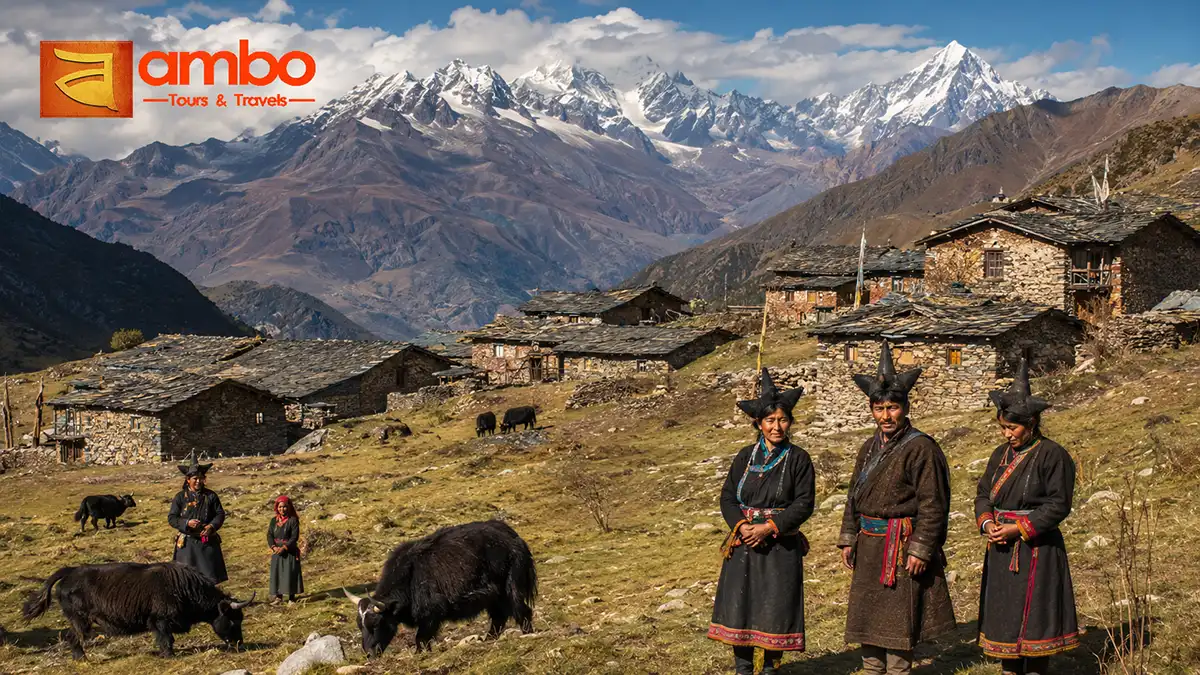
Merak Sakteng Trek — Into the Brokpa Highlands of Eastern Bhutan
Paro · Bumthang · Trashigang · Merak · Sakteng · Phongmey
Tour Information
- Sakteng Wildlife Sanctuary — one of the world's few protected areas established partly to preserve migoi habitat
- Merak and Sakteng — twin Brokpa villages with centuries-old nomadic culture unchanged by the outside world
- Nagchungla Pass (4,100m) — highest point, with panoramic Eastern Himalayan views
- Red panda, snow leopard, clouded leopard and 300+ bird species in the sanctuary
- Domestic flights included — Paro to Bumthang and return (25 minutes over the Himalayan ranges)
- Bumthang valley sightseeing — Ura Valley, Membartsho and Jakar Dzong
- Trashigang Dzong — the great fortress-monastery of eastern Bhutan
- Tiger's Nest on arrival — approached from the Paro valley trail
- Fully private and guided — dedicated trekking crew throughout
The Merak Sakteng Trek is the only route in Bhutan that penetrates the protected wilderness of the Sakteng Wildlife Sanctuary — a 740 sq km reserve in the far east of the kingdom, home to red panda, snow leopard, clouded leopard, over 300 bird species, and the legendary migoi (Bhutan's version of the yeti). The trek connects the twin Brokpa villages of Merak and Sakteng: communities of semi-nomadic herders whose distinctive culture — yak-hair star-shaped hats, wool garments, turquoise jewellery — sets them apart from any other people in Bhutan.
The 18-day expedition begins in Paro with Tiger's Nest, crosses to Bumthang by domestic flight, drives through Thrumshingla National Park to Trashigang in the east, then enters the sanctuary on foot. Eight days of trekking cross Nagchungla Pass (4,100m) — the highest point — and pass through highland terrain that very few international visitors ever see. The route ends at Phongmey before a return to Paro via Bumthang.
Two domestic flights (Paro–Bumthang and Bumthang–Paro) are included in the package price. Operated by Ambo Tours, DOT Licence No. 1053330, Thimphu.
Tour Pricing
18 Days Bhutan Journey — Cost
All prices in USD per personCost includes Sustainable Development Fee (SDF) of US $100 per person per night and Bhutan Visa Fee of US $40 per person. Entrance fees for monuments and festival visits are paid separately.
Detailed Itinerary
Your Merak Sakteng Trek Bhutan adventure starts with one of aviation's most remarkable landings. The plane banks between Himalayan ridgelines into Paro International Airport — Bhutan's only international gateway and a landing that consistently ranks among the world's most spectacular. Your Ambo Tours guide meets you warmly at arrivals and transfers you to your hotel.
Paro sits at 2,300 m and the afternoon is free to acclimatise, walk the town's painted main street, and soak in the first impressions of Bhutan — prayer flags, whitewashed farmhouses, and a pace of life entirely unlike home.
Tip: Drink plenty of water and rest well. Tomorrow's hike demands fresh legs. Dinner and overnight in Paro.
Tomorrow — the iconic hike to Tiger's Nest Monastery, the defining image of Bhutan tourism worldwide.
No Bhutan itinerary is complete without this climb. Taktsang Monastery (Tiger's Nest) clings to a sheer cliff face 900 metres above the Paro Valley floor at 3,120 m — one of the most sacred and photogenic sites in Asia. Guru Rinpoche flew here on the back of a tigress in the 8th century to meditate in a cave at this very spot, before founding Bhutanese Buddhism as we know it. Countless high Buddhist masters have meditated here since.
The 15-km round trip hike takes around six hours at a comfortable pace. The trail climbs through blue pine forest past fluttering prayer flags, with the monastery revealing itself progressively — first as a distant speck of gold, then as an impossible architectural feat above the cliff.
- A teahouse halfway up serves the most rewarding lunch of the trip — with the monastery perfectly framed above.
- Allow extra time inside the inner sanctuaries — cameras must be left at the gate, and the stillness within is extraordinary after the climb.
Tip: Start by 7 am to beat the midday heat and afternoon crowds. Carry at least 1.5 litres of water. Dinner and overnight in Paro.
Tomorrow, a domestic flight takes you east to Bumthang — the spiritual heartland of Bhutan.
After breakfast, Ambo Tours transfers you to Paro Airport for the scenic domestic flight east to Bathpalathang Airport in Bumthang (2,800 m). The 25-minute flight skims over forested ridgelines, glacial valleys, and the patchwork of central Bhutan's highland landscape — a journey that takes the better part of a day by road condensed into a spectacular quarter-hour window seat.
Arrive in Bumthang — the cultural and spiritual heartland of Bhutan, home to some of the oldest temples in the kingdom. Check in to your guesthouse and spend the afternoon acclimatising to the higher altitude while exploring the valley surroundings.
Bumthang's broad meadows, apple orchards, and ancient monastery rooftops create a scene that feels entirely separate from western Bhutan. The air is noticeably thinner and cooler than Paro. Dinner and overnight in Bumthang.
Tomorrow, a full day of cultural sightseeing through Bumthang's most remarkable sacred sites.
Today Ambo Tours takes you through the spiritual landscape of Bumthang valley — a region where ancient temples, sacred rivers, and nomadic traditions have remained intact for centuries. This is essential cultural preparation before the remote eastern trek ahead.
- Visit the ancient town of Ura — a traditional highland settlement with closely packed stone houses and medieval village layout, sitting high on a ridge above the valley.
- Explore Membartsho (Burning Lake) — a sacred river gorge five minutes' walk from the road, where the great treasure-revealer Terton Pema Lingpa discovered dharma treasures hidden by Guru Rinpoche in the 15th century. He dived into the pool holding a burning butter lamp and surfaced with the treasures intact. The site remains deeply sacred and is ideal for quiet reflection.
- Visit Jakar Dzong (the Castle of the White Bird) — the administrative and religious centre of Bumthang, perched on a hilltop with sweeping valley views.
- Walk the Bumthang valley floor through barley fields and apple groves — one of the most peaceful Bhutan landscape walks in the country.
Dinner and overnight in Bumthang.
Tomorrow, the long drive east to Mongar takes you across the highest road point in Bhutan at Thrumshingla Pass.
Today's drive east from Bumthang to Mongar (1,600 m) crosses the highest point on Bhutan's lateral road — Thrumshingla Pass (3,800 m) — before a long, dramatic descent into the subtropical eastern lowlands. The road passes through villages of Ura and Sengor, with cascading waterfalls, diverse cloud forest flora, and on clear days a distant view of Gangkar Puensum (7,570 m) — the world's highest unclimbed mountain.
The descent to Lingmethang (700 m) brings the Kurichu River into view — the site of eastern Bhutan's largest hydroelectric power station — before the road climbs back up to Mongar. The transition from cold highland to warm subtropical air within a single day of driving is one of the most dramatic environmental shifts on any Bhutan trip.
Arrive in Mongar — a small, friendly district town and the business hub of eastern Bhutan. Check in to your hotel and rest. Dinner and overnight in Mongar.
Tomorrow the drive continues east to Trashigang — the largest district in Bhutan and your gateway to the Merak Sakteng Trek.
A shorter drive today brings you east to Trashigang (1,150 m) — the administrative centre of Bhutan's largest district, a region whose altitude ranges from 600 metres in the subtropical lowlands to 4,000 metres in the alpine north. The district road descends through broad valleys and rural farmland before arriving at the town perched above the confluence of two rivers.
In the afternoon, visit Trashigang Dzong — a beautifully positioned fortress-monastery overlooking the river junction below. Built in the 17th century, it served as the administrative and military headquarters of eastern Bhutan for generations and remains one of the finest Bhutan dzong sites in the eastern region.
The evening offers time to explore Trashigang town — its market, local tea shops, and riverside walk give a genuine sense of life in far eastern Bhutan that most visitors never reach. This is your last night before the Merak Sakteng Trek begins tomorrow. Dinner and overnight in Trashigang.
Tomorrow — the trek starts. Drive to Chaling and begin walking toward Merak.
The Merak Sakteng Trek Bhutan officially begins today. Your Ambo Tours trekking crew loads the equipment and your vehicle drives approximately two hours from Trashigang to the road end at Chaling (2,135 m) — the trailhead for the entire trek.
From Chaling, the trail climbs gradually toward Shaktimi meadow, where yaks and sheep graze on open hillsides and stone yak herders' huts are scattered across the slope. The landscape feels immediately remote. The trail then climbs steadily to Mendula Pass (3,345 m) — a high saddle with sweeping views of eastern Bhutan's forested ridgelines.
After the pass, the trail descends through dense rhododendron forest to your first campsite at Donmong Chu (3,145 m) — a beautiful meadow beside a clear mountain river. Your Ambo Tours cook team will have a warm camp meal ready. Dinner and overnight at camp.
Tomorrow, the trek continues deeper into the highland terrain toward Damnongchu.
Today is the longest trekking day of the first section. The trail from Chaling follows an unsealed road from Rangjung before entering open highland terrain. The route climbs steadily through mixed forest and alpine meadow, passing through the settlement of Mindrula before arriving at the Damnongchu camping area (3,316 m) — a sheltered highland camp at the edge of a broad open pasture.
Eastern Bhutan feels profoundly different from western Bhutan on foot. The forest is denser and more diverse. The settlements are smaller and more isolated. The sound of the trails is quieter. Your Ambo Tours guide introduces the ecology and the cultural geography of the region as you walk — context that makes each meadow and ridgeline more meaningful.
Tip: Drink steadily throughout the day. The altitude at camp is noticeably higher than Trashigang and dehydration at this elevation slows recovery overnight. Dinner and overnight at camp.
Tomorrow, the trail descends to the unique Brokpa village of Merak.
Today the trail from Damnongchu follows the river bank with gradual ascents and descents through scenic highland terrain. The walking is rhythmic and beautiful — open sky, clean streams, and the first signs of the Brokpa community appearing in the landscape as you approach Merak village (3,145 m).For another route into remote Bhutanese highland culture, see our Laya-Gasa Trek — an 18-day expedition to the Layap people of northwestern Bhutan.
The Brokpa people of Merak are one of Bhutan's most distinctive ethnic communities — semi-nomadic yak herders who have inhabited these high eastern valleys for generations, speaking their own dialect and wearing a style of dress found nowhere else in the kingdom. The men and women of Merak wear the characteristic yak-hair hat with five fabric spikes radiating from the crown — originally designed to channel rainwater away from the face during the heavy eastern monsoons.
- Explore the stone houses and narrow lanes of Merak village — a living community unchanged by tourism or development.
- Observe yak herding practices, butter-making, and the daily rhythms of highland Brokpa life.
- Your Ambo Tours guide facilitates respectful introductions and cultural exchange with village residents.
Dinner and overnight at camp in Merak.
Tomorrow, the high route to Migsa Teng crosses the dramatic Nagchungla Pass (4,100 m).
Today is the most physically demanding day of the Merak Sakteng Trek Bhutan. The trail from Merak climbs steadily and then steeply to Nagchungla Pass (approximately 4,100 m) — the highest point of the entire trek and a viewpoint of extraordinary scope. On clear days, the eastern Himalayan ranges stretch across the horizon in a panorama that rewards every step of the ascent.
The descent from the pass enters dense rhododendron woodland — species that bloom in vivid pink and crimson during spring, creating one of the finest forest walks in eastern Bhutan. The trail winds through this protected forest before opening into a clearing at Migsa Teng — your campsite for the night, surrounded by rhododendron trees on all sides.
The Sakteng Wildlife Sanctuary encompasses this terrain. The sanctuary was famously established partly to protect the habitat of the migoi — Bhutan's yeti — and its forests shelter red pandas, snow leopards, and a remarkable diversity of Himalayan bird species. Keep your eyes and ears open throughout the descent. Dinner and overnight at camp.
Tomorrow, an easier day through beautiful forest leads to the village of Sakteng.
Today's walk from Migsa Teng to Sakteng is one of the most pleasant stages of the trek — the trail makes its way through beautiful mixed forest with a short climb before the valley of Sakteng opens below. The descent is gradual and the forest shelters the path from wind and sun.
Sakteng village (3,100 m) is the second of the twin Brokpa settlements and the heart of the Sakteng Wildlife Sanctuary. The village sits in a broad, sheltered valley surrounded by forested ridgelines — a setting of remarkable natural beauty. The Brokpa community here shares the same semi-nomadic heritage as Merak, with seasonal migrations to lower pastures and a deep dependence on the yak economy.
Arrive in the early afternoon with time to explore the village before evening. Your Ambo Tours guide arranges for community interaction where possible. Dinner and overnight at camp in Sakteng.
Tomorrow is a full rest day in Sakteng — use the time to explore the valley and sanctuary at your own pace.
Today Ambo Tours gives you a full day in Sakteng to rest, explore, and absorb what makes this valley so extraordinary. The Sakteng Wildlife Sanctuary is one of the few protected areas on earth established in part to protect a mythological creature — the migoi, Bhutan's answer to the yeti, whose habitat the Bhutanese government has officially recognised and preserved. Explore our full Bhutan trekking guide to compare all routes, difficulty levels, and permits across the kingdom. Whether or not the migoi exists, the sanctuary's forests genuinely shelter red pandas, snow leopards, Himalayan black bears, clouded leopards, and over 300 bird species.
- Walk the sanctuary trails with your guide, watching for wildlife and birdlife in the rhododendron and bamboo forest.
- Visit the Sakteng community — learn about traditional Brokpa medicine, yak-hair weaving, and the nomadic seasonal calendar that governs life in this valley.
- Rest and recover physically — the descent section ahead requires fresh legs.
Tip: The best birdwatching is in the early morning hours before 9 am. Carry binoculars if you have them. Dinner and overnight at camp in Sakteng.
Tomorrow the trek turns south and west toward Jyengkhar Teng.
Today is the longest walking day of the descent section. The trail from Sakteng heads south and west, mostly downhill through forest and open grassland to Jyengkhar Teng. The route feels different from the inward journey — the landscape transitions gradually from high sanctuary forest to lower, warmer terrain as altitude decreases.
The trail is well-defined and the walking pace can be comfortable. Your Ambo Tours cook team serves a hot lunch at a suitable point along the route. The final hour brings you to the Jyengkhar Teng campsite — a forest clearing with a small stream nearby providing fresh water.
The evening at this lower camp carries noticeably warmer air than the Sakteng nights. The birdlife changes too — different species appear as the forest character shifts with altitude. Dinner and overnight at camp.
Tomorrow, the final trekking day descends through mixed terrain to Phongmey.
The final day of the Merak Sakteng Trek Bhutan is a fitting conclusion — a trail of rolling ascents and descents through increasingly settled terrain, with the sounds of village life gradually replacing the silence of the sanctuary forest. The path passes through hamlets and farmland as the altitude continues to drop and the landscape softens.
Arrive at Phongmey — a village in the lower Trashigang district — where your Ambo Tours vehicle waits to celebrate the completion of the trek. The moment of stepping from trail onto road carries the particular satisfaction that only multi-day trekking through genuinely remote terrain can produce.
Your guide and cook crew gather for a brief celebration before the drive. The trekking crew has carried loads, navigated trail junctions, and cooked meals at altitude for eight days — their contribution to this expedition deserves genuine appreciation. Dinner and overnight in Phongmey or transfer to Trashigang.
Tomorrow, a short drive returns you to Trashigang before the long journey back west begins.
A short morning drive from Phongmey returns you to Trashigang. After eight days on trail, the comfort of a hotel room, a hot shower, and a restaurant meal feels extraordinary. Your Ambo Tours team has arranged accommodation and the day is largely yours to rest and recover.
If energy allows, revisit Trashigang Dzong in the afternoon with the different perspective that a completed trek brings. The dzong's position above the river, which may have felt like just another sight on Day 6, now carries a sense of arrival — you have walked through the valleys it once governed. The evening market in Trashigang town offers a relaxed opportunity to browse local produce and handicrafts from eastern Bhutan.
Dinner and overnight in Trashigang.
Tomorrow, the long drive west to Bumthang begins — retracing the route through Mongar and across the Thrumshingla range.
The drive from Trashigang back west to Bumthang is the longest road day of the entire tour — a full day of mountain highway that retraces the journey through Mongar, up the subtropical gorges to Lingmethang, and over the Thrumshingla Pass (3,800 m) before descending into the familiar broad meadows of Bumthang valley.
Your Ambo Tours driver sets a comfortable pace with stops for meals and photographs. The return journey through the Sengor and Ura sections of the lateral road reveals details missed on the outward drive — different light, different season, and eight days of high-altitude trekking between then and now giving everything a different quality of attention.
Arrive in Bumthang by evening. Check in to your guesthouse and enjoy a relaxed dinner in the valley that anchors the middle of this Bhutan trek itinerary. Dinner and overnight in Bumthang.
Tomorrow, a domestic flight returns you to Paro for the final night of the tour.
A morning transfer to Bathpalathang Airport puts you on the 25-minute domestic flight back to Paro — the same scenic route as the outward flight, now viewed with the full perspective of everything you have experienced since. The forested ridgelines of central Bhutan scroll beneath the wings one more time before the Paro valley opens below.
Your Ambo Tours driver meets you at Paro Airport and transfers you to your hotel. The rest of the day is free — walk through Paro town, browse the craft shops on the main street for last-minute souvenirs, or simply sit by the Paro Chhu river and reflect on eighteen days in this extraordinary kingdom.
If time allows, the Ambo Tours guide can arrange an evening walk to the cantilever bridge below Rinpung Dzong — a quiet and beautiful way to spend a final Bhutan evening. Dinner and overnight in Paro.
Tomorrow, your Merak Sakteng Trek Bhutan journey with Ambo Tours comes to a close.
Your Merak Sakteng Trek Bhutan expedition with Ambo Tours comes to a close after an early breakfast. Your guide and driver transfer you to Paro International Airport as per your flight schedule — and as the plane climbs between the ridgelines one final time, the prayer flags and terraced valleys of Paro recede below.
Eighteen days have taken you from the cliff-face wonder of Tiger's Nest to the spiritual landscape of Bumthang, across the highest road in Bhutan at Thrumshingla, through the subtropical gorges of eastern Bhutan to Trashigang, and then eight days on foot through terrain that fewer visitors reach than summit Everest. The Brokpa communities of Merak and Sakteng, the Nagchungla Pass at 4,100 m, the wildlife of the Sakteng Wildlife Sanctuary, and the silence of the eastern highland forest — these are experiences that belong to a category no itinerary can fully prepare you for.
Bhutan's commitment to sustainable tourism, Gross National Happiness (GNH), and the protection of its living cultural and ecological heritage keeps this trek genuine. The entire Ambo Tours team thanks you for travelling with us and hopes to welcome you back to the Land of the Thunder Dragon.
Included / Excluded
- ✔All meals — breakfast, lunch, and dinner
- ✔Accommodation on twin / double sharing basis (single supplement extra)
- ✔All transportation within the kingdom including airport transfers
- ✔Sustainable Development Fee — Government tax (SDF)
- ✔Bhutan visa fee
- ✔English-speaking private local guide
- ✔Sightseeing as per itinerary
- ✔Bottled water throughout the journey
- ✖International flights to and from Paro (PBH)
- ✖Entrance fees for museums and monuments
- ✖Gratuities for guides and drivers
- ✖Travel insurance premiums
- ✖Payments for services provided on a personal basis
- ✖Cost for any services not mentioned under "Cost Includes"
- ✖Cost incurred due to mishaps, strikes, political unrest, etc.
- ✖Personal expenses — laundry, beverages, or personal services
Ambo Tours & the 1% Club
Every tour we run includes a contribution to a Bhutanese NGO of your choice — at no extra cost to you. We call this the 1% Club: a minimum of 1% of your trip's profit, or Nu 5,000, whichever is higher, donated on every single journey. You choose where it goes.
What is the Merak Sakteng Trek?
The Merak Sakteng Trek is eastern Bhutan's defining wilderness journey — an 18-day expedition that crosses the country from Paro to the remote highlands of the Trashigang district, entering the Sakteng Wildlife Sanctuary and connecting the twin Brokpa villages of Merak and Sakteng. It is the only trekking route in Bhutan that passes through the sanctuary, a 740 sq km protected area established in 2003 and famous for its extraordinary biodiversity and its legendary association with the migoi.
The Brokpa people of Merak and Sakteng are among the most culturally distinctive communities in the Himalayan world. Their star-shaped yak-hair hats — worn as protection against the heavy rain and hail of the eastern highlands — are instantly recognisable and found nowhere else. A full cultural immersion day at Sakteng village is built into the itinerary.
The expedition combines trekking with overland touring through central and eastern Bhutan — Bumthang valley, Thrumshingla National Park, Trashigang — and two domestic flights over the Himalayan ranges that are themselves a highlight of the journey.
Altitude & Acclimatisation
The Merak Sakteng Trek is rated Easy to Moderate and is the most accessible of the longer Ambo Tours trekking routes. The highest point is Nagchungla Pass at 4,100m, reached on Day 10 of the expedition (Day 4 of trekking from Chaling). The approach to the pass is gradual — the route has already spent two nights above 3,100m before reaching the highest point.
The itinerary begins at Paro (2,300m) and includes three days at lower elevations in Bumthang (2,800m) and Trashigang (1,150m) before the trek begins, giving the body ample time to adjust before altitude becomes relevant. Unlike the western trekking routes, the Merak Sakteng Trek does not spend multiple nights above 4,000m — the high pass is crossed in a single day and the camps on either side are below 3,800m.
Mild altitude symptoms (headache, fatigue) are possible at Nagchungla and at the Migsa Teng camp (3,800m). Your guide carries basic altitude medication and monitors the group throughout. The descent from the pass to Sakteng (3,100m) is completed on the same day.
Trek Route Map
The map below shows the 8-day Merak Sakteng Trek route from the Chaling trailhead through Merak village, over Nagchungla Pass (4,100m), through Sakteng Wildlife Sanctuary, and down to the trek endpoint at Phongmey in eastern Bhutan.

What to Pack for the Merak Sakteng Trek
The eastern Himalayan climate is wetter and more unpredictable than the western routes. Merak and Sakteng receive significantly more rainfall than Paro or Thimphu, and the sanctuary forests can be wet at any time of year. A good waterproof layer is the single most important item to pack.
Essential items:
- Waterproof outer shell jacket and trousers — eastern Bhutan is wet; this is not optional
- Warm insulating layer (fleece or light down) — for evenings at Merak, Migsa Teng and Sakteng
- Sturdy trekking boots — waterproof, with ankle support, fully broken in
- Trekking poles — recommended for Nagchungla Pass and the long descent on Day 13
- Thermal base layers — one set minimum
- Warm hat and gloves — for Nagchungla Pass (4,100m) and camp evenings above 3,000m
- Gaiters — highly recommended given the wet terrain
- Sunscreen SPF 50+ and UV sunglasses — still required at altitude despite cloud cover
- Insect repellent — eastern Bhutan forests have leeches in the warmer months
- Small daypack (20–25L) — main luggage travels by pack horse
Sleeping bags, tents, and all camp equipment are provided. For a full Bhutan packing reference, see our complete Bhutan packing guide.
Frequently Asked Questions
The Merak Sakteng Trek is the only trekking route that passes through the Sakteng Wildlife Sanctuary — a protected area in the far east of Bhutan that was established partly to preserve the habitat of the migoi, Bhutan's legendary yeti-like creature. The sanctuary is home to red panda, snow leopard, clouded leopard, and over 300 bird species. The route also visits the twin Brokpa villages of Merak and Sakteng — communities of semi-nomadic herders whose star-shaped yak-hair hats, wool garments, and turquoise jewellery are found nowhere else in Bhutan or the Himalayan world.
The Merak Sakteng Trek is rated Easy to Moderate — it is the most accessible of Ambo Tours' multi-day high-altitude treks. The highest point is Nagchungla Pass at 4,100m, reached on Day 10 after a 5–6 hour day from Merak village. Day 8 (Damnongchu — 19km) is the longest day and the most physically demanding. The route does not involve sustained high-altitude exposure above 4,000m and is suitable for trekkers with reasonable fitness who have not necessarily done Himalayan trekking before.
Eastern Bhutan — where the Merak Sakteng Trek takes place — is separated from Paro by a two-day drive over high mountain passes. The domestic flights between Paro and Bumthang (approximately 25 minutes each way over the Himalayan ranges) save two days of road travel in each direction and make the eastern regions accessible within an 18-day itinerary. Both domestic flights are included in the package price. The flight itself, operated by Druk Air or Bhutan Airlines, is an extraordinary experience — low-altitude passes over the central Himalayan ranges.
Spring (March to May) and autumn (September to November) are both ideal. Spring brings rhododendron blooms throughout the sanctuary — the eastern forests are exceptionally rich in rhododendron species — and the best chance of clear views from Nagchungla Pass. Autumn offers stable weather and cooler trekking temperatures. The route is possible but more challenging during the pre-monsoon period (June) and is not recommended during the monsoon (July to August) due to leeches, wet trails, and poor visibility.
The Brokpa are the indigenous semi-nomadic herders of the Merak and Sakteng valleys in eastern Bhutan. Their most distinctive feature is the yak-hair hat — shaped like a five-pointed star — worn by both men and women as protection from the frequent rain and hail of the eastern highlands. Their economy revolves around yak herding, supplemented by trade in wool, butter, and cheese. The Brokpa speak a language distinct from Dzongkha and other Bhutanese dialects. A full rest day at Sakteng village is included in the itinerary for cultural exchange — visiting households, observing yak-hair weaving, and exploring the village lhakhang.
The Sakteng Wildlife Sanctuary supports one of the most biodiverse ecosystems in the eastern Himalaya. Red panda are the most commonly sighted large mammal on the route. Snow leopard and clouded leopard inhabit the sanctuary but are rarely seen. Over 300 bird species have been recorded, including Satyr tragopan, blood pheasant, and numerous species of laughingthrush. Yak herds are a constant presence from Merak northward. The sanctuary was also established to protect the habitat of the migoi — the Bhutanese equivalent of the yeti — though sightings remain, as ever, unconfirmed.
Ready to Begin Your Journey?
Our Thimphu team responds within 24 hours. Tell us your dates and we will handle the rest.