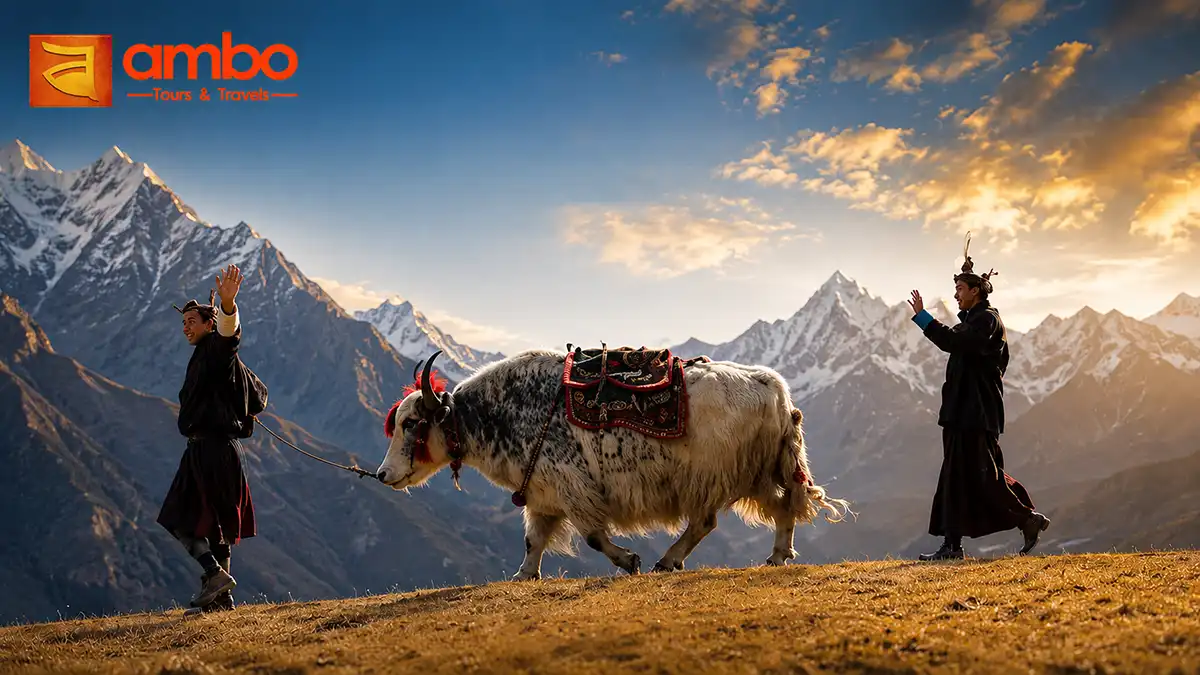
Royal Highland Festival Tour — Laya Village, Gasa & Bhutan's High Himalaya
Paro · Thimphu · Punakha · Gasa · Laya
Tour Information
- Attend the Royal Highland Festival in Laya village (3,800 m) — yak contests, horse races, Auley ballads and sacred mask dances
- Stay overnight in a genuine Laya homestay — one of Bhutan's most remote and distinctive highland communities
- Visit Gasa Dzong — a remote 17th-century hilltop fortress rarely reached by visitors
- Soak in Gasa Tshachu — mineral-rich thermal hot springs in the Mo Chhu river valley
- Hike to Taktsang Monastery (Tiger's Nest) — 900 m above Paro Valley through blue pine forest
- Visit Punakha Dzong — the Palace of Great Happiness, built in 1637 at the confluence of two rivers
- Cross Dochula Pass (3,100 m) with 108 memorial chortens and Himalayan panoramas
- Explore the Layap people — Bhutan's most distinctive highland community, known for their iconic conical bamboo hats
- Full day Thimphu cultural tour including Buddha Dordenma, Royal Textile Museum and Zorig Chusum Institute
- Fully private and inclusive: SDF, visa, licensed guide, transport, homestay, accommodation and all meals
The Royal Highland Festival takes place each October at Laya village — one of the most remote and remarkable communities in Bhutan, sitting at 3,800 metres in the Gasa district near the Tibetan border. For two days, the festival ground comes alive with yak beauty contests, highland horse races, Auley ballad performances, sacred mask dances, and exhibitions of yak-hair weaving and alpine produce. It is Bhutan's highest-altitude festival, and one of its most extraordinary.
This 10-day private tour is built around those two festival days. The journey takes you from Thimphu's capital culture through Punakha's river valley, north through the remote Gasa district with its thermal hot springs and clifftop dzong, up to Laya village for the festival, and back via Paro for the Tiger's Nest hike before departure. The overnight stay in a genuine Laya homestay is unlike anything available on a standard Bhutan itinerary.
Every detail is handled by Ambo Tours' licensed team in Thimphu — permits, accommodation, guide, transport, and all meals throughout.
Tour Pricing
10 Days Bhutan Journey — Cost
All prices in USD per personCost includes Sustainable Development Fee (SDF) of US $100 per person per night and Bhutan Visa Fee of US $40 per person. Entrance fees for monuments and festival visits are paid separately.
Detailed Itinerary
Your Royal Highland Festival Bhutan journey begins with one of commercial aviation's most dramatic arrivals. The plane banks between Himalayan ridgelines into Paro International Airport — terraced rice fields, prayer flags, and forested valley walls appear in the window all at once. Your Ambo Tours guide welcomes you warmly at arrivals and begins the scenic drive east to Thimphu.
The route winds through traditional villages and picturesque valleys. It gives you your first real sense of the Bhutan landscape — unhurried, layered, and entirely unlike anywhere else. After lunch in Thimphu, the afternoon begins with two gentle orientation stops:
- Memorial Chorten — a striking golden stupa built in honour of Bhutan's third King, Jigme Dorji Wangchuck. It is the most active daily worship site in the capital. Elderly Bhutanese walk its circumambulation path at dawn and dusk without fail.
- Kaja Throm (Town Centre) — a leisurely stroll through Thimphu's clock tower square, where local artisans sell handicrafts and everyday Bhutanese life unfolds around you. Just minutes away, a single traffic officer directs the city's vehicles — Thimphu has no traffic lights anywhere.
Dinner and overnight in Thimphu.
Tomorrow brings a full day of Thimphu sightseeing — from the world-famous Buddha Dordenma to traditional arts workshops and local markets.
Today Ambo Tours takes you through Thimphu's finest cultural, artistic, and natural attractions. Each stop adds a different layer of understanding — together they create a complete picture of Bhutan Buddhist culture and the philosophy of Gross National Happiness (GNH) that defines this kingdom.
- Buddha Dordenma at Kuenselphodrang — a 51.5-metre bronze and gilded statue of Shakyamuni Buddha, one of the largest in the world. It sits on a forested hilltop above Thimphu with panoramic valley views. Visit in the morning when the light catches the gold surface at its best.
- Simply Bhutan — an immersive cultural showcase where you can taste ara (traditional rice wine), watch folk dances, try on national dress, and meet local artisans demonstrating traditional crafts.
- Takin Preserve at Motithang — home to the Takin, Bhutan's national animal. This distinctive bovine-goat hybrid is found nowhere else on earth and is said to have been created by the Divine Madman Drukpa Kunley through his Tantric powers.
- National Postal Museum — where your own portrait can be printed onto an official Bhutanese postage stamp in minutes. A genuine Bhutan hidden gem stop.
- Folk Heritage Museum — a reconstructed traditional Bhutanese farmhouse bringing the rural past of the country to life through domestic artefacts and tools.
- Royal Textile Museum — showcasing centuries of Bhutanese weaving tradition, regional patterns, and royal garments. Essential context for the hand-woven textiles you will see in Laya village later this week.
- Zorig Chusum Institute (School of Arts and Crafts) — watch apprentice artists practise thangka painting, wood carving, and embroidery under the National Institute for Bhutan's 13 traditional arts.
- Local markets — browse handicrafts, fresh produce, dried chillies, and Bhutanese souvenirs at the Centenary Farmers' Market (open on weekends) or the nearby craft bazaar on Norzin Lam.
Dinner and overnight in Thimphu.
Tomorrow, the road crosses Dochula Pass to the subtropical warmth of Punakha.
The drive from Thimphu to Punakha (1,200 m) is one of the finest short road journeys in the Himalayas. Your Ambo Tours driver stops first at Dochula Pass (3,100 m) — where 108 Druk Wangyal memorial chortens crown a hilltop wrapped in prayer flags. On clear mornings, the snow-capped peaks of the eastern Himalayas fill the entire horizon. The chortens were built in honour of Bhutanese soldiers — a moving and photogenic site that appears in every serious Bhutan travel guide.
Descend through cool alpine forest into the subtropical warmth of Punakha Valley. The vegetation changes dramatically as you lose altitude — from pine to banana palms in less than an hour of driving.
- Visit Punakha Dzong (Palace of Great Happiness, built 1637 by Zhabdrung Ngawang Namgyal) — positioned at the confluence of the Pho Chhu and Mo Chhu rivers. It is Bhutan's former capital and the winter seat of Je Khenpo. Its main temple features four embossed cypress entrance pillars decorated in gold and silver — one of the finest interiors in any Bhutan dzong.
- Walk 20–30 minutes through rice fields to Chimi Lhakhang — the fertility temple of the Divine Madman Drukpa Kuenley (built 1499). He taught that religion is an inner feeling — not a matter of monastic ordination. Childless couples from across Bhutan visit here seeking his blessing.
Dinner and overnight in Punakha.
Tomorrow the road climbs north into the remote Gasa district — one of Bhutan's least populated and most dramatic highland regions.
The drive north from Punakha to Gasa follows the Mo Chhu River upstream through one of the most dramatic and least-visited road journeys in Bhutan. Dense forest closes in on both sides. Small hillside villages appear on the ridgelines. Terraced fields cling to steep slopes. The landscape grows wilder and more remote with every kilometre.
Gasa district is one of Bhutan's least populated — and most extraordinary — regions. Two highlights fill the afternoon:
- Gasa Dzong — built in the 17th century on a hilltop commanding sweeping views of the valley below. The dzong served for centuries as a defence stronghold protecting the region from Tibetan invasions. Today it functions as both an administrative and monastic centre. The hilltop position and mountain backdrop make it one of the most photogenic Bhutan dzong sites in the country.
- Gasa Tshachu (Hot Springs) — the mineral-rich thermal springs sit a short walk downhill from the road in a serene natural setting. Bathing in the therapeutic waters is a deeply restorative experience — and a perfect way to prepare your body for the high-altitude hiking and festival days ahead.
Tip: Carry warm layers. Gasa sits higher than Punakha and the evenings are noticeably cooler. Dinner and overnight in Gasa.
Tomorrow, the drive and hike to Laya village — one of Bhutan's most remote and distinctive highland communities.
Today you reach one of the most remote and remarkable villages in all of Bhutan. After breakfast in Gasa, drive approximately two hours along winding mountain roads beside rivers and through dense forest to Taktse Makha — the road head and trailhead for Laya.
From here, the hike to Laya village (3,800 m) takes one to two hours. The trail climbs steadily through pine forest, grazing pastures, and small settlements. Steeper sections reward with widening views of pristine Himalayan wilderness. As the trail crests the final rise, Laya village appears below — traditional stone houses clustered against a backdrop of snow-capped peaks.
The Layap people are one of Bhutan's most distinctive highland communities. The women wear their iconic conical bamboo hats decorated with turquoise and silver ornaments — a style found nowhere else in the kingdom. Men and women both wear handwoven black wool garments that mark their identity across the highlands.
- Settle into your homestay accommodation — sleeping in a genuine Laya household is one of the most authentic experiences on any Bhutan trip.
- Walk the village lanes, interact with residents, and acclimatise gently to the altitude before the festival begins tomorrow.
Tip: Drink plenty of water on arrival. Move slowly and eat a full dinner — your body needs fuel at 3,800 m. Dinner and overnight at homestay in Laya.
Tomorrow — the Royal Highland Festival Bhutan 2026 opens.
This is the day your Royal Highland Festival Bhutan tour has been building toward. The festival ground sits against one of the most spectacular Himalayan backdrops available anywhere on earth — snow-capped peaks circling a high alpine meadow at 3,800 m, with the Layap community gathered in their finest traditional dress. Your Ambo Tours guide brings you to the grounds early to experience the opening ceremonies fully.
The Royal Highland Festival celebrates the ancient traditions and livelihood of Bhutan's nomadic highland communities. No other festival in the kingdom brings together these mountain cultures in one place.
- Yak beauty contest and yak competitions — herders proudly present their finest animals, decorated and groomed. The yak is central to Layap survival — providing milk, butter, cheese, wool, hide, and transport — and the contest celebrates this bond.
- Highland horse races — riders in traditional dress race across the festival ground in a display of horsemanship and community pride.
- Traditional archery contests — Bhutan's national sport, played here in its highland form.
- Auley songs and dances — performers in colourful Layap attire sing epic ballads in the ancient oral tradition, accompanied by energetic communal dances.
- Exhibition stalls — yak butter, artisan cheese, textiles woven from yak hair, medicinal herbs gathered from the alpine slopes, and handcrafted tools used in highland daily life.
As evening approaches, the Ambo Tours guide gathers the group for traditional music and bonfire celebrations under the clear Himalayan sky. Dinner and overnight at homestay in Laya.
Tomorrow, the second and final day of the Royal Highland Festival — with mask dances, strongman contests, and cultural storytelling.
The second day of the Royal Highland Festival Bhutan 2026 opens with a fuller and more ceremonial programme. The Ambo Tours guide has you at the festival ground early for the morning's highlights.
- Sacred mask dances — monks in elaborate costumes perform cham dances that re-enact chapters of Buddhist scripture. These performances carry the same spiritual weight as the larger tshechu festivals held in Bhutan's dzong courtyards.
- Highland strongman competitions — endurance contests and traditional feats of strength that have been part of highland community life for generations.
- Cultural storytelling and Auley chanting — epic oral ballads passed down among Bhutan's nomadic highlanders over centuries. Listening to them at altitude, in the community where they were born, is an experience no cultural museum can replicate.
- Agricultural and livestock exhibitions — yak herding demonstrations, displays of local produce, and highland tools used in daily life. This is the best opportunity to speak directly with herders and artisans through your guide.
After lunch, begin the return journey toward Punakha — hiking back down to Taktse Makha, then driving south through the Gasa valley. The road follows the Mo Chhu River back through the same dramatic mountain scenery, which feels different in the afternoon light. Dinner and overnight at hotel in Punakha.
Tomorrow the drive continues to Paro via Dochula Pass for the final two days of the tour.
After breakfast, the drive from Punakha back west to Paro retraces the mountain highway via Dochula Pass (3,100 m). On a clear morning, this second crossing of the pass reveals angles of the Himalayan panorama you may have missed on Day 3 — use the stop for a final set of mountain photographs with the 108 chortens in the foreground.
Arrive in Paro in the early afternoon and begin sightseeing immediately:
- Ta Dzong — National Museum of Bhutan — an ancient circular watchtower converted into a national museum, housing galleries of fine arts, bronzes, textiles, religious relics, and natural history. Its stamp collection — including 3-D, silk, embossed, and the famous triangular yeti stamp — is particularly popular. The museum provides the historical context that ties together everything you have seen this week.
- Rinpung Dzong (Fortress of the Heap of Jewels, built 1646 by Zhabdrung Ngawang Namgyal) — the administrative and monastic centre of Paro district, its wooden-gallery courtyard lined with vivid Bhutan Buddhist culture murals.
- Kichu Lhakhang — one of Bhutan's oldest temples, built in the 7th century by Tibetan King Songtsen Gampo as one of 108 temples constructed in a single day across the Himalayan region. Its serene atmosphere and antiquity make it one of the most moving sites in the Paro valley.
Dinner and overnight in Paro.
Tomorrow — the defining hike of any Bhutan trip: the climb to Tiger's Nest Monastery.
No Bhutan tour package ends without this day. Start with an early breakfast — the hike to Taktsang Monastery (Tiger's Nest) rewards those who arrive early with the best light and the fewest fellow walkers on the trail.
The monastery sits dramatically about 1,000 metres above the Paro Valley floor at 3,120–3,200 m. The trail climbs through serene pine forest, passing prayer flags and viewpoints that widen with every step. The halfway teahouse marks a natural rest stop with the monastery perfectly framed above — the most photographed view in all of Bhutan tourism.
- The round trip hike takes four to five hours at a comfortable pace.
- Allow an extra hour to explore the monastery complex — meditation caves, sacred shrines, and intricately decorated temples reflect centuries of Bhutan Buddhist culture. Cameras must be left at the entrance gate.
- Horse rides are available to the viewpoint for those who prefer a gentler start to the lower section.
Guru Rinpoche flew to this cave on the back of a flying tigress in the 8th century to meditate and bring Buddhist teachings to Bhutan. The main complex was damaged by fire in 1998 and fully restored — the restoration itself is a testament to the depth of devotion this site inspires.
After descending, your Ambo Tours guide joins you for a farewell dinner in Paro — a celebration of ten days of Himalayan culture, highland festival, and extraordinary landscape. Dinner and overnight in Paro.
Tomorrow, your Royal Highland Festival Bhutan journey with Ambo Tours comes to a close.
Your Royal Highland Festival Bhutan tour with Ambo Tours comes to a close after breakfast. Your guide and driver transfer you to Paro International Airport as per your flight schedule. As the plane climbs steeply between the ridgelines one final time, the prayer flags and painted farmhouses of the Paro valley recede below.
Ten days have taken you from the giant Buddha of Thimphu to the river-confluence grandeur of Punakha Dzong, north through the remote thermal springs of Gasa, all the way up to the extraordinary Laya village at 3,800 m for two full days of the Royal Highland Festival — yak contests, Auley ballads, highland horse races, mask dances, and bonfire celebrations under a clear Himalayan sky. The journey home through Paro added the ancient temples of Kichu and the cliff-face wonder of Tiger's Nest as an unforgettable final chapter.
The Layap community of Laya, the Gasa district, and the Royal Highland Festival together represent a side of Bhutan that the majority of visitors never reach. Bhutan's commitment to sustainable tourism and Gross National Happiness (GNH) keeps this highland culture alive and unhurried. The entire Ambo Tours team thanks you for travelling with us. Tashi Delek!
Included / Excluded
- ✔All meals — breakfast, lunch, and dinner
- ✔Accommodation on twin / double sharing basis (single supplement extra)
- ✔All transportation within the kingdom including airport transfers
- ✔Sustainable Development Fee — Government tax (SDF)
- ✔Bhutan visa fee
- ✔English-speaking private local guide
- ✔Sightseeing as per itinerary
- ✔Bottled water throughout the journey
- ✖International flights to and from Paro (PBH)
- ✖Entrance fees for museums and monuments
- ✖Gratuities for guides and drivers
- ✖Travel insurance premiums
- ✖Payments for services provided on a personal basis
- ✖Cost for any services not mentioned under "Cost Includes"
- ✖Cost incurred due to mishaps, strikes, political unrest, etc.
- ✖Personal expenses — laundry, beverages, or personal services
Ambo Tours & the 1% Club
Every tour we run includes a contribution to a Bhutanese NGO of your choice — at no extra cost to you. We call this the 1% Club: a minimum of 1% of your trip's profit, or Nu 5,000, whichever is higher, donated on every single journey. You choose where it goes.
About the Royal Highland Festival
The Royal Highland Festival was established under the patronage of His Majesty the King of Bhutan to celebrate and preserve the culture of Bhutan's highland nomadic communities — particularly the Layap people of Gasa district. Held annually in October at Laya village (3,800 m), the festival brings together yak herder communities from across the Gasa highlands in a two-day celebration of traditional skills, music, and sport against one of the most dramatic Himalayan backdrops in the kingdom.
The festival programme is unlike any other in Bhutan. Yak beauty contests see herders present their finest animals, decorated and groomed for competition — the yak is central to Layap survival, providing milk, butter, meat, wool, and transport. Highland horse races fill the festival ground with colour and noise. Auley songs — ancient oral ballads passed down through generations of highland communities — are performed by groups in full Layap ceremonial dress. Sacred cham mask dances performed by monks re-enact chapters of Buddhist scripture. And on the edges of the ground, exhibition stalls display yak butter, artisan cheese, textiles woven from yak hair, and medicinal herbs gathered from alpine pastures above 4,000 metres.
For context on Bhutan's wider festival calendar, see our complete guide to Bhutan festivals.
Laya Village & the Layap People
Laya sits at 3,800 metres in the Gasa district of northern Bhutan, accessible only on foot from the nearest road. It is one of Bhutan's most remote permanently inhabited villages, and home to the Layap — a semi-nomadic community whose way of life has remained largely unchanged for centuries. Layap women are instantly recognisable by their iconic conical bamboo hats decorated with traditional ornaments, a cultural marker unique to this community and to this altitude.
The Layap are yak herders. Their seasonal migration routes take them between the high alpine pastures above 4,000 metres in summer and the lower valley floors in winter, following patterns established over generations. The village itself is a cluster of stone and timber farmhouses on a steep hillside, with a small monastery at its centre. An overnight stay in a genuine Laya homestay — sleeping in a working highland household — is one of the most immersive experiences available anywhere in Bhutan.
Laya lies on the route of the Laya-Gasa Trek, one of Bhutan's classic multi-day wilderness routes. Travellers who wish to extend their time in this region can combine the festival with the full trek.
Gasa District — Hot Springs & Remote Dzong
The journey north from Punakha to Laya passes through Gasa district — one of Bhutan's least visited and most atmospheric regions. The road follows the Mo Chhu river upstream through increasingly dramatic gorges and forest, passing small villages and monastery outposts before arriving at Gasa town.
Gasa Dzong stands on a hilltop commanding sweeping views of the valley — built in the 17th century, it is one of Bhutan's most remote administrative fortresses and sees a fraction of the visitors that reach Punakha or Paro. A short walk downhill from the road brings you to Gasa Tshachu, mineral-rich thermal hot springs in a serene natural setting beside the river. The springs are used by local communities year-round and are particularly welcome after the Laya hike on the return journey.
For a full overview of Bhutan's planning essentials before your journey, visit our Bhutan travel guide. For information on travel costs including SDF, see our cost of travelling to Bhutan guide.
Itinerary Map
Map coming soon.
Frequently Asked Questions
Ready to Begin Your Journey?
Our Thimphu team responds within 24 hours. Tell us your dates and we will handle the rest.