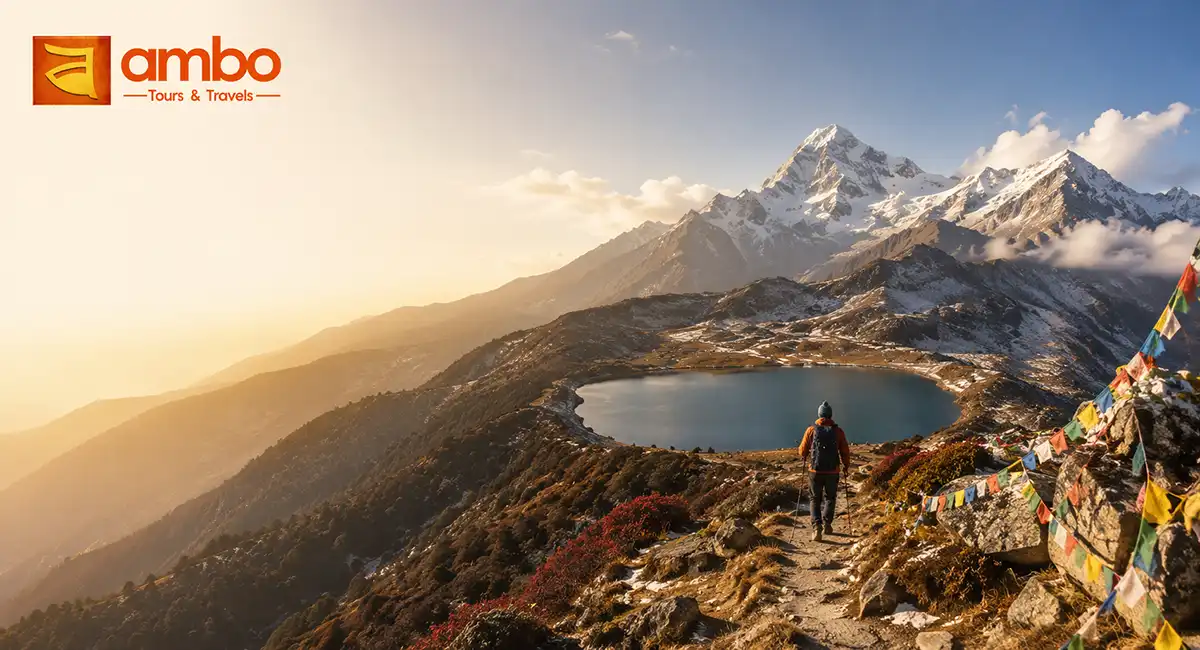
Druk Path Trek Bhutan
Paro - Thimphu - Punakha - Gangtey
Tour Information
- Sacred alpine lakes: Jimilangtsho, Janeetsho, and Simkota
- Phume La pass at 4,080m with views of Gangkar Puensum — world's highest unclimbed peak
- Phajoding Monastery perched above the clouds
- Yak herder encounters in high pastures
- Descent through ancient blue pine forest into Thimphu
- Thimphu city lights visible from camp on clear nights
- Optional Tiger's Nest hike on arrival or departure day
Bhutan is one of the last truly unspoiled destinations on earth — and this 11-day Druk Path Trek itinerary is one of the best ways to see it properly. Starting and ending in the valley of Paro, the trip combines two days of cultural sightseeing, a six-day high-altitude trek through remote alpine wilderness, and a day excursion to the ancient royal valley of Punakha.
You will hike to Tiger's Nest Monastery, cross the 4,080-metre Phume La pass, camp beside sacred mountain lakes, and explore Thimphu — a capital city unlike any other. Accommodation is in comfortable 3-star hotels and well-equipped mountain campsites throughout.
All Bhutan visa and permit logistics are handled for you. Best time to visit Bhutan for the Druk Path Trek route: October to December and March to May. check our detailed guide on best time to visit Bhutan.
Tour Pricing
11 Days Bhutan Journey — Cost
All prices in USD per personCost includes Sustainable Development Fee (SDF) of US $100 per person per night and Bhutan Visa Fee of US $40 per person. Entrance fees for monuments and festival visits are paid separately.
Detailed Itinerary
The descent into Paro is unlike any other — your aircraft banks sharply between snow-dusted peaks before touching down in one of the world's most dramatic airport valleys, and just like that, your Bhutan trip has begun. A friendly representative from Ambo Tours meets you at the terminal and takes care of all Bhutan visa and Bhutan permit formalities, so you can start exploring without delay.
After a relaxed lunch, the afternoon is filled with some of the best Bhutan sightseeing that Paro has to offer — all within easy walking distance of each other and perfect for shaking off any travel fatigue.
- Ta Dzong (National Museum) – A former watchtower perched above the valley, now home to religious relics, thangka paintings, and ancient handicrafts that give a rich overview of Bhutan's cultural and spiritual history.
- Paro Rinpung Dzong (Paro Dzong) – One of the finest examples of Bhutan dzong architecture, this impressive fortress-monastery houses a celebrated painting of the saint Milarepa, revered across Bhutan as a master of meditation who attained enlightenment in a single lifetime.
- Traditional Cantilever Bridge – A beautifully preserved wooden bridge still in everyday use, offering a lovely riverside stroll and a great photo moment.
Paro sits at around 2,280 metres, so take it easy on your first afternoon and drink plenty of water. The evenings are cool year-round — pack a light jacket. For dinner, try ema datshi, Bhutan's national dish of chilli and melted cheese served over red rice — simple, warming, and completely addictive. Tomorrow, you tackle one of the most famous hikes in all of Bhutan tourism.
This is the day that most travellers circle on the calendar before they even book their Bhutan holiday — the hike to Taktsang Monastery (Tiger's Nest), a sacred 17th-century temple complex perched on a sheer cliff face 900 metres above the Paro valley. It is, without question, one of the most iconic things to do in Bhutan.
The trail is well-maintained and broad, climbing steadily through fragrant pine forest for about 1.5 to 2 hours. The views get better with every switchback. According to legend, Guru Rinpoche flew to this very spot on the back of a tigress in the 8th century to bring Buddhism to Bhutan — a story your guide will bring to life along the way. A teahouse midway up the trail is a welcome spot for lunch and a cold drink.
- Taktsang Lhakhang (Tiger's Nest) – The main monastery complex built around the guru's meditation cave; dress modestly and remove shoes before entering the temples.
- Drukgyel Dzong – In the afternoon, visit this reconstructed hilltop fortress built in 1644 to mark a famous victory over Tibetan invaders. On a clear day, the sacred peak of Mt. Jomolhari (7,314 m) rises as a spectacular backdrop.
Wear comfortable walking shoes with good grip, carry at least 1.5 litres of water, and start the hike early to avoid the midday heat. Horses are available for the lower section if needed. In the evening, try a bowl of thukpa (noodle soup) at a local restaurant in Paro town — hearty, affordable, and exactly what your legs need after a full day on the trail. Tomorrow the real adventure begins: your first day of trekking.
Boots laced and pack on your back, today marks the beginning of a multi-day Bhutan mountain trek that takes you far from the roads and into some of the most unspoiled highland wilderness in all of Bhutan travel. The journey starts directly from Paro valley with a steady, rewarding climb up toward the remote ridge monastery of Jele Dzong.
The ascent covers 1,090 metres — the biggest climb of the entire trek — but the trail is well-graded and your guide keeps a steady, manageable pace. As you gain height, the rooftops of Paro disappear below and the Bhutan landscape opens into wide alpine meadows and sky. On a clear day, a chain of snow-capped Himalayan peaks lines the northern horizon in a sight that makes every uphill step worthwhile.
- Jele La (3,400 m) – A windswept mountain pass decorated with colourful prayer flags; a natural rest point and a great spot for photos.
- Jele Dzong – A small, remote monastery sitting right at the ridgeline — peaceful, rarely visited, and deeply atmospheric.
- Lhakhang of Buddha Shakyamuni – A simple chapel near camp housing a revered Buddha statue, worth a quiet visit before dinner.
Camp tonight sits at 3,480 metres — temperatures drop significantly after sundown, so layer up and keep your sleeping bag accessible. Your camp cook will prepare a warm dinner of red rice, dal, and seasonal vegetables — simple, nourishing food that forms the backbone of a Bhutan cultural tour on foot. Drink plenty of water and avoid alcohol on your first night at altitude. Tomorrow, the trail pushes deeper into the alpine zone toward Jangchulakha.
Morning breaks cold and clear over Jele Dzong camp, and today's stage eases into a more manageable rhythm — a gradual climb through one of the most beautiful alpine forest corridors on the entire Bhutan itinerary. Thick stands of rhododendron line the trail on both sides, their twisted branches draped in lichen and moss, and if you're trekking between late April and early May, these slopes are ablaze with colour — one of the best times to visit Bhutan for highland trekking.
The walking is steady and enjoyable, with frequent opportunities to stop, breathe in the mountain air, and take in the views. Mt. Chomolhari (7,326 m) and its neighbouring peaks appear and disappear through gaps in the treeline throughout the day — teasing, magnificent, and enormous.
- Rhododendron forest trail – A long, atmospheric walk through dense alpine woodland rich in birdlife; listen for the blood pheasant calling in the undergrowth.
- Chomolhari viewpoints – Several natural clearings along the ridge offer direct sightlines to Bhutan's most sacred border peak.
- Yak herder camps – Nomadic herding families graze their yaks on these high pastures; a brief stop at a herder's camp is a genuine and memorable cultural encounter.
Camp tonight is at 3,770 metres — noticeably colder than last night. A warm fleece, thermal base layers, and waterproof outer shell are essential kit for this altitude. Your camp cook will prepare a hearty dinner; try to eat well even if your appetite is slightly reduced, as good nutrition helps with acclimatisation. Treat yourself to a cup of sweet Bhutanese butter tea before bed — warming and surprisingly comforting once you get used to it. Tomorrow, the ridge walk continues toward the sacred Jimilangtsho lakes.
Today's stage follows the high ridgeline above Jangchulakha in a long, open traverse that many trekkers consider the most visually spectacular day of the entire Bhutan trip. The trail rolls gently along the spine of the mountain with sweeping valley views on both sides and the Himalayan chain stretching across the northern horizon — this is the Bhutan landscape at its most raw and rewarding.
The sacred peak of Jichu Drake (6,989 m) dominates the skyline for much of the day — the mountain is considered the protective deity of Paro valley, and seeing it from this elevated perspective gives a real sense of the deep relationship between geography and Bhutan Buddhist culture. The trail descends at the end of the day to the beautiful Jimilangtsho lakes, a group of high-altitude tarns famous for their large, fat trout.
- Jichu Drake panorama – One of the finest mountain viewpoints on the entire trek, best enjoyed on a clear morning before clouds build.
- Jimilangtsho lakes – Sacred alpine lakes ringed with prayer flags; your guide will share the local legends surrounding these waters.
- Wildlife spotting – Keep an eye out for Himalayan blue sheep, ravens, and the occasional red fox on the open moorland sections.
At 3,870 metres, tonight is the highest camp of the trek — headaches and mild breathlessness are common and normal. Drink water constantly, walk slowly, and avoid overexertion after reaching camp. Dinner tonight is a camp favourite: kewa datshi (potato and cheese stew) — comfort food at altitude. Tomorrow is the most challenging day of the trek, crossing into wild new terrain above the Simkota Lake.
Today is the toughest and most adventurous stage of the trek, and for many travellers it becomes the most memorable day of their entire Bhutan holiday. The trail climbs hard through dwarf rhododendron scrub and open moorland before the Bhutan mountain terrain opens into a vast, remote highland plateau — a landscape that feels genuinely wild and untouched, far from any road or village.
En route, the turquoise lake of Janeetsho appears without warning in the middle of the plateau — a stunning, isolated body of water that appears on very few maps and feels like a true Bhutan hidden gem. Yak herder camps are scattered across the surrounding meadows; these semi-nomadic families spend their summers at this altitude, moving their herds between seasonal pastures in a way of life that has changed little in centuries.
- Janeetsho Lake – A remote glacial lake passed mid-route; a beautiful and rarely photographed spot well off the standard Bhutan tourism trail.
- High yak herder settlements – Chance encounters with Bhutanese pastoral families at their summer camps — authentic, unscripted, and genuinely interesting.
- Simkota Lake – Tonight's spectacular campsite on the grassy bank of a wild mountain lake known for its large trout population.
The 820-metre ascent is steep in places — take it slowly, use trekking poles if you have them, and rest whenever you need to. If you're lucky (and your guide has a fishing line), freshly caught Simkota lake trout can be grilled over the camp fire for dinner — one of those simple outdoor meals that tastes better than anything in a restaurant. Tomorrow the trail begins its long descent toward Phajoding and eventually Thimphu.
The final full trekking day of your Bhutan itinerary opens with the gradual climb to Phume La (4,080 m) — the highest point of the entire route and one of the most rewarding moments of the whole Bhutan trip. On a clear morning, the view from this pass is extraordinary: Gangkar Puensum (7,570 m), the highest unclimbed peak in the world, anchors the northern horizon alongside a full sweep of the Bhutanese Himalayan chain.
From the pass, the trail descends steadily through fragrant juniper woodland — the scent is clean and sharp and somehow perfectly suited to the mood of a final trekking day — before arriving at the ancient hermitage of Phajoding Monastery, a cluster of meditation retreat houses and small temples clinging to the hillside above Thimphu valley. This is one of the most spiritually evocative Bhutan monastery sites on the entire trek.
- Phume La (4,080 m) – The trek's highest point; allow time here to take in the panorama and photograph the Himalayan giants to the north.
- Juniper forest descent – A long, beautiful walk through high-altitude woodland that's wonderfully atmospheric in the late afternoon light.
- Phajoding Monastery – An active retreat centre where monks and nuns undertake extended periods of solitary meditation; approach with respect and quiet curiosity.
Tonight's camp at Phajoding sits at 3,610 metres with the lights of Thimphu visible far below in the valley — a sight that stirs a surprising mix of achievement and mild reluctance that the trek is almost over. Your camp cook will mark the last night on the trail with a special dinner; raise a cup of hot ginger tea to the mountains you've crossed. Tomorrow is a short, satisfying descent into the capital.
The final morning of the trek is short, downhill, and genuinely enjoyable — a gentle 5-kilometre descent through a beautiful corridor of tall blue pines that leads you gradually out of the wilderness and into the outskirts of Thimphu, the capital of Bhutan and one of the most distinctive small cities in Asia. There are no traffic lights here — this is a country that takes gross national happiness (GNH) seriously, and it shows.
The walk takes about three hours at a relaxed pace, and your guide will point out medicinal plants, bird species, and forest shrines along the way. Arriving in Thimphu on foot through the forest is a quietly memorable way to enter a capital city — far better than any taxi ride. Your hotel is clean, comfortable, and well-located for the afternoon's exploration.
- Blue pine forest walk – A final meditative descent through dense, quiet woodland; a perfect way to decompress after six days on the trail.
- Thimphu arrival – Check in, shower, and let your legs recover before heading out to explore the capital on foot.
- Buddha Dordenma – If energy allows, the short drive to this enormous hilltop Buddha statue rewards with sweeping views over the entire Thimphu valley.
The afternoon is yours to do as you please — browse the weekend market if it's running, pick up souvenirs along Norzin Lam (Thimphu's main street), or simply sit at a café and watch the world go by. For dinner, head to one of Thimphu's popular local restaurants and order jasha maroo (spiced minced chicken) with red rice — a Bhutanese staple that tastes even better after a week on the trail. Tomorrow, a full-day excursion takes you to the beautiful valley of Punakha.
Today takes you out of Thimphu on one of the most scenic day drives in all of Bhutan travel, winding up through rhododendron forest to the famous Dochula Pass (3,100 m) before descending into the warm, subtropical valley of Punakha — the ancient capital of Bhutan and home to what many visitors consider the most beautiful Bhutan dzong in the entire country.
The pass itself is worth the drive alone. On clear mornings, 108 white memorial chortens line the ridge against a backdrop of snow-capped Himalayan peaks stretching across the horizon. In late April and early May, the surrounding slopes burst into colour as the rhododendrons bloom — one of the best times to visit Bhutan for this particular view.
- Dochula Pass (3,100 m) – Stop for tea at the small café here and take in the panoramic mountain views; a highlight of any Bhutan itinerary.
- Punakha Dzong – Built in 1637 at the confluence of two rivers, this stunning fortress is the winter home of Bhutan's senior monks and the site of the famous royal wedding of 2011. Architecture, history, and setting combine to make this one of the finest things to do in Bhutan.
- Chimi Lhakhang – A charming Bhutan monastery set amid golden paddy fields, dedicated to the eccentric and beloved saint Drukpa Kunley — the Divine Madman. The walk across the fields to reach it is half the experience.
Lunch in Punakha is a relaxed, unhurried affair — try phaksha paa (pork slow-cooked with dried chilli and radish), a regional speciality that is warming and full of flavour. The drive back to Thimphu in the late afternoon follows the same mountain road in reverse, equally beautiful in the evening light. Tomorrow, a full morning of cultural sightseeing in Thimphu before the drive back to Paro.
Thimphu rewards a full morning of unhurried exploration, and today's Bhutan cultural tour covers a genuinely impressive range of sites — from ancient temples to living craft schools — that together paint a vivid portrait of what makes this small kingdom so distinct from anywhere else on earth. This is Bhutan sightseeing at its most varied and meaningful.
- National Memorial Chorten – A much-loved stupa in the heart of the city, built as a memorial to Bhutan's third king; locals walk slow circles around it in quiet morning prayer, and joining them briefly is a genuinely moving experience.
- Changangkha Lhakhang – A 12th-century temple on a promontory above the city with great views over Thimphu; one of the oldest and most atmospheric sites in the capital.
- Zilukha Nunnery (Drubthob Monastery) – An active nunnery where the daily routines of Bhutanese monastic life play out quietly and authentically.
- School for Arts and Crafts – Watch young students learning all 13 traditional Bhutanese art forms, from thangka painting to weaving — a living example of sustainable tourism Bhutan through cultural preservation.
- Folk Heritage Museum – A beautifully recreated traditional farmhouse that brings everyday Bhutanese history to life without any fuss.
- Motithang Takin Reserve – A short visit to see the takin, Bhutan's wonderfully odd national animal — part wildebeest, part goat, and entirely Bhutanese.
Before leaving Thimphu, stop at the market along Norzin Lam for affordable, authentic souvenirs — hand-woven textiles, incense, wooden bowls, and local spices all make excellent gifts. The early evening drive to Paro takes about an hour through the river valley and is a pleasant, easy end to a busy day. Tonight is your last night in Bhutan — make it count with a final dinner of whatever dish you loved most on this trip. Tomorrow, the kingdom bids you farewell.
Your final morning in Paro arrives gently — the valley is quiet, the air is crisp, and the mountains that greeted you on arrival now stand as a familiar and affectionate backdrop to your last few hours in the kingdom. Whether you've been here for the Bhutan sightseeing, the trekking, or simply the rare pleasure of travelling somewhere that feels entirely itself, the feeling on departure day is the same for almost everyone: I want to come back.
Depending on your flight time, there may be a relaxed window for a final stroll through Paro town, a last cup of butter tea, or a browse through the small craft shops near the dzong for any last-minute souvenirs. Your guide will ensure your Bhutan permit documents are all in order for the airport check-in.
- Paro market street – A casual morning browse through local craft and souvenir shops near the town centre.
- Drukgyel Dzong viewpoint – If time and skies allow, a quick stop at the ruined fortress for one last view of Mt. Jomolhari is a fittingly grand farewell.
As your aircraft climbs steeply above the valley and banks between the peaks, take a last look down at the patchwork of rice fields, monasteries, and forested ridgelines below — a landscape almost entirely unchanged for centuries. Bhutan does not try to impress you. It simply is what it is, and that is more than enough. If the spirit moves you to return, the remote valleys of Bumthang and Haa Valley are waiting. Tashi Delek — good luck, and safe travels.
Included / Excluded
- ✔All meals — breakfast, lunch, and dinner
- ✔Accommodation on twin / double sharing basis (single supplement extra)
- ✔All transportation within the kingdom including airport transfers
- ✔Sustainable Development Fee — Government tax (SDF)
- ✔Bhutan visa fee
- ✔English-speaking private local guide
- ✔Sightseeing as per itinerary
- ✔Bottled water throughout the journey
- ✖International flights to and from Paro (PBH)
- ✖Entrance fees for museums and monuments
- ✖Gratuities for guides and drivers
- ✖Travel insurance premiums
- ✖Payments for services provided on a personal basis
- ✖Cost for any services not mentioned under "Cost Includes"
- ✖Cost incurred due to mishaps, strikes, political unrest, etc.
- ✖Personal expenses — laundry, beverages, or personal services
Ambo Tours & the 1% Club
Every tour we run includes a contribution to a Bhutanese NGO of your choice — at no extra cost to you. We call this the 1% Club: a minimum of 1% of your trip's profit, or Nu 5,000, whichever is higher, donated on every single journey. You choose where it goes.
What is the Druk Path Trek?
The Druk Path Trek is Bhutan's most celebrated high-altitude walking route, connecting Paro valley with the capital Thimphu across 56 kilometres of alpine terrain. The trail passes through blue pine and rhododendron forest, climbs above 4,000 metres to a chain of sacred glacial lakes, and skirts the ridgeline with views across to the permanent snows of the Himalayan north.
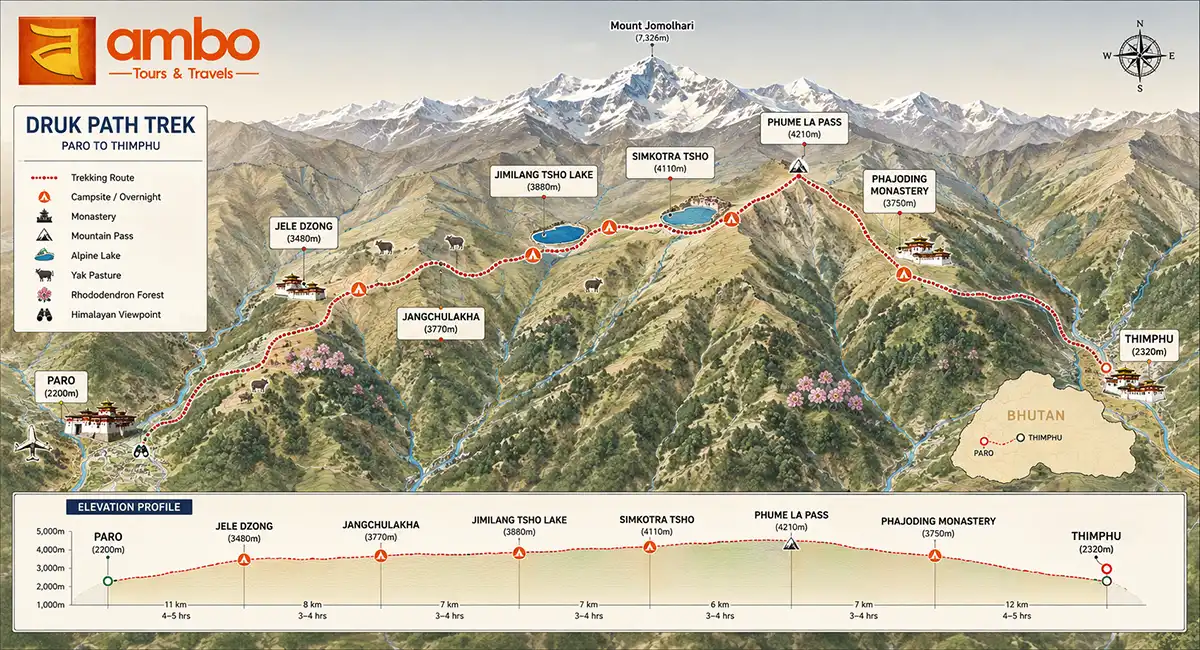
Unlike Bhutan's longer wilderness treks, the Druk Path is achievable for travellers with reasonable fitness and no prior trekking experience. Daily walking stages are short — between 5 and 11 kilometres — and the pace is entirely your own. What makes it exceptional is not difficulty but setting: each camp is positioned above the valley floor, with morning views that no road in Bhutan can reach.
Ambo Tours runs this route Paro to Thimphu, the direction that gives you a gradual altitude gain in the first two days and finishes with a descent directly into the capital — so your last night on trek ends with the lights of Thimphu spread below you.
Altitude, Difficulty & Fitness
The Druk Path Trek is graded Easy to Moderate. The challenge is altitude rather than technical difficulty — there is no scrambling, ropes, or glacier travel. The trail is well-defined throughout.
The altitude profile is the key thing to understand before you go. You start at Paro at 2,280 metres and reach the highest point — Phume La pass — at 4,080 metres on Day 7. The highest campsite sits at 4,110 metres. Most trekkers feel some mild effects of altitude above 3,500 metres: reduced appetite, slower breathing, and tiredness. These are normal and pass with rest and hydration.
The one genuinely strenuous section is Day 1: a 1,090-metre ascent from Paro to Jele Dzong at 3,480 metres. This takes 4–5 hours and is steep in places. If you arrive in Paro a day early and spend it acclimatising with a gentle walk, Day 1 becomes significantly easier. We strongly recommend this buffer day and build it into your itinerary by default.
Who is this trek suitable for? Active travellers who walk regularly, are comfortable on uneven ground, and have no serious cardiac or respiratory conditions. Age is not a barrier — we have guided trekkers in their late 60s on this route. Prior high-altitude experience is helpful but not required.
A Typical Day on the Druk Path Trek
Wake-up tea arrives at your tent at around 6:30am. Breakfast — hot porridge, eggs, toast, and Bhutanese butter tea if you want it — is ready by 7:15. Camp is packed and loaded onto horses by the time you set off, usually between 7:30 and 8:00.
Most days involve 3–5 hours of walking with a natural rest stop at a viewpoint or lakeside. Your guide walks with you throughout; the horsemen and cook move ahead to set up lunch at a flat spot along the trail. Lunch is a proper hot meal — rice, lentils, vegetables, and usually a protein.
Afternoon arrivals at camp are typically between 1:00 and 3:00pm, which leaves several hours of daylight for rest, photography, or short explorations around the campsite. On lake-camp days, the light on the water in late afternoon is extraordinary.
Dinner is served in the dining tent at around 6:30pm: three courses, hot drinks, and good conversation. Nights above 3,500 metres are cold — temperatures regularly drop to 0°C or below even in October — but your sleeping bag and the kitchen tent's warmth handle this well. Lights out by 9:00pm is standard; most trekkers sleep deeply at altitude once acclimatised.
Altitude Sickness on the Druk Path Trek
Acute Mountain Sickness (AMS) is a possibility on any trek above 3,000 metres. On the Druk Path, most trekkers spend three nights above 3,800 metres, so understanding the basics is important.
Common symptoms of mild AMS include headache, fatigue, loss of appetite, nausea, and disrupted sleep. These are normal responses to altitude and usually resolve within 24 hours if you rest and stay hydrated. Do not ascend further if you have symptoms.
Warning signs that require immediate descent: severe or worsening headache that does not respond to paracetamol, loss of coordination, confusion, or a dry cough that becomes persistent and wet. These symptoms are rare on the Druk Path but require action — descent of even 300–500 metres typically brings rapid relief.
What we do: Our guides are trained in altitude sickness recognition and carry a pulse oximeter to monitor blood oxygen levels each morning. We carry supplemental oxygen for emergencies. Our itinerary builds in rest days and a gradual ascent profile specifically to reduce AMS risk. Acetazolamide (Diamox) is available in Paro and Thimphu pharmacies for those who want additional prophylaxis — consult your doctor before the trek.
The best prevention is simple: drink 3–4 litres of water daily, avoid alcohol for the first three days, and never push through symptoms to reach the next camp.
Best Time for the Druk Path Trek
The Druk Path Trek is walkable in most months, but two seasons give the best experience.
Spring (March to May) is the most dramatic season. Rhododendrons bloom red and pink across the hillsides from late March through April. Views are generally clear in the mornings, with afternoon cloud building over the Himalaya. Snow is possible on Phume La pass until mid-April. This is the busiest season.
Autumn (October to December) is the clearest season. The post-monsoon air is washed clean and Himalayan views from Phume La are at their sharpest. October and November are the peak months. December is perfectly feasible — cold at night (below -5°C at camp) but gloriously clear by day, and with far fewer other trekkers on the trail.
Monsoon (June to September) is possible but not recommended. The trail is wet and muddy, leeches are active below 3,000 metres, and views are limited by cloud.
Winter (January to February) brings significant snowfall above 3,500 metres. The trek is possible with proper equipment and an experienced guide, but the high passes may be blocked after heavy snowfall.
Frequently Asked Questions
The Druk Path Trek is rated Easy to Moderate. Daily walking distances are short (5–11 km), but the first day involves a 1,090-metre ascent to Jele Dzong at 3,480m. The highest camp is at 4,110m. Good general fitness is sufficient — no technical climbing required. The main challenge is altitude, not terrain.
The highest point is Phume La pass at 4,080 metres, reached on Day 7. From here, Gangkar Puensum (7,570m) — the highest unclimbed peak in the world — is visible on a clear day.
The best seasons are March to May and October to December. Spring offers rhododendron blooms and clear views. Autumn brings stable weather and the clearest Himalayan panoramas. December is feasible with appropriate cold-weather gear.
Yes. However, the first day's climb from Motithang to Phajoding is steep. Most operators including Ambo Tours run the Paro-to-Thimphu direction for a more gradual altitude gain in the first two days.
All trekking in Bhutan requires a Bhutan visa (USD 40) and the Sustainable Development Fee (USD 100/night). No separate trekking permit is required for the Druk Path Trek. All logistics are handled by your licensed operator before arrival.
No. Fishing is not permitted in the high-altitude lakes including Jimilangtsho and Simkota. These are protected areas. The large trout visible in the lakes are protected wildlife.
Ready to Begin Your Journey?
Our Thimphu team responds within 24 hours. Tell us your dates and we will handle the rest.