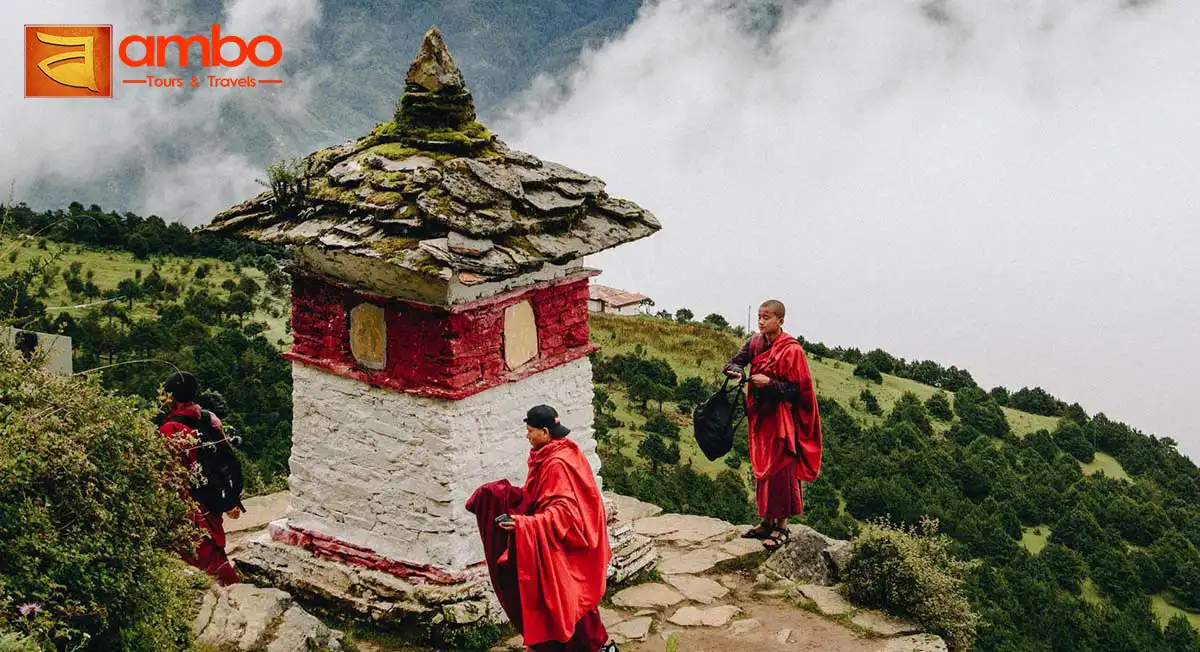
5-Day Bhutan Itinerary — Paro, Thimphu & Punakha
Paro · Thimphu · Punakha
Tour Information
- Tiger's Nest (Taktsang Monastery) — 10km round trip hike to Bhutan's most iconic site on a 900m cliff face
- Punakha Dzong — the great fortress-monastery built in 1637 at the confluence of two sacred rivers
- Dochula Pass (3,140m) — 108 memorial chortens with Himalayan peak views on clear days
- Traditional farmhouse evening — hot stone bath (Dotsho) and home-cooked dinner in Paro
- Thimphu sightseeing — Zorig Chusum School of Arts, Takin Reserve, National Textile Museum
- Chimi Lhakhang — 15th-century fertility temple reached through golden paddy fields
- Khamsum Yulley Namgyal Chorten — hilltop temple above Punakha with Mo Chhu valley views
- Fully private and guided — vehicle, guide, and itinerary exclusively yours
- SDF (USD 100/night) and visa fee (USD 40) included in all prices
Five days is the most popular first visit to Bhutan — long enough to experience the three essential western valleys at a pace that allows you to actually inhabit each place rather than rush through it. This 5-day Bhutan itinerary moves from Thimphu on arrival through Punakha Dzong and Dochula Pass, then concludes with the Tiger's Nest hike in Paro and a traditional farmhouse evening with hot stone bath.
Day 1 arrives in Thimphu — Bhutan's car-free capital until 2016, where traditional architecture and modern Bhutanese life coexist without advertising hoardings. Day 2 crosses Dochula Pass (3,140m) to Punakha, the former royal capital built at the confluence of the Pho Chhu and Mo Chhu rivers. Day 3 returns to Thimphu for the Buddha Dordenma and Memorial Chorten. Day 4 is the Tiger's Nest hike — the 10km round trip to Taktsang Monastery on its 900m cliff face — followed by a farmhouse dinner and traditional hot stone bath. Day 5 departs from Paro.
All journeys are fully private — your guide, vehicle, and itinerary are exclusively yours. No shared transport, no group timings. Operated by Ambo Tours, DOT Licence No. 1053330, Thimphu.
Tour Pricing
5 Days Bhutan Journey — Cost
All prices in USD per personCost includes Sustainable Development Fee (SDF) of US $100 per person per night and Bhutan Visa Fee of US $40 per person.
Detailed Itinerary
The descent into Paro is one of the most dramatic airport approaches on earth. Druk Air pilots navigate between steep forested ridges before the runway appears in a valley that has remained unchanged for centuries. After immigration and permit formalities, your English-speaking guide meets you at the arrivals hall.
The drive to Thimphu takes about an hour. En route, stop to walk across the suspension bridge to Tachog Lhakhang — a 15th-century temple sitting at the base of a forested mountain, accessed via one of Bhutan's oldest iron chain bridges. It is a rarely visited place and a quiet introduction to the kingdom's sacred geography.
- School of Traditional Arts and Crafts (Zorig Chusum) — Watch students mastering all 13 traditional Bhutanese art forms over a six-year programme. Thangka painting, wood carving, lacquerwork — each craft practised with an unhurried seriousness that tells you something important about Bhutanese life.
- National Textile Museum — A beautiful showcase of antique weaving traditions and intricate textile designs. The kira and gho worn daily by Bhutanese people represent centuries of accumulated craft knowledge.
- Motithang Takin Reserve — Home to Bhutan's national animal, a creature so unusual that a royal decree was required to create a dedicated preserve. The takin is found nowhere else in the wild.
- Centenary Farmers Market (Thursday to Sunday) — A vibrant riverside market of dried chillies, local cheese, buckwheat flour, and handwoven textiles. The best place in Thimphu to understand daily Bhutanese commerce.
- Changlimithang Archery Stadium — If there is a match in session, stop and watch. Bhutanese archery is played at distances that seem impossible, accompanied by singing, dancing, and a level of competitive spirit that is entirely joyful.
Thimphu sits at 2,320 metres — stay hydrated and take the first evening slowly. Dinner tonight is a welcome meal of traditional Bhutanese cuisine: ema datshi (chilli and local cheese), red rice, and pork with radish. Tomorrow, the road climbs to Dochula Pass and drops into the ancient royal capital of Punakha.
The drive from Thimphu to Punakha is one of the great road journeys in Bhutan. The road climbs through pine and rhododendron forest to the cloud-swept heights of Dochula Pass (3,140 m) — and on a clear morning, the panorama of Himalayan peaks stretched across the northern horizon is simply breathtaking. The 108 Druk Wangyal Chortens stand in a semicircle against the sky. Beyond them: Gangkhar Puensum, Masagang, Jejekangphu Gang.
- Dochula Pass — Stop for tea at the cafeteria and spend time among the chortens. The Druk Wangyal Lhakhang beside the pass was built by the Queen Mother of Bhutan and contains some of the most beautiful modern murals in the kingdom.
- Chimi Lhakhang — A 20-minute walk through golden paddy fields leads to this 15th-century temple dedicated to Lama Drukpa Kunley, the Divine Madman. A place of pilgrimage for couples hoping to conceive, decorated in ways that surprise most visitors. The walk itself is a journey through working Bhutanese farmland.
- Punakha Dzong — Built in 1637 at the exact confluence of the Pho Chhu (Father River) and Mo Chhu (Mother River), this is widely considered the most beautiful dzong in Bhutan. The coronation of the first king took place here in 1907. The jacaranda trees in the courtyard bloom purple in March. Allow at least an hour.
- Punakha Suspension Bridge — At 350 metres, one of the longest suspension bridges in Bhutan, draped in prayer flags over the Pho Chhu. It moves noticeably with each step.
- Sangchhen Dorji Lhuendup Nunnery — Rarely on standard itineraries. A hilltop nunnery above Punakha with sweeping sunset views over both the Punakha and Wangdue valleys. The light here in the late afternoon is extraordinary.
Punakha sits at 1,200 metres — noticeably warmer than Thimphu. Pack a lighter layer for the afternoon. Overnight in Punakha. Tomorrow begins with a morning hike to one of the most beautiful hilltop temples in Bhutan.
Punakha valley in the morning has its own quiet perfection — mist rising from the rivers, monks crossing the ancient bridge, the Dzong glowing pale gold in the early light. Begin the day with a hike that earns its views.
A suspension bridge and a 20-minute walk through terraced paddy fields leads to Khamsum Yueley Namgyal Lhakhang — a gilded hilltop temple commissioned by Her Majesty the Queen Mother. The one-hour walk uphill is gentle and entirely worth it. The panorama of the Punakha valley from the temple terrace, with the two rivers winding through the fields below, is among the most beautiful views in Bhutan.
- Khamsum Yueley Namgyal Lhakhang — Hilltop temple via paddy field trail. Approx. 1 hour uphill. The interior contains beautifully preserved murals depicting tantric deities. Rarely crowded.
- Dochula Pass — The return drive crosses the pass again. It never loses its power, particularly if clouds have cleared since the morning drive.
- Buddha Dordenma (Kuenselphodrang) — A 51.5-metre bronze and gold Buddha statue on the ridge above Thimphu, fulfilling an 8th-century prophecy. The view of the entire Thimphu valley from its base is best in late afternoon when the light softens.
- National Memorial Chorten — Built in 1974 as a memorial to the Third King, the Father of Modern Bhutan. A living site of daily prayer — join elderly Bhutanese devotees in their evening circumambulation, spinning prayer wheels and murmuring mantras in the fading light.
- Tashichhodzong — The seat of government and the throne room of the Je Khenpo. Built and rebuilt across centuries, rebuilt in the 1960s without nails or formal architectural plans. Entry by permit, arranged by your guide.
The hike to Khamsum is best done early before the day heats up. Wear comfortable shoes and carry water. Tomorrow is the day the entire journey has been building toward — an early start for Tiger's Nest.
Taktsang Palphug Monastery — Tiger's Nest — is built into a granite cliff at 3,120 metres above sea level, 900 metres above the floor of the Paro valley. The first structure was raised in 1692 on the site where Guru Rinpoche is said to have flown from Tibet on the back of a tigress to meditate in the cave below. The cave is still accessible during the visit, and is among the holiest sites in Vajrayana Buddhism.
The drive from Thimphu to Paro takes one hour. The trail begins at the car park (2,450 m) and climbs through blue pine forest hung with lichen and prayer flags. The first major viewpoint — reached after about 90 minutes — offers the view seen in every photograph of Bhutan. The path then descends into a gorge, passes a waterfall that drops directly from the cliff above the monastery, and climbs a steep staircase cut into the rock face.
- Tiger's Nest hike to viewpoint — Approx. 90 minutes. Stop for tea at the viewpoint cafeteria and take the photograph that will define your memories of this journey.
- Tiger's Nest monastery complex — Four main temples built around the meditation cave of Guru Rinpoche. Remove your shoes at the gate. Photography is not permitted inside.
- Kyichu Lhakhang — One of 108 temples built across the Himalayas in a single day by Emperor Songtsen Gampo in the 7th century. The original structure is still standing — one of the oldest temples in Bhutan and among its most sacred.
- Traditional Paro Farmhouse Visit — An afternoon tour of a working Bhutanese farming family home. Three storeys of rammed earth and timber, with grain stores on the ground floor and the family shrine at the top.
- Traditional Hot Stone Bath (Dotsho) — River stones heated over open fire and lowered into a wooden tub of mineral-rich water. A practice used by Bhutanese farmers for centuries to ease muscle ache and cold. One of the most distinctive and memorable experiences available in Bhutan — and the perfect way to end the day after the Tiger's Nest hike.
- Farmhouse Dinner — A home-cooked Bhutanese meal with the farming family. Expect red rice, ema datshi, and stories told through your guide.
Start no later than 7:30 am for the Tiger's Nest hike. Carry at least 1.5 litres of water. Walking poles help on the descent — your guide can arrange these in Paro town. Horses are available for the first section at an additional cost. The Tiger's Nest entrance fee is included in the tour cost.
The last morning in the Paro valley. The mountains are visible at dawn before cloud builds. The river sounds clearer. Breakfast is unhurried.
Depending on your departure time, there may be time for a final walk through Paro town — the main street has been selling the same things for decades: thangkas, wooden masks, incense, woven belts, Bhutanese stamps. A silk prayer flag costs less than a coffee.
Visit Rinpung Dzong if time permits — the administrative and religious centre of Paro district, built in 1646, with the wooden covered bridge (Nemi Zam) in front that is one of the most photographed structures in Bhutan. The National Museum (Ta Dzong) is also worth a final hour if your flight is afternoon.
Your guide accompanies you to Paro International Airport (PBH) for departure formalities. The flight out — banking sharply between ridges — offers a last look at the valley before the aircraft levels into open sky.
If you are already thinking about returning, the 7 days Bhutan tour adds Gangtey Valley and the black-necked crane wetlands to this itinerary. Until then, the philosophy of Gross National Happiness travels with you.
Included / Excluded
- ✔All meals — breakfast, lunch, and dinner
- ✔Accommodation on twin / double sharing basis (single supplement extra)
- ✔All transportation within the kingdom including airport transfers
- ✔Sustainable Development Fee — Government tax (SDF)
- ✔Bhutan visa fee
- ✔Entrance fees for museums and monuments
- ✔English-speaking private local guide
- ✔Sightseeing as per itinerary
- ✔Bottled water throughout the journey
- ✖International flights to and from Paro (PBH)
- ✖Gratuities for guides and drivers
- ✖Travel insurance premiums
- ✖Payments for services provided on a personal basis
- ✖Cost for any services not mentioned under "Cost Includes"
- ✖Cost incurred due to mishaps, strikes, political unrest, etc.
- ✖Personal expenses — laundry, beverages, or personal services
Ambo Tours & the 1% Club
Every tour we run includes a contribution to a Bhutanese NGO of your choice — at no extra cost to you. We call this the 1% Club: a minimum of 1% of your trip's profit, or Nu 5,000, whichever is higher, donated on every single journey. You choose where it goes.
About This Itinerary
The 5-day Bhutan itinerary is the most popular first visit to the kingdom — and for good reason. It covers Bhutan's three essential western valleys in a sequence that makes geographical and experiential sense: arrive in Thimphu to acclimatise to altitude and culture, cross the Himalayas to Punakha for the finest dzong in Bhutan, return through Thimphu for the Buddha Dordenma and Memorial Chorten, then spend the final full day on the Tiger's Nest hike in Paro before a farmhouse evening that encapsulates everything Bhutan is.
The pacing is deliberate. Two nights in Thimphu (Days 1 and 3) mean you never feel rushed. One night in Punakha (Day 2) means an early start for Khamsum Yulley Namgyal Chorten before the day heats up. Day 4 starts with the Tiger's Nest hike completed before lunch, leaving the afternoon for Kichu Lhakhang and the farmhouse evening without any sense of crowding the day.
For travellers who can extend to seven days, our 7-day Bhutan tour adds Gangtey Valley and the black-necked crane habitat at Phobjikha — the natural extension of this route.
Best Time for This Itinerary
This 5-day itinerary works well across most of the year with two peak windows and one period to avoid.
Spring (mid-March to late May) is the most popular season. Rhododendrons bloom along the Dochula Pass road in March and April, the Paro Tshechu festival typically falls in March or April, and the Tiger's Nest trail is at its most atmospheric with wildflowers along the upper sections. Visibility from Dochula Pass is best in April before the pre-monsoon haze builds.
Autumn (October to mid-November) is the second peak. Crystal-clear mountain views from Dochula Pass, cool temperatures ideal for the Tiger's Nest hike, and the Thimphu Tshechu festival in September/October. The paddy fields around Chimi Lhakhang are golden at harvest time.
Monsoon (June to August) — the route is possible but not recommended. Heavy rainfall, leeches on the Tiger's Nest trail in August, and persistent cloud cover obscuring the Dochula Pass views. Prices are lower but the experience is compromised.
Winter (December to February) — cold but clear. Dochula Pass views are exceptional on clear winter days and there are almost no other tourists. The Tiger's Nest hike is cold but doable with proper layers. Worth considering for travellers who prefer solitude.
For a full month-by-month breakdown, see our best time to visit Bhutan guide.
Travel Tips for Your Bhutan Journey
Dress code for dzongs and temples — covered shoulders and knees are required at all dzongs, temples, and monasteries including Tiger's Nest. Carry a light scarf or long-sleeved layer even in warm weather. Footwear must be removed before entering all temple chambers.
Tiger's Nest hike — start no later than 7:30am to avoid the afternoon heat and the peak visitor window between 10am and 1pm. Carry at least 1.5 litres of water. Trekking poles are useful for the descent. The hike takes 4–6 hours round trip depending on pace — there is no shame in taking the horse to the viewpoint and hiking only the final section to the monastery.
Altitude — Thimphu sits at 2,320m and Dochula Pass at 3,140m. Most visitors feel no significant altitude effects on this route. Stay hydrated, avoid alcohol on the first evening, and take the first day gently. If you have pre-existing heart or respiratory conditions, consult your doctor before travelling to Bhutan.
Currency — Bhutan uses the Ngultrum (BTN), pegged 1:1 to the Indian Rupee. Credit cards are accepted at most hotels and better restaurants in Thimphu and Paro. Carry a little USD cash for monastery donations, tips and small purchases. Ngultrum cannot be exchanged outside Bhutan — spend remaining notes on local crafts or food before departure.
Photography — photography is not permitted inside temple and dzong interiors. Always ask your guide before photographing monks, ceremonies, or locals at close range. The views from outside Tiger's Nest and from Dochula Pass are unrestricted and exceptional.
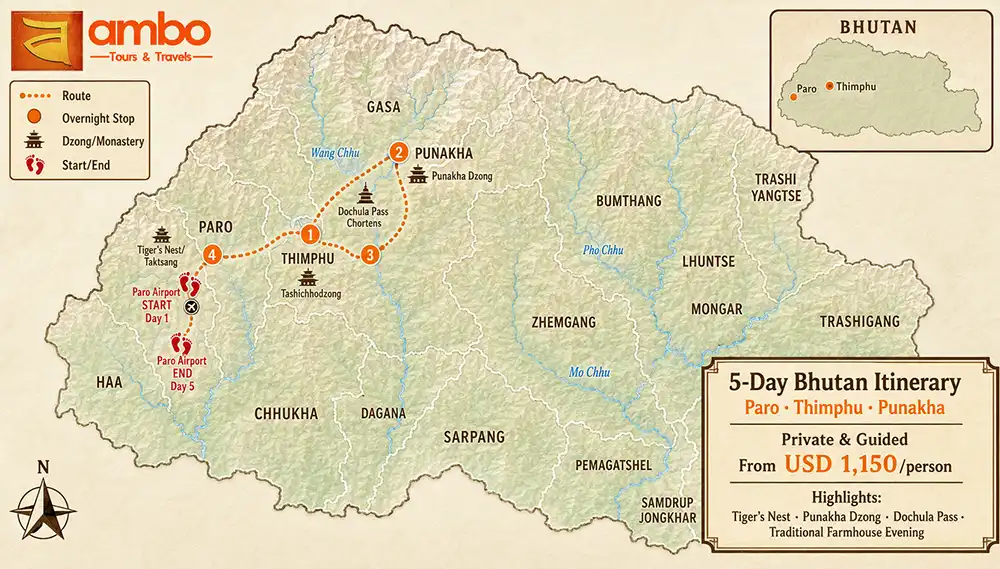
Itinerary Map
The map below shows the 5-day route from Paro Airport through Thimphu, Punakha, and back to Paro — with key cultural sites marked along the route.
Frequently Asked Questions
Five days is the most popular first visit to Bhutan. It covers the three essential western valleys — Thimphu, Punakha, and Paro — at a pace that allows you to experience each place rather than rush through it. You will hike to Tiger's Nest, see Punakha Dzong, cross Dochula Pass, and spend an evening in a traditional Bhutanese farmhouse. For most first-time visitors, five days is the ideal starting point. If you have seven days, our 7-day Bhutan tour adds Gangtey Valley and the black-necked crane wetlands of Phobjikha.
Our 5-day Bhutan itinerary is priced from USD 1,150 per person for groups of 3 or more, USD 1,280 for two travellers, and USD 1,490 for a solo journey. All prices include the Sustainable Development Fee (SDF) of USD 100 per person per night and the Bhutan visa fee of USD 40 per person. For a full breakdown of what's included and excluded, see our Bhutan travel cost guide.
The SDF is a government-mandated fee of USD 100 per person per night paid by all international visitors to Bhutan. It funds public services, conservation, and infrastructure across the kingdom. The fee was reduced from USD 200 to USD 100 in September 2023. It is included in the price of this tour — you do not pay it separately. Indian nationals pay a different rate of INR 1,200 per night. For full details see our Bhutan visa and entry guide.
Yes — the Tiger's Nest hike is the centrepiece of Day 4. The 10km round trip takes 4–6 hours at a comfortable pace and is accessible to most reasonably fit travellers. No prior hiking experience is required. Horses are available for the first section to the viewpoint at an additional cost. The entrance fee is included in the tour price.
Spring (mid-March to late May) and autumn (October to mid-November) are both ideal. Spring brings rhododendron blooms along the Dochula Pass road and the Paro Tshechu festival in March/April. Autumn offers the clearest Himalayan views from Dochula Pass and crisp trekking conditions for Tiger's Nest. For a month-by-month breakdown, see our best time to visit Bhutan guide.
This is a fully private journey. Your guide, vehicle, and itinerary are exclusively yours for the duration. You will not share transport or sightseeing time with other travellers. The maximum group size is 6 persons. This is standard for all Ambo Tours arrangements — we do not operate shared group departures.
All international visitors require a Bhutan visa (USD 40, arranged by your licensed operator before travel) and a passport valid for at least 6 months beyond your travel dates. Indian nationals require a valid passport or voter ID and do not need a visa, but do require an entry permit arranged through a licensed operator. Your visa clearance letter is emailed before departure and presented at Paro on arrival. Full details in our Bhutan visa and entry guide.
Ready to Begin Your Journey?
Our Thimphu team responds within 24 hours. Tell us your dates and we will handle the rest.