Bhutan is one of the few places in the world where the culture you read about before you travel is the culture you actually encounter when you arrive. It has not been curated for tourists or staged for cameras. The dzongs, the festivals, the dress, the rituals — these are living expressions of a society that has made deliberate choices about what to preserve and what to let go.
Visitors who arrive with some understanding of Bhutanese customs find their experience transformed. What might otherwise be a beautiful but opaque landscape of ancient buildings and unfamiliar ceremonies becomes comprehensible, moving, and genuinely connective.
This guide covers the essentials: religion, dress, etiquette at religious sites, festivals, food, language, and the social customs that shape everyday life in Bhutan.
Religion — The Foundation of Everything
Vajrayana Buddhism
Bhutan is the world’s only Vajrayana Buddhist kingdom, and this is not a ceremonial designation. Buddhism shapes the architecture, the agricultural calendar, the legal system, the concept of governance, and the texture of daily interaction in ways that have no direct equivalent in other countries.
Vajrayana — sometimes called Tantric Buddhism — is the Tibetan form of the faith, and it is expressed in Bhutan through an extraordinarily rich tradition of ritual, symbolism, and sacred art. The prayer flags strung across passes and rivers, the chortens at village entrances, the monks in their red robes walking between temples — none of this is decorative. It is functional, deeply felt, and maintained because it matters.
The Je Khenpo and the Dual System
Bhutan operates what is called the Tshogdu — a dual system in which temporal authority (the monarchy and government) and spiritual authority (the Je Khenpo, Bhutan’s chief abbot) coexist in explicit partnership. The Je Khenpo’s winter residence is Punakha Dzong; his summer residence is the Tashichho Dzong in Thimphu. This movement between the two buildings — with hundreds of monks accompanying him — is one of the most visually striking expressions of how seriously Bhutan takes the integration of governance and spiritual life.
Other Traditions
While Vajrayana Buddhism is dominant, Bhutan also has a tradition of Bon — the pre-Buddhist animist faith — whose influence persists in certain rituals and sacred sites, particularly in remote valleys. A small population of Hindus, primarily of Nepali origin, live in southern Bhutan.
Dress and Appearance
The National Dress
Bhutan has an official national dress, and wearing it is mandatory in certain contexts. For men, this is the gho — a knee-length robe tied at the waist with a cloth belt called a kera. For women, this is the kira — an ankle-length dress fastened at the shoulders with silver clasps and paired with a jacket called a toego.
National dress is required in all dzongs, government buildings, and official settings. It is worn with obvious pride by Bhutanese citizens in everyday life — not because it is required on the street, but because it is genuinely part of identity.
As a visitor, you will not be expected to wear the gho or kira. However, you will be expected to dress modestly when visiting religious and official sites.
What Visitors Should Wear
At dzongs, monasteries, and temples, both men and women should ensure:
- Shoulders are covered
- Knees are covered
- Footwear is removed before entering the main halls
Loose, layered clothing is both culturally appropriate and practically sensible given Bhutan’s variable altitudes and temperatures. Avoid tight or revealing clothing when visiting religious sites. A light scarf or shawl carried in a daypack serves as a simple solution when coverage is needed.
Etiquette at Religious Sites

Entering Temples and Dzongs
Remove your shoes before entering any temple or the main halls of a dzong. Shoe racks are provided at entrances. In some dzongs, you are also required to wear the traditional scarf — a kabney for men and a rachu for women. These are provided or can be purchased locally.
Move quietly and respectfully inside. Photography is often restricted within the inner halls — your guide will advise you on what is and is not permitted in each specific location. When in doubt, ask before photographing.
Circumambulation
Chortens (Buddhist stupas), mani walls (long walls of carved prayer stones), and prayer wheels should all be passed in a clockwise direction. This is not a ceremonial rule reserved for festivals — it is how Bhutanese people move around these objects in ordinary daily life. Following this convention is a small but genuine gesture of respect.
Prayer Wheels
Prayer wheels — cylindrical drums on spindles, filled with rolled prayers — are spun clockwise as an act of merit. If you wish to spin one, do so clockwise and with a settled intention rather than as a casual tourist gesture.
Monks and Religious Figures
Do not touch monks or religious figures without permission, and do not initiate physical contact. Standing to the left of a monk, guide, or elder — rather than stepping in front of or above them — is a basic expression of respect. Pointing at religious images, statues, or monks with a finger is considered impolite. Use an open hand instead.
Sacred Sites Off-Limits to Visitors
Certain inner sanctums, most notably some inner temples within major dzongs, are closed to all but practitioners. Your guide will navigate this clearly. Do not attempt to enter spaces that are cordoned or where signs indicate restricted access.
Festivals — Tshechus and Sacred Celebrations
What Is a Tshechu?
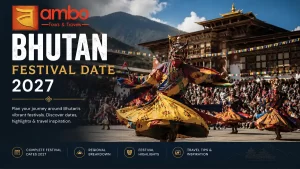
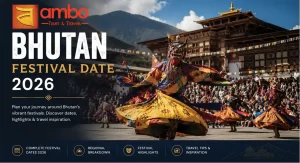
A Tshechu is a religious festival held annually in dzongs across Bhutan, marking the anniversary of events in the life of Guru Rinpoche — the Indian saint who brought Buddhism to Bhutan in the 8th century. Each Tshechu runs for three to five days and includes sacred masked dances (Cham), folk performances, and the display of a Thongdrel — a vast embroidered religious scroll — at dawn on the final day.
The Tshechu is not a performance staged for visitors. It is a religious event at which the Bhutanese community gathers to receive blessings, earn spiritual merit, and affirm their shared faith. Visitors are welcome to attend, but this context matters for how you engage with what you see.
Major Annual Festivals
Paro Tshechu — March/April, at Rinpung Dzong. The most internationally attended festival. Punakha Drubchen — February/March, a dramatic re-enactment at Punakha Dzong. Thimphu Tshechu — September/October, the largest festival in western Bhutan. Wangdue Tshechu — September/October. Jambay Lhakhang Drup — October/November, Bumthang. Ancient and spiritually significant. Black-Necked Crane Festival — November, Phobjikha Valley.
Festival dates follow the lunar calendar and shift each year. Confirm exact dates for your travel year before booking.
How to Attend Respectfully
Dress modestly and cover shoulders and knees. Move around the edges of the gathering rather than pushing through crowds to reach the front. If you are photographing, be aware of your presence — crouching, stepping back, and moving quietly are all gestures of respect. Do not block the view of local worshippers.
Your guide will position you appropriately and explain what each dance represents as the festival unfolds.
Food and Drink in Bhutan
Ema Datshi — The National Dish
If Bhutan has a single defining dish, it is ema datshi — chilli peppers cooked with soft cheese in a rich, spicy sauce served over red rice. The chilli in Bhutan is not a spice; it is a vegetable, treated as the main ingredient rather than a seasoning. The heat level is genuine.
Most packages include breakfast and dinner, and meals are typically a combination of Bhutanese and continental dishes, calibrated to the preferences of international visitors. Tell your guide or operator if you have a strong preference for local food — many visitors find Bhutanese cuisine one of the most distinctive and enjoyable aspects of their trip.
Other Staples
Red rice — slightly nutty, less starchy than white rice, and grown in Bhutan’s river valleys. Jasha maru — spiced minced chicken, a popular comfort food. Phaksha paa — pork cooked with dried chillies and radishes. Suja — butter tea, made with tea, yak butter, and salt. An acquired taste and a cultural staple. Ara — a traditional spirit distilled from rice, wheat, or maize. Offered in homes as a gesture of hospitality.
Dietary Requirements
Vegetarian and vegan options are available throughout western Bhutan and in most guesthouses. Buddhist dietary principles mean that meat consumption varies — some communities eat meat freely, others observe restrictions on certain days. Inform your operator of any dietary requirements and they will ensure your meals are suitable.
Language
Dzongkha
The official language of Bhutan is Dzongkha, a Tibetan-derived language spoken primarily in the western districts. It is the language of government, education, and formal communication.
Bhutan also has a significant number of regional languages and dialects — Sharchopkha in the east, Nepali in the south, and several valley-specific languages in central Bhutan. The linguistic diversity of this small country is remarkable.
English
English is the medium of instruction in Bhutanese schools and is widely spoken by educated Bhutanese, particularly in western Bhutan and among younger generations. Menus, signs, and official communications are typically bilingual in Dzongkha and English. You will have no practical language barrier with your guide.
A Few Useful Phrases
- Kuzu Zangpo — Hello / Greetings (the standard greeting, used at any time of day)
- Kadrin Chhe — Thank you
Attempting even a word of Dzongkha is received warmly by Bhutanese people. It costs nothing and earns a great deal.
Social Customs and Daily Life
Hospitality
Bhutanese hospitality is genuine and unhurried. If you are invited into a home — which your guide may arrange — it is customary to accept any offered food or drink with both hands or with the right hand supported by the left at the wrist. Refusing outright can be interpreted as dismissiveness, though a gentle declining gesture after a token acceptance is understood.
Photography of People
Ask before photographing individuals, particularly monks, elderly people, and anyone in a formal or ceremonial setting. Most people are happy to be photographed with advance permission. Photographing someone from a distance without acknowledgement is considered impolite.
Environmental Respect
Bhutan’s environmental record is extraordinary — over 72% of the country remains under forest cover, it is constitutionally mandated to keep at least 60% forested in perpetuity, and it is the world’s only carbon-negative country. Visitors are expected to contribute to this rather than undermine it. Do not litter, do not pick flowers or plants in protected areas, and follow your guide’s instructions in national parks and wildlife sanctuaries.
Tipping
Tipping is not a cultural tradition in Bhutan in the way it is in some countries, but it is appreciated as a gesture of satisfaction. A tip for your guide at the end of your trip — typically USD 10–15 per day for a couple, scaled by group size — is a genuine acknowledgement of their work. Drivers are similarly appreciated with a smaller tip.
Frequently Asked Questions
Is Bhutan culturally conservative?
Bhutan is socially traditional in many respects — religious practice is central to public life, dress standards exist in official contexts, and hierarchies of age and spiritual seniority are respected. It is not, however, unwelcoming or rigid toward visitors. Bhutanese people are warm, curious about the world, and accustomed to international guests. Respectful engagement is reciprocated generously.
Can I visit monasteries and Dzongs freely?
Most major dzongs and monasteries are open to visitors accompanied by a licensed guide. Some inner sanctums are restricted. Photography rules vary by site. Your guide manages access and advises on restrictions as they apply at each location.
What should I do if I witness a private ceremony?
Observe quietly from a respectful distance. Do not insert yourself into a ceremony that is not open to visitors, and follow your guide’s lead on whether and how to engage. Most ceremonial activity is not private in the exclusive sense — Bhutanese religious life is generally lived in shared space — but your presence should be that of a respectful witness, not a participant or photographer pressing for access.
Travel With Understanding
The depth of your experience in Bhutan is directly proportional to the depth of your engagement with its culture. The more you understand before you arrive, the more you will perceive and appreciate once you are here.
Our guides are Bhutanese nationals who have grown up within this culture. They bring it alive not through rehearsed commentary but through personal knowledge and genuine pride in what they are sharing.
Plan Your Journey with Ambo Tours →
Written by the Ambo Tours team, Thimphu, Bhutan. DOT License No. 1053330.
Ready to Experience Bhutan?
Tell us your dates and interests — our team in Thimphu will craft a personalised itinerary within 24 hours, at no cost.