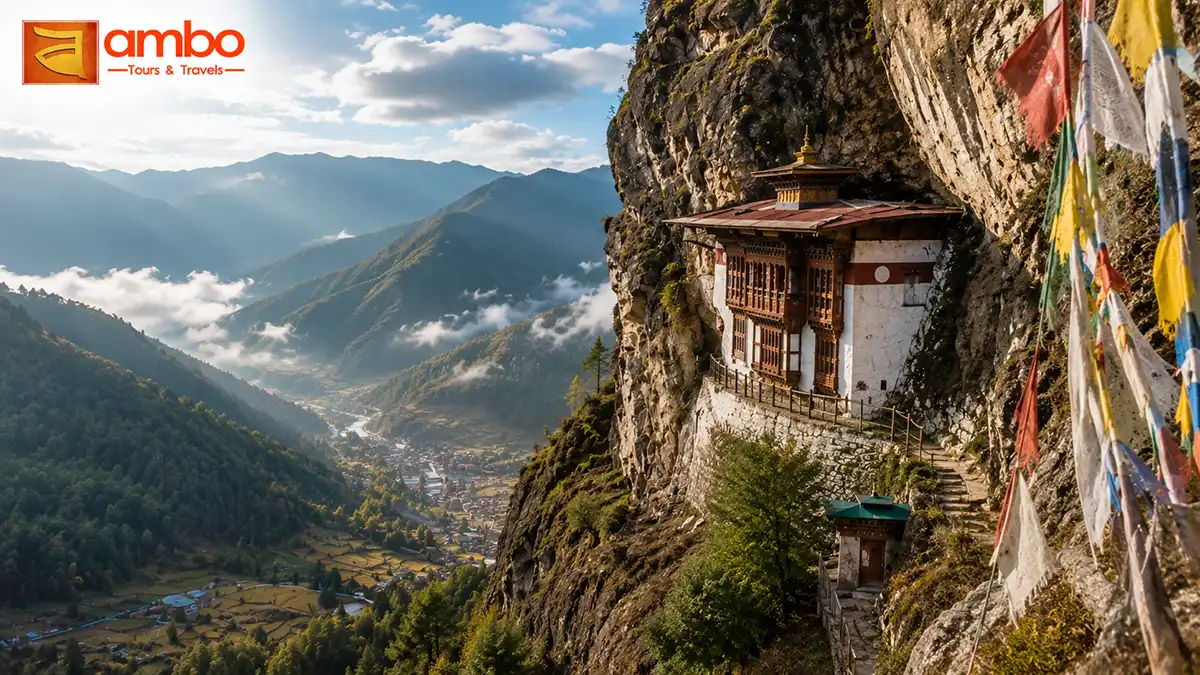
Juneydrak — also spelled Juneydrag or Jungney Drak — clings to a near-vertical cliff face above Katsho village in Haa Valley, earning it a local nickname that says everything about the setting: the Tiger’s Nest of Haa. It’s smaller and far less visited than Paro’s famous Taktsang Monastery, but it carries an equally serious weight of legend, tied to two of the most important figures in Himalayan Buddhist history — Guru Rinpoche himself, and an 11th-century female tantric master whose footprint is said to remain pressed into the rock.
Where Juneydrak Is and How to Reach It
The hike begins at Katsho village, about a kilometre north of Haa town, just before the main bridge — a paved road branches east for roughly a kilometre to reach the village. From Katsho, the trail follows a stream past the Chorten Dangrim mani wall (a wall lined with prayer wheels), then crosses a two-legged archway chorten known as a khonying. From there it climbs through a rhododendron forest before a marked junction sends you up toward the hermitage itself.
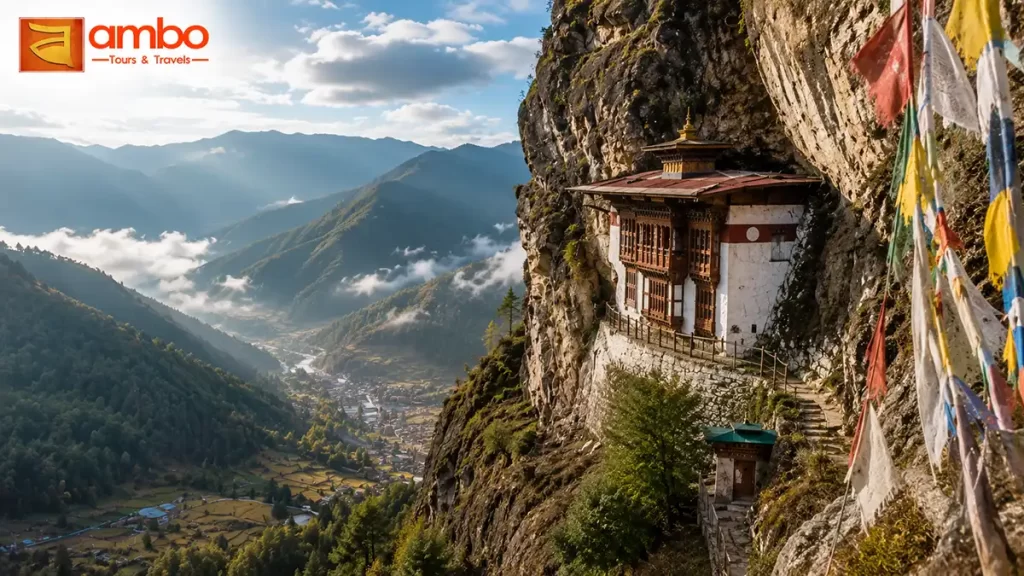
Depending on the exact route and pace, the hike from Katsho takes anywhere from 20 to 40 minutes each way — short by Bhutanese hiking standards, but steep enough near the top that it earns its comparison to Tiger’s Nest. The final approach, where wooden ladders once led up to the hermitage, has since been improved with concrete steps and a guide rope, though the exposure along the cliff edge still makes for a genuinely dramatic final stretch. It’s not recommended in the rain, and isn’t a good fit for anyone uneasy with heights.
A caretaker, or in some accounts a small community of nuns, lives near the hermitage and holds the keys to the lhakhang (temple) itself — you’ll need to find them to get inside rather than simply arriving and walking in.
The Legend of Guru Rinpoche and the Demon
Juneydrak’s spiritual significance traces back to Guru Rinpoche (Padmasambhava), the 8th-century tantric master credited with establishing Buddhism across Bhutan. Local tradition holds that Guru Rinpoche subdued a demon at this exact cliffside site, and that physical impressions left in the rock — footprints and handprints among them — are the lasting evidence of that struggle. This is the same category of legend attached to many of Bhutan’s cliffside monasteries, Tiger’s Nest included, where sacred sites are understood not just as places of worship but as locations where the landscape itself bears the marks of a spiritual victory.
Machig Labdrön’s Footprint
Juneydrak’s second, equally significant claim is a footprint said to belong to Machig Labdrön (1055–1149), one of the most important female figures in Tibetan Buddhist history. She’s credited with founding and perfecting the Chöd practice — a meditation ritual in which the practitioner visualises the ritual dismemberment and offering of their own body, a technique aimed at the complete dissolution of ego and attachment. Machig Labdrön remains one of the few women to found her own lineage within Tibetan Buddhism, and a site holding a physical trace of her practice is rare enough to draw pilgrims specifically for that reason, separate from the Guru Rinpoche connection.
What the Hike Is Actually Like
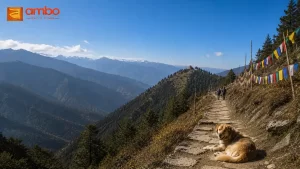
This is a compact, atmospheric hike rather than an endurance test — the appeal is concentrated rather than drawn out. Expect a stream crossing, a walk through a genuinely pretty rhododendron forest (best in spring bloom), a couple of traditional chorten structures worth pausing at, and then a short, steep, slightly exposed final climb to the hermitage itself. Many visitors continue past Juneydrak to Katsho Goemba, a short distance further along the ridge, which offers wide views back down over Katsho village and houses a small collection of antique thangkas worth a look inside.
Some longer route variants exist too — it’s possible to approach from Wangtsa village instead of Katsho, joining the main trail near the same Chorten Dangrim mani wall, in which case you’re looking at roughly 2.5 hours rather than 20–40 minutes. Most travelers stick with the shorter Katsho approach unless they’re specifically after a longer day on the trail.
For travelers who want a full day rather than a short outing, Juneydrak and Katsho Goemba both sit along the longer Haa Panorama Trail — an 11km, roughly 6-hour route running from Yangthang Monastery to Wangtsa village through pine forest, with the best views in the valley of all three Meri Puensum peaks along the way. It’s a natural extension for anyone who’s already done the shorter Meri Puensum hike and wants to see this side of Haa Valley in more depth.
Practical Tips
- Wear grippy footwear — the final approach involves steps and an exposed cliff edge, and can be slick after rain.
- Avoid the hike entirely in wet weather; the exposed final stretch is not worth the risk.
- Bring a small offering or be prepared for a modest donation if the caretaker opens the lhakhang for you.
- Combine this with Katsho Goemba, a short extension along the same ridge, for a fuller half-day out.
- A licensed Bhutanese guide is mandatory for all hikes in Bhutan, and is especially useful here for locating the caretaker and navigating the marked trail junctions.
Frequently Asked Questions
Why is Juneydrak called the “Tiger’s Nest of Haa”?
Juneydrak clings to a near-vertical cliff face in a dramatic setting that closely echoes Paro’s famous Taktsang (Tiger’s Nest) Monastery, though on a smaller scale and with far fewer visitors — hence the local nickname.
How long is the hike to Juneydrak Hermitage?
From Katsho village, the hike takes roughly 20 to 40 minutes each way, depending on pace and exact route. A longer variant from Wangtsa village takes around 2.5 hours.
What is the significance of Juneydrak Hermitage?
Juneydrak is linked to two major figures in Himalayan Buddhist history: Guru Rinpoche, said to have subdued a demon at the site, and Machig Labdrön, the 11th-century female tantric master credited with founding the Chöd practice, whose footprint is said to remain in the rock.
Is the Juneydrak hike difficult?
The approach through the forest is moderate, but the final stretch to the hermitage is steep and exposed along a cliff edge, aided by concrete steps and a guide rope. It’s not recommended in wet weather or for anyone uneasy with heights.
Explore more of Bhutan’s hidden trails in our complete guide to Bhutan’s best hiking trails and hidden monastery walks.
Ready to Experience Bhutan?
Tell us your dates and interests — our team in Thimphu will craft a personalised itinerary within 24 hours, at no cost.