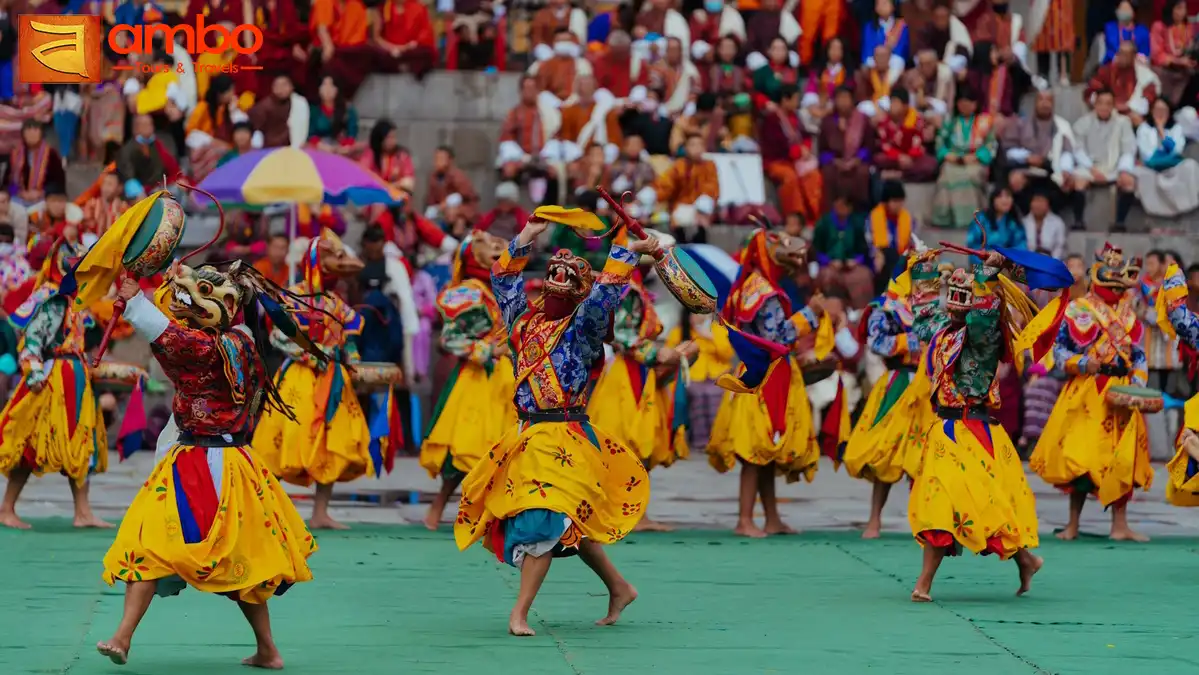
Punakha Tshechu Festival Tour — Sacred Cham Dances at Punakha Dzong
Paro · Punakha · Phobjikha · Thimphu
Tour Information
- Punakha Tshechu — sacred Cham dances at Punakha Dzong with the mustard-flower valley as backdrop
- Punakha Dzong (est. 1637) — the most beautiful dzong in Bhutan at the river confluence
- Mustard flower season — late February and March when the Punakha valley turns brilliant yellow
- Tiger's Nest hike on Day 2 — a full dedicated day before the festival begins
- Chimi Lhakhang — 15th-century temple of the Divine Madman through golden paddy fields
- Phobjikha Valley — black-necked crane winter sanctuary and Gangtey Gompa
- Thimphu cultural programme — Memorial Chorten, Zorig Chusum, Tashichhodzong
- Dochula Pass (3,100m) crossed twice — morning and evening lighting both exceptional
- Fully private — guide, vehicle and itinerary exclusively yours
The Punakha Tshechu is one of the most visually spectacular festivals in Bhutan — sacred Cham masked dances performed over three days at Punakha Dzong, the great 17th-century fortress-monastery built at the confluence of the Pho Chhu and Mo Chhu rivers. The festival honours Guru Rinpoche and commemorates the legacy of Zhabdrung Ngawang Namgyal, the saint who unified Bhutan. Held in late February or early March, it falls during the mustard flower season when the Punakha valley floor turns brilliant yellow — one of the most photographed landscapes in Bhutan.
This 9-day tour arrives in Paro for Tiger's Nest on Day 2, drives to Punakha on Day 3 via Dochula Pass, dedicates Day 4 entirely to the festival, then continues to Phobjikha Valley and Gangtey before returning through Thimphu for two days of cultural sightseeing.
The festival setting is exceptional — Punakha Dzong rising from the river confluence with prayer flags and the valley in mustard bloom behind the dancers. No other festival in Bhutan combines this landscape with this architectural backdrop. Operated by Ambo Tours, DOT Licence No. 1053330, Thimphu.
Tour Pricing
9 Days Bhutan Journey — Cost
All prices in USD per personCost includes Sustainable Development Fee (SDF) of US $100 per person per night and Bhutan Visa Fee of US $40 per person. Entrance fees for monuments and festival visits are paid separately.
Detailed Itinerary
Touch down in Paro and feel the magic of Bhutan travel begin the moment your plane weaves between emerald valleys and snow-dusted peaks — the approach to Paro International Airport is itself one of the world's great aviation spectacles. A warm representative from your Bhutan tour package welcomes you on arrival, setting the tone for an unforgettable Bhutan holiday.
After a leisurely lunch, your Bhutan sightseeing adventure begins with a visit to the National Museum (Ta Dzong), perched above the valley like a sentinel of history. Its circular walls shelter ancient religious relics, thangka paintings, and priceless handicrafts that offer an extraordinary window into Bhutan's Buddhist culture. This is the perfect cultural orientation for first-time visitors.
- Explore the National Museum, Ta Dzong — religious art, armour, and royal artifacts
- Visit Rinpung Dzong, one of Bhutan's most iconic fortress-monasteries, and admire the celebrated painting of the saint Milarepa
- Stroll across the traditional cantilever wooden bridge spanning the Paro Chu river — a living piece of Bhutan's cultural heritage
Practical tip: Dress in layers — Paro sits at around 2,200 metres and evenings can be cool year-round. Lightweight, breathable fabrics work best for daytime sightseeing. The best time to visit Bhutan for clear skies is spring (March–May) or autumn (September–November).
Local flavour: Tonight, try Ema Datshi — Bhutan's beloved national dish of fiery chillies cooked in a rich cheese sauce. It's humble, warming, and unforgettable. Tomorrow, lace up your boots — one of the most legendary hikes in all of Bhutan tourism awaits.
No Bhutan itinerary is complete without the pilgrimage to Taktsang Monastery — the legendary Tiger's Nest — and today that iconic moment is yours. Rising dramatically from a sheer granite cliff face 900 metres above the Paro valley, this sacred monastery is the defining image of Bhutan tourism and a once-in-a-lifetime sight that never fails to take the breath away.
The trail begins through fragrant pine forest, gradually opening to sweeping panoramas of the valley below. The 1.5 to 2-hour uphill hike is broad and well-maintained, suitable for moderately fit travellers. Legend tells that the great Guru Rinpoche (Padmasambhava) flew to this sacred site on the back of a tigress in the 8th century, bringing Bhutan's Buddhist culture to these mountains. Pause at the traditional teahouse midway for tea and snacks before making the final ascent.
- Hike to Taktsang Monastery (Tiger's Nest) — one of the most sacred Bhutan monastery sites on earth
- Enjoy valley and Bhutan mountain views from the midpoint teahouse
- Afternoon visit to the partially reconstructed Drukgyel Dzong, built in 1644 to commemorate victory over Tibetan invaders
Practical tip: Start the hike early (by 8am) to avoid afternoon crowds and catch the best light on the monastery facade. Wear sturdy shoes, carry water, and bring a light rain jacket. Altitude is around 3,120 metres at the monastery — take it slow if you're acclimatising.
Cultural highlight: On clear days, the sacred Mount Jomolhari (7,314m) looms magnificently behind Drukgyel Dzong — a breathtaking pairing of ancient human endeavour and raw Himalayan grandeur. Tomorrow, the road winds over a dramatic high-altitude pass toward the ancient capital of Punakha.
This morning's drive from Paro to Punakha is one of the great road journeys of any Bhutan trip — a cinematic traverse of mountain passes, rhododendron forests, and rice-terraced river valleys that distils everything extraordinary about the Bhutan landscape. Settle in as your vehicle climbs toward the clouds.
The highlight of the journey is the celebrated Dochula Pass (3,100 metres), crowned by 108 memorial chortens (stupas) arranged in concentric circles. On a clear morning, the panorama of Himalayan peaks stretching across the northern horizon — including Bhutan's highest summits — is extraordinary. In late April and early May, the surrounding hillsides explode in rhododendron blooms, a riot of red, pink, and white that makes this one of the most spectacular drives in all of Bhutan sightseeing.
- Stop at Dochula Pass for panoramic Himalayan views and the iconic 108 Druk Wangyal Chortens
- Descend into the warm subtropical Punakha valley, a dramatic contrast to the highlands
- Afternoon visit to the magnificent Punakha Dzong — the 'Palace of Great Happiness' — built in 1637 at the confluence of the Mo Chu and Pho Chu rivers
Practical tip: Carry a warm layer for the pass (it can be cold and windy even in summer) and sunscreen — the UV at altitude is intense. Punakha sits at just 1,200 metres, so expect noticeably warmer temperatures upon arrival — a welcome change.
Cultural highlight: Punakha Dzong is a masterpiece of traditional Bhutanese architecture — its three-storey main temple features four intricately embossed entrance pillars of cypress, decorated in gold and silver. It was here that Bhutan's first king was crowned in 1907. Tonight, savour Phaksha Paa, a hearty pork and chilli stew beloved in the Punakha region. Tomorrow, the festival grounds come alive.
Punakha awakens in festive splendour today as the Punakha Tsechu — one of Bhutan's most spiritually charged festivals — unfolds within the magnificent courtyard of Punakha Dzong. Locals dressed in their finest gho and kira (traditional dress) pour in from surrounding villages, having walked for hours to attend this sacred gathering. This is Bhutan cultural tour experiences at their most vivid and moving.
Introduced in 2005 to preserve Bhutan's Buddhist culture and honour the legacy of Zhabdrung Ngawang Namgyal — the visionary leader who unified Bhutan — the Punakha Tsechu features elaborate cham masked dances performed by monks in brilliant brocade robes. The performances are accompanied by ancient chants and the resonant thunder of long horns, and each dance tells a moral story where good triumphs over evil — a joyful, colourful expression of Bhutan's Buddhist philosophy.
- Morning: Witness Punakha Tsechu masked dances at Punakha Dzong
- Photograph brilliantly costumed monks and the incredible Dzong backdrop
- Afternoon: Short walk to Chimi Lhakhang — the temple of the 'Divine Madman' Drukpa Kuenley, celebrated as a symbol of fertility and unconventional wisdom
Practical tip: Arrive at the festival grounds early to secure a good viewing position. Dress respectfully — shoulders and knees covered — and always ask before photographing monks or worshippers. This is a Bhutan hidden gem experience for those lucky enough to time their visit correctly.
Local flavour: Join locals for Ara — traditional Bhutanese rice wine — often shared generously during festival days. It's a beautiful expression of the warmth and community spirit that defines Bhutan travel. Tomorrow, the journey continues into the wild glacial landscapes of the Phobjikha Valley.
Leave the warm lowlands of Punakha behind and ascend into one of Bhutan's most pristine and captivating landscapes — the bowl-shaped glacial expanse of Phobjikha Valley. The winding mountain road threads through ancient oak groves and rhododendron forests before cresting a high pass and revealing the valley in its full, sweeping glory. Few Bhutan landscapes feel quite this untouched.
Sitting at around 3,000 metres, Phobjikha is one of Bhutan's rare glacial valleys and a designated wildlife sanctuary — most famously the wintering ground of the endangered Black-Necked Crane, which migrates here from the Tibetan plateau between November and March. Watching these elegant birds glide across the marsh at dusk is one of the most magical wildlife moments available on any Bhutan tour package.
- Drive through Wangduephodrang market town en route — a glimpse of everyday Bhutan life
- Visit the Phobjikha Crane Sanctuary to observe Black-Necked Cranes in the wild (November to March)
- Explore Gangtey Gompa (Monastery), one of Bhutan's oldest and most architecturally striking monasteries, dating to the 16th century
Practical tip: The valley can be cold and misty, especially at dawn and dusk — pack a warm jacket, thermals, and waterproof outer layers. Binoculars are highly recommended for crane and bird watching. This is a sustainable tourism Bhutan showpiece — stay on marked trails and respect the wildlife habitat.
Local flavour: Warm up with Butter Tea (Suja) — a salty, creamy brew made with yak butter that's an acquired taste but utterly reviving at altitude. Tomorrow, the valley rewards early risers with a tranquil morning walk before the drive back toward Thimphu.
The morning mist still clings to the Phobjikha Valley as you set out for a gentle walk — one of the most peaceful moments in any Bhutan itinerary. This glacial paradise is a Bhutan hidden gem for hikers and nature lovers, and the trail through the valley floor offers close encounters with local life: farmhouses draped in drying chillies, prayer flags whispering in the mountain breeze, and school children embarking on long walks to reach their nearest classroom.
Before departing, revisit the richly renovated Gangtey Monastery in the morning light — its golden rooftops and intricately painted interior feel even more stunning when you have time to linger. A walk down through the village reveals traditional Bhutanese farmhouses and offers genuine insight into rural Bhutan's Buddhist culture and agricultural rhythms.
- Morning valley walk — spot wildlife, prayer wheels, and local village life
- Final visit to Gangtey Monastery for architecture, murals, and panoramic views
- Afternoon drive back to Thimphu, crossing the scenic Dochula Pass once more
Practical tip: Wear comfortable walking shoes for the morning trail — parts of the valley path can be soft and muddy. The drive to Thimphu takes around 4 hours, so an early post-lunch departure is advised to arrive before dark. This is also an ideal opportunity to appreciate how Bhutan tourism balances modernity and tradition along the way.
Local flavour: Pack a local picnic lunch of Khatem (buckwheat pancakes with honey) before you leave the valley — a delicious, hearty staple of the highland communities of Bhutan. Tomorrow, the buzzing capital Thimphu offers a full day of culture, art, and iconic Bhutan sightseeing.
Vibrant, quirky, and unlike any other capital city on earth, Thimphu is the beating heart of modern Bhutan — a city where monks and smartphones coexist, where there are no traffic lights (a white-gloved traffic officer directs cars instead), and where Gross National Happiness (GNH) is written into government policy. A full day here is one of the richest Bhutan cultural tour experiences imaginable.
- Visit the National Memorial Chorten — a spiritual landmark initiated by Bhutan's Third King as a monument to world peace and protection from modernisation's negative forces
- Explore the 12th-century Changangkha Temple, perched above the city with sweeping valley views — a favourite for families seeking blessings for newborns
- See the Drubthob Monastery and the peaceful Zilukha Nunnery housed within
- Visit the Takin Preserve — home to Bhutan's wonderfully peculiar national animal, a beast that looks like a wildebeest had an encounter with a mountain goat
- Tour Tashichhodzong — the 'Fortress of the Glorious Religion', seat of Bhutan's government and the central monk body, rebuilt without plans or nails in the 1960s
Practical tip: If your visit falls on a weekend (Friday to Sunday), don't miss the Thimphu Weekend Market — a sensory feast of fiery chillies, fresh local cheese, dried meats, handicrafts, and household goods that captures everyday Bhutanese life brilliantly. This is one of the best things to do in Bhutan for food lovers.
Local flavour: Try Jasha Maru — a spiced minced chicken curry that's a Thimphu restaurant staple — at one of the city's excellent local eateries. Tomorrow, there's still more to discover before bidding farewell to this extraordinary destination on your Bhutan travel guide checklist.
Your final full day of exploration begins in Thimphu with a deep dive into the creative and intellectual soul of Bhutan — a morning dedicated to arts, crafts, and centuries of preserved knowledge before the gentle drive back to Paro for your last night in this extraordinary kingdom. For those planning their Bhutan trip, this day reveals a side of the country that goes well beyond monastery visits.
- Visit the School for Arts and Crafts (Zorig Chusum) — watch young artisans master all 13 traditional Bhutanese art forms, from thangka painting to weaving, wood carving, and appliqué
- Explore the National Library, housing an extraordinary collection of Bhutanese scriptures and manuscripts dating back to the 8th century
- See the Traditional Paper Factory — witness the ancient art of Daphne bark papermaking, still practised the same way it has been for centuries
- Tour the Folk Heritage Museum — a fascinating replica of a medieval Bhutanese farmhouse that brings everyday historical life vividly to life
Optional: For active travellers, swap one of the museum visits for a morning hike to the ancient Tango or Cheri Monasteries (45 minutes each way) or the longer hike to Phajoding Monastery for sweeping views of the Thimphu valley — a wonderful Bhutan mountain experience to end your cultural immersion.
Practical tip: The late afternoon drive to Paro is one of the most pleasant in Bhutan — a wide valley road lined with weeping willows and rice fields. Arrive in time to explore Paro town at sunset, when the light turns golden over the valley and the dzong glows magnificently. Bhutan travel doesn't get more cinematic than this.
Local flavour: Celebrate your final evening with a traditional Bhutanese hot stone bath (Dotsho) — river stones heated in a fire are dropped into a wooden tub filled with water and medicinal herbs. It's deeply restorative and one of the most uniquely Bhutan holiday experiences you can have. Tomorrow, it's time to carry these memories home.
The final morning of your Bhutan tour package arrives with the quiet, bittersweet feeling that only the most meaningful journeys leave behind. Enjoy a leisurely breakfast at your hotel in Paro, perhaps with one last look at the forested ridgelines and the distant flash of a prayer flag in the morning breeze. Bhutan has a way of settling deeply into the soul — and many who visit once find themselves already planning their return.
Your representative will escort you to Paro International Airport for your onward flight. The departure itself is a spectacle — as your plane banks over the valley, the landscape of terraced fields, ancient dzongs, and Himalayan peaks unfolds below one final time, a breathtaking farewell from this last Shangri-La.
- Enjoy a final hotel breakfast and any last-minute souvenir shopping in Paro town
- Browse Paro's handicraft shops for hand-woven textiles, Daphne paper notebooks, or thangka paintings — all ethically produced and excellent keepsakes
- Transfer to Paro Airport with your Bhutan travel guide representative for a warm send-off
Practical tip: Bhutan's Bhutan visa and Bhutan permit requirements mean all tourism is managed and purposeful — part of the country's commitment to sustainable tourism Bhutan and the philosophy of Gross National Happiness (GNH). It is this deliberate, mindful approach to welcoming visitors that makes every Bhutan holiday feel so unhurried, so genuine, and so deeply nourishing.
Tashi Delek! — May you be well and happy. Until next time, Bhutan waits with its mountains, its monasteries, and its extraordinary grace. Visit Bhutan once, and a part of you will never truly leave.
Included / Excluded
- ✔All meals — breakfast, lunch, and dinner
- ✔Accommodation on twin / double sharing basis (single supplement extra)
- ✔All transportation within the kingdom including airport transfers
- ✔Sustainable Development Fee — Government tax (SDF)
- ✔Bhutan visa fee
- ✔English-speaking private local guide
- ✔Sightseeing as per itinerary
- ✔Bottled water throughout the journey
- ✖International flights to and from Paro (PBH)
- ✖Entrance fees for museums and monuments
- ✖Gratuities for guides and drivers
- ✖Travel insurance premiums
- ✖Payments for services provided on a personal basis
- ✖Cost for any services not mentioned under "Cost Includes"
- ✖Cost incurred due to mishaps, strikes, political unrest, etc.
- ✖Personal expenses — laundry, beverages, or personal services
Ambo Tours & the 1% Club
Every tour we run includes a contribution to a Bhutanese NGO of your choice — at no extra cost to you. We call this the 1% Club: a minimum of 1% of your trip's profit, or Nu 5,000, whichever is higher, donated on every single journey. You choose where it goes.
About the Punakha Tshechu
The Punakha Tshechu is held annually at Punakha Dzong — the great 17th-century fortress-monastery built by Zhabdrung Ngawang Namgyal at the confluence of the Pho Chhu (Father River) and Mo Chhu (Mother River). The festival honours Guru Rinpoche through three days of sacred Cham masked dances, and commemorates the victories of Zhabdrung's forces over Tibetan invaders — making it both a religious ceremony and a celebration of Bhutanese nationhood.
What sets the Punakha Tshechu apart from all other Bhutanese festivals is its setting. The dzong rises directly from the river confluence, its whitewashed walls reflected in the water. The late February and March timing coincides with the mustard flower season when the Punakha valley floor turns brilliant yellow. The combination of sacred dance, extraordinary architecture, and blooming valley is found nowhere else.
The festival also includes a dramatic re-enactment of the defeat of the Tibetan army — the Serda — performed with mock battles and traditional costumes. For the full context of Bhutan's festival tradition, see our complete guide to Bhutan festivals.
Festival Dates & Schedule
The Punakha Tshechu is held annually in late February or early March — exact dates are set by the Bhutanese lunar calendar each year. The festival runs for three days at Punakha Dzong.
This itinerary includes: Day 4 is a full festival day at Punakha Dzong, including the afternoon walk to Chimi Lhakhang after the dances close for the day.
Mustard flower timing: The mustard fields in the Punakha valley are typically in full bloom from mid-February to mid-March — the same window as the festival. This is not guaranteed to overlap perfectly every year as the lunar calendar shifts, but in most years the valley is in bloom during the Tshechu.
Contact our Thimphu team to confirm exact festival dates for your travel year and check availability. Punakha accommodation fills quickly during the festival window. See our Bhutan festival calendar for confirmed dates.
What to Expect
Festival setting — the Punakha Tshechu is held in the inner courtyard of Punakha Dzong. The courtyard is intimate compared to Paro and Thimphu, giving a closer viewing experience of the dances. Arrive early — by 8am at the latest — to secure a good position. Your guide will manage positioning for each day's main dances.
The Serda re-enactment — one of the unique elements of the Punakha Tshechu is the Serda, a dramatic re-enactment of the victory of Zhabdrung's forces over Tibetan invaders. Performed with mock battles, traditional weapons, and costumes, it is more theatrical than the purely religious dances and gives important historical context to the festival.
Mustard fields photography — the yellow mustard fields below Punakha Dzong are most accessible from the road between Lobesa and the dzong. Your guide will stop at the best viewpoint on the Day 3 arrival and Day 4 morning. Early morning light is best.
Dress code — covered shoulders and knees required at all times at the dzong and festival. Traditional Bhutanese dress can be rented in Punakha town if desired.
For full cultural preparation see our Bhutan culture and customs guide.
Itinerary Map
The map shows the 9-day route from Paro through Punakha, Phobjikha Valley, Thimphu and back to Paro.
Map coming soon.
Frequently Asked Questions
The Punakha Tshechu is one of Bhutan's most celebrated annual festivals, held at Punakha Dzong each spring. The festival runs for three days with sacred Cham masked dances performed by monks in brocade costumes — honouring Guru Rinpoche and commemorating the legacy of Zhabdrung Ngawang Namgyal, the saint-king who unified Bhutan in the 17th century. The festival setting is exceptional: Punakha Dzong rises from the confluence of the Pho Chhu and Mo Chhu rivers, with the mustard-flower valley floor behind the dancers in yellow bloom.
The Punakha Tshechu is held annually in late February or early March — the exact dates follow the Bhutanese lunar calendar and shift each year. The festival coincides with the mustard flower season in the Punakha valley, when the valley floor turns a brilliant yellow. Contact our Thimphu team with your available travel window and we will confirm the exact dates for your year. See our complete Bhutan festivals guide for the full annual calendar.
The Punakha Tshechu is unique for its setting. The festival is held inside Punakha Dzong — widely regarded as the most beautiful dzong in Bhutan — at the confluence of two sacred rivers. The late February and March timing coincides with the mustard flower season when the entire Punakha valley floor turns yellow. No other festival in Bhutan combines this architectural backdrop, this river setting, and this landscape in bloom simultaneously. The intimacy of the dzong courtyard also gives a closer viewing experience than the larger festivals in Paro and Thimphu.
Possibly — Day 5 visits Phobjikha Valley where the cranes winter from late October to mid-March. The Punakha Tshechu falls in late February or early March, which sits at the very end of the crane season. Numbers are lower than the November-December peak but sightings are still possible. Your guide will advise on current crane presence on the morning of Day 5. Even without cranes, Gangtey Gompa and the valley landscape fully justify the full day.
Yes — Day 2 is dedicated entirely to the Tiger's Nest hike. The 10km round trip takes 4–6 hours and is accessible to most reasonably fit travellers. Starting in Paro before the festival means the hike is completed without time pressure. Start no later than 7:30am. Entrance fee paid at the gate, not included in the tour price.
This tour is timed for the Punakha Tshechu in late February or March — one of the most beautiful times to visit the Punakha valley. Spring in Bhutan also brings rhododendron blooms along the Dochula Pass road and clear mountain visibility before the pre-monsoon haze builds. For a full seasonal guide see our best time to visit Bhutan guide.
Ready to Begin Your Journey?
Our Thimphu team responds within 24 hours. Tell us your dates and we will handle the rest.