Black-Necked Crane Festival Tour — Phobjikha Valley, Bumthang & Beyond
Paro · Thimphu · Punakha · Phobjikha Valley · Bumthang · Trongsa · Wangduephodrang
Tour Information
- Attend the Black-Necked Crane Festival at Gangtey Goenpa, Phobjikha Valley — held annually on November 11th
- Observe Black-Necked Cranes (Trung Trung) feeding and flying across Phobjikha's marshy valley floor
- Hike to Taktsang Monastery (Tiger's Nest) — 900m above Paro Valley through blue pine forest
- Visit Punakha Dzong — the Palace of Great Happiness, built in 1637 at the confluence of two rivers
- Cross Dochula Pass (3,100m) with 108 memorial chortens and panoramic Himalayan views
- Explore Bumthang — Kurjey Lhakhang, Tamshing Lhakhang, Jambay Lhakhang and Jakar Dzong
- Visit Trongsa Dzong — the largest dzong in Bhutan and ancestral seat of the royal dynasty
- Walk Phobjikha Valley nature trails at 3,000m — one of Bhutan's most pristine glacial bowls
- See Gangtey Goenpa — the only Nyingmapa monastery in western Bhutan
- Morning hike to Khamsum Yueley Namgyal Chorten above Punakha's rice fields
- Fully private and inclusive: SDF, visa, licensed guide, transport, accommodation and all meals
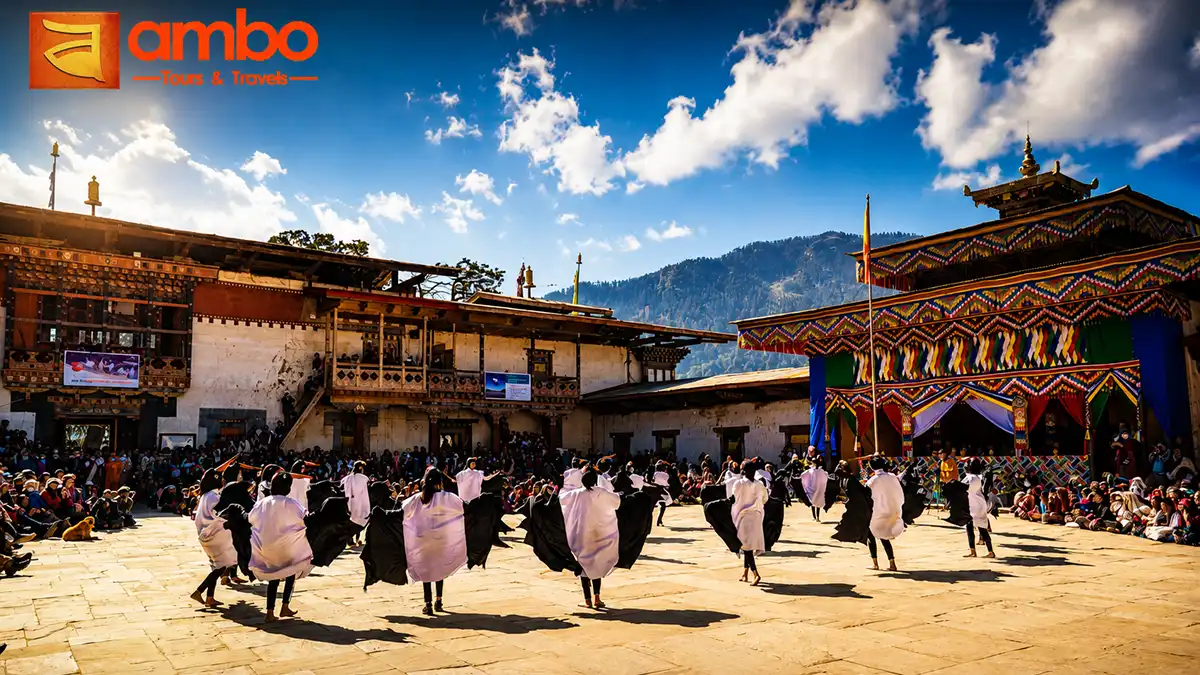
The Black-Necked Crane Festival is one of Bhutan's most intimate and unusual celebrations — held every year on November 11th at the courtyard of Gangtey Goenpa, deep in the glacial bowl of Phobjikha Valley. Local schoolchildren perform crane dances in traditional costume, community stalls fill the monastery grounds, and in the marshy valley below, the cranes themselves — sacred in Bhutan, known as Trung Trung — arrive from the Tibetan plateau for winter.
This 11-day private tour is built around that festival day, but it is far more than a single event. The journey takes you through the full sweep of Bhutan — from the drama of Paro's mountain arrival and Thimphu's capital culture, through the warmth of Punakha's river valley and the high silence of Phobjikha, into the spiritual heartland of Bumthang with its ancient temples and sacred caves, and back through Punakha and Paro for the Tiger's Nest hike before departure.
It is a tour for travellers who want to see Bhutan properly — not just the highlights, but the layers beneath them.
Tour Pricing
11 Days Bhutan Journey — Cost
All prices in USD per personCost includes Sustainable Development Fee (SDF) of US $100 per person per night and Bhutan Visa Fee of US $40 per person. Entrance fees for monuments and festival visits are paid separately.
Detailed Itinerary
Your Bhutan travel adventure begins the moment your plane descends through a corridor of Himalayan giants — the flight into Paro is widely regarded as one of the most breathtaking mountain approaches in the world, a cinematic welcome to the last great Himalayan kingdom. A warm representative from your Bhutan tour package greets you at the airport exit, ready to begin an unforgettable journey.
After a relaxed lunch, the afternoon opens with rich Bhutan sightseeing around Paro's historic valley. Begin at the Ta Dzong Museum, a circular watchtower-turned-museum brimming with religious relics, ancient thangka paintings, royal regalia, and traditional handicrafts — the ideal cultural orientation for your Bhutan holiday.
- Visit Ta Dzong Museum — religious artifacts, royal history, and traditional art
- Explore Rinpung Dzong and admire the iconic painting of the saint Milarepa, master of meditation
- Drive to Thimphu (1.5 hours) following the scenic Pachu River through willow-lined valleys
Practical tip: Paro sits at 2,200 metres — take it easy on arrival and stay well hydrated. Dress in smart, modest layers as you'll be entering religious sites. Upon arrival in Thimphu, your guide will provide a thoughtful orientation on Bhutanese etiquette — a genuinely helpful introduction to Bhutan's Buddhist culture and the customs that make this kingdom so distinctive.
Local flavour: Settle into your Thimphu hotel and try Ema Datshi for dinner — Bhutan's national dish of green chillies and soft cheese, fiery and deeply comforting. Tomorrow, the capital reveals its many layers in a full day of cultural discovery.
Thimphu is the world's only capital city without a traffic light — a fact that perfectly encapsulates the gentle, unhurried spirit of Bhutan tourism. Once a quiet river valley village, it has blossomed into a vibrant yet deeply traditional city where Gross National Happiness (GNH) is national policy and monks share the streets with students and civil servants in traditional dress.
Today's Bhutan cultural tour begins at the National Memorial Chorten, one of the most recognisable landmarks in the kingdom, completed by the Royal Queen Mother as a memorial stupa honouring the Third King who passed away in 1972. Elderly devotees circle the chorten in a ceaseless rhythm of prayer and devotion — a deeply moving scene at any hour of the day.
- Visit the National Memorial Chorten — a monument to world peace and Bhutan's Buddhist culture
- Explore the 12th-century Changangkha Temple, perched above the city with sweeping valley views
- See the peaceful Zilukha Nunnery at Drubthob Monastery
- Visit the Takin Preserve — home to Bhutan's wonderfully bizarre national animal
- Tour Tashichhodzong — the 'Fortress of the Glorious Religion', seat of government and the central monk body, rebuilt in the 1960s without plans or nails
Practical tip: Dress respectfully for all temple and dzong visits — shoulders and knees covered, shoes removed at entrances. If your visit falls on a weekend, the Thimphu Weekend Market (Friday to Sunday) is unmissable — a kaleidoscope of chillies, fresh cheese, dried meats, and handicrafts that captures everyday Bhutanese life perfectly. This is one of the best things to do in Bhutan for those who love food and culture.
Local flavour: For lunch, try Jasha Maru — a warmly spiced minced chicken curry served with red rice, a staple of Thimphu's local restaurants and a quintessential taste of Bhutan. Tomorrow, the road climbs into the clouds over the legendary Dochula Pass toward the ancient royal capital of Punakha.
Few drives in the world match the drama of the route from Thimphu to Punakha — a journey that climbs through pine and rhododendron forest to the cloud-swept heights of Dochula Pass (3,100 metres) before plunging into the warm subtropical embrace of the Punakha valley. This is Bhutan landscape at its most theatrical, and a highlight of any Bhutan itinerary.
At the pass, 108 memorial chortens (stupas) stand in concentric circles against a panorama of Himalayan peaks — on a clear morning, it is genuinely one of the most beautiful sights in all of Bhutan tourism. In late April and early May, the surrounding forests erupt in rhododendron blooms of red, pink, and white, transforming the mountainside into a painter's dream.
- Stop at Dochula Pass for the iconic 108 Druk Wangyal Chortens and Himalayan panoramas
- Visit the magnificent Punakha Dzong — the 'Palace of Great Happiness', built in 1637 at the confluence of the Mo Chu and Pho Chu rivers
- Afternoon walk to Chimi Lhakhang — the temple of the 'Divine Madman' Drukpa Kuenley, a beloved fertility shrine reached through a trail of golden paddy fields
Practical tip: Carry a warm layer for Dochula Pass — even in summer, the pass can be cold and misty. Punakha at 1,200 metres is dramatically warmer, so a light change of clothes is handy. The walk to Chimi Lhakhang takes about 20 minutes each way through picturesque farmland — wear comfortable shoes.
Local flavour: Punakha Dzong's three-storey main temple, with its four intricately embossed cypress pillars decorated in gold and silver, is where Bhutan's first king was crowned in 1907 — history you can feel in the stone beneath your feet. Tonight, warm up with Phaksha Paa, a hearty pork and red chilli stew beloved in the Punakha region. Tomorrow, the journey heads into one of Bhutan's wildest and most beautiful glacial valleys.
This morning's drive leads first into the bustling market town of Wangduephodrang, where a dramatic fortress-monastery commands the confluence of two rivers from its rocky spur — a commanding sight that encapsulates the military genius of ancient Bhutanese architecture. This is Bhutan's Buddhist culture and strategic history written in stone, 385 years old and still magnificent.
- Visit Wangduephodrang Dzong (built 1639) — one of Bhutan's most strategically positioned fortress-monasteries
- Drive through oak and rhododendron forests over a high mountain pass
- Arrive in the sweeping glacial bowl of Phobjikha Valley — one of the most pristine Bhutan landscapes in the kingdom
- Visit Gangtey Goempa — the only Nyingmapa monastery in western Bhutan, richly decorated and architecturally outstanding
- Explore the marshy valley floor to spot the legendary Black-Necked Cranes (November to March)
Practical tip: Phobjikha sits at around 3,000 metres — pack warm layers, thermals, and a waterproof jacket as the valley can be cold and misty at any time of year, especially at dawn and dusk when the cranes are most active. Binoculars are essential for wildlife watching. Of only approximately 1,600 Black-Necked Cranes believed to exist in the world, some 400–500 winter here — making this one of the most significant sustainable tourism Bhutan wildlife sites on the planet.
Local flavour: The Black-Necked Crane — known in Bhutan as Trung Trung — is woven into Bhutanese folklore, song, and legend. Their annual arrival in November is celebrated as a community event, and their graceful presence across the marshy valley floor is utterly spellbinding. Tonight, warm your hands on a bowl of Butter Tea (Suja) — salty, creamy, and reviving at altitude. Tomorrow, the valley comes alive with one of Bhutan's most joyful community festivals.
Phobjikha Valley transforms today into a stage of colour, dance, and community spirit as the beloved Black-Necked Crane Festival unfolds — one of the most joyful and genuine cultural celebrations in all of Bhutan tourism, and a Bhutan hidden gem that relatively few international travellers are fortunate enough to witness.
Organised by the local community, the festival is a heartfelt tribute to these sacred birds and the valley they call home each winter. Students perform the mesmerising crane dance, dressed in flowing white costumes that mimic the birds' elegant movements. Local stalls overflow with handmade treasures — yak tail dusters, butter tea cups, turquoise jewellery, and traditional Bhutanese handicrafts — making it one of the most authentic things to do in Bhutan for culture and craft lovers alike.
- Watch the enchanting crane dance performed by local schoolchildren in traditional costume
- Browse community stalls for handcrafted souvenirs and local produce
- Visit the Black-Necked Crane Information Centre to learn about conservation efforts
- Explore the network of nature trails winding through the valley's marshy bottomlands
- Observe Black-Necked Cranes feeding and flying against the backdrop of the surrounding hills
Practical tip: The festival typically takes place in November to coincide with the cranes' arrival — timing your Bhutan trip around this event is one of the most rewarding decisions you can make. Dress warmly, bring good walking shoes for the nature trails, and carry a camera with a zoom lens for crane photography at distance.
Local flavour: Share a cup of Chang — traditional Bhutanese barley beer, mild and slightly cloudy — with locals at the festival stalls. It's a wonderful expression of the communal generosity that defines Bhutan's Buddhist culture. Tomorrow, the road stretches east toward the spiritual heartland of Bumthang, crossing mountain passes and ancient chortens along the way.
Today is one of the great driving days of any Bhutan itinerary — a full-day traverse of central Bhutan's mountain spine, crossing high passes, threading through ancient forests, and stopping at some of the most historically significant sites in the kingdom. The reward at journey's end is Bumthang, the spiritual and historical heartland of Bhutan — a valley of barley fields, apple groves, and centuries-old temples that feels like the soul of the country made visible.
- Cross the dramatic Pele La Pass (3,420m) on the Black Mountain range — panoramic Bhutan mountain views on clear days
- Stop at the ornate Chendebji Chorten, an 18th-century stupa built in unusual Tibetan style with painted eyes facing all four directions
- Visit the monumental Trongsa Dzong — the largest dzong in Bhutan, ancestral home of the royal dynasty, with 22 temples within its complex
- Explore the Ta Dzong Museum in Trongsa, housing royal family artifacts and traditional armour
- Visit the Chummey Weavers' Workshop in Bumthang — see the famous Mathra wool textiles being crafted by hand
Practical tip: This is a long driving day — wear comfortable clothes, bring snacks, and take the mountain passes slowly if you feel altitude effects. Trongsa Dzong sits above a spectacular canyon; the view from its walls stretches for miles across the Bhutan landscape. Bumthang valley sits at around 2,600 metres — evenings are cool year-round.
Local flavour: Bumthang is famous for its organic buckwheat — try Khatem (buckwheat pancakes with honey) at your lodge tonight, made with grain grown in the surrounding fields. Bumthang is also associated with Guru Rinpoche (Padmasambhava) — tomorrow, you'll walk in the footsteps of this legendary figure at some of Bhutan's oldest and most sacred sites.
Bumthang is where Bhutan's Buddhist culture runs deepest — a valley of extraordinary temples, medieval palaces, and sacred meditation caves that have drawn pilgrims for over a thousand years. A full day here is the most spiritually rich Bhutan cultural tour experience in the entire kingdom, and one of the defining reasons travellers return to visit Bhutan again and again.
- Visit Jakar Dzong (the 'Dzong of the White Bird'), the administrative and religious heart of Bumthang, offering sweeping views across the valley
- Explore Tamshing Lhakhang (founded 1501) — one of Bhutan's most important Nyingmapa temples, with remarkable ancient Buddhist wall paintings and the famous chain-mail coat of Terton Pemalingpa, which visitors may attempt to carry around the inner sanctuary
- Visit Kurjey Lhakhang — one of the most sacred Bhutan monastery sites in the kingdom, where Guru Rinpoche himself meditated in a cave that is now enshrined within the temple complex
- Explore Jambay Lhakhang, one of Bhutan's oldest temples, erected by Tibetan king Songtsen Gampo in the 7th century — among the very first Buddhist temples built in the Himalayan region
Practical tip: Begin your temple circuit early to avoid any afternoon haze. Dress respectfully at all sites — Kurjey Lhakhang and Jambay Lhakhang are active pilgrimage sites and deeply sacred to Bhutanese Buddhists. Photography rules vary; always ask your guide before shooting inside temple interiors.
Local flavour: Bumthang produces Bhutan's only craft beer — the famous Red Panda Beer, brewed at the Swiss-founded Bumthang Brewery. A glass on your lodge terrace with the valley spread before you is one of the most relaxed and memorable moments of any Bhutan trip. Tomorrow, the long road turns westward again, back toward Punakha via the high passes of central Bhutan.
The return journey westward from Bumthang to Punakha is a full-day mountain odyssey — one of those rare travel days where the drive itself is as memorable as the destination. The road climbs over the Kiki La and Yo-Tong La passes, threads through dense coniferous forests, and gradually softens into the warmer, terraced river valleys of central Bhutan. This is the Bhutan landscape in its full, unhurried glory.
- Drive over Yo-Tong La Pass (3,400m) with views into deep forested valleys
- Short break and refreshments in Trongsa town
- Lunch stop at the beautiful Chendebji Chorten — a serene riverside picnic beside one of central Bhutan's most unusual landmarks
- Cross the high Pele La Pass (3,420m) and descend toward the warm subtropical Punakha valley
Practical tip: This is a long, winding mountain drive — carry water, light snacks, and motion sickness tablets if needed. The altitude fluctuates significantly throughout the day, so layers are essential. Road conditions in central Bhutan can be variable, particularly after rain — your driver will know the road well, so trust their pace and enjoy the scenery.
Cultural insight: The landscape between Bumthang and Punakha is quintessential Bhutan — farmhouses with painted phallus symbols to ward off evil spirits, prayer flags strung between pine trees, and yak herders moving their animals across high-altitude meadows. This is Bhutan travel beyond the highlights, and it is utterly authentic.
Local flavour: Tonight in Punakha, try Hoentoe — Bumthang's famous buckwheat dumplings stuffed with turnip greens and cheese, a delicious reminder of the eastern valleys you've just left behind. Tomorrow brings one of the most scenic hikes of the entire Bhutan itinerary — high above the river to a breathtaking hilltop chorten.
The morning begins with one of the most rewarding hidden hikes in all of Bhutan sightseeing — a trail from Yabesa village through golden rice fields and up a forested hillside to the gleaming Khamsum Yueley Namgyal Chorten, commissioned by Her Majesty Queen Ashi Tshering Yangdon Wangchuk. Perched on a dramatic hill above the Punakha river, the chorten's gilded rooftop and intricate Nyingmapa paintings create a sense of arriving somewhere truly sacred — a Bhutan hidden gem that rewards every step of the ascent.
- Morning hike to Khamsum Yueley Namgyal Chorten via rice fields and forest trail (approx. 45 minutes each way)
- Enjoy a picnic lunch on the scenic Punakha riverside — one of the most peaceful moments of the entire trip
- Visit Wangduephodrang Dzong perched dramatically at the confluence of two rivers
- Drive to Thimphu for handicraft and souvenir shopping
- Afternoon transfer to Paro for the final overnight
Practical tip: Wear good walking shoes for the morning hike — the trail rises steadily and can be slippery after rain. The views from the chorten over the Punakha valley and the winding river below are extraordinary and well worth the effort. In Thimphu, the government-run handicraft emporiums near the clocktower offer quality-guaranteed textiles, thangkas, and wooden items — excellent for last-minute Bhutan travel souvenirs.
Local flavour: Pick up some Bumthang honey or locally made Daphne paper notebooks in Thimphu's craft stores — beautiful, lightweight gifts that carry the spirit of Bhutan home with you. Tomorrow, the grand finale: the legendary hike to Tiger's Nest, the most iconic Bhutan monastery in the world.
Today is the moment every Bhutan itinerary builds toward — the ascent to Taktsang Monastery, universally known as the Tiger's Nest, and the single most iconic image in all of Bhutan tourism. Clinging to a sheer granite cliff face 900 metres above the Paro valley floor, this sacred monastery seems to defy both gravity and imagination, and standing before it for the first time is an experience that stays with you forever.
The trail winds upward through fragrant blue pine forest, opening gradually to ever more dramatic views of the valley below. The approximately 2-hour hike is broad and well-maintained — a horse can be arranged to the viewpoint for those unable to walk the full trail. Along the way, stop at the traditional teahouse for tea, snacks, and a moment to absorb the jaw-dropping view of the monastery perched impossibly above you.
- Hike to Taktsang Monastery (Tiger's Nest) — the holiest Bhutan monastery site, where Guru Rinpoche meditated in the 8th century
- Pause at the traditional teahouse for refreshments and panoramic valley views
- Afternoon visit to the reconstructed Drukgyel Dzong (built 1644) — with Mount Jomolhari (7,314m) as a stunning backdrop on clear days
- Explore other highlights of the Paro valley on the return drive
Practical tip: Begin the hike no later than 8am to enjoy the monastery in morning light and beat the midday crowds. Wear sturdy, grippy shoes, carry 1–2 litres of water, and bring a light rain jacket. The monastery interior requires removing shoes and is deeply sacred — move quietly and respectfully. This is the pinnacle of any Bhutan trip.
Local flavour: Celebrate tonight in Paro with a traditional Bhutanese hot stone bath (Dotsho) — river stones heated over fire and dropped into a wooden tub of herbal water. It's gloriously restorative after a big hike, and one of the most uniquely Bhutan luxury tour experiences available. Tomorrow, the mountains bid you farewell — but Bhutan has a way of never truly letting go.
The final morning of your Bhutan holiday arrives with the particular tenderness that only the most meaningful journeys leave behind. Enjoy a leisurely breakfast at your Paro hotel, perhaps one last walk through the willow-lined streets of this beautiful valley town, pausing to watch the mist lift from the surrounding ridgelines as prayer flags flutter in the morning breeze. Ten days in Bhutan feels both like a lifetime and not nearly enough.
- Enjoy a final hotel breakfast and any last-minute shopping in Paro town
- Browse Paro's handicraft shops for hand-woven textiles, thangka paintings, or wooden prayer wheels
- Transfer to Paro International Airport for your onward flight
Practical tip: Ensure your Bhutan permit clearance and departure documentation are with your guide the evening before. The departure flight from Paro is as spectacular as the arrival — as the plane climbs above the valley, a final panorama of terraced fields, ancient dzongs, and snow-capped peaks unfolds below, a breathtaking farewell from the last Shangri-La.
Reflection: From the sacred heights of Tiger's Nest to the crane-haunted silence of Phobjikha Valley, from the festival drums of Punakha Dzong to the meditation caves of Bumthang — this Bhutan tour package has delivered the full, extraordinary spectrum of what it means to visit Bhutan. A country that measures its success not in GDP but in Gross National Happiness (GNH) is a country that leaves every thoughtful traveller changed. The principles of sustainable tourism Bhutan practises ensure that this magic endures for generations to come.
Tashi Delek! — May you be well and happy. Until we meet again in these mountains, Bhutan keeps your heart.
Included / Excluded
- ✔All meals — breakfast, lunch, and dinner
- ✔Accommodation on twin / double sharing basis (single supplement extra)
- ✔All transportation within the kingdom including airport transfers
- ✔Sustainable Development Fee — Government tax (SDF)
- ✔Bhutan visa fee
- ✔English-speaking private local guide
- ✔Sightseeing as per itinerary
- ✔Bottled water throughout the journey
- ✖International flights to and from Paro (PBH)
- ✖Entrance fees for museums and monuments
- ✖Gratuities for guides and drivers
- ✖Travel insurance premiums
- ✖Payments for services provided on a personal basis
- ✖Cost for any services not mentioned under "Cost Includes"
- ✖Cost incurred due to mishaps, strikes, political unrest, etc.
- ✖Personal expenses — laundry, beverages, or personal services
Ambo Tours & the 1% Club
Every tour we run includes a contribution to a Bhutanese NGO of your choice — at no extra cost to you. We call this the 1% Club: a minimum of 1% of your trip's profit, or Nu 5,000, whichever is higher, donated on every single journey. You choose where it goes.
About the Black-Necked Crane Festival
The Black-Necked Crane Festival (Thrung Thrung Karmo Tshechu) has been celebrated at Gangtey Goenpa since 1998, when the Royal Society for Protection of Nature established it as a conservation awareness event. What began as a local school programme has grown into one of Bhutan's most distinctive annual celebrations.
On November 11th, the monastery courtyard fills with local schoolchildren performing elaborate crane dances — mimicking the birds' movements in traditional costume, with white robes and painted crane-face masks. Community craft stalls, folk songs, and traditional performances accompany the ceremony. The Black-Necked Crane Information Centre nearby provides context on the birds' migration patterns, biology, and the conservation efforts that have helped their population recover.
The cranes themselves — visible in the valley from late October through February — are the real backdrop. Walking the nature trails of Phobjikha early in the morning, with the mist lifting off the marshes and dozens of cranes feeding in the valley floor, is one of the quieter and more memorable experiences Bhutan offers.
Phobjikha Valley
Phobjikha is a wide glacial bowl at approximately 3,000 metres, surrounded by the Black Mountains on three sides. It is one of the most ecologically significant valleys in Bhutan — a designated wildlife sanctuary and the primary wintering ground for Black-Necked Cranes in the country.
The valley's marshy bottomlands, fed by Nakay Chhu river, support not only the cranes but a rich diversity of birdlife, and the surrounding forests of blue pine and fir are home to serow, barking deer, and the occasional leopard. Unlike the populated river valleys of western Bhutan, Phobjikha retains a genuine remoteness — the road into the valley descends steeply from the Black Mountain ridge, and the landscape opens suddenly into a broad open bowl that feels entirely apart from the rest of the country.
Gangtey Goenpa sits on a forested ridge above the valley floor — the only Nyingmapa monastery in western Bhutan, richly decorated, and architecturally among the most outstanding in the kingdom. For a deeper look at the valley, see our Phobjikha Valley destination guide.
Bumthang — Bhutan's Spiritual Heartland
Bumthang comprises four connected valleys — Choskhor, Tang, Ura, and Chhume — collectively forming the spiritual and cultural heart of Bhutan. The valleys are home to some of the oldest and most sacred temples in the country, several predating the formal establishment of Buddhism in Bhutan.
Kurjey Lhakhang marks the cave where Guru Rinpoche himself meditated in the 8th century — one of the most sacred sites in the entire kingdom. Tamshing Lhakhang, founded in 1501 by Terton Pemalingpa, contains ancient murals considered among the finest in Bhutan. Jambay Lhakhang, one of 108 temples erected by Tibetan King Songtsen Gampo in the 7th century, is believed to pin down a demoness whose body spans the Himalayan region.
Beyond its temples, Bumthang is known for its apple orchards, buckwheat farms, artisan cheese dairies, and the Bumthang Brewery — home of Red Panda beer. The pace here is noticeably slower than western Bhutan, and the quality of light in the valleys, particularly in autumn, draws photographers consistently. See our Bumthang travel guide for the full destination overview.
Itinerary Map
Map coming soon.
Frequently Asked Questions
Ready to Begin Your Journey?
Our Thimphu team responds within 24 hours. Tell us your dates and we will handle the rest.