7-Day Bhutan Tour — Paro, Thimphu, Punakha & Gangtey Valley
Paro · Thimphu · Punakha · Gangtey
Tour Information
- Tiger's Nest (Taktsang Monastery) — full day dedicated to the 10km round trip hike on a 900m cliff face
- Punakha Dzong — the most beautiful dzong in Bhutan, at the confluence of the Pho Chhu and Mo Chhu rivers
- Gangtey Valley (Phobjikha) — the winter sanctuary of the endangered black-necked crane
- Gangtey Gompa — the only Nyingmapa monastery in western Bhutan, founded 1613
- Dochula Pass (3,100m) — 108 memorial chortens with Himalayan peak views on clear days
- Chimi Lhakhang — 15th-century fertility temple reached through golden paddy fields
- Thimphu cultural immersion — Zorig Chusum, Folk Heritage Museum, Changangkha Lhakhang
- Kyichu Lhakhang — one of 108 temples built across the Himalayan world in a single day in 659 AD
- Fully private — guide, vehicle and itinerary exclusively yours. SDF and visa included.
Seven days is the most popular duration for a first journey to Bhutan — and this itinerary is designed to justify that reputation. It covers all four of western Bhutan's defining destinations: Thimphu, where traditional architecture and modern Bhutanese life meet without a single billboard; Punakha, where the finest dzong in the kingdom sits at the confluence of two sacred rivers; Gangtey, where the black-necked cranes return each winter to the glacially formed Phobjikha Valley; and Paro, where Tiger's Nest clings to a 900m cliff face above the valley.
Days 1 and 2 in Thimphu pace the cultural immersion — the school of 13 traditional arts, the Folk Heritage Museum, and Changangkha Lhakhang on the ridge above town. Day 3 crosses Dochula Pass (3,100m) to Punakha. Day 4 reaches Gangtey and the Gangtey Nature Trail. Day 5 is the long scenic drive back to Paro with an afternoon at Rinpung Dzong and Kyichu Lhakhang. Day 6 belongs entirely to Tiger's Nest.
All journeys are fully private — your guide, vehicle, and itinerary exclusively yours. Operated by Ambo Tours, DOT Licence No. 1053330, Thimphu.
Tour Pricing
7 Days Bhutan Journey — Cost
All prices in USD per personCost includes Sustainable Development Fee (SDF) of US $100 per person per night and Bhutan Visa Fee of US $40 per person.
Detailed Itinerary
The descent into Paro is unlike any other landing in the world. Druk Air pilots navigate between steep forested ridges before the runway appears, framed by the Paro Chhu river and a valley that has remained unchanged for centuries. After immigration and permit formalities, your English-speaking guide meets you in the arrivals hall and the journey begins.
The drive to Thimphu takes about an hour through pine-lined roads following the Wang Chhu river. En route, pause at Tamchog Lhakhang — a 15th-century monastery accessible by a traditional iron chain bridge, built by the same engineer responsible for Paro's Rinpung Dzong.
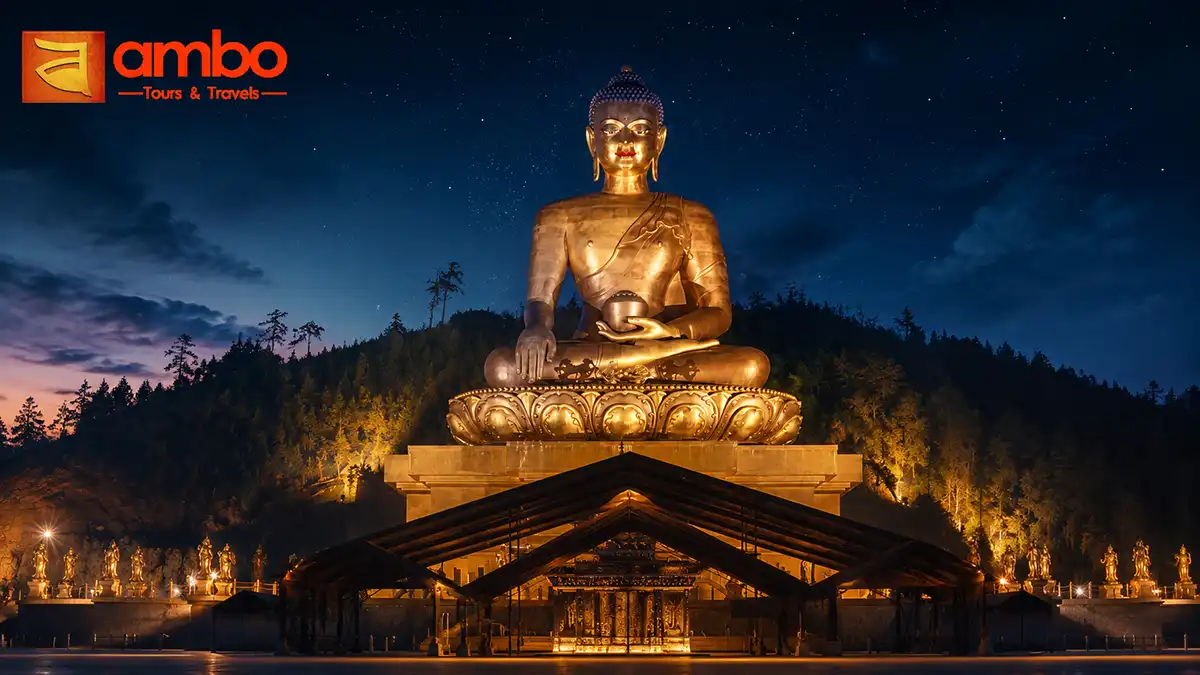
- Buddha Dordenma (Buddha Point) — The 51-metre gilded Buddha overlooking the Thimphu valley. A quiet place in late afternoon, with views that stretch to the Himalayan foothills.
- Motithang Takin Reserve — Home to Bhutan's national animal, a creature so unusual it prompted a royal decree to create a dedicated preserve. The takin is found nowhere else in the wild.
Dinner is a welcome meal of traditional Bhutanese cuisine — expect ema datshi (chilli and local cheese, the national dish), red rice, and pork with radish. Thimphu sits at a moderate altitude, so stay hydrated and take the evening slowly.
Thimphu is the only capital city in the world without traffic lights. The police officer directing traffic from a white booth at the main intersection became a symbol of the city — removed briefly when lights were installed, then reinstated after public outcry. That story tells you much about how Bhutan approaches the balance between tradition and modernity.
Today moves at a considered pace through the capital's most significant cultural sites:
- Tashichho Dzong — The seat of government and the throne room of the Je Khenpo (chief abbot). Built and rebuilt across centuries, the current structure dates to 1962. Entry is by permit, arranged by your guide.
- Folk Heritage Museum — A preserved three-storey rammed earth farmhouse from the 18th century, furnished as it would have been lived in. One of the most honest introductions to Bhutanese rural life in the country.
- National Institute for Zorig Chusum — The school of the 13 traditional arts, where students spend years learning thangka painting, wood carving, weaving, and lacquerwork. Visitors can observe classes in session.
- Simply Bhutan — An interactive cultural centre with hands-on experiences: try archery, dress in traditional gho or kira, taste ara (local grain spirit). Lunch at their restaurant is worth the stop.
- Changangkha Lhakhang — A 15th-century monastery on the ridge above town where parents bring newborns to receive blessings. The view of Thimphu from here — satellite dishes, dzong, mountains — is the city in one frame.
Dress modestly when visiting monasteries and dzongs. Tomorrow, your journey crosses one of Bhutan's most scenic mountain passes toward Punakha.
The drive from Thimphu to Punakha climbs through switchbacks to Dochula Pass at 3,100 metres — and on a clear morning, this is one of the most arresting views in the Himalayas. The 108 chortens (Druk Wangyal Chortens) stand in a semicircle against the sky, and behind them the entire eastern Himalayan range spreads across the horizon: Gangkhar Puensum, Masagang, Jejekangphu Gang. Carry a warm layer; the pass is cold even in spring.
From Dochula, the road drops sharply into a sub-tropical valley. The temperature rises, the vegetation thickens, and Punakha appears — the former winter capital of Bhutan, warmer than Thimphu and richer in history.
- Punakha Dzong — Built in 1637 at the exact confluence of the Pho Chhu (Father River) and Mo Chhu (Mother River), this is widely considered the most beautiful dzong in Bhutan. The coronation of the first king took place here in 1907. The jacaranda trees in the courtyard bloom purple in March.
- Chimi Lhakhang — A 15th-century temple dedicated to Lama Drukpa Kunley, the "Divine Madman." The walk through paddy fields to reach the monastery is a journey through working Bhutanese farmland. A place of pilgrimage for couples hoping to conceive.
- Punakha Suspension Bridge — At 160 metres, one of the longest suspension bridges in Bhutan, strung with prayer flags over the Pho Chhu. It moves with each step.
Overnight in Punakha. Enjoy local delicacies like phaksha paa (pork with radish) for dinner by the river — the temperature here is noticeably warmer than Thimphu.
The drive to Phobjikha Valley climbs steadily through broadleaf forest, past Wangdue Phodrang, and over the Pelela Pass (3,420 m) — the unofficial boundary between western and central Bhutan. The black mountain ranges to the west trap cold air, creating the high-altitude wetland that makes Phobjikha one of the most significant ecosystems in the eastern Himalayas.
Gangtey is the kind of place that slows people down. The wide flat valley floor, the marshland, the distant ridgeline — it is a landscape that asks you to be present rather than moving toward the next thing.
- Gangtey Goenpa (Gangtey Monastery) — Founded in 1613 by the first Peling Gyalse Rinpoche, this is the only Nyingmapa monastery in western Bhutan. The main temple sits on a low hill above the valley with unobstructed views in every direction.
- Gangtey Nature Trail — A 2.5 km walk through marshland and community forest. Between October and March, this trail is the best place in Bhutan to see the rare black-necked cranes, which migrate here from the Tibetan Plateau. The valley holds up to 600 birds each winter.
- Khewa Lhakhang — A small community monastery at the valley floor, rarely visited by tour groups, with original 17th-century murals still intact.
Overnight in Gangtey. Temperatures drop after sunset; the valley holds cold, so pack a warm layer for the evening.
The drive back to Paro is itself part of the experience. The road descends from Pelela back through Wangdue and Punakha, follows the river west, and climbs again toward Paro through the Tang Chhu gorge. Forests change character as altitude shifts. Stop at a roadside tea house mid-morning — the butter tea is made fresh.
In Paro, the afternoon covers the valley's most historically significant sites ahead of tomorrow's hike to Tiger's Nest:
- Kyichu Lhakhang — One of the 108 temples built across the Himalayas in a single day by Emperor Songtsen Gampo in the 7th century. The original structure is still standing, making it one of the oldest temples in Bhutan.
- Paro Rinpung Dzong — The administrative and religious centre of Paro district, built in 1646. The wooden covered bridge in front (Nemi Zam) is one of the most photographed structures in Bhutan.
- National Museum (Ta Dzong) — The former watchtower above Rinpung Dzong, converted to a museum in 1968. Displays cover textiles, thangkas, arms and armour, coins, and natural history.
Early night recommended. Tomorrow's Tiger's Nest hike begins at 7:30 am and the morning deserves a rested body.
Taktsang Palphug Monastery — Tiger's Nest — is built into a granite cliff at 3,120 metres above sea level, 900 metres above the floor of the Paro valley. The first structure was raised in 1692 on the site where Guru Rinpoche is said to have flown from Tibet on the back of a tigress to meditate in the cave below. The cave is still accessible during the visit, and is among the holiest sites in Vajrayana Buddhism.
The hike begins at the car park (2,450 m) and climbs through blue pine forest hung with lichen and prayer flags. The trail is well-marked and steadily graded. The first major viewpoint — reached after about 90 minutes — offers the view seen in every photograph. From here, the path descends into a gorge, passes a waterfall that drops directly from the rock face above the monastery, and climbs a steep staircase cut into the cliff.
You enter through a wooden gate into a complex of four main temples built around the cave. Remove your shoes. Photography is not permitted inside.
- Start no later than 7:30 am to avoid both crowds and midday heat.
- Carry at least 1.5 litres of water — the tea house at the first viewpoint is the only resupply point on the trail.
- Walking poles help on the descent — your guide can arrange these in Paro town the evening before.
- Horses are available for the first section (to the first viewpoint) for an additional fee.
- The entrance fee for Taktsang is included in the tour cost.
Return to Paro by early afternoon. Farewell dinner at a restaurant with views of the valley.
The last morning in the Paro valley has its own quality. The mountains are visible at dawn before cloud builds. The river sounds clearer. Breakfast is unhurried.
Depending on your departure time, there may be time for a final walk through Paro town — the main street has been selling the same things for decades: thangkas, wooden masks, incense, woven belts, Bhutanese stamps. A silk prayer flag costs less than a coffee and travels well.
Ensure all Bhutan permit and travel documents are ready before heading to the airport. Your guide accompanies you to Paro International Airport (PBH) for departure formalities. The flight out — banking sharply between ridges — offers a last look at the valley before the aircraft levels into open sky.
If you are already thinking about returning, consider Bumthang Valley in central Bhutan or the remote Haa Valley for a deeper journey into the kingdom. Until then, the philosophy of Gross National Happiness travels with you.
Included / Excluded
- ✔All meals — breakfast, lunch, and dinner
- ✔Accommodation on twin / double sharing basis (single supplement extra)
- ✔All transportation within the kingdom including airport transfers
- ✔Sustainable Development Fee — Government tax (SDF)
- ✔Bhutan visa fee
- ✔Entrance fees for museums and monuments
- ✔English-speaking private local guide
- ✔Sightseeing as per itinerary
- ✔Bottled water throughout the journey
- ✖International flights to and from Paro (PBH)
- ✖Gratuities for guides and drivers
- ✖Travel insurance premiums
- ✖Payments for services provided on a personal basis
- ✖Cost for any services not mentioned under "Cost Includes"
- ✖Cost incurred due to mishaps, strikes, political unrest, etc.
- ✖Personal expenses — laundry, beverages, or personal services
Ambo Tours & the 1% Club
Every tour we run includes a contribution to a Bhutanese NGO of your choice — at no extra cost to you. We call this the 1% Club: a minimum of 1% of your trip's profit, or Nu 5,000, whichever is higher, donated on every single journey. You choose where it goes.
About This Tour
The 7-day western Bhutan tour is the definitive first journey to the kingdom — the itinerary that covers the four destinations every visitor should see, at a pace that allows genuine experience rather than rushed sightseeing.
Days 1 and 2 are spent in Thimphu — Bhutan's capital and the only city in the world without traffic lights until 2016. The cultural programme here is deeper than most short tours allow: the School of 13 Traditional Arts (Zorig Chusum), the Folk Heritage Museum in an 18th-century farmhouse, and Changangkha Lhakhang on the ridge above town with its views across the valley.
Day 3 crosses Dochula Pass (3,100m) to Punakha — the former royal capital where Punakha Dzong stands at the confluence of the Pho Chhu and Mo Chhu rivers. Built in 1637, it is widely regarded as the most beautiful dzong in Bhutan. Day 4 reaches Gangtey and the Phobjikha Valley — the broad, flat glacial valley that serves as the winter home of the endangered black-necked crane. Day 5 is the long scenic return to Paro. Day 6 belongs entirely to Tiger's Nest.
For travellers who want more — specifically three days in the ancient temples of Bumthang — our 10-day Bhutan itinerary is the natural extension. For a shorter first visit, our 5-day Bhutan itinerary covers Thimphu, Punakha, and Paro without Gangtey.
Best Time for This Tour
The 7-day western Bhutan tour works across most seasons, with two distinct peak windows and one to avoid.
Spring (mid-March to late May) is the most popular season. Rhododendrons bloom along the Dochula Pass road in March and April — the forests between Thimphu and Punakha are spectacular. The Paro Tshechu festival falls in March or April and is one of the most extraordinary cultural events in Bhutan. Mornings are clear; views from Dochula Pass of the northern Himalayan range are at their best before the pre-monsoon haze builds in May.
Autumn (October to mid-November) offers the clearest mountain visibility of the year, stable weather ideal for the Tiger's Nest hike, and — from late October — the return of the black-necked cranes to Phobjikha Valley. The Thimphu Tshechu festival falls in September. The Gangtey Tshechu in October is directly on this itinerary.
Winter (December to February) — cold, empty, and exceptionally clear. The black-necked cranes are present in Gangtey in peak numbers through January. Dochula Pass views are outstanding on clear winter mornings. Recommended for experienced Bhutan travellers or those who prefer solitude.
Monsoon (June to August) — not recommended for this itinerary. Heavy rainfall, leeches on the Tiger's Nest trail, and persistent cloud on Dochula Pass. Prices are lower but the experience is significantly compromised.
For a complete month-by-month breakdown, see our best time to visit Bhutan guide.
Travel Tips
Tiger's Nest — start early. The hike begins at the car park at 2,450m and rises to 3,120m over approximately 5km. Start no later than 7:30am to avoid the 10am–1pm peak visitor window and the afternoon heat. Carry at least 1.5 litres of water. Trekking poles are helpful for the descent. The hike takes 4–6 hours round trip. Horses are available for the first section (to the first viewpoint tea house) at an additional cost paid at the trailhead.
Gangtey and altitude. Phobjikha Valley sits at approximately 3,000m — higher than Thimphu. Most visitors feel no significant effects but the first evening in Gangtey can bring mild headache or fatigue. Stay hydrated and avoid alcohol on the Day 4 evening.
Dress code for dzongs and temples. Covered shoulders and knees are required at Punakha Dzong, Tashichhodzong, Rinpung Dzong, and all temples including Tiger's Nest. Footwear must be removed before entering all temple chambers. Carry a light scarf or long-sleeved layer regardless of the season.
Photography at Tiger's Nest. Photography is not permitted inside the temple chambers. The exterior and the approach trail are unrestricted. The viewpoint across the gorge — reached approximately 90 minutes into the hike — provides the classic Tiger's Nest photograph.
Paro departure tip. Paro Airport has limited post-security retail and only one departure hall. Arrive at least 2.5 hours before your flight. The departure itself — the aircraft banking steeply between ridges immediately after takeoff — is an experience worth staying alert for.
For a full packing reference, see our complete Bhutan packing guide.
Itinerary Map
Map coming soon.
Frequently Asked Questions
Seven days is the most popular duration for a first journey to Bhutan, and for good reason. It allows you to cover all four of western Bhutan's key destinations — Thimphu, Punakha, Gangtey, and Paro — without feeling rushed. The Tiger's Nest hike alone justifies the length. If you have the flexibility to add two more days, Bumthang Valley in central Bhutan can be included. For most visitors, 7 days is the right starting point.
Our 7 days Bhutan tour is priced from US $1,690 per person for groups of 3 or more, US $1,830 for two travellers, and US $2,240 for a solo journey. These prices include the Bhutan Sustainable Development Fee (SDF) of US $100 per night and the visa fee of US $40 per person. International flights to Paro are not included.
The SDF is a government-mandated daily fee of US $100 per person per night, introduced to fund Bhutan's free healthcare, education, and infrastructure. It applies to all international visitors and is included in your tour cost. It replaces the previous minimum daily tariff system introduced in 2022.
Spring (mid-March to late April) and Autumn (October to mid-November) are the ideal seasons. Spring brings rhododendron blooms and the Paro Tshechu festival; autumn offers the clearest Himalayan views and the chance to see black-necked cranes in Gangtey (October–November). Both seasons have mild daytime temperatures and low rainfall. Winter is cold but peaceful and significantly less crowded.
Yes — the Tiger's Nest hike is the centrepiece of Day 6 in this itinerary. The 10 km round trip takes 4–6 hours depending on pace. It is accessible to most reasonably fit travellers; you do not need prior hiking experience. Horses are available for part of the ascent at an additional cost. The entrance fee is included in the tour price.
The black-necked cranes migrate to Phobjikha Valley (Gangtey) between late October and early March, with peak numbers in November and December. If your journey falls within this window, Day 4 in Gangtey offers a genuine chance to see these birds on the Gangtey Nature Trail. Outside this season, Gangtey is still worth a full day for the monastery and landscape alone.
This is a fully private journey — your guide, vehicle, and itinerary are exclusively yours. The maximum group size is 6 persons. You will not share transport or sightseeing time with other travellers. This is standard for all Ambo Tours arrangements.
All international visitors require a Bhutan visa (US $40, arranged by your tour operator before travel) and a passport valid for at least 6 months beyond your travel dates. Indian nationals require a valid passport or voter ID card and do not need a visa, but do require an entry permit arranged through a licensed Bhutanese operator. Your visa clearance letter is emailed to you before departure and presented on arrival at Paro.
Ready to Begin Your Journey?
Our Thimphu team responds within 24 hours. Tell us your dates and we will handle the rest.