Bhutan’s festivals are unlike any cultural event you have attended. They are not performances staged for visitors. They are not heritage recreations or tourist spectacles. They are religious events — acts of collective faith — that Bhutanese families travel from distant valleys to attend, dress in their finest traditional clothing for, and participate in as a genuine expression of Buddhism.
You, as a visitor, are a guest at something that belongs entirely to Bhutan. Understanding that distinction before you arrive is what transforms a festival visit from sightseeing into something far more significant.
This guide covers everything you need to know: what Tsechus are, how they work, which ones to attend, when they happen, and how to plan your journey around them.
What Is a Tsechu?
The word Tsechu means “tenth day” in Dzongkha, the national language of Bhutan. The name refers to the tenth day of a lunar month — considered auspicious across the Himalayan Buddhist world — on which these festivals are traditionally held.
Tsechus are religious festivals held in honour of Guru Rinpoche, the eighth-century Buddhist master who is credited with bringing Buddhism to Bhutan. According to Bhutanese tradition, Guru Rinpoche performed miracles on the tenth day of various lunar months, and tsechus commemorate those acts.
At their core, tsechus are a form of collective merit-making. Attending a tsechu, and witnessing the sacred mask dances performed within it, is believed to purify negative karma and accumulate merit for the next life. The dances are not entertainment — they are a form of teaching, enacting stories from Buddhist scripture and Bhutanese religious history in a way that is accessible to anyone, literate or not.
The Cham Dances
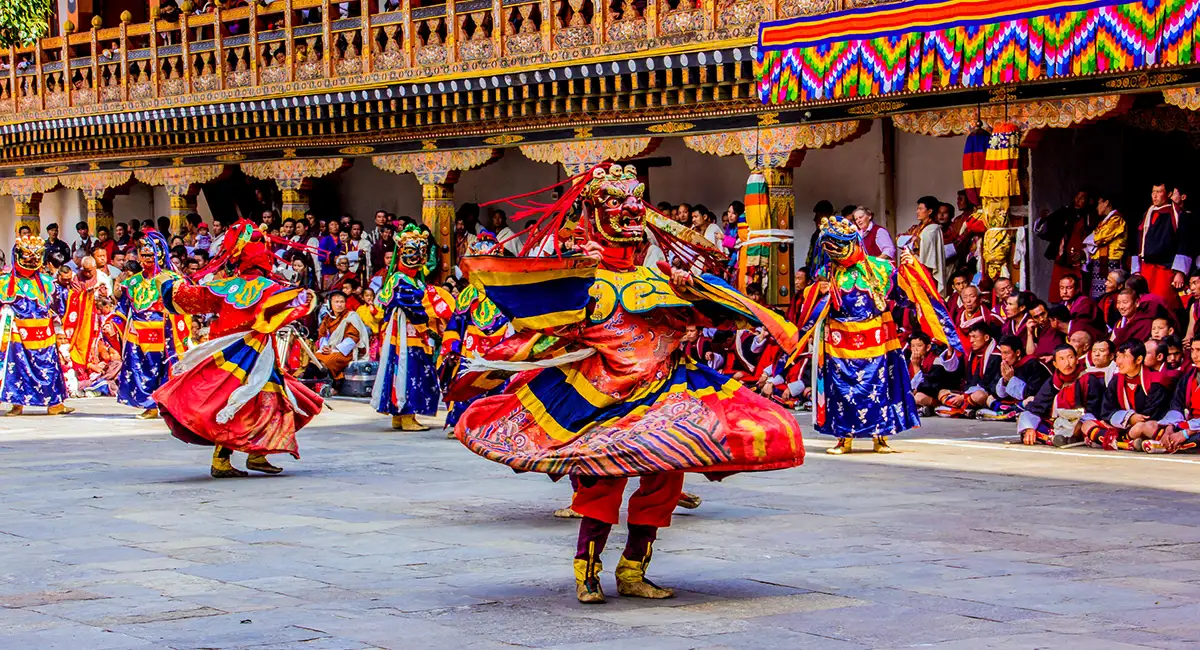
The central event of every tsechu is the cham — sacred mask dance. Performed by monks and trained lay dancers in elaborate costumes that can weigh upwards of 10 kilograms, each dance depicts a specific story or spiritual teaching.

Common themes include the subjugation of evil, the manifestation of Guru Rinpoche in his eight forms, the judgement of the dead by the Lord of Death, and the triumph of the dharma. The masks themselves — depicting fierce deities, skulls, animals, and peaceful Bodhisattvas — are sacred objects, stored in the Dzong treasury and brought out only for the festival.
To watch a cham performance is to watch something that has not fundamentally changed in three centuries.
The Thongdrol
On the final day of most major tsechus, a thongdrol is unfurled at dawn. A thongdrol is a monumental religious tapestry — often several storeys tall — depicting a deity or sacred figure. It is displayed only briefly, before the sun’s rays fall on it directly, because the silk threads are irreplaceable and ancient.
The word means “liberation on sight.” According to Bhutanese Buddhist belief, merely seeing the thongdrol at the moment of unfurling carries the same merit as a lifetime of practice. Thousands of Bhutanese gather before dawn to witness this. If you are fortunate enough to be present, arrive early and stand among the crowd, not apart from it.
The Festival Calendar: Major Tsechus in 2026
Bhutan’s festivals follow the lunar calendar, which means the exact Gregorian dates shift slightly each year. Confirm specific 2026 dates with your operator before booking.
Punakha Tshechu — February/March
Held at Punakha Dzong — often considered the most beautiful dzong in Bhutan — the Punakha Tshechu is one of the most atmospheric festivals in the country. The setting alone justifies the journey: a fortress monastery at the confluence of two rivers, surrounded by mustard fields in full bloom.
The Punakha festival includes a unique event not seen elsewhere — the re-enactment of a 17th-century battle in which Bhutanese soldiers repelled a Tibetan invasion. Hundreds of men in traditional battle dress recreate the confrontation in the dzong’s courtyard.
Duration: 3 days Location: Punakha Dzong, Punakha Valley Best for: First-time visitors, those interested in historical re-enactment alongside religious ceremony, travellers combining with Thimphu or Paro
Paro Tshechu — March/April
The Paro Tshechu is the most internationally recognised festival in Bhutan and the one most commonly targeted by first-time visitors. It is held in and around Rinpung Dzong in the Paro Valley, with the thongdrol unfurled on the final morning at Paro Rinpung Dzong’s ground.
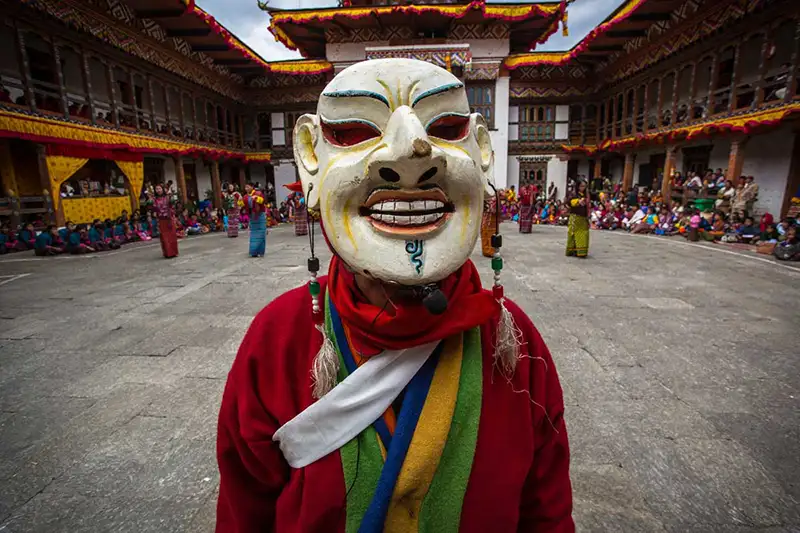
Five days of cham performances draw Bhutanese from across the western valleys, and the combination of traditional dress, mountain backdrop, and religious ceremony is extraordinary. The thongdrol unfurling at Paro is one of the most powerful moments you can witness in Bhutan — the crowd, the pre-dawn cold, and the scale of the tapestry combine into something difficult to put into words.
Because it falls during Bhutan’s peak spring season, Paro Tshechu requires the earliest planning of any festival. Flights and accommodation sell out months in advance.
Duration: 5 days Location: Rinpung Dzong, Paro Best for: First-time visitors, those who can plan 4–6 months ahead, spring travellers Planning note: Book by November for a March/April festival. This is not an exaggeration.
Ura Yakchoe — April/May
Ura Yakchoe is held in the remote Ura Valley of Bumthang — one of the most beautiful high-altitude villages in central Bhutan. It is smaller and far less visited than Paro or Thimphu Tshechu, but for many travellers who have attended multiple Bhutanese festivals, Ura is their favourite.
The intimacy of a small valley festival, where almost everyone present is Bhutanese and the setting is surrounded by hillside pastures and traditional farmhouses, offers something the larger festivals cannot. You are not observing from a distance — you are simply present at a community event, and the community happens to be celebrating something ancient and alive.
Duration: 5 days Location: Ura Village, Bumthang Best for: Repeat visitors, those who have done Paro or Thimphu and want something more intimate, travellers interested in central Bhutan Note: Requires travel to Bumthang — plan a minimum of 8–10 days to incorporate the journey properly.
Inquire about Ura Yakchoe Tour →
Haa Summer Festival — June/July
The Haa Summer Festival is a relatively recent event — established to promote the little-visited Haa Valley and its cultural heritage. Unlike the tsechus, it is not a purely religious observance but a cultural festival combining traditional dress, food, archery, and folk performances.
Haa Valley is one of Bhutan’s most remote and least-visited destinations, a high green valley near the Tibetan border that sees a fraction of the tourism of Paro or Thimphu. Attending the summer festival is a way to visit Haa with a reason — and the valley itself is worth the journey regardless.
Duration: 2 days Location: Haa Valley Best for: Off-season travellers, those seeking something genuinely different from the main tsechu circuit, Bhutan repeat visitors
Thimphu Tshechu — September/October
The Thimphu Tshechu is the largest festival in Bhutan by attendance. Held at Tashichho Dzong — the main administrative and religious seat of the Bhutanese government — it draws tens of thousands of Bhutanese from across the country. The city comes alive in a way that the rest of the year does not.
Because Thimphu is Bhutan’s capital and the arrival point for most overland travellers, the Thimphu Tshechu is logistically the easiest festival to attend. It falls in autumn, which is also Bhutan’s second peak season — the skies are clear, the air is sharp, and mountain views are excellent.
The thongdrol at Thimphu is one of the largest in the country.
Duration: 3 days Location: Tashichho Dzong, Thimphu Best for: First-time visitors who cannot manage spring travel, those combining Bhutan with autumn trekking, anyone wanting to see Bhutan at its most festive
Jambay Lhakhang Drup — October/November
The Jambay Lhakhang Drup in Bumthang is one of Bhutan’s most sacred festivals, held at the Jambay Lhakhang temple — said to be one of 108 temples built in a single day by the Tibetan king Songtsen Gampo in the 7th century. The festival includes the Mewang, a fire blessing ceremony, and the Tercham, a naked dance performed at midnight by torchlight.
The Tercham is exceptional in the context of Bhutanese Buddhism — an ancient rite performed only at this festival, representing the primordial energy of the tantric tradition. It draws devout Bhutanese from hundreds of kilometres away.
Duration: 4 days Location: Jambay Lhakhang, Bumthang Best for: Travellers with some knowledge of Tibetan Buddhism, those seeking deep cultural immersion beyond the more accessible western festivals
Inquire about Jambay Lhakhang Drup Tour →
Black-Necked Crane Festival — November
Technically not a tsechu, but one of the most moving events in Bhutan’s annual cultural calendar. Held at the Gangtey Monastery in Phobjikha Valley to celebrate the arrival of black-necked cranes from the Tibetan plateau, the festival is a community expression of the reverence Bhutanese people hold for these birds.
The cranes are considered sacred — believed to circle the monastery three times before landing in the valley each year. Local children perform dances in crane costumes. Birdwatchers and cultural travellers attend alongside the Bhutanese community.
Duration: 1 day (with the cranes present for approximately 4 months through February) Location: Gangtey Monastery, Phobjikha Valley Best for: Wildlife enthusiasts, birdwatchers, families, those combining with a western Bhutan itinerary in November
View Black-Necked Crane Festival Tour →
Nalakhar Tshechu — November/December
Held in the Bumthang district’s Ngang Lhakhang, the Nalakhar Tshechu is one of the more obscure festivals — largely unknown to visitors — but deeply significant to the local community. Small, intimate, and attended primarily by residents of the surrounding valleys.
For travellers who have seen the major tsechus and want to experience something at village scale, this is a compelling option.
How to Choose the Right Bhutan Festival to attend
With so many festivals spread across the year, the question most travellers ask is: which one is right for me?
If this is your first visit to Bhutan, Paro Tshechu or Thimphu Tshechu. They are the largest and most accessible, and the sheer scale of Bhutanese participation at these events is overwhelming in the best sense.
If you want something intimate and uncrowded, Ura Yakchoe or Jambay Lhakhang Drup. These draw far fewer visitors and the experience is correspondingly more personal.
If you are combining Bhutan with trekking, Thimphu Tshechu (autumn) pairs naturally with the Jomolhari Trek or Druk Path in the same season. Paro Tshechu (spring) pairs with the same treks in spring conditions.
If you want something completely different, the Black-Necked Crane Festival or Haa Summer Festival offer experiences that sit outside the tsechu tradition entirely.
Practical Notes for Festival Travel
Book early — this is not optional. For Paro Tshechu specifically, accommodation in Paro valley sells out 4–6 months in advance. Our team in Thimphu will need to secure your hotel before confirming your booking.
Dress respectfully. Bhutanese people attend festivals in their finest traditional dress — women in the kira, men in the gho. You are not expected to dress traditionally, but neat, conservative clothing is expected. Shoulders and knees covered. No shorts, no vest tops.
Arrive before the dances begin. The best positions — particularly for the thongdrol unfurling — go to those who arrive early. Your guide will advise on timing. For the thongdrol, this means before dawn.
Do not obstruct the space. Festival courtyards have specific areas for Bhutanese participants and areas where visitors stand. Follow your guide’s direction and do not cross into ceremonial spaces.
Photography etiquette. Photography of the cham dances is generally permitted from visitor areas. Photography inside temple halls is usually not permitted. Always ask your guide before pointing a camera at monks or lamas at close range. Some moments are simply not for photographs — read the atmosphere and respect it.
Planning a Festival Journey with Ambo Tours
Every festival tour we operate is built around the specific event — its dates, its location, and the itinerary that makes most sense around it. We do not run group tour buses. Every journey is private, tailored to your pace and interests, with a guide who knows the specific festival you are attending and can explain what you are seeing as it unfolds.
If you know which festival interests you, contact us with your dates and we will design the rest.
Plan your festival journey with Ambo Tours →
Frequently Asked Questions about Bhutan festivals
What is a tsechu in Bhutan? A tsechu is a religious festival held in honour of Guru Rinpoche, the master who brought Buddhism to Bhutan. The word means “tenth day” in Dzongkha, referring to the auspicious lunar date on which the festivals are traditionally held. The central feature is the cham — sacred mask dance — performed by trained monks and lay dancers in elaborate costumes.
Which is the most famous festival in Bhutan? The Paro Tshechu is the most internationally recognised, drawing visitors from around the world for its five-day programme and the dawn unfurling of a massive sacred tapestry called the thongdrol. The Thimphu Tshechu is the largest by attendance.
When is the best time to attend a festival in Bhutan? Spring (March–May) and autumn (September–November) are the main festival seasons and also Bhutan’s best weather windows. Paro Tshechu falls in spring; Thimphu Tshechu falls in autumn. Both seasons coincide with clear skies and comfortable temperatures. Read our detailed article on best time to visit Bhutan for a season by season comparison.
Do I need to book far in advance for Bhutan festivals? Yes. For Paro Tshechu, 4–6 months in advance is the minimum. For other festivals, 2–3 months is advisable. Accommodation in smaller valleys like Bumthang is limited and fills early.
Can I attend a Bhutan festival independently without a guide? No. All international visitors to Bhutan must travel through a licensed tour operator and be accompanied by a licensed guide. Your guide is also invaluable at festivals — explaining what each dance represents, navigating the crowd, and ensuring you are in the right place at the right moments.
What should I wear to a Bhutan festival? Conservative, neat clothing. Shoulders and knees covered. Bhutanese people dress formally — women in the traditional kira, men in the gho. Visitors are not expected to wear traditional dress but are expected to dress respectfully. Avoid shorts, sleeveless tops, or clothing with large logos.
Ready to Experience Bhutan?
Tell us your dates and interests — our team in Thimphu will craft a personalised itinerary within 24 hours, at no cost.