7-Day Luxury Bhutan Tour — Five-Star Lodges, Private Guide & Bespoke Itinerary
Paro · Thimphu · Punakha · Gangtey
Tour Information
- Five-star lodges throughout — COMO Uma Punakha, Gangtey Lodge, Le Meridien Paro and equivalents
- Tiger's Nest hike on a full dedicated day — premium packed lunch from your lodge on request
- Punakha Dzong at the confluence of the Pho Chhu and Mo Chhu rivers
- Gangtey Lodge above Phobjikha Valley — the finest position in the Gangtey valley
- Black-necked cranes in Gangtey (late October to mid-March) — up to 600 birds at peak season
- Dochula Pass (3,100m) — 108 memorial chortens with Himalayan peak views
- Paro Day 1 — Rinpung Dzong, Kyichu Lhakhang (659 AD) and Ta Dzong National Museum
- Fully private — guide, vehicle and itinerary exclusively yours for all 7 days
- SDF (USD 100/night) and visa fee (USD 40) included in all prices
This 7-day luxury Bhutan tour covers the same four western destinations as our standard itinerary — Paro, Thimphu, Punakha, and Gangtey — at a level of accommodation and service that transforms the experience. Five-star lodge properties throughout: Le Meridien or Bhutan Spirit Sanctuary in Paro, DusitD2 Yarkay or Hotel Pemako in Thimphu, COMO Uma Punakha or &Beyond Punakha River Lodge, and Gangtey Lodge above the Phobjikha Valley.
The distinction between a luxury and standard Bhutan tour is primarily in what happens outside the sightseeing hours. Arriving at a lodge positioned above the valley rather than in town. Breakfast with mountain views rather than in a hotel dining room. A private guide who has time to explain rather than move. Evenings unhurried rather than managed.
The cultural programme itself is identical — Tiger's Nest on Day 6, Punakha Dzong on Day 3, Gangtey Nature Trail on Day 4, Tashichhodzong and Zorig Chusum in Thimphu. What changes is the frame around those experiences. Operated by Ambo Tours, DOT Licence No. 1053330, Thimphu.
Tour Pricing
7 Days Bhutan Journey — Cost
All prices in USD per personCost includes Sustainable Development Fee (SDF) of US $100 per person per night and Bhutan Visa Fee of US $40 per person. Entrance fees for monuments and festival visits are paid separately.
Detailed Itinerary
The descent into Paro is one of the most technically demanding airport approaches in the world — pilots navigate between forested ridges before the runway appears in a valley that has barely changed in centuries. After immigration and permit formalities, your guide meets you at arrivals and your luxury Bhutan journey begins immediately.
The afternoon is unhurried. Paro's most significant sites are within the valley and require no driving between them:
- Paro Rinpung Dzong — Built in 1646 at a commanding position above the Paro Chhu river, the dzong is accessed via Nemi Zam, a traditional wooden cantilever bridge. The whitewashed fortress walls and dark timber galleries contain two main temples and the district administrative offices, all functioning simultaneously. Allow an hour.
- Ta Dzong (National Museum) — The circular watchtower above Rinpung Dzong, converted to a museum in 1968. Seven floors of thangka paintings, armour, coins, textiles, and natural history. The building's architecture is as interesting as its contents.
- Kyichu Lhakhang — One of 108 temples built across the Himalayas by Emperor Songtsen Gampo in 659 AD. The original 7th-century structure is still standing and in active use. The atmosphere in late afternoon — butter lamp smoke, spinning prayer wheels, elderly pilgrims circumambulating — is quietly extraordinary.
Check-in at your five-star lodge takes place in the late afternoon. Properties in Paro sit in privileged positions: above the valley floor with unobstructed views of the rice terraces, the dzong, and the ridgelines. Request a valley-facing room for the light at dawn.
Welcome dinner at the lodge restaurant. Paro's luxury properties take Bhutanese cuisine seriously — expect ema datshi (chilli and local cheese, the national dish) prepared with restraint and precision rather than the canteen portions served elsewhere, paired with Bhutanese red rice grown in the terraced fields visible from the dining room.
The drive from Paro to Thimphu takes an hour along the Wang Chhu river gorge — pine-forested, unhurried, the occasional monastery appearing on a ridge above the road. En route, a short stop at Tamchog Lhakhang: a 15th-century monastery accessed via one of the original iron-chain bridges built by the engineer-saint Thangtong Gyalpo. The crossing takes five minutes and sets the correct tone for everything that follows.
Thimphu is the only capital city in the world without traffic lights. The police officer who once directed traffic from a white booth at the main intersection became a city symbol — removed briefly when lights were installed, reinstated after public objection. That detail tells you most of what you need to know about how Bhutan weighs tradition against modernity.
- Buddha Dordenma (Kuenselphodrang) — A 51.5-metre seated bronze and gold Buddha on the ridge above Thimphu, fulfilling an 8th-century prophecy. The statue is hollow and contains 125,000 smaller Buddha statues. The view of the valley from its base, particularly in late afternoon, is the best elevated perspective of the capital available.
- Zorig Chusum (School of Traditional Arts) — Students spend six years mastering Bhutan's 13 traditional arts. The classrooms at intermediate and senior levels produce work of remarkable quality — thangka paintings, lacquerwork, embroidery, wood carving. Visitors may observe classes in session. A private session with a master artisan can be arranged through your guide.
- National Memorial Chorten — Built in 1974 as a memorial to the Third King. A living site of daily circumambulation — join elderly Bhutanese devotees in their evening rounds, prayer beads in hand, murmuring mantras. This is not a tourist attraction; it is an active place of devotion, and entering that rhythm is one of the more moving experiences available in Thimphu.
- Tashichhodzong — The Royal Secretariat and seat of the Je Khenpo (chief abbot), rebuilt in the 1960s without nails or formal architectural drawings. The courtyard at dusk, illuminated against the surrounding pine forest, justifies the visit alone.
- Changangkha Lhakhang — A 15th-century hilltop temple where Thimphu families bring newborns to receive blessings. The view of the city from the monastery terrace is useful orientation.
Overnight at your five-star property in Thimphu. The luxury hotels in the capital — DusitD2 Yarkay and Pemako among them — sit centrally, walking distance from the clock tower square and the weekend market. Request a mountain-facing room for the snow peaks visible on clear mornings.
The drive from Thimphu to Punakha climbs through pine and rhododendron forest to Dochula Pass at 3,100 metres. On a clear morning — most reliable in October and November, and in early March before the haze builds — the entire eastern Himalayan range spreads across the horizon behind the 108 Druk Wangyal Chortens: Gangkhar Puensum, Masagang, Jejekangphu Gang. Carry a warm layer; the pass is cold even in spring and summer. A private tea service at the pass cafeteria can be arranged in advance.
- Dochula Pass — 108 whitewashed chortens on a ridge at 3,100 m, built by the Queen Mother of Bhutan to honour soldiers who fell in the 2003 conflict with Assam militants. The Druk Wangyal Lhakhang beside the pass contains modern murals of outstanding quality depicting the Fourth King's military campaign. Rarely visited, worth the 20-minute detour.
- Chimi Lhakhang — A 15th-century temple dedicated to Lama Drukpa Kunley, the Divine Madman, reached via a 20-minute walk through working paddy fields. A place of pilgrimage for couples hoping to conceive, decorated in ways that surprise most visitors. The walk itself is worth as much as the temple.
- Punakha Dzong — Built in 1637 at the exact confluence of the Pho Chhu (Father River) and Mo Chhu (Mother River), this is widely considered the most beautiful building in Bhutan and one of the finest examples of Himalayan vernacular architecture anywhere. The coronation of the first king took place here in 1907. The jacaranda trees in the courtyard bloom purple in late March. Allow 90 minutes.
- Punakha Suspension Bridge — At 350 metres, one of the longest suspension bridges in Bhutan, strung with prayer flags over the Pho Chhu. It moves with each step.
- Khamsum Yueley Namgyal Lhakhang — A gilded hilltop temple commissioned by the Queen Mother, reached via a 45-minute walk through terraced paddy fields. The interior contains beautifully preserved modern murals. The panorama of the Punakha valley from the terrace — both rivers winding through the fields below — is among the finest views in western Bhutan.
Overnight at your five-star property in Punakha. The luxury lodges here — COMO Uma Punakha and &Beyond Punakha River Lodge among them — are positioned at the far western end of the valley, above the Mo Chhu river bend. Dinner with valley views as the light fades over the paddy fields.
The road from Punakha to Phobjikha Valley climbs steadily through broadleaf forest, past the small town of Wangdue Phodrang, and over Pelela Pass (3,420 m) — the unofficial boundary between western and central Bhutan. The vegetation changes as altitude rises. The black mountain ranges to the west trap cold air, creating the high-altitude wetland that makes Phobjikha one of the most ecologically significant valleys in the Himalayas.
Gangtey arrives slowly, the valley widening as the road descends from the pass. The wide flat floor, the marshland that floods in monsoon, the monastery on its low hill — it is a landscape that asks you to slow down.
- Gangtey Goenpa (Gangtey Monastery) — Founded in 1613 by the first Peling Gyalse Rinpoche, the only Nyingmapa monastery in western Bhutan. The main temple sits on a hill above the valley with unobstructed views in every direction. The monks' quarters surround it like a small village. The gomchen (married monks) who maintain the monastery have done so across generations — the same families, the same routines, for four centuries.
- Gangtey Nature Trail — A 2.5 km loop through marshland and community forest. Between late October and mid-March, this trail is the best place in Bhutan to see black-necked cranes, which migrate here from the Tibetan Plateau. The valley holds up to 600 birds each winter. Outside crane season, the trail offers an excellent cross-section of the valley's wetland ecosystem.
- Khewa Lhakhang — A small community monastery at the valley floor with original 17th-century murals still intact. Rarely on standard itineraries. Your guide can arrange access.
Overnight at Gangtey Lodge or equivalent five-star property in the valley. The lodge sits on the forested ridge above the monastery with a direct sight line to the crane marshes. Temperature drops sharply after sunset at 3,000 metres — the warmth of the lodge dining room in the evening, after a day in the cold valley, is one of the more pleasurable contrasts on this itinerary.
The long drive back to Paro is itself part of the experience. The road descends from Pelela back through Wangdue and Punakha, follows the Pho Chhu west, and climbs again toward Paro through the Tang Chhu gorge. The forests change character as altitude shifts between passes and valleys. Stop at a roadside tea house mid-morning — your guide knows which ones are worth the detour.
Arrival in Paro by early afternoon allows time for the valley sites you didn't cover on Day 1:
- Traditional Bhutanese Farmhouse — A working farming family home: three storeys of rammed earth and timber, grain stores on the ground floor, the family shrine at the top. An afternoon here tells you more about daily Bhutanese life than any museum. Your five-star lodge can arrange a private farmhouse dinner on request — a meal cooked by the family, eaten at the family table, accompanied by ara (local grain spirit).
- Drugyel Dzong — A ruined 17th-century fortress at the northern end of the valley, built to commemorate Bhutanese victories over Tibetan-Mongol invasions. On clear days, the peak of Jomolhari (7,314 m) fills the sky behind it. The combination of burned whitewash and Himalayan summit is one of the most photographed views in Bhutan.
- Paro Town Bazaar — The main street has been selling handwoven textiles, thangka prints, wooden masks, incense, and Bhutanese stamps for decades. The better craft shops carry certified antique reproductions; your guide can identify which are worth your time.
Early night. Tomorrow requires a 7:00 AM breakfast.
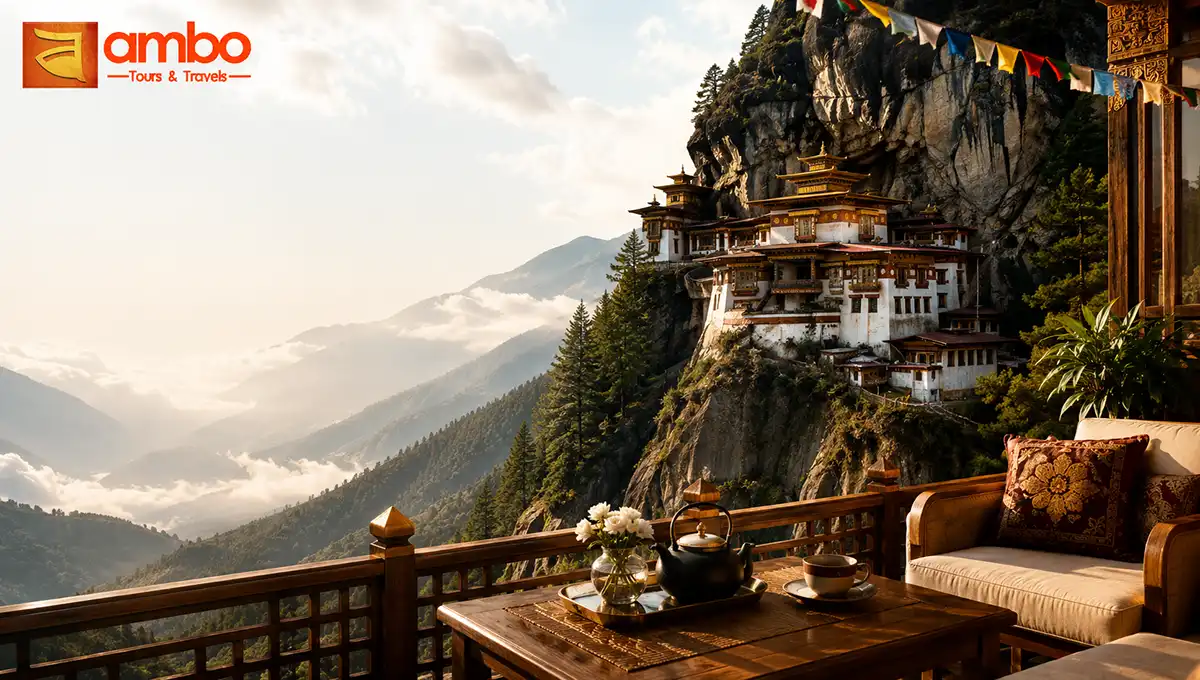
Taktsang Palphug Monastery — Tiger's Nest — is built into a granite cliff at 3,120 metres above sea level, 900 metres above the Paro valley floor. The first structure was raised in 1692 on the site where Guru Rinpoche is said to have flown from Tibet on the back of a tigress to meditate in the cave below. The cave is still accessible during the visit, and is among the holiest sites in Vajrayana Buddhism.
The hike begins at the car park (2,450 m) and climbs through blue pine forest hung with lichen and prayer flags. On a clear morning the forest floor carries the smell of pine resin and cold mountain air. The first viewpoint — reached after about 90 minutes — offers the photograph seen in every image of Bhutan. From here the path descends into a gorge, passes a waterfall that drops directly from the cliff above the monastery, and climbs a steep staircase cut into the rock face.
- First viewpoint and cafeteria — Tea and lunch available. Your lodge can arrange a packed lunch of higher quality than the cafeteria offering if requested the evening before. Take 20–30 minutes here before continuing — the view from the descent section back to the monastery is different and worth the angle.
- Taktsang monastery complex — Four main temples built around the meditation cave of Guru Rinpoche. Remove shoes at each entrance. Photography is not permitted inside the temples. The Pelphug cave temple, directly above the original cave, is the most sacred chamber on the route.
- Descent via waterfall — The path back passes the waterfall from a different angle than the ascent. On sunny mornings a rainbow forms in the spray at midday.
Return to the car park by early afternoon. Farewell dinner at your lodge that evening — most five-star properties in Paro offer a private dining option in a pavilion above the valley, which can be arranged for the final night on request.
Practical notes: Start no later than 7:30 AM to reach the monastery before afternoon cloud builds and before the main body of day-tour groups arrives from Thimphu. Carry at least 1.5 litres of water. Walking poles are available from the trailhead. Horses are available for the first section at an additional cost. The Tiger's Nest entrance fee is not included in the tour cost and is paid at the gate.
The final morning in the Paro valley. The mountains are visible at dawn before cloud builds. Breakfast is unhurried — most five-star lodges lay out the morning meal on the terrace when the weather permits, which in spring and autumn it almost always does.
Your guide accompanies you to Paro International Airport (PBH) for departure formalities. Arrive at least two hours before your flight for international departures; three hours during peak season when multiple flights depart within a short window. The check-in hall at Paro Airport is small and efficient — there is no airport lounge, but the departure area has a good selection of the same crafts available in town, often at the same prices.
The flight out banks sharply between the ridges and offers a last aerial view of the valley — the dzong on its hill, the patchwork of rice terraces, the river threading through the floor — before the aircraft levels into open sky.
If you are already considering a return journey: the 18-day East-West Bhutan itinerary extends this route east through Trongsa, Bumthang, and Mongar, covering the cultural heartland of the kingdom that western itineraries leave unexplored. When you are ready, the kingdom will be exactly as you left it.
Included / Excluded
- ✔All meals — breakfast, lunch, and dinner
- ✔Accommodation on twin / double sharing basis (single supplement extra)
- ✔All transportation within the kingdom including airport transfers
- ✔Sustainable Development Fee — Government tax (SDF)
- ✔Bhutan visa fee
- ✔English-speaking private local guide
- ✔Sightseeing as per itinerary
- ✔Bottled water throughout the journey
- ✖International flights to and from Paro (PBH)
- ✖Entrance fees for museums and monuments
- ✖Gratuities for guides and drivers
- ✖Travel insurance premiums
- ✖Payments for services provided on a personal basis
- ✖Cost for any services not mentioned under "Cost Includes"
- ✖Cost incurred due to mishaps, strikes, political unrest, etc.
- ✖Personal expenses — laundry, beverages, or personal services
Ambo Tours & the 1% Club
Every tour we run includes a contribution to a Bhutanese NGO of your choice — at no extra cost to you. We call this the 1% Club: a minimum of 1% of your trip's profit, or Nu 5,000, whichever is higher, donated on every single journey. You choose where it goes.
About This Tour
The 7-day luxury Bhutan tour is built on a simple proposition: the same four western destinations that every first-time visitor should see — Paro, Thimphu, Punakha, and Gangtey — experienced from five-star lodge properties rather than town-centre hotels.
The itinerary is identical in structure to our standard 7-day western tour. Day 1 arrives in Paro with Rinpung Dzong and Kyichu Lhakhang. Day 2 moves to Thimphu for the Buddha Dordenma, Zorig Chusum, and Tashichhodzong. Day 3 crosses Dochula Pass to Punakha Dzong. Day 4 reaches Gangtey and the Phobjikha Valley. Day 5 returns to Paro. Day 6 is Tiger's Nest. What changes is the frame around each of those experiences — where you sleep, how you eat, and the pace at which everything moves.
Properties are confirmed at time of booking and tailored to your preferences. Contact our Thimphu team to discuss specific lodge options, honeymoon arrangements, or bespoke additions to the itinerary.
For travellers who want the same cultural depth without the luxury accommodation cost, our standard 7-day Bhutan tour covers the same destinations from USD 1,690.
Best Time for This Tour
Spring (mid-March to late May) — rhododendrons bloom throughout the valleys. The Paro Tshechu festival in March or April is the single most extraordinary cultural event available on this route. Views from Dochula Pass are sharpest before the pre-monsoon haze builds. This is the peak season for luxury lodge demand — book well in advance.
Autumn (October to mid-November) — the clearest mountain visibility of the year. The black-necked cranes return to Phobjikha Valley from late October, with peak numbers in November. The Thimphu Tshechu is in September. Autumn is the second peak season for luxury properties.
Winter (December to February) — cold but exceptional for clear skies and solitude. The five-star lodges are quieter and some offer off-season rates. The black-necked cranes are present in Gangtey through January. The Tiger's Nest hike is cold but very quiet. Recommended for travellers who have visited before and want the intimate winter experience.
For a complete month-by-month breakdown, see our best time to visit Bhutan guide.
Travel Tips
Lodge check-in timing — most five-star lodges in Bhutan have afternoon check-in (2pm or 3pm). Day 1 arriving in Paro means arriving directly into the valley for sightseeing before check-in rather than heading to a hotel first. Your guide manages the luggage transfer while you visit Rinpung Dzong and Kyichu Lhakhang.
Tiger's Nest on Day 6 — your lodge can prepare a premium packed lunch for the trail on request, which is considerably better than the midpoint cafeteria option. Request this the evening before. Start no later than 7:30am. The hike takes 4–6 hours round trip. Entrance fee paid at the gate.
Gangtey Lodge position — Gangtey Lodge sits on the ridge above the valley floor with direct views across the crane habitat. Request a room facing the valley for the best sunrise views. The evening light across Phobjikha is exceptional in autumn.
Dress code — covered shoulders and knees are required at all dzongs and temples regardless of the accommodation level. Carry a light layer even in warm weather. Your guide will brief you before each visit.
For a full luxury packing reference including what to bring for five-star lodge settings, see our complete Bhutan packing guide.
Itinerary Map
The map below shows the 7-day luxury tour route from Paro through Thimphu, Punakha, Gangtey, and back to Paro.
Map coming soon.
Frequently Asked Questions
Three things distinguish this from a standard 7-day Bhutan tour. First, accommodation: this itinerary uses 5-star lodges in Paro, Thimphu, Punakha, and Gangtey — properties like COMO Uma Punakha, DusitD2 Yarkay, Gangtey Lodge, and Le Meridien Paro, each positioned with privileged valley views rather than in town centres. Second, pace: the itinerary allows genuine time at each destination rather than rushing between sites. Third, the private format: your guide, vehicle, and daily programme are exclusively yours. You will not share any element of the tour with other travellers.
Specific properties depend on availability at time of booking and can be tailored to your preference. Options in Paro include Le Meridien Riverfront Paro, Zhiwa Ling Heritage Hotel, and Bhutan Spirit Sanctuary. In Thimphu, DusitD2 Yarkay and Hotel Pemako. In Punakha, COMO Uma Punakha and &Beyond Punakha River Lodge. In Gangtey, Gangtey Lodge. All are government-rated five-star with full board included. Contact our Thimphu team to confirm availability and request specific properties for your dates.
The itinerary covers the same four destinations and the same key sites — Tiger's Nest, Punakha Dzong, Dochula Pass, Gangtey. The difference is entirely in accommodation and pace. Our standard 7-day tour uses 3-star hotels; this luxury version uses 5-star lodges at approximately three times the accommodation cost. The private guide and vehicle are the same. If budget is the primary consideration, the standard tour delivers the same cultural experience at significantly lower cost. If accommodation quality and exclusive setting are priorities, the luxury tour is designed for that.
Our 7-day luxury Bhutan tour starts from USD 4,000 per person for groups of 3 or more, USD 5,250 for two travellers, and USD 5,950 for a solo journey. All prices include the SDF of USD 100 per night, the Bhutan visa fee of USD 40, all meals at five-star properties, private guide, private vehicle, and all in-country transportation. For a full cost breakdown see our Bhutan travel cost guide.
Yes — if your journey falls between late October and mid-March, when the cranes migrate from the Tibetan Plateau to Phobjikha Valley. Day 4 is dedicated to Gangtey and the Gangtey Nature Trail passes directly through the crane habitat. Peak numbers of up to 600 birds are in November and December. Outside this window, Gangtey remains a full day — Gangtey Gompa and the valley landscape justify the visit in any season.
Spring (mid-March to late April) and autumn (October to mid-November) are ideal. Spring brings rhododendron blooms and the Paro Tshechu festival. Autumn offers the clearest Himalayan visibility and the black-necked crane season in Gangtey. Winter (December to February) is cold but uncrowded — the five-star lodges are quieter and some offer off-season rates. For a full breakdown see our best time to visit Bhutan guide.
Yes — this is one of our most popular honeymoon itineraries. The combination of five-star lodge properties, private guiding, and the extraordinary Bhutanese landscape makes it naturally suited to a honeymoon. Properties like COMO Uma Punakha and Gangtey Lodge have specific honeymoon arrangements on request. For a dedicated honeymoon guide to Bhutan, see our Bhutan honeymoon guide. We can also extend the itinerary or add bespoke elements — contact our Thimphu team with your requirements.
Ready to Begin Your Journey?
Our Thimphu team responds within 24 hours. Tell us your dates and we will handle the rest.