Traveling alone is a different kind of courage. It requires you to be fully present — no companion to share the decision-making, no familiar face to turn to when something surprises you. Most experienced solo travelers will tell you that the journeys they took alone are the ones they remember most clearly.
Bhutan rewards that quality of attention.
This guide addresses every question solo travelers ask before making the decision to come here: what it costs, how the guided model works for people traveling alone, whether it is safe, what solo female travel looks like, and what to expect from a private journey in a country that has no independent backpacker infrastructure.
The short version: Bhutan is one of the finest solo travel destinations in Asia. The guided model that some travellers initially see as a constraint turns out, almost universally, to be one of the best parts of the experience.
How Solo Travel Works in Bhutan
Bhutan does not permit independent travel for international visitors. Every visitor must book through a licensed tour operator and travel with a licensed guide. This applies whether you are a group of ten or a group of one.
For solo travelers, this means your journey looks like this: you have a private guide, a private vehicle and driver, a day-by-day itinerary designed specifically for you, and a single point of contact throughout the trip. There is no group tour bus, no strangers whose pace you must match, no compromise on where to stop or how long to linger.
The solo travel experience in Bhutan is, in practice, a fully private experience. You move at exactly the pace you choose. If you want to sit for an hour in a monastery courtyard watching monks go about their day, you sit. If you want to stop on a mountain pass and not speak for ten minutes, you stop. No one is waiting.
This is categorically different from group tours marketed as solo travel in other countries. In Bhutan, solo means genuinely solo — just you, your guide, and the country.
The Cost of Traveling Solo in Bhutan
This is the part of Bhutan solo travel that requires honest discussion.
The Single Supplement Reality
Bhutan’s tour costs are built on a per-person model that assumes some sharing of fixed costs — guide, vehicle, driver — across multiple travellers. When you travel alone, those fixed costs are yours entirely. This is sometimes called the single supplement, and in Bhutan it is more significant than in most destinations.
The Sustainable Development Fee (SDF) is USD 100 per person per night regardless of group size. A solo traveler pays the same SDF as each person in a couple or group.
The tour package rate — covering guide, vehicle, accommodation and most meals — typically works out to:
| Group Size | Estimated Package Rate Per Person Per Night |
|---|---|
| Solo traveler | USD 220–280 |
| 2 travelers | USD 160–200 |
| 3–4 travelers | USD 130–160 |
Rates are indicative and vary by accommodation standard and season. Add USD 100 SDF per person per night to all figures.
For a solo traveller on a 7-night trip in comfortable mid-range accommodation, an approximate total budget would be:
- SDF: USD 700 (7 × USD 100)
- Package: USD 1,750 (7 × USD 250)
- Total: approximately USD 2,450 before flights
This is a meaningful cost. It is also, if you consider what is included — private guide, private vehicle, all accommodation, most meals, all entry fees — a reasonable one for what is delivered.
Ways to Manage the Solo Cost
Travel in shoulder season. March/April and September/October are peak season with full rates. If your schedule allows, late November, December, January and February offer identical experiences at lower package rates, with fewer other visitors.
Keep your itinerary tight. Bhutan’s best experiences are concentrated in the western valley circuit — Paro, Thimphu, Punakha. A well-built 6–7 night trip covers this thoroughly. Extending to Bumthang adds cost and travel time; it is worth it, but do not extend beyond what your budget comfortably supports.
Be flexible on accommodation. The SDF is fixed. The package cost is where budget choices are available. Staying in well-run mid-range guesthouses rather than luxury lodges reduces the nightly package rate significantly without reducing the quality of the cultural experience.
Join a small group if available. Some operators (including us) occasionally run small-group fixed-departure tours around major festivals. If your dates align, this reduces the per-person cost substantially. Ask about availability.
See the full Bhutan travel cost breakdown →
What Solo Travel Actually Feels Like in Bhutan
The concern most solo travelers express before arriving is loneliness — the idea that without a companion, a country as intensely beautiful as Bhutan might feel like something missing.
Almost no one reports this after the fact.
The guide relationship in Bhutan is different from other countries. Your guide is not a functionary reading from a script at designated stops. They are licensed professionals — often deeply knowledgeable about Bhutanese history, Buddhism, architecture and natural history — who are with you for every hour of every day. Over a 7-day journey together, a real conversation develops. Most solo travelers describe their Bhutanese guide as one of the most memorable parts of the trip.
The solitude that Bhutan offers — the actual solitude of being in a valley with no one else around, of climbing to a monastery in the blue pine forest with only the sound of wind and prayer flags — is the kind that most solo travellers actively seek. It is not the loneliness of being in a crowd without a companion. It is the presence of being fully in a place.
Many solo travelers also find that the guided model removes a category of anxiety that independent travel carries. You do not need to navigate, negotiate transport, or figure out where to eat. That energy goes elsewhere.
Solo Female Travel in Bhutan
Bhutan is one of the safest countries in Asia for women traveling alone, by any measure that matters.
Safety
Violent crime against tourists is exceptionally rare in Bhutan. The country has one of the lowest crime rates in Asia, and the culture of hospitality — grounded in Buddhist values — means that visitors are treated with genuine care. Solo female travellers consistently report feeling more comfortable and less harassed in Bhutan than in any comparable South or Southeast Asian destination.
The presence of a licensed guide also means you are never truly alone. Your guide handles every interaction with hotels, restaurants, transport and sites. You have a trusted local companion throughout the journey.
Cultural Context
Bhutanese society is relatively egalitarian by regional standards. Women hold positions of authority in government, business, and in some areas of religious life. There is no cultural tradition of female travelers being treated as anomalous or problematic.
The dress expectations at monasteries and Dzongs — shoulders and knees covered — apply to all visitors and are no more restrictive than equivalent religious sites in Europe or Japan.
Practical Notes for Solo Female Travelers
- Bhutan’s accommodation ranges from intimate family-run guesthouses to international luxury lodges. All operate to professional standards of security and privacy.
- Solo women are welcome on all treks. Trek crews — guides, cooks, horsemen — are professional and accustomed to hosting solo travelers.
- There is no need to modify your planned itinerary based on gender. Every destination, every trail, every festival is equally accessible.
The Best Itinerary for Solo Travelers
6 Nights — Western Bhutan (Recommended Starting Point)
This is the itinerary we most often recommend for first-time solo travelers. It is long enough to settle in and experience the country properly; short enough to be financially manageable for a solo budget.
Day 1 — Arrive Paro Afternoon acclimatisation walk through Paro town. Visit Rinpung Dzong. Dinner and early night — the altitude and journey will have their way with you regardless.
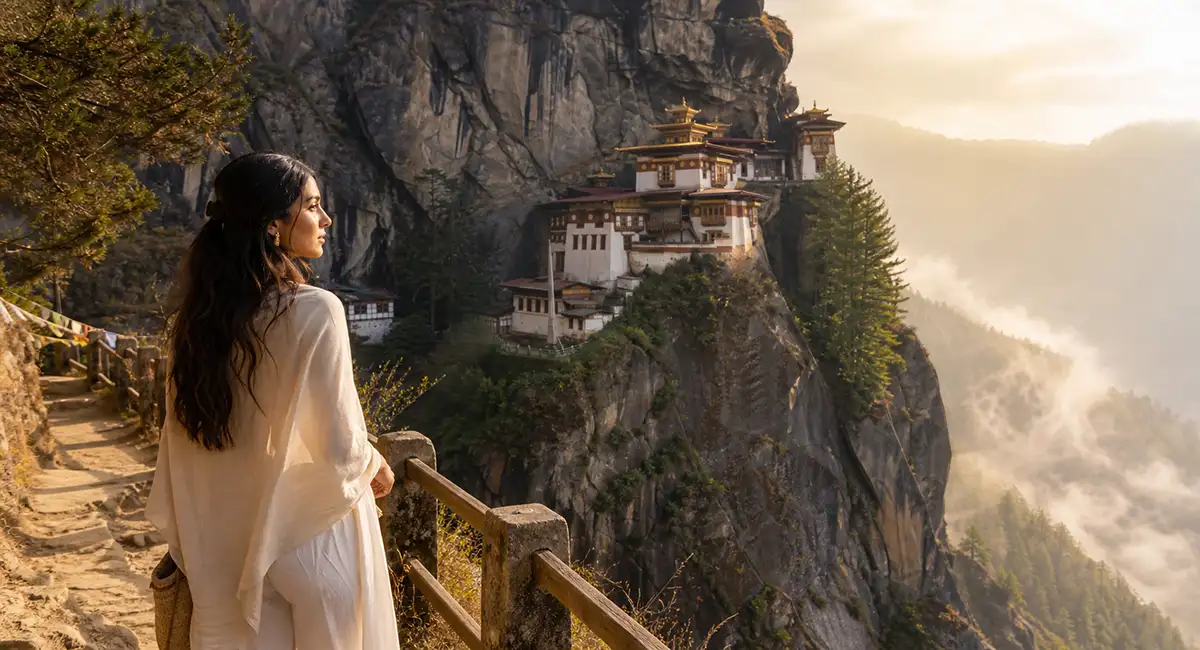
Day 2 — Tiger’s Nest The hike to Paro Taktsang is the defining experience of most visits to Bhutan. A 4–5 hour round trip through blue pine forest, ascending 900 metres to a monastery built into a sheer cliff face. Hiking alone with a guide, at your own pace, is actually ideal for this — you stop when you want, rest when you need, and arrive at the top without managing anyone else’s energy.
Day 3 — Paro Valley Kyichu Lhakhang — one of the oldest temples in Bhutan, intimate and quiet. The National Museum. Afternoon at the Paro market. This is a day to move slowly.
Day 4 — Drive to Punakha via Dochula Pass Dochula Pass at 3,100 metres, clear days offering a full Himalayan panorama. Punakha Dzong in the afternoon — the most beautiful building in Bhutan. Suspension bridge crossing the Mo Chhu.
Day 5 — Punakha Khamsum Yulley Namgyal Chorten hike — 45 minutes uphill through farmland, arriving at a small temple with 360-degree valley views. Afternoon in the valley.
Day 6 — Drive to Thimphu Tashichho Dzong, Memorial Chorten, Folk Heritage Museum. The National Textile Museum if your interests run that way. Thimphu’s craft bazaar for anything you want to take home.
Day 7 — Departure from Paro
10 Nights — Adding Bumthang
The travelers who find Bhutan most transformative are consistently those who reach Bumthang. The addition of 4 nights in central Bhutan — its oldest temples, its high-altitude valleys, its unhurried pace — is the difference between seeing Bhutan’s highlights and understanding what Bhutan is.
For solo travelers with the budget and the time, this is the version we recommend without reservation.
Trekking Solo in Bhutan
Solo trekking in Bhutan is fully supported — and in some ways ideal.
Because every trek requires a licensed guide and is accompanied by a full crew of cooks and horse-handlers, “solo trekking” in Bhutan means you are the only paying guest on a private trek with professional support. You have a guide, a cook preparing hot meals at camp, and pack animals carrying equipment. The wilderness is genuine — you may not see another trekking group for three days — but you are never without support.
For solo travelers who want Bhutan’s remote high-altitude landscapes without the intimidation of true solo wilderness, this is the ideal structure. You have the solitude of the landscape and the security of a professional crew.
Recommended treks for solo first-timers:
- Druk Path Trek — 5 days, Paro to Thimphu, passing three high-altitude lakes. Moderate difficulty. The most accessible multi-day trek in Bhutan.
- Bumdrak Trek — 3 days, a shorter circuit above Paro Taktsang. Spectacular views, manageable duration.
- Jomolhari Trek — 8–9 days, high altitude, genuine wilderness. For solo travelers with prior high-altitude trekking experience.
See the full Bhutan Trekking Guide →
Combining Bhutan with Neighbouring Countries
Bhutan sits naturally within a broader Himalayan itinerary. Most solo travelers who visit Bhutan are already in the region, or are building a trip around multiple destinations.
Bhutan + Nepal: The most common combination. Fly into Kathmandu, spend a week in Nepal (Kathmandu Valley, Pokhara, or a shorter trek), then connect to Paro via Druk Air or Bhutan Airlines. The contrast between Nepal’s open, independent travel atmosphere and Bhutan’s guided private experience is striking — many solo travelers find the transition from one to the other clarifying.
Bhutan + India: Bhutan connects directly to Delhi, Kolkata, and other Indian cities via Paro Airport. A Bhutan extension at the end of an India trip is one of the most logical structures for travelers already in the subcontinent.
Bhutan + Thailand: Bangkok is a direct connection to Paro. Solo travelers routed through Southeast Asia can add Bhutan without a major routing detour.
Practical Information for Solo Travellers
Visa and Entry
Your licensed tour operator handles all visa processing. You provide your passport details; they submit to the Department of Tourism of Bhutan. Visa approval takes 5–7 working days. The visa fee is USD 40, paid once per trip. Full visa guide →
Communication
Mobile signal (Bhutan Telecom and TashiCell) is available in all main towns and along most driving routes. Signal is absent on multi-day treks and in some remote valleys. Wi-Fi is available at most hotels. For solo travellers who want to stay connected, the coverage is sufficient for all reasonable purposes.
Currency and Cash
Bhutan uses the Ngultrum (Nu), pegged 1:1 to the Indian Rupee (which is also accepted). Indian Rupees in denominations below Rs.100 are not accepted. ATMs exist in Thimphu and Paro but have a reputation for occasional unreliability. Your tour package covers most expenses — guide, vehicle, accommodation, most meals — so daily cash needs are modest. Withdraw what you need in Thimphu before heading to smaller towns.
Health
The main health consideration for solo travelers in Bhutan is altitude. Thimphu sits at 2,320 meters; Paro at 2,280 meters; high passes on treks reach 4,000–5,400 meters. Altitude sickness is possible, particularly if you fly in from sea level and move too quickly.
Practical steps: drink water consistently from the moment you land, avoid alcohol on the first day, do not plan strenuous activity on day one. Consult your doctor about Diamox (acetazolamide) before departure if you are prone to altitude effects. Your guide will monitor your condition and adjust pace if needed.
A basic personal first aid kit and any prescription medications should be brought from home. Pharmacies in Thimphu are reasonably well-stocked; outside the capital, options are limited.
Emergency Contacts
- Bhutan Police: 113
- Emergency Medical: 112
Ambo Tours and Travels will provide emergency contact numbers before your trip. Your guide also serves as your first point of contact for any issue that arises during your journey.
A Final Note on Traveling Alone Here
Solo travel is sometimes framed as a bold or unusual choice, particularly in a destination like Bhutan. We do not see it that way.
Many of the travelers who come to Bhutan alone are experienced enough to know what they want from a journey. They want depth over entertainment. They want a guide who can explain what they are seeing, not a tour group that moves to a schedule. They want the freedom to stop when something moves them.
That is exactly what Bhutan, and the guided private model, provides.
If that sounds like you, we would be glad to build the itinerary.
Traveling solo doesn’t mean traveling alone — our 7-day Bhutan tour includes solo pricing and a private guide throughout.
Start planning your solo Bhutan journey →
Frequently Asked Questions
Can I travel to Bhutan alone? Yes. Solo travel is perfectly possible in Bhutan. All international visitors must travel through a licensed tour operator with a licensed guide — but for solo travellers this means a private guide and private vehicle, making it one of the most genuinely private travel experiences available.
Is Bhutan safe for solo travelers? Bhutan is one of the safest countries in Asia. Crime against tourists is extremely rare, the culture is hospitable, and the presence of a licensed guide throughout your journey means you always have a trusted local companion. Solo female travelers consistently rate Bhutan as among the safest destinations they have visited.
Is Bhutan expensive for solo travelers? More expensive per person than group travel, yes. Fixed costs (guide, vehicle) are not shared when you travel alone. A solo traveler can expect to pay approximately USD 350–380 per person per night all-in (including the USD 100 SDF). For a 7-night trip this is approximately USD 2,450 before flights. See our full cost guide for a detailed breakdown.
Do I need to speak Dzongkha or Hindi to travel in Bhutan? No. English is widely spoken by guides, hotel staff, and most people in tourism-facing roles. Your licensed guide will handle all communication throughout your journey.
Can solo female travellers trek in Bhutan? Yes, fully and without restriction. Trek crews are professional and experienced with solo guests. Bhutan’s trekking routes are safe and the full-support model means you have a cook, guide, and crew with you at all times.
Can I join a group tour to reduce solo costs? Some operators including Ambo Tours occasionally run small fixed-departure group tours, particularly around major festival dates. Ask about availability — if a small group tour aligns with your dates, it can reduce your per-person cost significantly while retaining a genuine Bhutan experience.
How far in advance should a solo traveler book Bhutan? A minimum of 3–4 weeks for most travel periods; 3–4 months for peak season (spring and autumn) and festival dates, when accommodation books out early. Earlier is always better.
Ready to Experience Bhutan?
Tell us your dates and interests — our team in Thimphu will craft a personalised itinerary within 24 hours, at no cost.