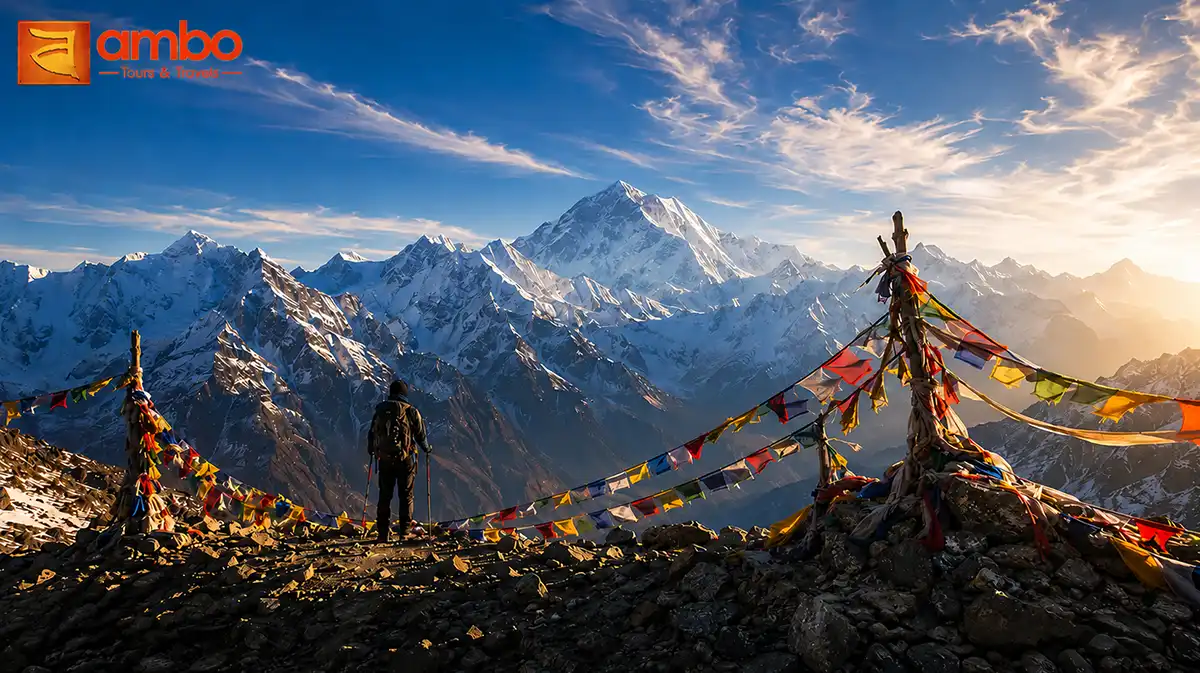
Snowman Trek Bhutan — One of the World's Hardest Treks
Paro - Thimphu - Punakha - Gasa - Bumthang
Tour Information
- Crosses 11 high mountain passes — including Rinchen Zoe La at 5,320m
- The remote Lunana district — one of the most isolated inhabited regions on earth
- Views of Gangkhar Puensum (7,570m) — world's highest unclimbed peak
- Ancient Lunana villages and yak herder settlements unchanged for centuries
- Blue sheep, Himalayan wolf, and black-necked crane habitat
- Trekking in Bhutan's Himalayan rain shadow — best visibility of any trek
- One of fewer than 1,000 people who complete this route each year
Snowman Trek Bhutan — 28-Day Expedition
The Snowman Trek Bhutan is widely regarded as one of the most challenging and most breathtaking long-distance treks on earth — a 28-day expedition through remote high-altitude passes, ancient highland villages, glacial lakes, and the legendary wilderness of the Lunana region. Fewer trekkers complete the Snowman Trek each year than summit Mount Everest, and Ambo Tours is proud to offer one of the most carefully supported expeditions available in Bhutan.
This Bhutan trek begins with acclimatisation in Paro — including a hike to Tiger's Nest Monastery (Taktsang) — before the trail heads north through rhododendron and conifer forest to the base of Mount Jhomolhari (7,314 m). From there, the Snowman Trek Bhutan crosses more than a dozen high passes above 4,500 m, traverses the remote settlements of Laya and Lunana, and reaches the highest campsite at Jichu Dramo (5,050 m) before descending to the motor road and returning through Thimphu and Paro for departure. Throughout the entire journey, the experienced licensed guides and logistics crew of Ambo Tours handle every detail — camp, meals, permits, and mountain safety.
Whether you are an experienced high-altitude trekker searching for Bhutan's ultimate wilderness challenge or a seasoned adventurer adding this legendary route to a lifetime of journeys, the Snowman Trek with Ambo Tours delivers everything the Bhutan travel guide literature has promised — and more. Scroll through the complete 28-day Bhutan itinerary below and contact Ambo Tours to discuss availability, fitness requirements, and preparation for your expedition.
Tour Pricing
28 Days Bhutan Journey — Cost
All prices in USD per personCost includes Sustainable Development Fee (SDF) of US $100 per person per night and Bhutan Visa Fee of US $40 per person. Entrance fees for monuments and festival visits are paid separately.
Detailed Itinerary
Your Snowman Trek Bhutan adventure begins the moment the plane banks between ridgelines on final approach to Paro International Airport. On clear days, the sacred peaks of Jhomolhari and Jichu Drake dominate the horizon — the very mountains you will stand beneath in just a few days. The Ambo Tours guide and driver meet you at arrivals and transfer you to your hotel.
In the afternoon, begin your Bhutan sightseeing with a visit to Ta Dzong — a fortified watchtower now serving as the National Museum of Bhutan, housing ancient thangka paintings, armour, and a fascinating philatelic display. Walk the trail down to Rinpung Dzong (built 1646), its wooden galleries lined with vivid murals illustrating Bhutan Buddhist culture.
In the evening, stroll through Paro town, browse the market, and meet the locals — a warm introduction to life in this kingdom. Dinner and overnight in Paro.
Tomorrow, an acclimatisation hike to Tiger's Nest Monastery prepares your lungs for the high passes ahead.
Before the Snowman Trek begins in earnest, Ambo Tours takes you on the finest acclimatisation hike in Bhutan — the legendary climb to Taktsang Monastery (Tiger's Nest), perched 900 metres above Paro Valley at 3,100 m. Guru Rinpoche is said to have flown here on the back of a tigress in the 8th century to meditate in a cave beneath where the monastery now stands.
The trail winds through blue pine forest past expanding views and prayer flags. Lunch is served at the halfway cafeteria with the monastery framed dramatically above. Explore the inner sanctuaries before hiking back to Paro — your legs and lungs will thank you for this preparation.
Tip: Wear the same boots you plan to trek in — this is the perfect break-in day. Dinner and overnight in Paro.
Tomorrow the Snowman Trek Bhutan officially begins with a drive to the trailhead at Zangkipang.
The moment has arrived. Your Ambo Tours crew loads the equipment and drives through apple orchards and conifer forests to the trailhead at Zangkipang, where the Snowman Trek officially starts. Today's stage is intentionally gentle — a gradual walk along the Paro Chhu river through rhododendron and conifer forest, crossing several clear mountain streams.
After two to three hours of steady hiking, you reach Shingkharap — a wide open area with a lone farmhouse that traditionally serves as a rest stop for highland traders. Push a little further to your first campsite at 3,110 m, where the Ambo Tours support crew will have tents pitched and a warm meal ready.
Tip: Use this easy first day to check your pack weight and boot fit — small adjustments now save big discomfort later. Dinner and overnight at camp.
Tomorrow the trail follows the Pa Chhu river deeper into the mountains toward Soi Thangkha.
The trail today follows the Pa Chhu (Paro River) through a canopy of pine, oak, and spruce — one of the most beautiful forested sections of the entire Snowman Trek Bhutan. The path ascends and descends in a steady rhythm, with the river always audible through the trees.
Your Ambo Tours cook team serves hot lunch at a bridge crossing on the left bank. After lunch, the trail climbs through dense rhododendron forest before crossing the river again to reach camp at Soi Thangkha at 3,750 m. The night sky here, away from any light pollution, is extraordinary.
Tip: Begin using trekking poles from today — the terrain becomes more demanding from here onward. Dinner and overnight at camp.
Tomorrow you push above the treeline toward the iconic Jangothang base camp beneath Jhomolhari.
Today marks the transition above the treeline into true high-altitude Bhutan landscape. The trail climbs past an army camp and then breaks free of the last trees into open sky and yak pastures. Pass a mani wall and enter yak herder territory, where barley, potatoes, and turnips grow in small stone-walled plots.
Your Ambo Tours guide arranges lunch inside a yak herder's camp — a deeply authentic encounter with the highland communities that live at this altitude year-round. Pass through the settlements of Soe and Takethang before crossing a final plateau to arrive at Jangothang at 4,040 m.
The campsite view stops you in your tracks — Mount Jhomolhari (7,314 m) and Jichu Drake (6,989 m) tower directly above. Dinner and overnight at camp.
Tomorrow is an acclimatisation day at Jangothang — use it wisely, as the high passes ahead demand it.
Jangothang is one of the most dramatic base camps in the Himalayas, and today Ambo Tours gives you a full day to acclimatise and explore. The flat grassy valley floor sits beneath the colossal face of Mount Jhomolhari, with an ancient ruined fortress on a hillock in the foreground.
The recommended acclimatisation hike heads north on an open slope, climbing gradually to around 4,895 m — higher than Mont Blanc — for views of Jhomolhari that most visitors to Bhutan never see. Keep eyes open for rare blue sheep, griffon vultures, golden eagles, and Bhutan's national flower, the blue poppy.
Most trekkers show early signs of altitude sickness here — headache and reduced appetite are normal. Rest, hydrate, and eat well. Dinner and overnight at camp.
Tomorrow the route crosses the first major pass, Ngye La (4,700 m), toward Lingshi.
The first serious pass day of the Snowman Trek starts early. The trail follows a stream before crossing a bridge and climbing steeply to the first ridge — where Jhomolhari (7,314 m), Jichu Drake (6,989 m), and Tsherim Gang (6,789 m) appear together in one breathtaking panorama.
Continue across a flat valley before the final push to Ngye La pass at 4,700 m, draped in prayer flags. The descent is gradual, with Lingshi Dzong appearing on its hilltop long before you reach the valley. Your Ambo Tours guide sets a pace that keeps the group together safely.
Camp at Lingshi at 4,010 m. Dinner and overnight at camp.
Tomorrow begins with a visit to the remarkable Lingshi Dzong before continuing to the charming village of Chebisa.
Begin the morning with a visit to Lingshi Dzong — perched on a commanding hilltop with views of green valleys and snow-capped peaks. For centuries this dzong served as both a pilgrim way station and a defence fortress against Tibetan and Mongol forces. It remains one of the most isolated and atmospheric Bhutan dzong sites in the country.
Today's trek is one of the gentler stages on the Snowman Trek Bhutan — a pleasant walk through highland villages and yak herder camps. The destination is Chebisa — a charming small village adorned by a crystal-clear waterfall tumbling directly behind the settlement.
Camp beside the stream at 3,850 m — one of the most picturesque campsites of the entire journey. Dinner and overnight at camp.
Tomorrow brings the long climb to Gogu La pass (4,500 m) — blue sheep sightings are common near the summit.
The day opens with a demanding four-hour climb to Gogu La pass (4,500 m). Near the rocky summit, blue sheep graze on steep terrain inaccessible to most creatures. The views from the top justify every laboured step of the ascent.
Descend through rhododendron bushes to a sheltered lunch stop. The afternoon rolls through intermittent ascents and descents, crossing streams and passing yak herder camps before arriving at Shakshepasa at 3,980 m. A final steep climb up the north side of the valley brings you to camp at Shoumuthang at 4,250 m.
Your Ambo Tours cook team will have a hot meal waiting. Dinner and overnight at camp.
Tomorrow crosses Jari La pass (4,700 m) and descends to the grazing grounds of the rare Himalayan Takin.
The trail opens through edelweiss-edged meadows before the climb to Jari La pass at 4,700 m. To the south-east, Kangbum (6,526 m) fills the skyline — a view that rewards the hard morning push.
Descend into the Tsarijathang Valley — a wide summer grazing ground and one of the few places on earth where you may encounter the Himalayan Takin in its natural habitat. These extraordinary creatures, Bhutan's national animal, roam here in small herds during autumn. Your Ambo Tours guide knows where to look.
Cross the stream — the footbridge is frequently washed out, so a wet crossing may be needed — and climb to the rocky meadow camp at Robluthang at 4,200 m. Dinner and overnight at camp.
Tomorrow is the most demanding day of the first half — the crossing of Shingchen La at 5,005 m.
Today you cross the highest pass of the first section of the Snowman Trek Bhutan — Shingchen La at 5,005 m. The climb is long and demanding, threading through boggy patches, streams, marmot-hole terrain, and moraine fields. The summit view of Gangchenta (Tiger Mountain, 6,840 m) filling the northern horizon makes every laboured breath worthwhile.
The descent follows rough moraine terrain to the Kango Chhu River. Another stream crossing may be wet. After cedar forest, the trail opens into the scattered meadow of Lingmithang at 4,140 m, with Tiger Mountain towering behind your campsite.
Your Ambo Tours support team deserves recognition today. Dinner and overnight at camp.
Tomorrow, a comparatively gentle walk leads to Laya — the second-highest settlement in Bhutan.
Wake to the sight of Gangchenta peak framed above camp in the early morning light. Today's walk to Laya village is the shortest stage of the Snowman Trek and one of the most pleasant — a mossy, damp forest filled with birdsong gives way to sweeping mountain views as the trail descends into the valley.
Laya sits at 3,800 m and is the second-highest permanent settlement in Bhutan — home to the Layap people, whose culture and dress remain distinctly their own. Your Ambo Tours guide introduces you to the village with appropriate cultural context.
Arrive mid-morning with time to rest and explore before dinner. Overnight at camp in Laya.
Tomorrow is a rest day in Laya — experience the extraordinary hospitality of one of Bhutan's most unique highland communities.
Laya is one of the great Bhutan hidden gem experiences — and today Ambo Tours gives you a full day to explore it freely. Doors open readily to visitors here, and a cup of butter tea or local chang (barley wine) is offered without hesitation.
The women of Laya wear distinctive black wool kiras and tall conical bamboo hats decorated with turquoise, silver ornaments, and strings of beads — a style found nowhere else in the kingdom. Watch daily life unfold: weaving, herding, and the quiet rhythms of a community unchanged for centuries.
Use the day to rest your legs, check equipment, and prepare mentally for the remote Lunana section ahead — the most isolated stretch of the entire Snowman Trek Bhutan. Dinner and overnight at camp in Laya.
Tomorrow the trek resumes toward Rodophu, climbing above the treeline into the glacial valleys approaching Lunana.
Leaving Laya, the trail drops to the Lunana trail junction before climbing to a hilltop with wide views over the Mo Chhu and Rhodo Chhu rivers. This is the start of the most remote section of the Snowman Trek Bhutan — a route that fewer than a few hundred trekkers complete each year.
The route follows the Rhodo Chhu valley through mixed conifer forest before breaking above the treeline. From a large rockslide, a stunning view of a glacial valley unfolds, with a massive glacier on the flanks of Tsenda Gang (7,100 m).
Camp at Rodophu at 4,160 m, just beyond a wooden bridge. Your Ambo Tours cook team will have warm food and hot drinks ready. Dinner and overnight at camp.
Tomorrow the route climbs to Tshomo La pass (4,915 m) with views of Jhomolhari and the Tibetan border.
Today's stage takes the Snowman Trek to its highest campsite so far. The trail follows the river through rhododendron scrub before turning right up a long valley climb to Tshomo La pass at 4,915 m. At the summit, views of Mount Jhomolhari and the distant Tibetan plateau stretch across the horizon — one of the finest panoramas of the entire Bhutan trek.
From the pass, the route descends onto a barren high plateau intersected by yak trails. Navigation here requires the experience your Ambo Tours guide brings. Camp at Narithang at 4,900 m — your highest camp yet on this Bhutan itinerary.
Tip: Eat a full dinner even if appetite is suppressed — your body needs fuel for tomorrow's pass. Dinner and overnight at camp.
Tomorrow you cross Ganglakarchung La (5,120 m) — one of the highest points on the entire Snowman Trek.
Ganglakarchung La at 5,120 m is among the most spectacular passes on the Snowman Trek Bhutan. The summit panorama includes Kangbum (6,530 m), Tsendhen Gang (7,100 m), Teri Gang (7,300 m), and Jejegangphu Gang (7,120 m) — four of Bhutan's highest peaks visible at once.
Descend through massive moraine fields to the edge of a cliff where glacial tongues from Teri Gang feed two turquoise lakes far below. One of these lakes burst its moraine dam in 1961, sending a catastrophic flood that destroyed the Mochu Bridge at Punakha.
Continue down into the Tangchu valley to camp at Tarina at 4,350 m. Dinner and overnight at camp.
Tomorrow, waterfalls and juniper forest lead to Woche — the first village of the Lunana region.
The trail from Tarina passes through juniper forest along the Tangchu River, flanked by dramatic waterfalls cascading from cliffs above — one of the most visually striking walking sections of the Snowman Trek.
After a gentle climb, a steep final ascent leads to Woche Village — the first settlement in the legendary Lunana region, at 4,350 m. Arriving here on foot carries genuine weight — Lunana is among the most remote inhabited places on earth and a true Bhutan hidden gem.
Your Ambo Tours guide introduces you to the community here. Dinner and overnight at camp in Woche.
Tomorrow, the trail climbs to Keche La pass (4,650 m) before descending to the Lunana hub of Lhedi.
Climb from Woche over moraine to Keche La pass (4,650 m) — a summit marked by prayer flags and framed by the striking three-pronged peaks of Jejegangphu Gang. A clear glacial lake sits just below the pass, its colour shifting between blue and green with the light.
Descend into the Pochu Valley and pass through Thaga Village at 4,050 m — where bitterly cold winds funnel down the valley in autumn afternoons. The trail follows the Phochu River past scattered settlements and small waterfalls to reach Lhedi at 4,200 m.
Lhedi has a school, a basic health unit, and a wireless station — small signs of connectivity in one of the most isolated places on the Bhutan travel map. Your Ambo Tours team sets camp. Dinner and overnight at camp.
Tomorrow is a more straightforward river trail day toward Thanza.
Today's stage along the north bank of the Phochu River is among the more approachable days on the Snowman Trek Bhutan — a welcome rhythm of river walking and small farmland. Pass through scattered settlements before arriving at Chuzo Village at 4,090 m around midday.
En route, your Ambo Tours guide stops at Chezo Dzong — a small but significant fortified structure that reflects the long tradition of Bhutan dzong architecture even in the most remote corners of the country.
After lunch, follow the riverbed trail and climb a steep hill for a sweeping view over Thanza valley before descending to camp at 4,250 m. Dinner and overnight at camp.
Tomorrow is a rest day in Thanza — explore the medieval-like village or hike to the glacial lakes above.
Thanza is unlike anywhere else on any Bhutan itinerary — a settlement where residents weave their own cloth, fashion their own boots and hats, build homes from stone and hand-hewn wood, and survive on grains, yak meat, and valley cheese. A day here is one of the most powerful Bhutan cultural tour experiences imaginable.
Today Ambo Tours offers two options. The first is a village exploration — visit homes, watch craft-work, and experience Lunana hospitality. The second is a hike to Raphstreng Tsho and Thorthormi Tsho glacial lakes — source of the Phochu River, which burst its moraine dam in 1994 causing catastrophic flooding in Punakha.
From above Thanza, Zongphu Gang (7,100 m) forms a 3,000 m wall of ice and snow directly behind the village. Rest well tonight — the highest camps of the trek lie just ahead. Dinner and overnight at camp.
Tomorrow the route ascends toward Jaze La (5,200 m) and the camp at Tshochena at 5,000 m.
Today marks the beginning of the highest section of the Snowman Trek. Climb south from Thanza to Danji at 4,500 m — a summer yak grazing ground where herds of blue sheep are commonly spotted. The air is thin and the pace must stay deliberate.
From Danji, climb several hundred metres to a ridge with excellent views, then follow the trail to Jaze La pass at 5,200 m. The summit offers views of surrounding peaks in every direction, including the outline of Gangkar Puensum (7,570 m) — the highest unclimbed mountain on earth.
Descend to Tshochena at 5,000 m. Your Ambo Tours support crew will have hot soup and tea ready. Drink plenty of fluids and rest fully. Dinner and overnight at camp.
Tomorrow's camp at Jichu Dramo (5,050 m) will be the highest campsite of the entire Snowman Trek.
This is the roof of your entire Snowman Trek Bhutan experience. The trail follows the shore of a blue-green glacial lake before climbing to a ridge at 5,150 m with a full 360-degree panorama of snowy peaks. On very clear days, the microwave tower at Dochula Pass is visible in the far distance — a surreal reminder of how far you have walked.
Cross a small saddle at 5,120 m and descend into a wide glacial valley. Pass Loju La pass (5,170 m) before arriving at Jichu Dramo camp at 5,050 m — the highest campsite of the entire trek and a Bhutan mountain experience like no other.
Your Ambo Tours team has worked exceptionally hard to establish this high camp. Eat well and keep warm — temperatures drop sharply after dark. Dinner and overnight at camp.
Tomorrow, the descent begins — crossing Rinchen Zoe La (5,350 m), the highest pass of the entire Snowman Trek.
Today you cross Rinchen Zoe La at 5,350 m — the absolute summit of the Snowman Trek Bhutan and one of the highest trekking passes in the Himalayas. The moraine climb is demanding, but the reward is a view of Gangkar Puensum (7,570 m) — the world's highest unclimbed mountain.
Descend through a broad marshy valley threaded with turquoise lakes and steep moraine faces. The route enters rhododendron and juniper forest at Tampe Chu — the return of trees after days of bare, high-altitude terrain feels almost emotional for most trekkers on this Bhutan trek.
Camp at Thongsa Thang at 4,400 m, near Chukarpo. Your Ambo Tours team marks the crossing with a special dinner. Dinner and overnight at camp.
Tomorrow the trail descends to the beautiful turquoise lake camp at Tampetsho (4,320 m).
Descend along the right bank of the river to Galapang yak pasture at 4,025 m, then climb steeply back into a mix of juniper and silver fir forest. The trail to Tampetsho follows a stream upward to one of the trek's most beautiful rewards: a perfectly clear turquoise glacial lake sitting in a natural bowl of steep ridges.
It is one of the finest wild camp settings in all of Bhutan, and your Ambo Tours crew will have tents pitched at the lake's edge at 4,320 m. Take time to sit and appreciate where you are.
Dinner and overnight at camp.
Tomorrow, the last major pass of the Snowman Trek — Tampela La (4,600 m) — leads to the sacred Omtsho Lake.
The final significant pass of the Snowman Trek Bhutan: Tampela La at 4,600 m, where blue sheep are commonly seen on the slopes above the trail. From the summit, the long descent back toward lower Bhutan truly begins.
Descend to Omtsho Lake — a sacred body of water where the great 15th-century saint Terton Pema Lingpa is said to have dived in with a burning butter lamp and emerged carrying hidden dharma treasures — a story central to Bhutan Buddhist culture. Pass prayer flags at the lake outlet before descending steeply past a waterfall to the Nika Chu River.
Walk through mixed forest to arrive at Maraothang at 3,620 m — a wide meadow and your last night under canvas. Your Ambo Tours team marks the occasion. Dinner and overnight at camp.
Tomorrow, the final trekking day — a long descent to the road at Sephu.
The last day of the Snowman Trek is a gradual, triumphant descent through mixed deciduous and bamboo forest. Vegetation grows denser and greener with every metre of altitude lost. The sounds of the forest return: birdsong, rustling leaves, and streams swollen by mountain runoff.
Descend through forest and pasture to a large grassy area above Sephu Village at 2,650 m, where your Ambo Tours vehicle waits on the motor road. The moment you step off the trail onto tarmac carries relief, pride, and — for most trekkers — a pang of sadness that this extraordinary journey is over.
Drive to Punakha for overnight at a hotel. Treat yourself to a long, hot shower. Dinner and overnight at hotel in Punakha.
Tomorrow, drive to Thimphu with stops at Punakha Dzong and the giant Buddha Dordenma statue.
After weeks of raw wilderness, Thimphu will feel almost urban. But first, the drive from Punakha delivers one of the finest sights in all of Bhutan tourism — Punakha Dzong, sitting like an anchored ship at the confluence of the Pho Chhu and Mo Chhu rivers. Built in 1637 and once the capital of Bhutan, its whitewashed towers and golden rooftops are breathtaking from every angle.
Continue to Thimphu via Dochula Pass (3,140 m) — a stop you now view with entirely new eyes after crossing passes twice as high. Check in to your hotel and spend the afternoon at Kuenselphodrang, where the Buddha Dordenma — at 51.5 metres one of the world's largest bronze Buddha statues — gazes across the valley.
The evening is yours to explore Thimphu town and enjoy a restaurant meal. Dinner and overnight at hotel in Thimphu.
Tomorrow, the final drive to Paro and your departure from Bhutan.
The final morning of your Snowman Trek Bhutan expedition with Ambo Tours arrives quietly. After breakfast, the drive from Thimphu to Paro takes just one hour — a journey that once took days on foot. Your guide and driver transfer you to Paro International Airport, and farewells are exchanged with the warmth that comes only from shared hardship and extraordinary landscapes.
The Snowman Trek is one of the most difficult and most beautiful long-distance treks on earth. Fewer people complete it each year than summit Everest. You are now among them. Bhutan measures its wealth by Gross National Happiness (GNH) rather than GDP — and after 28 days here, you understand exactly why. Support sustainable tourism Bhutan, and whenever you are ready to return, Ambo Tours will be here. Safe onwards travels.
Included / Excluded
- ✔All meals — breakfast, lunch, and dinner
- ✔Accommodation on twin / double sharing basis (single supplement extra)
- ✔All transportation within the kingdom including airport transfers
- ✔Sustainable Development Fee — Government tax (SDF)
- ✔Bhutan visa fee
- ✔English-speaking private local guide
- ✔Sightseeing as per itinerary
- ✔Bottled water throughout the journey
- ✖International flights to and from Paro (PBH)
- ✖Entrance fees for museums and monuments
- ✖Gratuities for guides and drivers
- ✖Travel insurance premiums
- ✖Payments for services provided on a personal basis
- ✖Cost for any services not mentioned under "Cost Includes"
- ✖Cost incurred due to mishaps, strikes, political unrest, etc.
- ✖Personal expenses — laundry, beverages, or personal services
Ambo Tours & the 1% Club
Every tour we run includes a contribution to a Bhutanese NGO of your choice — at no extra cost to you. We call this the 1% Club: a minimum of 1% of your trip's profit, or Nu 5,000, whichever is higher, donated on every single journey. You choose where it goes.
What is the Snowman Trek?
The Snowman Trek is Bhutan's most legendary and most demanding long-distance route — a 25-day traverse of the entire Himalayan north of the country, from Paro valley in the west to Trongsa in the central east, passing through the remote Lunana district where some of the highest permanently inhabited villages on earth sit above 4,000 metres. It is considered one of the hardest treks in the world, not because of technical difficulty but because of its length, altitude, remoteness, and the physical and mental demands of sustained wilderness travel far from any road or evacuation route.
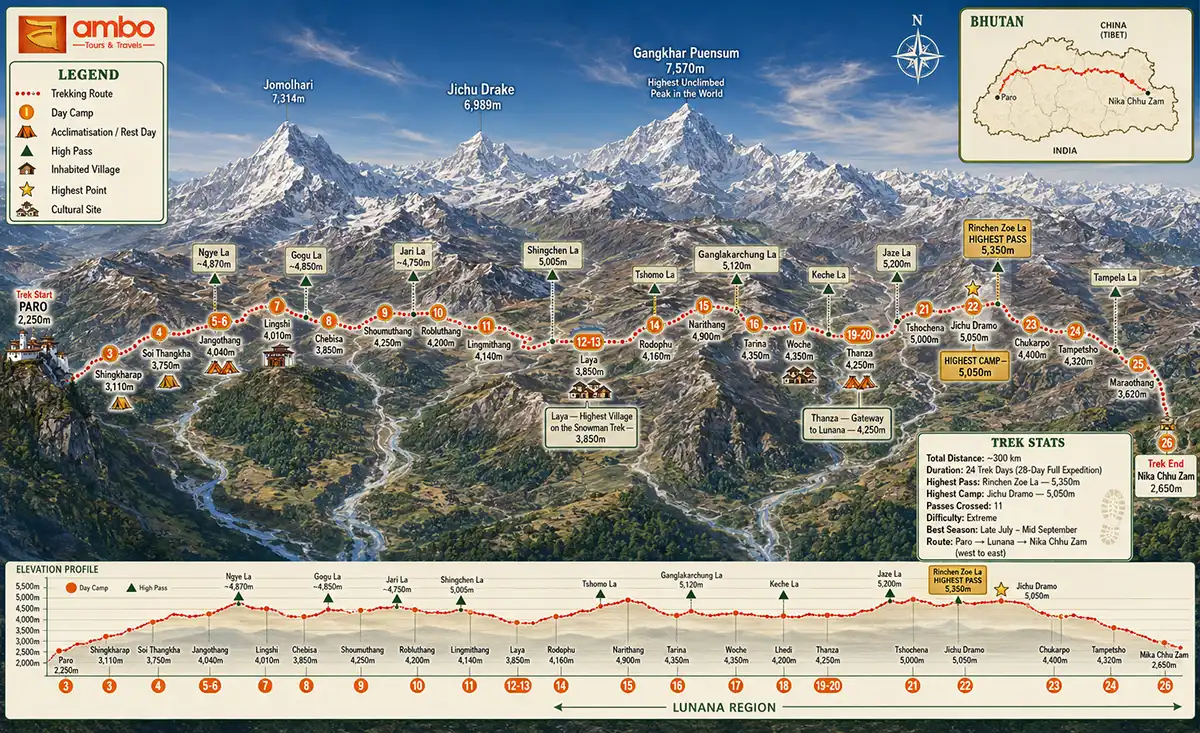
The trek crosses 11 high passes, the highest of which is Rinchen Zoe La at 5,320 metres. For much of the central section trekkers are five to seven days from the nearest road in any direction. Supply routes depend on yak caravans. The landscape shifts from the pine forests and river valleys of western Bhutan into the open, wind-swept plateau terrain of Lunana — a region of glacial lakes, permanent snowfields, and skies of a clarity that few places on earth can match.
Ambo Tours runs this trek as a 25-day expedition beginning with cultural days in Paro and Thimphu, trekking from Drukgyel Dzong through to Nikka Chhu near Trongsa, and closing with cultural days in Punakha and Paro including Tiger's Nest on the final morning.
Difficulty, Altitude & Fitness Requirements
The Snowman Trek is graded Extreme. It is the most demanding trek in Ambo Tours' portfolio and one of the most demanding in Asia. The challenges are cumulative rather than concentrated — no single day is the hardest, but the sustained physical and psychological demands of 25 days in high-altitude wilderness are unlike anything most trekkers have experienced.
The altitude profile: You begin at Paro (2,280m) and spend the majority of the route above 4,000 metres. The highest pass, Rinchen Zoe La, reaches 5,320m. Several other passes exceed 5,000m. Trekkers who have completed the route describe days 12–18 through Lunana as the most sustained high-altitude walking they have encountered anywhere in the Himalayas.
Daily distances range from 10 to 22 kilometres over 5–8 hours of walking. Some days involve back-to-back pass crossings above 5,000 metres. Rest days are built into the itinerary but the terrain rarely offers easy walking even on shorter stages.
Who should attempt this trek: Experienced high-altitude trekkers who have completed multi-day treks above 4,500 metres, have strong cardiovascular fitness, and can commit fully to the time and preparation required. A minimum of 6 months of dedicated fitness training before departure is recommended. Prior completion of the Druk Path Trek or a comparable Himalayan route is strongly advised.
Who should not attempt this: Anyone without prior high-altitude trekking experience, anyone with cardiac or respiratory conditions, or anyone who cannot commit to the full itinerary. The Snowman Trek has a completion rate of under 50% — the most common reason for abandonment is underestimating the cumulative physical demands.
A Typical Day on the Snowman Trek
Wake-up tea at 5:30am. At this altitude and latitude, the first light comes early and the air is cold — even in August, temperatures above 4,500 metres drop to near freezing before dawn. Breakfast by 6:15: hot porridge, eggs, toast, Bhutanese butter tea. Camp is struck and loaded onto yaks while you eat.
Most days begin walking by 7:00am. The pace is deliberate — at altitude, rushing is both uncomfortable and dangerous. Your guide sets a rhythm suited to the day's demands. Pass-crossing days begin with a long steady ascent through boulder fields and scree, often in silence broken only by wind and the sound of yak bells. The passes themselves offer panoramic views across the Himalayan chain that are the reward for everything the route asks of you.
Lunch at a sheltered spot, usually between 11:00am and 1:00pm — hot food prepared by the cook team who have moved ahead. Arrival at camp in the early to mid-afternoon. The hours between arriving and dinner are for rest, hydration, and recovery. In Lunana, the evening light on the surrounding peaks is extraordinary.
Dinner at 6:00pm in the dining tent. The social rhythm of camp — the shared meals, the conversations, the mutual support among trekkers — becomes one of the defining memories of the route. Lights out early: the body needs sleep at altitude, and most trekkers find they want it.
Altitude Sickness on the Snowman Trek
Altitude sickness management on the Snowman Trek is not a precaution — it is a core part of the itinerary. With multiple nights above 5,000 metres and extended time in the 4,000–4,500m range, AMS is a near-universal experience in some form, and recognising the difference between normal acclimatisation symptoms and dangerous progression is essential.
Normal symptoms above 4,000m: headache, reduced appetite, mild nausea, fatigue, disrupted sleep. These are expected and manageable with rest, hydration, and paracetamol. The rule is absolute: do not ascend with symptoms. The itinerary includes built-in acclimatisation days precisely for this.
Dangerous symptoms requiring immediate descent: severe headache unresponsive to medication, loss of coordination, confusion, dry cough that becomes wet and persistent (HAPE), or extreme fatigue and breathlessness at rest (HACE). These require descent of 500–1,000 metres immediately. In Lunana, evacuation by road is not possible — helicopter evacuation is the only option and is weather-dependent. This is not a reason to avoid the trek; it is a reason to prepare properly and recognise symptoms early.
What Ambo Tours provides: Guides trained in altitude sickness recognition, pulse oximeters at every camp above 4,000m, supplemental oxygen carried for emergencies, and an itinerary designed around responsible acclimatisation. Acetazolamide (Diamox) is strongly recommended for this trek — consult your doctor before departure.
Best Time for the Snowman Trek
The Snowman Trek has the most restricted seasonal window of any trek in Bhutan — and the timing is counterintuitive.
Late July to mid-September is the only viable season. The Lunana region sits in a Himalayan rain shadow and receives dramatically less monsoon rainfall than the rest of Bhutan — while Paro and Thimphu are experiencing heavy monsoon rain, Lunana is often clear and dry. This makes summer the optimal window for the central section of the trek. Temperatures at altitude are at their most manageable, wildflowers cover the high pastures, and the passes are snow-free.
October is tempting but risky. Early snowfall on the high passes — particularly Rinchen Zoe La — can close the route by mid-October. Some years October is clear; others, an early snowfall makes completion impossible. Ambo Tours does not recommend October departures for this reason.
All other months are not viable. The high passes hold deep snow from November through June, and the route is effectively closed. There are no exceptions — the Snowman Trek is a summer trek.
Booking lead time: Government permits for the Lunana region are strictly limited and are allocated months in advance. For a July or August departure, permits should be secured by February at the latest. Contact Ambo Tours early — this trek books out.
Frequently Asked Questions
The Snowman Trek is rated Extreme — it is widely considered one of the most demanding treks in the world. The route crosses 11 high mountain passes, spends multiple weeks above 4,000 metres, and covers over 300 kilometres through the remote Lunana district. Fewer than half of trekkers who attempt it complete the full route. Prior Himalayan trekking experience above 4,500 metres is essential.
The Snowman Trek takes approximately 25 days of active trekking. The Ambo Tours itinerary runs over 25 days including cultural days in Paro, Thimphu, and Punakha before and after the trek. The trekking portion begins at Drukgyel Dzong in Paro and ends at Nikka Chhu near Trongsa.
The highest pass on the Snowman Trek is Rinchen Zoe La at approximately 5,320 metres, crossed during the Lunana section of the route. Several other passes exceed 5,000 metres. Trekkers spend extended periods above 4,500 metres and must be fully acclimatised before attempting the high passes.
The only viable season for the Snowman Trek is late July to mid-September. Unusually for Bhutan, the Lunana region lies in a Himalayan rain shadow and receives far less monsoon rainfall than the rest of the country — making summer the best window. October brings early snowfall on the high passes that can make the route impassable.
The Snowman Trek requires a standard Bhutan visa (USD 40), the Sustainable Development Fee (USD 100/night), and special restricted area permits for the Lunana region. Permit numbers are strictly limited by the Bhutanese government. Ambo Tours handles all permit logistics — early booking is essential as permits sell out months in advance.
The Snowman Trek cannot meaningfully be shortened and retain the full experience — the remote Lunana section in the middle of the route is its defining feature. However, some trekkers complete the first half (Paro to Lunana) and exit by helicopter from Thanza when weather permits. Ambo Tours can advise on exit options during the planning stage.
Ready to Begin Your Journey?
Our Thimphu team responds within 24 hours. Tell us your dates and we will handle the rest.