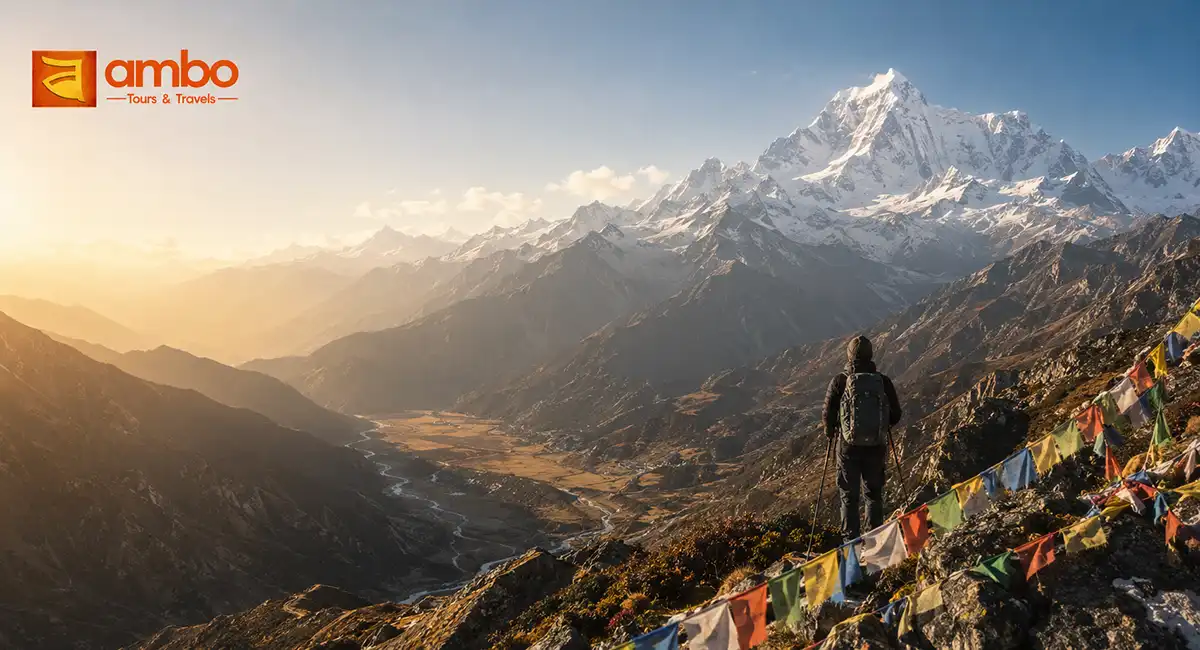
Gangkhar Puensum Trek Bhutan — The World's Highest Unclimbed Peak
Paro - Thimphu - Punakha - Bumthang
Tour Information
- Closest public access to Gangkhar Puensum (7,570m) — world's highest unclimbed peak
- Remote Lunana region — one of the least visited areas on earth
- Multiple nights above 4,000 metres in pristine alpine wilderness
- Ancient yak herder trails unchanged for centuries
- Views of the permanent Himalayan snowfields from base camp
- Crossing high passes with panoramas of Bhutan's northern border range
- Bumthang cultural immersion before and after the trek
The Gangkhar Puensum Trek Bhutan is one of the most extraordinary high-altitude expeditions in the Himalayan kingdom — a raw, remote journey through the sacred highlands of Bumthang district toward the base of Gangkhar Puensum (7,570 m), the world's highest unclimbed peak. For 18 days, the trek traverses vast alpine pastures, glacial basins, and ancient yak-herding routes that most travellers — and most trekkers — never reach. Ambo Tours places you deep into this wilderness on a fully supported Bhutan travel guide-worthy journey combining high-altitude trekking with Bhutan's finest cultural sights.
This Bhutan trek package begins in Paro — with Rinpung Dzong and the National Museum (Ta Dzong) — before a scenic domestic flight to Bumthang, Bhutan's spiritual heartland. The trek departs from Naspe Village and climbs steadily through rhododendron forest, alpine meadows, and high glacial terrain, reaching camp at Zhigeyphu (4,980 m) — the closest accessible point to the great unclimbed massif. The return route traverses new terrain via Tsoshap and Lambrong before descending to Bumthang. The final days add the grandeur of Punakha Dzong, the immersive cultural streets of Thimphu, and the defining hike to Tiger's Nest Monastery (Taktsang) in Paro as an unforgettable close.
Gangkhar Puensum remains unclimbed — Bhutan closed its high peaks to mountaineering in 1994 out of respect for local spiritual beliefs — making this base approach trek the most intimate encounter possible with the mountain's presence. For visa information, see our Bhutan visa and entry guide. For the best season, visit our best time to visit Bhutan page — October and April offer the clearest skies and most stable conditions. For costs, read our cost of travelling to Bhutan guide. Scroll through the complete 18-day Bhutan trek itinerary below and contact Ambo Tours to reserve your expedition dates.
Tour Pricing
18 Days Bhutan Journey — Cost
All prices in USD per personCost includes Sustainable Development Fee (SDF) of US $100 per person per night and Bhutan Visa Fee of US $40 per person. Entrance fees for monuments and festival visits are paid separately.
Detailed Itinerary
Your Gangkhar Puensum Trek Bhutan journey begins with one of commercial aviation's most dramatic arrivals. The plane banks between Himalayan ridgelines into Paro International Airport — on a clear day, the snow-capped summits of Mount Jomolhari and Mount Jichu Drake appear in the window. Your Ambo Tours guide welcomes you at arrivals with light refreshments and begins your first afternoon of Paro sightseeing.
- Ta Dzong — National Museum of Bhutan — a former circular watchtower converted into a national museum housing traditional Bhutanese art, ancient weaponry, and historical artefacts that offer essential context for the landscapes and culture you will encounter throughout this expedition.
- Rinpung Dzong (Fortress of the Heap of Jewels, built 1646) — the administrative and monastic centre of Paro district, with beautifully painted murals, ornate timber courtyards, and a commanding position above the Paro River.
- Paro Town — a leisurely evening stroll through local shops, traditional painted farmhouses, and market stalls draped in prayer flags. A gentle introduction to everyday Bhutanese life before the wilderness ahead.
Dinner and overnight in Paro.
Tomorrow, a scenic domestic flight carries you east to Bumthang — Bhutan's spiritual heartland — for a full afternoon of temple sightseeing before the trek begins.
After breakfast, a short domestic flight from Paro to Bumthang offers sweeping aerial views of forested valleys, winding rivers, and — on clear days — a panorama of snow-capped Himalayan peaks that sets the tone for the high-altitude terrain ahead. Bumthang is Bhutan's spiritual heartland: a cluster of four sacred valleys containing some of the kingdom's oldest and most revered temples.
- Jambay Lhakhang — one of Bhutan's oldest temples, built in the 7th century by Tibetan King Songtsen Gampo as one of 108 temples raised simultaneously across the Himalayan region. Its simple ancient architecture and sacred relics draw pilgrims from across the country.
- Kurjey Lhakhang — built around a rock bearing the body imprint of Guru Rinpoche, who meditated here and brought Bhutan Buddhist culture to the valley. One of the most important pilgrimage sites in the kingdom.
- Tamshing Monastery — founded by treasure-revealer Terton Pema Lingpa, known for its remarkable historic murals and active prayer halls.
- Kharchu Dratsang — a major monastic school offering insight into the daily life and study routine of young monks in Bhutan.
- Jakar Dzong — the Castle of the White Bird, overlooking the Bumthang valley from its hilltop position. It serves as both Bumthang's administrative and spiritual centre, and its silhouette against the surrounding ridgelines is one of the most striking in the country.
Dinner and overnight at a guesthouse in Bumthang. Rest well — the trek begins tomorrow.
Tomorrow the trail starts from Naspe Village and the real wilderness of the Gangkhar Puensum Trek begins.
After an early breakfast in Bumthang, your Ambo Tours driver takes you through scenic valleys and pine forest to Naspe Village — the official starting point of the Gangkhar Puensum Trek Bhutan. Meet your trekking crew, check equipment, and step onto the trail.
The path climbs gradually through mixed pine, fir, and rhododendron forest along mountain streams. Small stone shelters used by seasonal yak herders appear at intervals along the trail. As you gain altitude, the forest opens and distant ridgelines come into view. The landscape is immediately immersive — unhurried, layered, and entirely unlike the valley life left behind in Bumthang.
By late afternoon, arrive at Sadrusum — a tranquil campsite set in a broad alpine meadow surrounded by forested slopes and rolling highland terrain. This is your first night fully immersed in Bhutan's remote mountain wilderness.
Tip: Drink plenty of water and eat a full dinner. The altitude will increase significantly over the next four days. Overnight camp at Sadrusum.
Tomorrow the trail climbs into bamboo groves and high-altitude rhododendron forest toward the open alpine pastures of Tshampa.
Today's trek is the longest of the outward journey — and one of the most scenic. The trail climbs steadily through dense bamboo groves and high-altitude rhododendron forest, the canopy gradually thinning as you gain elevation. Wide alpine slopes open above the treeline, with cooler air and expanding panoramas across distant ridgelines and valleys.
The path crosses small mountain streams and traditional yak trails. Himalayan birds — including Impeyan pheasants, the national bird of Nepal, and various high-altitude raptors — are often spotted along this section. The scale of the landscape grows with every hour of walking.
By afternoon, arrive at Tshampa — a spacious yak-grazing pasture set in open meadows with wide panoramic views and beautiful evening light over the surrounding mountains. Tshampa is a camp you will return to on the descent, so take note of the terrain and the particular quality of silence at this altitude.
Overnight camp at Tshampa.
Tomorrow the trail continues across rolling alpine terrain toward the high basin of Shingo at 4,200 m.
Leave Tshampa and continue across rolling alpine terrain, following traditional yak herding routes over gentle ridges and wide plateaus. The vegetation becomes sparser as you climb — grassland gives way to rocky patches and open gravel terrain, and the air noticeably thins. On clear days, distant snow-dusted peaks appear on the horizon in every direction.
The trail undulates through open high-altitude landscape with uninterrupted views of the wider Bhutan Himalaya. This is one of the most meditative walking days of the trek — long, wide, and quiet, with few signs of human presence beyond the occasional cairn or prayer flag.
By late afternoon, arrive at Shingo — a striking high-altitude campsite set in a broad mountain basin beneath towering ridgelines. The silence and vastness of the landscape at Shingo create a powerful sense of remoteness and scale. Spend the evening acclimatising gently and drinking warm fluids.
Overnight camp at Shingo.
Tomorrow the trail reaches Bamarpa (Burtsham) at 4,550 m — the last staging camp before the high glacial approach to Zhigeyphu.
Today's route continues through expansive alpine pastures and open highland terrain used by yak herders during the summer months. The trail crosses small glacial-fed streams and gently climbs across wide valleys with sweeping views of rugged peaks and distant ridges. The environment becomes increasingly raw and remote — vegetation thins to near-zero, and the horizon opens up in every direction.
The Gangkhar Puensum Trek Bhutan reaches its most elemental character in this section. The quiet is not the quiet of a forest — it is the quiet of geological time. Enormous mountain walls, open sky, and the wind across empty grassland.
By afternoon, arrive at Bamarpa (Burtsham) — a dramatic high-altitude pasture surrounded by towering mountains and vast open sky. This is base camp for the acclimatisation day ahead and the gateway to the glacier approach. Spend the remainder of the afternoon resting, photographing, and quietly absorbing the grandeur of the high Himalayas.
Overnight camp at Bamarpa / Burtsham.
Tomorrow is a full acclimatisation day — with optional ridge walks and spectacular views of glacial valleys — before the demanding climb to Zhigeyphu begins.
Spend a full day acclimatising in this spectacular high-altitude basin. At 4,550 m, your body needs time to adjust before the climb to Zhigeyphu (4,980 m) tomorrow. The golden rule of high-altitude trekking — climb high, sleep low — has brought you here deliberately.
Optional short walks lead to nearby ridgelines with breathtaking views over glacial valleys and surrounding snow-capped peaks. Yak herds may be visible grazing in the distance. Prayer flags flutter along high points. The rest of the day is reserved for rest, hydration, and quiet observation of the mountain environment.
Tip: Drink at least three to four litres of water throughout the day. Eat a full lunch and dinner regardless of appetite — altitude suppresses hunger but your body requires fuel. Report any persistent headaches or nausea to your guide immediately. Overnight camp at Bamarpa / Burtsham.
Tomorrow — the highest camp on the entire trek. The glacial terrain of Zhigeyphu awaits.
This is the defining day of the Gangkhar Puensum Trek Bhutan. From Burtsham, the trail enters dramatic glacial terrain beneath towering rock walls and snow-streaked cliffs — the outer flanks of the Gangkhar Puensum massif, the world's highest unclimbed peak at 7,570 m.
The trail follows broad alpine basins carved by ancient glaciers, crossing small icy streams and open gravel flats. Ice-polished boulders and moraine ridges mark the passage of retreating glaciers. The sense of remoteness deepens with every step as the landscape becomes more rugged and the scale more overwhelming.
By afternoon, arrive at Zhigeyphu — one of the highest camps on any trek in Bhutan, set in a wild, remote cirque surrounded by sheer mountain walls and high ridgelines. The views here are vast and unforgettable, particularly in the golden light of late afternoon. This is as close as any visitor can legally approach the great unclimbed summit.
Bhutan closed its peaks above 6,000 m to climbing in 1994 out of deep respect for local spiritual beliefs — making this camp the ultimate encounter with Gangkhar Puensum. Breathe slowly. Look long. Overnight camp at Zhigeyphu.
Tomorrow is a full exploration and acclimatisation day at the high camp — the summit viewpoint experience of a lifetime.
Spend a full day resting and exploring the dramatic high-altitude surroundings of Zhigeyphu. Optional short walks lead to nearby viewpoints overlooking expansive glacial valleys, ice-polished slopes, and the distant snow-covered walls of Gangkhar Puensum — the world's highest unclimbed mountain.
The crisp mountain air, the silence, and the immense scale of the landscape make this one of the most memorable and humbling locations of the entire journey. No crowds. No infrastructure. Just glacial wilderness and one of the great untouched summits of the earth above you.
Photographers will want the early morning light — the mountain faces glow in the first hour after sunrise. Spend the afternoon reading, writing, or simply sitting with the view. This day exists as much for the spirit as for the body. Overnight camp at Zhigeyphu.
Tomorrow begins the long descent back toward lower ground — 24 km to Tshampa on the most demanding walking day of the trek.
A long but deeply rewarding day. From Zhigeyphu, the trail retraces alpine basins and rolling slopes, gradually descending from stark glacial terrain back toward the greener meadows and yak pastures of Tshampa. As altitude is lost, vegetation returns, the air warms, and breathing becomes easier — a visceral reminder of how high you have been.
The descent covers 24 km and takes seven to eight hours at a steady pace. The terrain is familiar from the ascent but reveals different details in the downhill direction — valleys that were ahead are now behind, and the panorama shifts constantly. Start early and maintain a comfortable, consistent pace.
Arrive at Tshampa by late afternoon. The familiar open meadows and sheltered campsite provide a welcome sense of comfort after three nights in the high glacial section. A hot meal and a long sleep are well earned.
Overnight camp at Tshampa.
Tomorrow the route diverges from the outward path — climbing into a new high hanging valley toward Tsoshap for the return traverse.
From Tshampa, today's route diverges from the outward path and climbs steadily into a high hanging valley — one of the most dramatically remote sections of the entire Gangkhar Puensum Trek Bhutan. The trail crosses rocky slopes, alpine grasslands, and narrow ridgelines, with wide views across distant valleys and layered mountain ranges opening on all sides.
This section of the trek feels especially quiet and rarely walked. Few trekkers take this return traverse, making the terrain feel genuinely unexplored. By afternoon, arrive at Tsoshap — a secluded campsite nestled in a high alpine bowl, surrounded by steep ridges and open sky. The stillness here is complete.
Overnight camp at Tsoshap.
Tomorrow the trail descends through dramatic high mountain terrain toward the broader valley floor of Lambrong.
Today's route traverses high mountain terrain, contouring along ridgelines and open slopes with wide Himalayan views. The trail passes through alpine grasslands and rocky sections, with sweeping panoramas of surrounding peaks and valleys. The light on the ridgelines in the morning hours is particularly striking on this section.
The descent into Lambrong Valley brings subtle changes in the landscape — more shelter from the wind, hints of returning vegetation, and the sound of mountain streams. Arrive at Lambrong — a broad alpine campsite beside mountain streams and rolling meadows — by mid-afternoon. The pace of the day is measured and comfortable, a welcome contrast to the demands of the high glacial days.
Overnight camp at Lambrong.
Tomorrow the descent continues — vegetation returns in earnest and the terrain softens toward the sheltered valley of Chokchomey.
Descend gradually from high alpine terrain into greener slopes dotted with shrubs and seasonal wildflowers. The landscape softens visibly with each hour of descent — more vegetation, more birdlife, flowing streams alongside the trail. The air is noticeably warmer and richer below 3,500 m, and the body responds with a natural lightness after so many days at altitude.
The path follows traditional herding routes into the sheltered valley of Chokchomey, where rolling hills and forested slopes create a peaceful and protected campsite. This is the final backcountry night of the Gangkhar Puensum Trek — a moment to reflect on the high terrain covered and the summit that watched over the whole journey.
Overnight camp at Chokchomey.
Tomorrow, the final trekking day brings you down to the road at Dur (Menchugang) and back to the comfort of Bumthang.
The final trekking day. Follow forested trails and gentle river paths as you descend through pine forest and lush valley floor toward Dur (Menchugang). The terrain gradually widens and settles — small farms appear on the hillsides, the sound of the river grows louder, and the world of roads and vehicles announces itself gently.
At the road head, your Ambo Tours vehicle is waiting. The trekking crew gather for a final handshake — they have carried, cooked, and guided through twelve days of remote Bhutanese wilderness. Take a moment to acknowledge that.
Transfer back to Bumthang through scenic valley roads, arriving in the late morning or early afternoon. Check into your hotel and spend the evening celebrating the completion of one of Bhutan's most demanding and rewarding high-altitude expeditions with a comfortable dinner and a long rest.
Overnight at hotel or guesthouse in Bumthang.
Tomorrow, a long scenic drive westward toward Punakha — with a stop at the famous Chendebji Chorten en route.
Depart early from Bumthang for the long but scenic drive west to Punakha. The road winds through panoramic mountain passes, dense forest, and open valley vistas — a gradual return from the remote highlands toward Bhutan's warmer, more fertile regions.
En route, stop at Chendebji Chorten — a 17th-century stupa modelled after the famous Boudhanath Stupa of Nepal, set in lush green surroundings beside the Nikka Chhu River. It is an ideal spot for photographs and a lunch break, and its Nepali-influenced architecture is a striking contrast to the distinctly Bhutanese structures of the journey so far.
Continue descending into Punakha Valley (1,200 m) — one of Bhutan's most fertile and picturesque regions, with vibrant rice paddies, meandering rivers, and a mild subtropical climate that feels almost tropical after weeks at altitude. Check into your hotel and spend the evening strolling through the valley, breathing warm air and watching the river light change at dusk.
Overnight at hotel in Punakha.
Tomorrow, Punakha Dzong, Chimi Lhakhang, Thimphu, and the final drive to Paro.
After breakfast, begin the day with a visit to Punakha Dzong (Palace of Great Happiness, built 1637 by Zhabdrung Ngawang Namgyal) — one of Bhutan's most magnificent fortress-monasteries, positioned at the confluence of the Pho Chhu and Mo Chhu rivers. Its grand courtyards, intricate woodwork, embossed gold and silver pillars, and vibrant Bhutan Buddhist culture murals make it arguably the finest dzong interior in the kingdom. It serves as the winter seat of the Je Khenpo and the site of Bhutan's most important royal ceremonies.
- Chimi Lhakhang — the fertility temple of the Divine Madman Drukpa Kunley (built 1499), reached by a 20–30 minute walk through rice fields. Childless couples from across Bhutan make pilgrimages here seeking his blessing.
- Simply Bhutan (Thimphu) — an immersive cultural showcase where you can taste ara (traditional rice wine), watch folk dances, and meet artisans demonstrating Bhutan's 13 traditional crafts.
- Buddha Dordenma at Kuenselphodrang — a 51.5-metre bronze and gilded statue of Shakyamuni Buddha overlooking Thimphu with panoramic valley views. One of the largest Buddha statues in the world.
- Browse local handicraft centres for weaving, wood carving, and traditional paper-making before the afternoon drive west to Paro.
Dinner and overnight in Paro.
Tomorrow — the defining hike of any Bhutan trip: the climb to Tiger's Nest Monastery (Taktsang).
No Bhutan trek package ends without this day. Start with an early breakfast — the hike to Taktsang Monastery (Tiger's Nest) rewards those who arrive early with the best light and the fewest fellow walkers on the trail. After twelve days of remote high-altitude wilderness, this famous hike will feel almost gentle — though the 1,000-metre ascent above the Paro Valley floor commands respect.
The trail climbs through serene pine forest, passing prayer flags and meditation caves. At the halfway teahouse, the monastery appears perfectly framed above — the most photographed view in all of Bhutan tourism. Guru Rinpoche flew to this cliff-face cave on the back of a flying tigress in the 8th century to meditate and bring Buddhist teachings to Bhutan. The main complex was damaged by fire in 1998 and fully restored in a process that itself reflects the depth of devotion this site inspires.
- Allow an extra hour inside the monastery complex — meditation caves, sacred shrines, and intricately decorated temples reflect centuries of Bhutan Buddhist culture. Cameras must be left at the entrance gate.
- Horse rides are available to the viewpoint for those who prefer a gentler start to the lower section of the trail.
After descending, visit Kichu Lhakhang — one of Bhutan's oldest temples, built in the 7th century as one of 108 temples constructed in a single day across the Himalayan region by Tibetan King Songtsen Gampo. Its serene atmosphere and antiquity make it one of the most moving sites in the Paro valley.
Your Ambo Tours guide joins you for a farewell dinner in Paro — a celebration of 18 days of Himalayan wilderness, ancient culture, and extraordinary landscape. Dinner and overnight in Paro.
Tomorrow, your Gangkhar Puensum Trek Bhutan journey with Ambo Tours comes to a close.
Your Gangkhar Puensum Trek Bhutan expedition with Ambo Tours comes to a close after breakfast. Your guide and driver transfer you to Paro International Airport as per your flight schedule. As the plane climbs steeply between the ridgelines one final time, the prayer flags and painted farmhouses of the Paro valley recede below — and the memory of glacial basins, towering unclimbed peaks, and the vast silence of the Bhutanese highlands settles in as something permanent.
Eighteen days have taken you from the ornate fortress walls of Rinpung Dzong and the ancient temples of Bumthang deep into the wilderness of the Gangkhar Puensum massif — the world's highest unclimbed peak — and back through the warmth of Punakha Valley, the cultural energy of Thimphu, and the cliff-face wonder of Tiger's Nest as an unforgettable final chapter.
The high camps of Zhigeyphu (4,980 m), the glacial silence of the approach basins, the return traverse through Tsoshap and Lambrong — together they represent a side of Bhutan that the vast majority of travellers never reach. Bhutan's commitment to sustainable tourism and Gross National Happiness (GNH) keeps these mountain environments wild and unhurried. The entire Ambo Tours team thanks you for travelling with us. Tashi Delek!
Included / Excluded
- ✔All meals — breakfast, lunch, and dinner
- ✔Accommodation on twin / double sharing basis (single supplement extra)
- ✔All transportation within the kingdom including airport transfers
- ✔Sustainable Development Fee — Government tax (SDF)
- ✔Bhutan visa fee
- ✔English-speaking private local guide
- ✔Sightseeing as per itinerary
- ✔Bottled water throughout the journey
- ✖International flights to and from Paro (PBH)
- ✖Entrance fees for museums and monuments
- ✖Gratuities for guides and drivers
- ✖Travel insurance premiums
- ✖Payments for services provided on a personal basis
- ✖Cost for any services not mentioned under "Cost Includes"
- ✖Cost incurred due to mishaps, strikes, political unrest, etc.
- ✖Personal expenses — laundry, beverages, or personal services
Ambo Tours & the 1% Club
Every tour we run includes a contribution to a Bhutanese NGO of your choice — at no extra cost to you. We call this the 1% Club: a minimum of 1% of your trip's profit, or Nu 5,000, whichever is higher, donated on every single journey. You choose where it goes.
What is the Gangkhar Puensum Trek?
The Gangkhar Puensum Trek is Bhutan's most remote and demanding expedition-style trek, leading to the base of Gangkhar Puensum — at 7,570 metres, the highest unclimbed peak in the world. The mountain has been closed to climbers since 1994 out of respect for Bhutanese spiritual beliefs, which hold the high peaks as sacred. No one has ever stood on its summit. The trek brings you as close as any traveller on earth can get.

The route runs as a loop from Jakar in Bumthang, heading north through deep river valleys and yak pastures, climbing steadily through 12 days of active trekking to the high camp at Zhigeyphu (4,980 m) before looping back via a different return valley. The 18-day itinerary with Ambo Tours combines the full trek with cultural days in Bumthang, Punakha, Thimphu, and Paro — including Tiger's Nest on the final morning.
This is a trek for experienced, fit, and patient travellers. The rewards — absolute wilderness, the permanent snowfields of the Himalayan north, and the knowledge that almost no one has been where you are standing — are unlike anything else in Bhutan.
Altitude, Difficulty & Fitness
The Gangkhar Puensum Trek is graded Strenuous. It is the most physically demanding trek in Ambo Tours' portfolio and requires serious preparation.
The altitude profile is the defining challenge. You start at Jakar, Bumthang at 2,750 metres and reach the highest camp at Zhigeyphu at 4,980 metres — nearly 5,000 metres above sea level — where you spend two nights. The itinerary includes two dedicated acclimatisation days: one at Bamarpa / Burtsham (4,550 m) on Day 7, and one at Zhigeyphu itself on Day 9. These are not rest days — they are medically essential and are built into the itinerary to reduce the risk of acute mountain sickness at the high camp.
Daily distances range from 7 to 14 kilometres, with the longest day being the return descent from Zhigeyphu to Tshampa (24 km, Day 10) — a long but mostly downhill stage. Most other days are 7–11 km over 4–6 hours.
Who is this trek for? Trekkers with prior high-altitude experience above 4,000 metres, strong cardiovascular fitness, and a minimum of 10–14 days of trekking preparation in the months before departure. Age is less important than fitness and acclimatisation history. A consultation with your doctor before booking is strongly recommended.
Who should not attempt this trek: Anyone with a history of heart or lung conditions, anyone who has not trekked at altitude before, or anyone whose schedule does not allow for the full 18 days including acclimatisation. Cutting the itinerary short to save time significantly increases AMS risk.
A Typical Day on the Gangkhar Puensum Trek
Wake-up tea arrives at camp between 6:00 and 6:30am. At this altitude, mornings are cold — temperatures at Zhigeyphu regularly drop below -10°C overnight, and the air at dawn bites hard even in October. Breakfast is hot and substantial: porridge, eggs, toast, and Bhutanese butter tea, served in the dining tent by 7:00am.
Most walking days begin between 7:30 and 8:00. Your guide leads at a deliberate pace — altitude demands slowness, and pushing the pace here has consequences. The terrain varies enormously across the 12 trek days: the lower valleys (Days 3–4) move through yak pastures and rhododendron forest; the middle section (Days 5–7) opens onto wide high-altitude grasslands with the Himalayan skyline appearing for the first time; the upper approach (Days 8–9) crosses glacial moraines and boulder fields with the permanent snowfields of Gangkhar Puensum filling the northern horizon.
Lunch is a hot meal prepared by the cook team at a sheltered spot along the trail — usually around midday. Camp arrival on most days is between 1:00 and 3:00pm, leaving time to rest, acclimatise, and absorb your surroundings before the temperature drops in late afternoon.
Dinner at 6:30pm in the dining tent. Three courses, hot drinks. The nights at high camp are extraordinary — no light pollution, no sound except wind, stars at a clarity that most people never experience. Trekkers who have done the Himalayas elsewhere consistently say Bhutan's wilderness feels different: quieter, less trafficked, more intact.
Altitude Sickness on the Gangkhar Puensum Trek
Altitude sickness is a serious consideration on this trek. With five nights above 4,000 metres and a high camp at 4,980 metres, the Gangkhar Puensum Trek carries a higher AMS risk than any other trek in Bhutan. Understanding the signs and the protocol is not optional — it is part of the preparation.
Mild AMS symptoms — headache, fatigue, reduced appetite, nausea, disrupted sleep — are common above 3,500 metres and are expected by most trekkers. They typically resolve with rest, hydration, and time. The key rule: never ascend with symptoms. If you feel unwell at camp, rest at that altitude. The itinerary's acclimatisation days at 4,550 m and 4,980 m exist precisely for this.
Serious AMS warning signs requiring immediate descent: severe or worsening headache unresponsive to paracetamol, loss of coordination or balance, confusion or altered mental state, persistent dry cough that becomes wet (High Altitude Pulmonary Edema), or shortness of breath at rest. These are emergencies. Descent of 500–1,000 metres brings rapid improvement in most cases.
What Ambo Tours provides: Our guides are trained in altitude sickness recognition and carry a pulse oximeter to monitor blood oxygen levels at every camp above 3,500 metres. We carry supplemental oxygen for emergencies. The two acclimatisation days in the itinerary are non-negotiable — they cannot be removed without creating a medically unsound schedule.
Prevention: Drink 3–4 litres of water daily. Avoid alcohol for the first five days. Eat even when appetite is low. Many trekkers on this route take Acetazolamide (Diamox) as prophylaxis — consult your doctor before the trek. Arrive in Bhutan at least one day before the trek begins to begin acclimatising from Bumthang's 2,750 m elevation.
Best Time for the Gangkhar Puensum Trek
The Gangkhar Puensum Trek has a narrower seasonal window than lower-altitude treks due to the high camp at 4,980 metres and the remote northern terrain.
Autumn (September to November) is the optimal season. October is the single best month — the post-monsoon air is clear, mountain views are at their sharpest, trail conditions are stable, and temperatures at high camp, while cold (below -10°C at night), are manageable with proper gear. September is possible but the tail end of monsoon can bring unsettled weather in the lower valleys. November is feasible in the first two weeks; by late November, snowfall at Zhigeyphu becomes a serious logistical consideration.
Spring (March to May) is the second viable season. April and May bring clear skies and warmer temperatures at altitude. The approach valleys are green and the rhododendrons bloom red and pink through the lower sections. Snow may linger on the high passes into mid-April. This is a less popular season for this trek — which means an even more private wilderness experience.
Monsoon (June to August) is not recommended. Heavy rainfall makes the lower valley trails muddy and difficult, river crossings become hazardous, and cloud cover obscures the Himalayan views that are the central reward of the trek.
Winter (December to February) is not viable. Heavy snowfall blocks the high passes and makes the Zhigeyphu approach dangerous. The trek is closed to all practical access in these months.
Frequently Asked Questions
The Gangkhar Puensum Trek is rated Strenuous. It involves multiple days above 4,000 metres, long daily stages, and remote terrain with no evacuation road access. Trekkers need strong fitness, prior high-altitude experience, and a minimum of 10–14 trekking days preparation.
No. Gangkhar Puensum (7,570m) has been closed to mountaineering since 1994 out of respect for Bhutanese spiritual beliefs. It remains the world's highest unclimbed peak. The trek approaches its base but does not attempt any ascent.
The trek reaches approximately 5,100–5,400 metres at its highest point near the base camp area. Trekkers spend several nights above 4,000 metres and must be well acclimatised before attempting the high camps.
The best seasons are October to November for the clearest skies and mountain views, and April to May for spring conditions. The trek is not recommended during monsoon (June to September) due to unstable weather and trail conditions at altitude.
In addition to the standard Bhutan visa (USD 40) and Sustainable Development Fee (USD 100/night), trekking in the Gangkhar Puensum region requires special restricted area permits. Ambo Tours handles all permit logistics before your arrival.
The Gangkhar Puensum Trek with Ambo Tours runs over approximately 15–18 days including cultural days, acclimatisation, and the full approach to base camp. The exact duration depends on your itinerary and acclimatisation schedule.
Ready to Begin Your Journey?
Our Thimphu team responds within 24 hours. Tell us your dates and we will handle the rest.