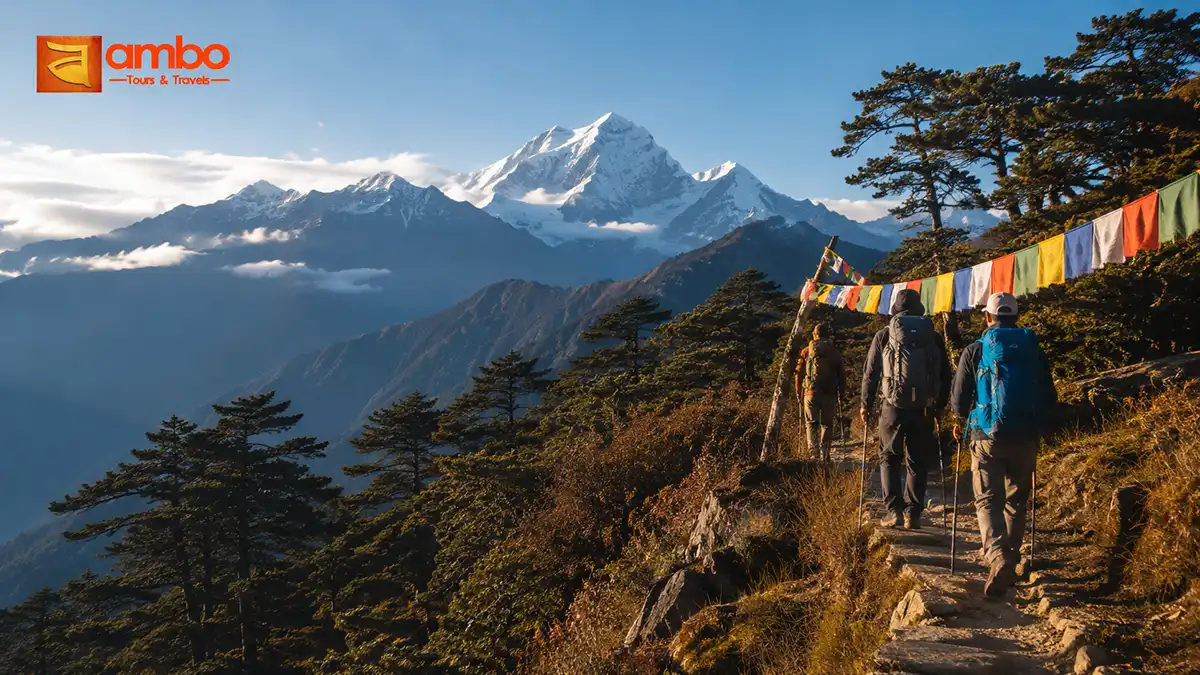
Bumdra Trek — Approach Tiger's Nest from Above
Paro - Thimphu - Punakha - Gangtey
Tour Information
- Approach Tiger's Nest Monastery from above — the view almost no visitor sees
- Overnight luxury camp at Bumdra Monastery, 3,800m above Paro valley
- Panoramic views of Jomolhari (7,314m) and the entire Paro valley
- Zangtopelri Temple — a rarely-visited sacred site between Bumdra and Tiger's Nest
- Punakha Dzong — the most beautiful fortress-monastery in Bhutan
- Phobjikha Valley and Gangtey Monastery — black-necked crane habitat
- Traditional hot stone bath (Dotsho) after the trek
- Fully private and guided — maximum 6 persons
- All SDF (USD 100/night) and visa fee (USD 40) included in price
Bumdra Trek, the short uphill trek that brings you directly to an amazing view of the Paro valley, breathtaking sunsets over the mountains of Haa, the seldom-visited sacred sites above Taktshang Goemba and the dreamlike Tiger’s Nest itself. 800 years ago, thousands of angels known as Dakinis moved in the area leaving their footprints on the rock. The Name ‘Bumdra’ signifies one hundred thousand FootPrints left by those Dakinis.
Here's the wiki page of Paro
The first day, it’s 4 hours uphill climb and on the second day downhill climb of about 3 hours. A total of about 14 kilometers will be covered during the trek. The trek will reward you with the spectacular view throughout your hike and camping in a wild is worth a call. Get yourself blessed while you visit the holy caves and view the tiger’s Nest monastery from the peak, the happiness is rewarded indeed.
Our camping arrangements during the Bumdra Trek is luxurious by all standards. We recommend you bring warm clothes as the camp is at a height of 4000 meters above the sea level.
Tour Pricing
9 days Bhutan Journey — Cost
All prices in USD per personCost includes Sustainable Development Fee (SDF) of US $100 per person per night and Bhutan Visa Fee of US $40 per person. Entrance fees for monuments and festival visits are paid separately.
Detailed Itinerary
Your Bhutan travel story begins with one of the most dramatic arrivals in all of aviation — a white-knuckle descent through a narrow Himalayan valley into Paro International Airport, where snow-capped peaks brush the wingtips and the ancient kingdom announces itself without a word. A dedicated representative from your Bhutan tour package will meet you at the airport exit to start your unforgettable Bhutan holiday.
After clearing customs, you make the scenic one-hour drive east along the Wang Chu river valley to Thimphu — the world's only capital city without a traffic light — where your hotel and first Bhutanese meal await. Settle in, freshen up, and head out for an introductory afternoon of Bhutan sightseeing.
- National Memorial Chorten: This gleaming white stupa, built by the Royal Queen Mother in memory of Bhutan's beloved Third King, is the spiritual pulse of modern Thimphu — circumambulated daily by hundreds of elderly devotees spinning prayer wheels in quiet meditation.
- Buddha Dordenma: Perched on a hilltop above the valley, this 51-metre golden Buddha is one of the largest in the world and one of the most arresting sights in all of Bhutan tourism — an ideal first landmark to photograph at golden hour.
- Thimphu Valley Walk: Stroll along the riverside promenade for your first immersion into the rhythms of Bhutanese daily life — monks in burgundy robes, schoolchildren in traditional dress, and market vendors selling dried chilies and local produce.
Practical tip: Thimphu sits at 2,334m — take the first afternoon gently to begin acclimatizing, especially if you have flown in from sea level. Drink plenty of water and avoid heavy meals on your first night.
For dinner, try ema datshi — Bhutan's fiery national dish of fresh chilies cooked in a rich local cheese sauce — at one of Thimphu's welcoming local restaurants. It is the perfect introduction to the bold, warming flavours of Bhutanese cuisine.
Tomorrow is a full day in Thimphu with deeper cultural exploration and optional hikes to some of the valley's most ancient monasteries.
Thimphu reveals its full depth today — a city where centuries of Bhutan Buddhist culture and a quietly modernising nation coexist in extraordinary harmony. This is Bhutan travel at its most intellectually and spiritually rewarding, and today's itinerary covers the city's finest cultural institutions alongside two of the valley's most treasured monasteries.
- Tashichhodzong: Begin at this majestic fortress-monastery — the 'Fortress of the Glorious Religion' — which houses His Majesty's secretariat, key ministries, and the central monk body. One of the most architecturally commanding Bhutan dzong structures in the country, its whitewashed walls and golden rooftops are iconic against the blue Thimphu sky.
- School for Arts and Crafts (Zorig Chusum): Watch the next generation of Bhutanese artisans master the 13 traditional arts — thangka painting, wood carving, weaving, lacquerware, and more. A living cultural archive and a cornerstone of sustainable tourism Bhutan.
- Folk Heritage Museum: A meticulously reconstructed 19th-century Bhutanese farmhouse that brings rural life vividly to life — one of the most immersive stops on any Bhutan cultural tour.
- Changangkha Temple: Dating to the 12th century, this hilltop temple and Bhutan monastery is among the oldest religious sites in the Thimphu valley, beloved by local families who come to receive blessings for newborn children.
- Tango & Cheri Monasteries (optional hike, 45 mins each): For those with energy and curiosity, a hike through pristine forest leads to two of the most ancient Bhutan monastery complexes in the region — a Bhutan hidden gem that most short itineraries miss entirely.
Practical tip: Dress modestly for all temple and dzong visits — covered shoulders and knees are non-negotiable. Carry a light rain jacket as afternoon showers are common in Thimphu, even during the best time to visit Bhutan in spring and autumn.
If your visit falls on a weekend, don't miss the vibrant Thimphu Weekend Market along the riverside — a riot of colour, local produce, dried meats, and traditional crafts that offers one of the most authentic windows into everyday Bhutanese life. Try kewa datshi (potato and cheese curry) for lunch — simple, warming, and quintessentially Bhutanese.
Tomorrow, the scenic mountain road to Punakha awaits, cresting the legendary Dochula Pass with its 108 memorial chortens and sweeping Himalayan panorama.
The drive from Thimphu to Punakha ranks among the most celebrated journeys in all of Bhutan tourism — a winding mountain road that crests the iconic Dochula Pass (3,100m) before descending into the warm, fertile embrace of Bhutan's ancient royal capital. Allow ample time at the pass; on a clear morning, it delivers one of the finest high-altitude viewpoints in the entire Himalayan kingdom.
At Dochula Pass, 108 gleaming memorial chortens stand in concentric rows beneath a forest of colourful prayer flags, built by Her Majesty the Queen Mother to honour fallen Bhutanese soldiers. On clear days, the entire eastern Himalayan horizon unfolds — a serrated wall of snow peaks including Gangkhar Puensum, the world's highest unclimbed mountain. In late April and early May, surrounding forests explode in rhododendron bloom — one of the most spectacular Bhutan landscape sights of any Bhutan trip.
- Dochula Pass (3,100m): Photograph the iconic chorten array and breathe in views of peaks that define the northern horizon. The Druk Wangyal Temple here is a must-visit for its extraordinary murals celebrating modern Bhutanese history.
- Punakha Dzong — 'Palace of Great Happiness': Built in 1637 at the confluence of the Mo Chu and Pho Chu rivers, this is widely regarded as the most beautiful Bhutan dzong in the kingdom. Its three-storey main temple, with four gold-and-silver embossed cypress pillars, is a masterwork of traditional Bhutanese architecture. Bhutan's first king was crowned here in 1907.
- Suspension Bridge: The historic wooden cantilever bridge leading to Punakha Dzong is one of the most photographed in Bhutan — walk across it slowly and savour the moment.
Practical tip: Punakha sits at just 1,200m — you will immediately notice the warmth compared to Thimphu. Pack lighter layers for afternoon exploration. The valley is significantly more humid, and rice grows in terraced paddies along the riverbanks — a lush, tropical contrast to the highlands above.
For dinner tonight, try phaksha paa — slow-cooked pork with red dried chilies — a Punakha valley speciality that is richer and more aromatic than its Thimphu counterpart. Pair it with Punakha's famous red rice for an authentically local meal.
Tomorrow the road winds west toward the Gangtey valley — one of the most breathtakingly beautiful and ecologically precious destinations in all of Bhutan travel.
Few destinations in all of Bhutan tourism inspire as much reverence as the Gangtey valley — a vast, glacier-carved bowl of forest, wetland, and farmland sitting at 2,900m in the heart of the Phobjikha region, and one of the most extraordinary Bhutan landscape experiences on earth. Today's drive from Punakha winds through high passes and pine forest before the valley opens up in a breathtaking sweep below you.
The drive itself is a sightseeing experience — terraced hillsides, traditional farmhouses with elaborate painted facades, and glimpses of the Black Mountains nature reserve make every bend in the road a new discovery. This is Bhutan travel at its most scenic and unhurried.
- Gangtey Monastery (Gangtey Goenpa): Perched on a forested ridge above the valley, this is one of the most important Nyingmapa monasteries in Bhutan and the spiritual heart of the entire Gangtey region. Its setting — overlooking the vast open valley — is simply unforgettable.
- Gangtey Nature Trail: A short, well-marked loop hike through the valley floor takes you through ancient black-necked crane habitat, past farmhouses and potato fields, and alongside meandering streams. This trail is a Bhutan hidden gem for birdwatchers and photographers alike.
- Phobjikha Valley viewpoints: The broad, flat valley floor offers sweeping 360-degree views of surrounding ridgelines — among the finest Bhutan mountain panoramas accessible without serious trekking.
Practical tip: The Gangtey valley is world-famous as the winter home of the endangered black-necked crane — if visiting between late October and February, witnessing these sacred birds flying in at dusk is one of the most moving wildlife experiences in all of Asia. In any season, binoculars are well worth carrying for the valley's abundant birdlife.
For dinner, try jasha maru — a warming Bhutanese spiced chicken stew served with rice — a staple of valley guesthouses and farmhouse kitchens, and the perfect meal after a day of high-altitude exploration.
Tomorrow brings more of the valley's magic alongside the drive back toward Punakha, with an evening temple visit to close a perfect day of Bhutan sightseeing.
Wake early in the Gangtey valley and step outside into mountain air so fresh and still it feels almost sacred — mornings here have a quality unique in all of Bhutan travel, with mist drifting across the valley floor and the ancient roofline of Gangtey Monastery emerging slowly from the clouds above. This final morning in the valley is unhurried and deeply restorative.
Before departing, explore any corners of the valley left unvisited yesterday — the Phobjikha wetland boardwalk, a local farmhouse visit, or simply a quiet walk through the terraced fields as the day warms up. This is sustainable tourism Bhutan at its most mindful — a place where slow travel is not just encouraged but essential.
- Gangtey valley morning walk: Follow the wetland trail at the valley's edge for final views of the surrounding peaks and, in winter months, the last sightings of the sacred black-necked cranes before they depart for the Tibetan plateau.
- Drive back to Punakha: The return journey offers new perspectives on the high passes and forested ridgelines — keep your camera ready for roadside prayer flags, monastery glimpses, and valley vistas that reveal themselves differently in the afternoon light.
- Chimi Lhakhang — Temple of the Divine Madman: Arriving in the Punakha valley in the afternoon, visit this beloved 15th-century fertility temple set amid golden rice paddies and reached via a gentle walk through farming villages. Drukpa Kunley — the irreverent saint known as the Divine Madman — is one of the most colourful figures in Bhutan Buddhist culture, and his temple draws pilgrims from across the kingdom seeking blessings for fertility and good fortune.
Practical tip: The walk to Chimi Lhakhang passes through active rice farming country — wear comfortable walking shoes and be prepared for narrow dirt paths. The visit is suitable for all ages and fitness levels, and takes approximately 45 minutes return from the road.
For dinner in Punakha, try a traditional ara (local grain spirit) aperitif before a meal of sikam paa — dried pork with radish and chili — a Punakha valley delicacy that pairs beautifully with steamed red rice and the cool evening air by the river.
Tomorrow, the road west to Paro opens the next chapter of your Bhutan holiday — a valley of ancient dzongs, sacred monasteries, and the promise of one of the world's great mountain hikes.
The drive from Punakha to Paro is one of the most varied and visually rewarding road journeys in all of Bhutan tourism — a 3.5-hour traverse that recrosses the Dochula Pass, drops through the Wang Chu gorge, and finally opens into the broad, serene Paro valley, cradled between forested ridgelines and framed by the distant sacred peak of Mount Jomolhari. Arriving in Paro feels like returning to the beginning of the world.
After checking into your hotel, the afternoon is dedicated to exploring the Paro valley and its remarkable concentration of historical and cultural landmarks — making this one of the richest single afternoons of Bhutan sightseeing in the entire itinerary.
- Rinpung Dzong (Paro Dzong): Cross the traditional covered bridge to this magnificent 17th-century fortress-monastery, whose whitewashed walls and golden rooftops dominate the valley. Inside, admire the famous painting of the saint Milarepa and the dzong's serene courtyard — a defining image of Bhutan Buddhist culture and one of the most-photographed Bhutan dzong structures in the country.
- Ta Dzong Museum: The cylindrical former watchtower above the dzong now houses Bhutan's national museum, with galleries of religious relics, thangka paintings, ancient armour, coins, and natural history exhibits — an ideal orientation into the breadth of Bhutan cultural tour heritage.
- Paro Town: Explore the charming main street with its traditional wooden shopfronts, browse local textile and craft stores for hand-woven fabrics and silver jewellery, and soak up the relaxed pace of life in one of Bhutan's most characterful small towns.
Practical tip: Paro valley sits at 2,200m — comfortable and mild in both spring and autumn, the best time to visit Bhutan. The valley is compact enough to walk or cycle between many of its major sights; ask your hotel about bicycle rental for a wonderfully unhurried way to explore.
For dinner in Paro, try a traditional farmhouse restaurant for hoentoe — buckwheat dumplings filled with turnip leaves and cheese, a local Paro speciality rarely found elsewhere in Bhutan and deeply satisfying after a long day of travel.
Tomorrow, your Bhutan trip enters its most adventurous phase — a two-day trek beginning at Sangchhoekhor Buddhist College and climbing to the sacred heights of Bumdra Monastery at 3,800m.
Today marks the beginning of one of the most rewarding and spiritually charged trekking experiences available on any Bhutan itinerary — the iconic Bumdra Trek, a two-day journey through ancient forest and sacred highland terrain that culminates at the cliff-clinging Bumdra Monastery (3,800m), one of the most atmospheric Bhutan monastery destinations in the entire Paro region.
The trek begins at Sangchhoekhor Buddhist College, a working monastic institution set among pine trees above the Paro valley floor. From here, a well-defined trail climbs steadily through dense conifer forest, past mani walls and prayer flag lines, with expanding views over the valley growing with every upward step.
- Sangchhoekhor Buddhist College: A functioning centre of Bhutan Buddhist culture and learning — one of the most serene starting points of any trek in Bhutan travel. Take a moment to watch young monks at study before the trail begins.
- Forest trail ascent: The climb through ancient blue pine and rhododendron forest is one of the most pristine walking environments in the entire Paro valley — listen for Himalayan monal pheasants and blood pheasants rustling in the undergrowth.
- Bumdra Monastery (3,800m): Perched dramatically on a rocky ledge above the clouds, this remote Bhutan monastery offers one of the most spectacular overnight camping experiences in all of Bhutan tourism. The views of Paro valley, Jomolhari, and the surrounding peaks from this altitude are simply extraordinary.
Practical tip: The ascent to Bumdra gains approximately 1,600m from the valley floor — allow 5 to 6 hours at a comfortable pace. Wear layered clothing, as temperatures at 3,800m drop sharply after sunset even in summer. A good sleeping bag, warm hat, and gloves are essential for the overnight camp.
Altitude note: At 3,800m, some travellers may experience mild headaches or fatigue. Stay well hydrated, avoid rushing, and your body will adjust naturally overnight. This is sustainable tourism Bhutan at its most immersive — a small-footprint wilderness experience far beyond the reach of day-trippers.
Camp dinner tonight is cooked on-site by your dedicated trekking cook — warm thukpa noodle soup and hearty dal bhat are perennial camp favourites, eaten around a lantern with Himalayan stars blazing overhead. Tomorrow, the most famous monastery in Bhutan awaits — the legendary Tiger's Nest.
This is the day your Bhutan holiday reaches its most iconic and unforgettable moment — waking at 3,800m above the Paro valley and beginning a spectacular ridgeline descent that leads, with heart-stopping drama, directly to the sacred clifftop citadel of Taktsang Monastery — the legendary Tiger's Nest — approaching it from above rather than below, as most visitors do, for a perspective that is almost impossibly beautiful.
The trail from Bumdra traverses open alpine ridgelines before descending through pine forest, passing the enchanting Zangtopelri Temple — a three-storey structure representing the celestial paradise of Guru Rinpoche — before the sheer granite cliff face of Taktsang suddenly reveals itself across the gorge.
- Zangtopelri Temple: A rarely-visited gem perched on the trail between Bumdra and Tiger's Nest — its three floors represent the three celestial realms of Bhutan Buddhist culture, and its carved wooden architecture is among the finest examples of traditional craftsmanship in the Paro valley. A true Bhutan hidden gem.
- Taktsang Monastery — Tiger's Nest: No description adequately prepares you for the moment you round the final bend of the trail and see Taktsang Monastery clinging impossibly to a sheer granite cliff 900 metres above the valley floor. According to legend, Guru Rinpoche flew here on the back of a tigress in the 8th century to subdue demons and bring the Dharma to Bhutan. The monastery complex — rebuilt after a 1998 fire — is a living pilgrimage site of extraordinary sanctity and architectural beauty.
- Paro valley return: After descending to the valley floor, your vehicle meets you at the trailhead for the drive back to your hotel — your legs will be tired, your heart full, and the memory of Tiger's Nest permanently etched into your experience of Bhutan travel.
Practical tip: Remove footwear before entering all temple chambers inside Tiger's Nest, and photography is not permitted inside the monastery — be respectful and present. The descent from Bumdra to the valley takes approximately 4 to 5 hours total; trekking poles are strongly recommended for the steep lower sections.
The evening is entirely at leisure in Paro — this is the moment to treat yourself to a traditional Bhutanese hot stone bath (dotsho), in which river stones are heated and immersed in a wooden tub filled with herbal water. After two days of trekking, there is no more restorative cultural experience in all of Bhutan tourism. Celebrate with a final dinner of ema datshi and locally brewed ara, and raise a quiet toast to the mountains.
Tomorrow is your final morning in the Land of the Thunder Dragon — a last breakfast in Paro before your departure flight carries you back over the peaks and away from one of the most extraordinary kingdoms on earth.
Every great Bhutan travel adventure must eventually give way to departure — but leaving Paro is itself a final, lingering gift. After a leisurely breakfast at your hotel, perhaps one last plate of ema datshi and butter tea to carry the warmth of the kingdom a little further into your journey home, your representative from the Bhutan tour package team will accompany you to Paro International Airport to bid you farewell with a heartfelt Tashi Delek.
As your plane climbs steeply from the valley and banks northward over the Himalayan wall, the Paro valley unfolds one final time through the window: the silver curve of the Paro Chhu river, the ancient rooftops of Rinpung Dzong, the dense pine forests where you trekked to Bumdra, and somewhere in the clouds above, the sacred summit of Jomolhari — unmoved, eternal, and as magnificent as on the day you arrived.
This 9-day Bhutan itinerary has taken you from the cultural depth of Thimphu to the royal splendour of Punakha Dzong; from the pristine wilderness of the Gangtey valley and its black-necked cranes to the sacred heights of Bumdra Monastery; and finally to the most iconic moment in all of Bhutan tourism — approaching Tiger's Nest from above, as pilgrims have done for centuries.
- Before you leave: Any last-minute souvenir shopping is best done in Paro town the morning before your flight — look for hand-woven textiles, Bhutanese postal stamps, thangka paintings, and locally produced incense.
- Bhutan permit documentation: Retain all Bhutan permit and Bhutan visa receipts — the Sustainable Development Fee paid as part of your Bhutan holiday directly funds education, healthcare, and conservation across the kingdom, embodying the national philosophy of Gross National Happiness (GNH).
- Airport tip: Paro Airport has limited post-security retail. Arrive at least two hours before departure, and confirm your onward flight details the evening before.
Practical tip: Bhutanese Ngultrum cannot be exchanged outside the country — spend any remaining notes on snacks, local crafts, or a final coffee in town before heading to the airport. Indian Rupees are also widely accepted and easily exchanged at the border.
Tashi Delek. Bhutan does not merely add a destination to your travel list — it changes the lens through which you see the world. The philosophy of Gross National Happiness, the pristine Bhutan landscape, the warmth of its people, and the thunder of prayer flags in mountain wind will stay with you far longer than the journey home. We hope to welcome you back to the Land of the Thunder Dragon very soon.
Included / Excluded
- ✔All meals — breakfast, lunch, and dinner
- ✔Accommodation on twin / double sharing basis (single supplement extra)
- ✔All transportation within the kingdom including airport transfers
- ✔Sustainable Development Fee — Government tax (SDF)
- ✔Bhutan visa fee
- ✔English-speaking private local guide
- ✔Sightseeing as per itinerary
- ✔Bottled water throughout the journey
- ✖International flights to and from Paro (PBH)
- ✖Entrance fees for museums and monuments
- ✖Gratuities for guides and drivers
- ✖Travel insurance premiums
- ✖Payments for services provided on a personal basis
- ✖Cost for any services not mentioned under "Cost Includes"
- ✖Cost incurred due to mishaps, strikes, political unrest, etc.
- ✖Personal expenses — laundry, beverages, or personal services
Ambo Tours & the 1% Club
Every tour we run includes a contribution to a Bhutanese NGO of your choice — at no extra cost to you. We call this the 1% Club: a minimum of 1% of your trip's profit, or Nu 5,000, whichever is higher, donated on every single journey. You choose where it goes.
What is the Bumdra Trek?
The Bumdra Trek is a two-day high-altitude trek above Paro valley in western Bhutan. Beginning at Sangchhoekhor Buddhist College, the trail climbs through ancient blue pine and rhododendron forest to Bumdra Monastery, perched at 3,800m on a rocky ledge above the clouds. The name Bumdra translates as 'one hundred thousand footprints' — a reference to the Dakinis, celestial beings said to have inhabited these heights 800 years ago, leaving their marks on the rock.
On the second day, the route traverses open alpine ridgelines before descending via the rarely-visited Zangtopelri Temple to Taktsang Monastery — Tiger's Nest — approached from above. The total trekking distance is approximately 14km across both days.
This tour combines the two-day trek with a full cultural journey through Thimphu, Punakha Dzong, and the Phobjikha Valley, making it one of the most complete introductions to western Bhutan available.
Altitude & Acclimatisation
The Bumdra Trek overnight camp sits at 3,800m above sea level — high enough for some travellers to experience mild altitude symptoms such as headache, fatigue, or disrupted sleep. This is entirely normal and manageable with the right preparation.
Our 9-day itinerary is structured to allow gradual acclimatisation before the trek begins. By Day 7 when the trek starts, you will have spent six nights in Bhutan at altitudes ranging from 1,200m (Punakha) to 2,900m (Phobjikha Valley), giving your body adequate time to adjust.
On the trek itself, your guide monitors the group throughout and carries basic altitude medication. The golden rule applies: if symptoms worsen rather than improve with rest, descend. The descent from Bumdra to the valley takes under two hours.
Travellers with pre-existing heart or respiratory conditions should consult their doctor before booking. We are happy to discuss altitude concerns directly — contact our Thimphu team before booking.
Trek Route Map
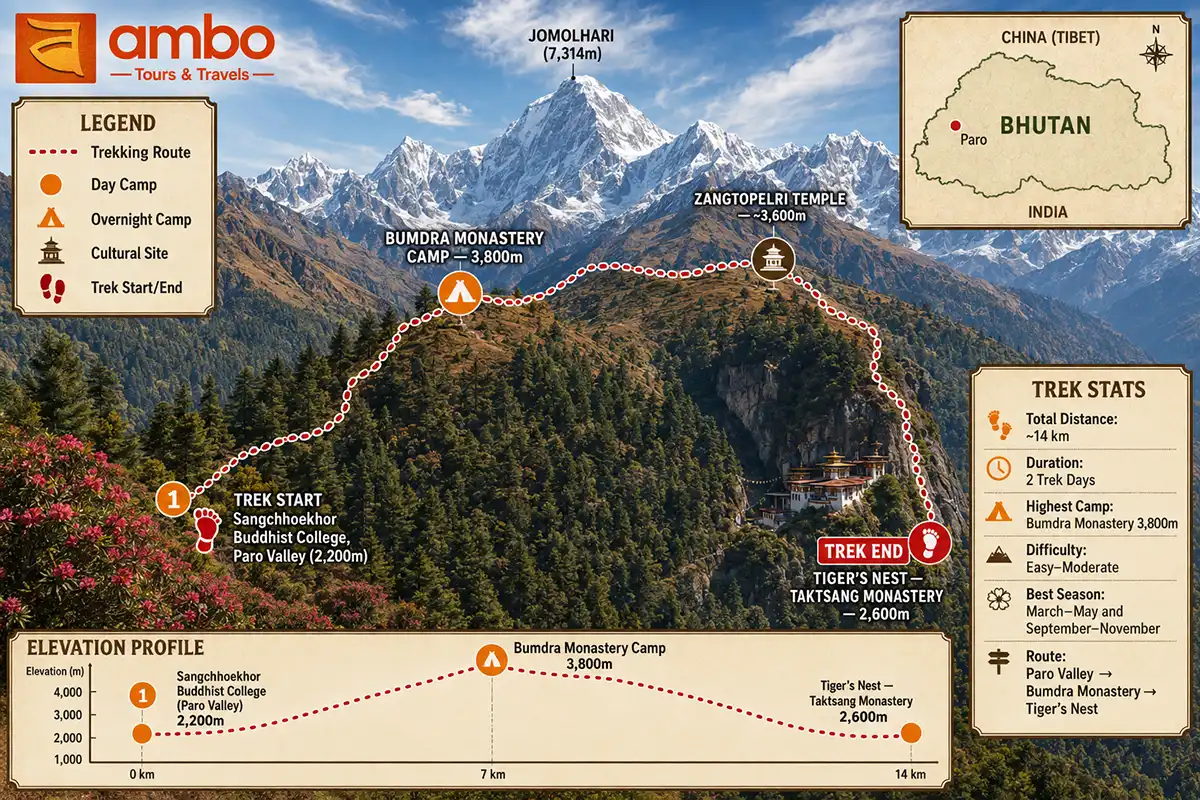
The map below shows the two-day Bumdra Trek route: ascending from Sangchhoekhor Buddhist College in the Paro valley (2,200m), through forest to the Bumdra Monastery overnight camp (3,800m), traversing the ridge past Zangtopelri Temple, and descending to Taktsang Tiger's Nest Monastery (2,600m).
What to Pack for the Bumdra Trek
The key consideration for the Bumdra Trek is temperature variation. Paro valley sits at 2,200m and can be warm during the day; Bumdra camp at 3,800m drops to near-freezing after sunset even in spring and autumn. Layer accordingly.
Essential items:
- Warm insulating layer (down jacket or fleece) — essential for camp evenings
- Waterproof outer shell — mountain weather changes quickly
- Sturdy trekking boots with ankle support — broken-in before the trip
- Trekking poles — highly recommended for the long descent on Day 2
- Thermal base layers — top and bottom
- Warm hat and gloves
- Sunscreen and sunglasses — UV is intense at altitude
- Personal medications and any prescribed altitude medication
- Small daypack for the trek days (main luggage stays at hotel)
Your overnight kit — sleeping bag, tent, dining tent — is all provided by Ambo Tours as part of the luxury camp setup. You do not need to carry camping equipment.
For a complete Bhutan packing list, see our full Bhutan packing guide.
Frequently Asked Questions
The Bumdra Trek is rated Easy to Moderate. The main challenge is Day 1 — a sustained uphill climb of approximately 1,600m vertical gain over 4–5 hours through blue pine and rhododendron forest. Most reasonably fit travellers complete it comfortably. Day 2 is predominantly downhill and takes around 3 hours. No previous trekking experience is required.
The overnight camp at Bumdra Monastery sits at approximately 3,800m above sea level. Some trekkers may experience mild altitude symptoms such as headache or fatigue at this elevation. We recommend spending at least two nights in Bhutan before the trek begins to acclimatise. Your guide carries a basic first aid kit and is trained to monitor for altitude-related symptoms.
The Bumdra Trek can be done with older children (12+) who are physically active and comfortable with a full day of uphill hiking. It is not recommended for younger children due to the altitude and duration of Day 1. Please mention the ages of children in your enquiry and we will advise based on the specific group.
The best seasons are spring (March to May) and autumn (September to November). Spring brings rhododendron blooms along the trail and the Paro Tshechu festival. Autumn offers crystal-clear views of Jomolhari and the Himalayan peaks from the Bumdra camp. The trek is not recommended during the monsoon season (June to August) due to slippery trails and poor visibility.
The overnight camp at Bumdra Monastery is luxury standard by trekking norms. Your dedicated trekking cook prepares a full hot dinner and breakfast on the mountain — typically thukpa noodle soup, dal bhat, and seasonal vegetables. Sleeping tents, dining tent, and toilet tent are all provided. Bring warm layers as temperatures at 3,800m drop significantly after sunset even in spring and autumn.
Most visitors hike to Taktsang Monastery (Tiger's Nest) from the valley floor below, taking 2–3 hours uphill. The Bumdra Trek approaches from above — you descend from the high ridge at 3,800m, passing Zangtopelri Temple, and arrive at Tiger's Nest from the top. This route is taken by a small fraction of all visitors and provides a completely different perspective of one of Asia's most iconic sights.
Ready to Begin Your Journey?
Our Thimphu team responds within 24 hours. Tell us your dates and we will handle the rest.