Bhutan is often described as a living museum of Vajrayana Buddhism, and nowhere is that clearer than in its religious architecture. But “monastery” is really an umbrella term travelers use for what is, in Bhutanese tradition, a much more precise system — dzongs, lhakhangs, goembas, chortens, and sacred sites each mean something distinct, and knowing the difference changes what you actually notice when you visit one. This guide breaks down each category, what to look for architecturally, and where to see real examples across the country.
Dzong — The Fortress-Monastery

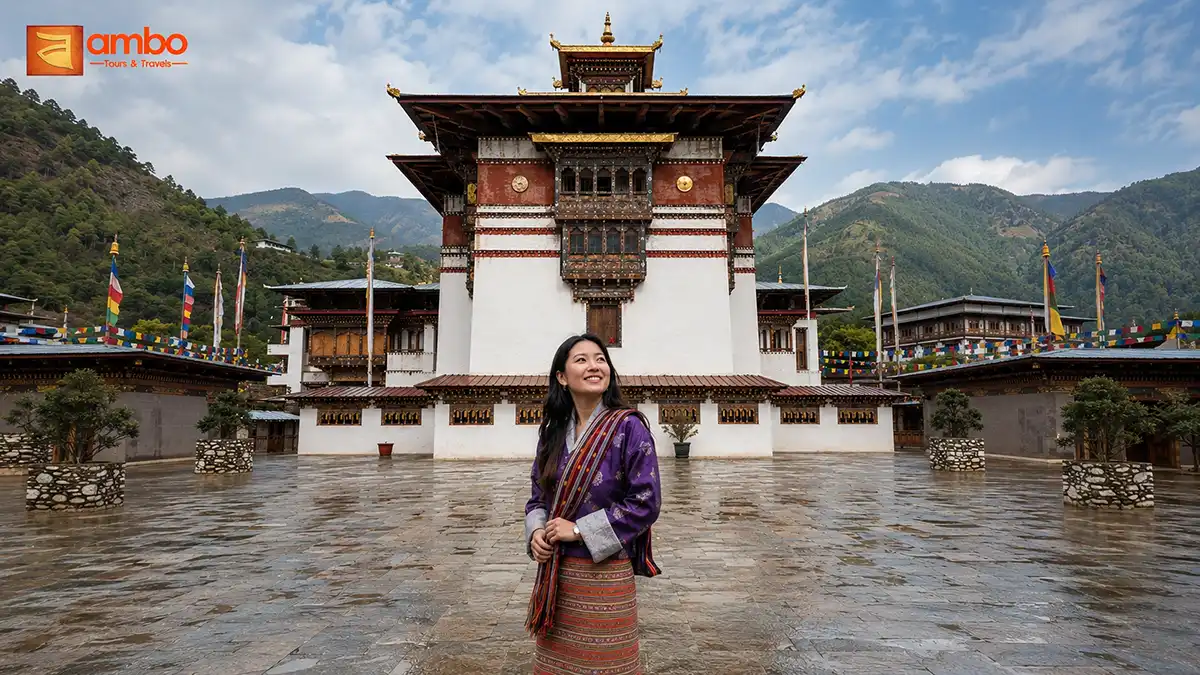
A dzong is Bhutan’s most architecturally dramatic structure: a fortress that is simultaneously a monastery and a seat of government. Since the 17th century, every Bhutanese district (dzongkhag) has been built around a dzong that houses both its religious institution and its civil administration under one roof — a genuinely unusual arrangement not seen in most Buddhist countries, where temporal and spiritual power are typically kept in separate buildings entirely.
What to look for: a massive central tower (the utse), high whitewashed masonry walls with no exterior windows on the lower levels (originally a defensive feature), an internal courtyard, and monk quarters and government offices arranged around it. Dzongs are usually sited on hilltops or at the confluence of two rivers — both strategically defensive positions.
Where to see one: Punakha Dzong, set at the confluence of the Mo Chhu and Pho Chhu rivers, is widely considered Bhutan’s most beautiful. Paro’s Rinpung Dzong and Trongsa Dzong — the largest fortress in the country — are two more of the most visited. Tashichho Dzong in Thimphu still functions as the seat of Bhutan’s national government today.
Lhakhang — The Village Temple
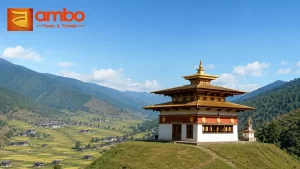
Lhakhang literally translates as “house of gods,” and it’s the most numerous and arguably the oldest form of religious building in Bhutan — with over 2,000 lhakhangs scattered across the country, many predating the dzongs by centuries. Where a dzong is a statement of regional power, a lhakhang is intimate and local: nearly every village in Bhutan has one, and it typically functions as the community’s social and spiritual center, not just a place of worship.
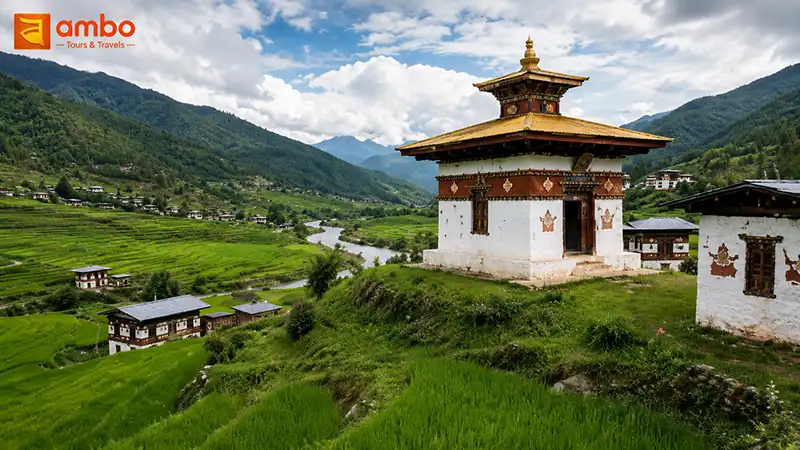
What to look for: a simple, usually single-storey building around a small enclosed courtyard, a red painted band along the upper wall, a gilded copper roof ornament, and — inside — walls completely covered in religious murals. Lhakhangs are generally much smaller and plainer from the outside than dzongs, but the interior artwork is often extraordinary.
Where to see one: Kyichu Lhakhang in Paro is one of Bhutan’s oldest temples, believed to date to the 7th century. Jambay Lhakhang in Bumthang is part of the same ancient network. Chimi Lhakhang in Punakha, the “fertility temple” associated with the Divine Madman Drukpa Kunley, is one of the most-visited lhakhangs on any Bhutan itinerary.
Goemba (Gompa) — The Monastery
Goemba is the proper Bhutanese term for what English-language guides usually just call a “monastery” — a residential religious community, home to monks who live, study, and practice on-site, as distinct from a lhakhang, which is primarily a place of worship rather than a residence. Goembas split into two distinct architectural sub-types worth knowing:
- Cluster-type: a core of one or two temples surrounded by a loose grouping of individual monk dwellings — an organic, spread-out layout rather than a single unified structure. Phajoding, above Thimphu, and Tharpaling in Bumthang are classic examples.
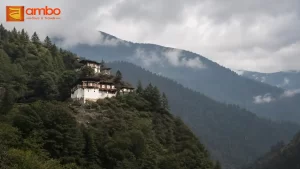
- Dzong-type: built like a fortress in miniature, with a central tower enclosed by exterior walls, monk cells, and service rooms arranged around it — structurally similar to a dzong but on a smaller, purely religious scale. Gangtey Monastery in Phobjikha Valley and Tango Monastery north of Thimphu are the most significant examples of this type.
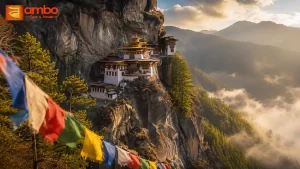
Bhutan’s cliffside monasteries — the ones clinging dramatically to rock faces, built around a cave or meditation site — are also technically goembas, though their construction method is unique even within this category. Tiger’s Nest (Paro Taktsang) is the most famous example in the world.
Chorten — The Stupa
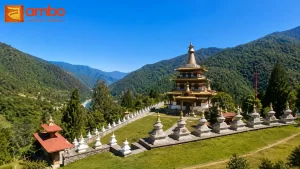
A chorten is a solid, usually bell-shaped or tiered structure that holds sacred relics — it’s not a building you enter, but a monument you walk around. Chortens represent the five elements of the universe in Buddhist cosmology: earth, water, fire, air, and space, expressed through the stupa’s distinct architectural tiers. You’ll find them everywhere in Bhutan — at crossroads, on mountain passes, beside bridges, and at the confluence of rivers — rather than as standalone destinations in their own right.
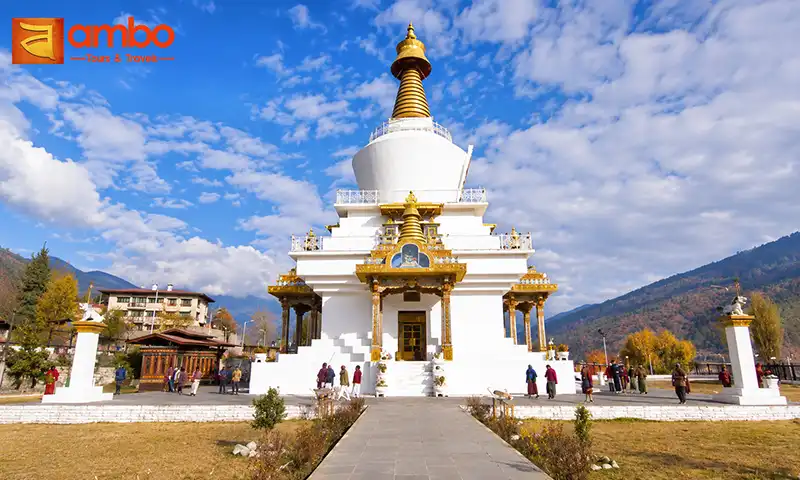
Where to see one: the Khamsum Yulley Namgyal Chorten near Punakha is one of the most elaborately decorated in the country and one of the few chortens travelers specifically hike to visit. The National Memorial Chorten in Thimphu is the most visited in the capital, a constant hub of local devotional activity.
Ney — Sacred Sites Beyond Buildings
Not every sacred place in Bhutan is a constructed building at all. A “ney” is a place sanctified by the presence or action of an enlightened being — a meditation cave, a rock bearing a footprint or handprint, a site where a demon was subdued or a blessing given. These sites carry the same devotional weight as a temple, sometimes more, precisely because the landscape itself is understood to be the relic. Several of the hikes we’ve covered in our Trails Hub lead to exactly this kind of site — Domendrel’s mandala rock, carved (according to legend) by a 17th-century ruler, and Juneydrak’s footprint, attributed to the 11th-century master Machig Labdrön, are both neys rather than conventional temples.
Anim Dratshang — Nunneries
Bhutan’s monastic tradition includes formally established nunneries (anim dratshang), home to female practitioners living under the same monastic discipline as their male counterparts, though historically with fewer resources and less institutional prominence. Bhutan’s oldest nunnery, Kila Goemba, dates to roughly the 9th century and remains home to around 50 nuns today, clinging to a cliff face below Chele La Pass — read our full guide to hiking to Kila Nunnery for the complete history and legend.
Why the Distinction Actually Matters When You Visit
Knowing which category you’re standing in front of changes what’s worth noticing. At a dzong, look for the interplay between religious and administrative life happening side by side — monks and civil servants sharing the same walls. At a lhakhang, the real reward is almost always inside: the murals, not the exterior. At a goemba, ask whether it’s cluster-type or dzong-type, and you’ll understand immediately why it’s laid out the way it is. And at a ney, the “building” might just be a rock — the significance lives entirely in the story, which is exactly why a good guide (and a good article) matters more at these sites than almost anywhere else in Bhutan.
Explore individual sites in depth: our complete guide to Tiger’s Nest Monastery, or browse our Trails Hub for hikes leading to Bhutan’s lesser-known sacred sites.
Ready to Experience Bhutan?
Tell us your dates and interests — our team in Thimphu will craft a personalised itinerary within 24 hours, at no cost.