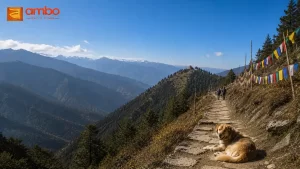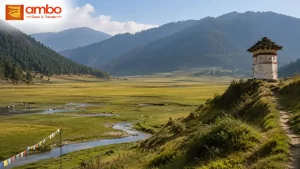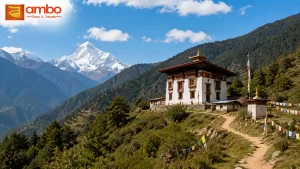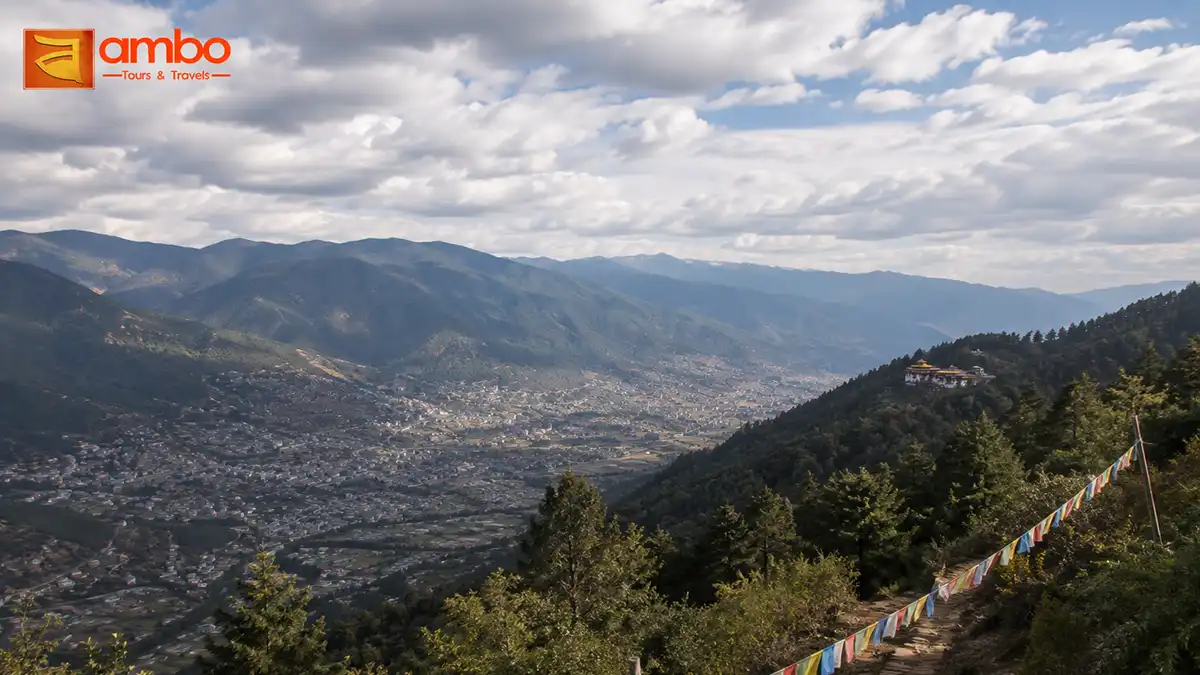
Above Motithang, on the upper edge of Thimphu, a single trailhead opens onto one of the richest hiking networks in the entire valley. From the Sangaygang viewpoint — better known locally as the BBS Tower — three distinct trails fork outward: a short, easy loop to a 1750s monastery, a demanding climb to one of Bhutan’s most storied high-altitude monastic complexes, and a scenic forest route toward the Paro border. Understanding how these three connect turns a single hiking day into one of the most flexible and rewarding outings near the capital.
Sangaygang: The Shared Starting Point
Sangaygang sits at 2,685 metres, roughly 15–20 minutes by car from central Thimphu, just above the Motithang Takin Preserve near a small roadside tea shop. Known locally as the BBS Tower for the telecommunications mast that marks the spot, it’s already a destination in its own right — a genuine panoramic viewpoint over Thimphu valley, with prayer flags snapping in the wind and the gentle sound of wind chimes drifting down from the tower above. From here, every trail in this network begins.
Option 1: The Sangaygang–Wangditse Loop (Easiest)
The shortest and gentlest option is a roughly two-hour round-trip loop to Wangditse Goemba. After a short, slightly steep initial stretch, the trail eases and passes apple orchards and scattered farmhouses before descending gently through oak, blue pine, and rhododendron forest to the monastery itself. Wangditse was founded in 1750 by attendants of Bhutan’s 8th Druk Desi and restored in 2001; its inner chapel houses statues of the guardian deities Yeshey Goenpo (Mahakala), Palden Lhamo (Mahakali), and Tsheringma, the goddess of longevity. The loop trail continues back to Sangaygang, passing views north toward Samteling Palace, home of the Fourth King, along the way.
Option 2: Phajoding Monastery (The Main Event)
A 13th-Century Foundation, an “Endangered Monument”
The most significant destination in this network is Phajoding Monastery, widely regarded as Thimphu’s most rewarding high-altitude day hike. Tradition holds that Phajo Drugom Zhigpo — the lama who popularized the Drukpa Kagyu school of Buddhism across Bhutan, and the same figure associated with founding both Tango Monastery and blessing Cheri — visited this site and founded a meditation hermitage here in the 13th century. The name itself reflects this: “Phajoding” derives from “Phajo” and “ding,” meaning roughly “Phajo’s spacious land.”
No structures survive from that original 13th-century foundation. What stands today dates to the mid-18th century, when Sherab Wangchuk, Bhutan’s 13th Druk Desi, restored and substantially extended the site. The full formal name of the monastery is remembered as Phajoding Thubten Jago Phungpo Wogmin Nampar Gyalwai Khangzang — translating roughly to “The Temple of the Buddha’s Doctrine, Vulture Peak Mountain, and the Akanishtha Mansion of Complete Victory.”
Phajoding today is a loose cluster of roughly ten temples, home to a small community of around 30 monks who remain genuinely welcoming to visitors — offering tea and hospitality to hikers who make the climb, and relying in part on visitor donations to sustain the community. In 2010, the once-prosperous, richly adorned monastery was formally declared an “endangered monument,” a designation reflecting both its historical importance and the real conservation challenges facing a remote high-altitude site of this scale.
One detail worth knowing: rather than clearing forest to build access roads, conservators instead built a ropeway system to transport construction materials up the mountainside from a base at Sangaygang — the scar of that ropeway line is still faintly visible cutting through the tree line if you know to look for it.
The Hike Itself
Phajoding sits at an elevation between 3,600 and 4,000 metres, and the climb from Sangaygang takes roughly three hours — a well-worn but genuinely demanding track, shared with local horse teams and other hikers, that can turn slippery and muddy during monsoon season. (An alternative, steeper trailhead exists above the Motithang Takin Preserve itself, offering a shorter but more strenuous ascent than the Sangaygang route.)
For those with energy to spare, the trail continues a further 1.5 hours beyond the monastery to a chorten at the peak above it — and for the truly ambitious, Phajoding also marks the starting point of the Druk Path Trek, one of Bhutan’s most celebrated multi-day routes, with a longer extension toward the “1000 Lakes” area running roughly 15km and 6–9 hours from Phajoding, largely unsigned and recommended only for well-prepared, experienced hikers.
Option 3: Pumola (Toward Paro)
The third option from the same Sangaygang trailhead is the Pumola hike (sometimes spelled Pomola), which winds through stands of blue pine and rhododendron forest, following a river valley below Phajoding, past open meadows where yaks graze. The trail climbs steadily along well-worn tracks, opening periodically to sweeping views over Thimphu valley.
At a key junction along the route, hikers choose their onward direction: right leads to a gompa and connects with the Phajoding trail; straight ahead continues toward Paro, running roughly parallel to the Druk Path Trek (some horsemen complete this full crossing in a single day); left loops back toward Thimphu’s Buddha Point. Each option varies in difficulty and duration, giving Pumola genuine flexibility depending on how much time and stamina you have.
One important note: portions of this trail network pass near Royal property. Stick to the marked route and never cross fences or take shortcuts, however convenient they may look — these areas are restricted and actively patrolled.
Best Time to Hike
September to November and March to May offer the clearest skies and most reliable conditions across this entire network. Monsoon season (roughly June to August) is best avoided if possible, particularly for the Phajoding climb, where the track becomes genuinely slippery and muddy.
Practical Tips
- Acclimatise in Thimphu for at least 1–2 days before attempting the full Phajoding climb, given the altitude involved.
- Start early — the climb is long, and afternoon cloud cover is common across this network.
- If visiting Phajoding, consider bringing a small offering (biscuits, tea, rice, sugar, or milk) for the monastery community, who rely significantly on visitor generosity.
- Respect the Royal property boundaries along the Pumola trail — do not cross fences or take shortcuts through restricted areas.
- A licensed Bhutanese guide is mandatory for all hikes in Bhutan, and especially valuable here given the network of forking trails and the genuine altitude and distance involved in the Phajoding option.
Frequently Asked Questions
How long does the hike to Phajoding Monastery take?
Approximately three hours from the Sangaygang trailhead, reaching an elevation between 3,600 and 4,000 metres. An alternative, steeper route from the Motithang Takin Preserve offers a shorter but more strenuous climb.
What makes Phajoding Monastery historically significant?
Tradition credits its founding to Phajo Drugom Zhigpo in the 13th century, the same lama associated with founding Tango Monastery. The current structures date to the mid-18th century restoration under the 13th Druk Desi. In 2010, it was formally declared an “endangered monument.”
Can I hike to Sangaygang, Phajoding, and Pumola all from the same starting point?
Yes — all three trails begin from the same Sangaygang (BBS Tower) trailhead above Motithang, forking outward from there toward Wangditse, Phajoding, or Pumola depending on the route you choose.
Is the Phajoding hike difficult?
It’s a genuinely demanding three-hour climb to high altitude, better suited to hikers who’ve had a day or two to acclimatise in Thimphu first, though it doesn’t require technical climbing skills.
Explore more of Bhutan’s hidden trails in our complete guide to Bhutan’s best hiking trails and hidden monastery walks. Interested in the monastery Phajoding shares its founder with? Read about Tango & Cheri Monastery.
Ready to Experience Bhutan?
Tell us your dates and interests — our team in Thimphu will craft a personalised itinerary within 24 hours, at no cost.