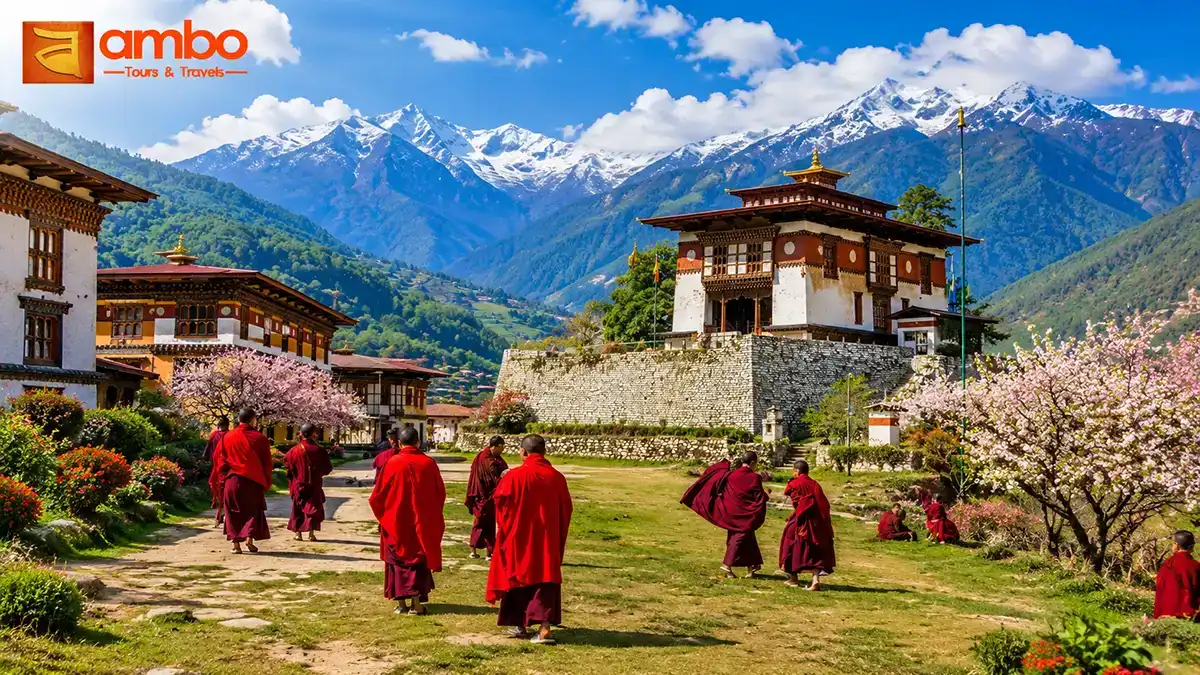
6-Day Bhutan Tour — Paro Tshechu, Tiger's Nest & Punakha Dzong
Paro · Thimphu · Punakha
Tour Information
- Paro Tshechu — sacred Cham masked dances at Rinpung Dzong, one of Bhutan's most extraordinary festivals
- Thongdrel dawn ceremony — giant silk thangka scroll unveiled at first light during the festival
- Tiger's Nest (Taktsang Monastery) — full day dedicated to the 10km hike on a 900m cliff face
- Punakha Dzong — the most beautiful dzong in Bhutan at the confluence of two sacred rivers
- Dochula Pass (3,140m) — 108 memorial chortens with Himalayan peak views
- Thimphu cultural programme — Buddha Dordenma, Tashichhodzong, Takin Reserve, Farmers Market
- Paro town — Rinpung Dzong, Kyichu Lhakhang (659 AD), traditional craft street
- Fully private — guide, vehicle and itinerary exclusively yours
- SDF (USD 100/night) and visa fee (USD 40) included in all prices
Six days is the ideal duration for a Bhutan journey built around the Paro Tshechu — the sacred masked dance festival held annually at Rinpung Dzong in spring. This itinerary arrives in time to spend two full days in Thimphu, crosses Dochula Pass (3,140m) for Punakha Dzong on Day 3, then moves to Paro for the festival on Day 4 and Tiger's Nest on Day 5.
The Paro Tshechu is one of the most extraordinary cultural events in the Himalayan world — monks in elaborate brocade costumes and painted masks perform sacred Cham dances in the dzong courtyard while Bhutanese families in traditional dress crowd the walls. On the final morning of the festival, the Thongdrel — a giant silk thangka scroll — is unveiled at dawn. Attending this is a once-in-a-lifetime experience available only to those with the timing and a licensed operator who knows the dates.
Outside the festival window, this 6-day itinerary runs as a standard western Bhutan tour covering Thimphu, Punakha, and Paro — with Tiger's Nest as the Day 5 centrepiece. Operated by Ambo Tours, DOT Licence No. 1053330, Thimphu.
Tour Pricing
6 Days Bhutan Journey — Cost
All prices in USD per personCost includes Sustainable Development Fee (SDF) of US $100 per person per night and Bhutan Visa Fee of US $40 per person. Entrance fees for monuments and festival visits are paid separately.
Detailed Itinerary
Your Bhutan travel adventure begins the moment your plane descends through clouds into a valley so green and serene it barely feels real. Paro International Airport — one of the world's most dramatic runways, hemmed in by Himalayan peaks — delivers an arrival that no other destination on earth can match. As you clear the arrivals hall, a licensed Ambo Tours guide greets you warmly, and your Bhutan tour package officially comes to life.
The 1.5-hour drive from Paro to Thimphu along the Paro Chhu river valley is itself a highlight — forested hillsides dotted with traditional whitewashed farmhouses, prayer flags strung across rivers, and the occasional dzong perched on a ridge. Wind down the window and breathe the pine-scented air; altitude here sits comfortably around 2,300 m, so no acclimatisation worries on Day 1.
- Buddha Dordenma — Towering 51.5 metres above the Kuenselphodrang hillside, this gilded bronze Buddha is one of the largest in the world and a defining symbol of Bhutan tourism. The panoramic view of Thimphu valley from the statue's terrace is extraordinary, especially in the golden late-afternoon light. Dress modestly (covered shoulders and knees) as a mark of respect inside the meditation hall.
In the evening, your guide can point you toward Thimphu's Clock Tower Square for a gentle first stroll — try a bowl of ema datshi (Bhutan's beloved chilli-and-cheese stew) at a local restaurant, the perfect introduction to Bhutanese cuisine and Bhutan Buddhist culture expressed through food. Overnight at your hotel in Thimphu, rested and eager for a full day of Bhutan sightseeing tomorrow.
Tomorrow: Dive deep into Thimphu's soul — from the Farmers Market to royal archery at Changlimithang.
Thimphu, the world's only capital city without a single traffic light, hums with a gentle energy that is wholly its own — and today you get an entire day to soak it all in on this landmark Bhutan cultural tour. Start your morning at the Thimphu Farmers Market (busiest on weekends), a riot of colour where farmers from across the valley lay out dried chillies, yak butter, fresh vegetables, hand-woven baskets, and every variety of local cheese. It is the beating pulse of everyday Bhutanese life and one of the most authentic things to do in Bhutan.
- Takin Reserve (Motithang) — Home to Bhutan's national animal, the bizarre and beloved Takin — a creature so odd that Bhutanese legend says it was created by the Divine Madman from the bones of a goat and a cow. The reserve is set in a forested enclosure on the hillside above the city; wear comfortable walking shoes.
- Changlimithang Archery Ground — Archery is Bhutan's national sport, and watching a match here is an unmissable slice of local life. Teams banter, sing, and perform victory dances between arrows fired at targets 145 metres away. If you're lucky, your guide may even arrange a practice shot for you.
- Tashichho Dzong — The crown jewel of Thimphu, this imposing fortress-monastery on the banks of the Wang Chhu river serves as the seat of Bhutan's government and the summer residence of the Je Khenpo (Chief Abbot). The whitewashed towers and golden rooftops are a masterclass in traditional Bhutanese architecture. Visit in the late afternoon when the light is warmest and the monks return from prayers. Dress code applies — long trousers/skirts and covered shoulders required.
For lunch, try phaksha paa (stir-fried pork with red chillies) at a local restaurant near the city centre — a bold, warming dish that perfectly encapsulates the flavours of Bhutan travel. The altitude in Thimphu (2,334 m) is gentle, but stay hydrated throughout the day. This is sustainable tourism Bhutan at its finest — every entry fee contributes directly to conservation and community development under the country's legendary Gross National Happiness philosophy. Overnight in Thimphu.
Tomorrow: A spectacular mountain drive to Punakha — with a cloud-piercing stop at Dochula Pass and the majestic Punakha Dzong awaiting you in the valley below.
Today's drive from Thimphu to Punakha is arguably the most scenic road journey in all of Bhutan travel — and it begins with an ascent that stops hearts and steals breath in equal measure. The road climbs steadily through blue pine and rhododendron forest until it crests at Dochula Pass at 3,140 metres, a sacred hilltop draped in thousands of colourful prayer flags and watched over by 108 hand-painted chortens (stupas) built by the Royal Queen Mother. On clear days, the entire eastern Himalayan range unfolds before you — a jaw-dropping panorama that is one of the true highlights of any Bhutan holiday. Dress in warm layers; it can be chilly and windy even in spring.
From Dochula, the road plunges down into the lush, almost tropical warmth of Punakha valley — a dramatic contrast that never gets old on a Bhutan itinerary. At just 1,200 m, Punakha is Bhutan's winter capital and feels worlds apart from the heights you just crossed.
- Punakha Dzong — Built in 1637 by the great unifier Zhabdrung Ngawang Namgyal, this fortress-monastery sits at the confluence of the Pho Chhu (Father River) and Mo Chhu (Mother River), making it one of the most photogenic Bhutan dzong structures in the country. Its lavishly painted interiors house the embalmed body of Zhabdrung himself, and its courtyards burst with jacaranda blossoms in spring. No visit to Bhutan tourism is complete without standing on its wooden cantilever bridge and looking back at those golden rooftops reflected in the water.
After exploring the dzong, enjoy a packed lunch or a riverside meal — red rice with butter bean soup is the quintessential Punakha comfort food. The drive back over Dochula Pass in the late afternoon, with the peaks turning amber, is a memory you'll carry forever. This day exemplifies why best time to visit Bhutan is spring — the mountain views from Dochula are clearest from March to May. Return to Thimphu for dinner and overnight.
Tomorrow: Paro comes alive for its most spectacular festival — the Paro Tshechu. Prepare to be dazzled.
There are experiences that define a Bhutan trip, and then there is the Paro Tshechu — a religious festival so vivid, so alive with devotion and colour that it rewires the way you see the world. Held annually in the courtyard of Rinpung Dzong in Paro, the Tshechu (meaning 'tenth day') commemorates the deeds of Guru Rinpoche, the tantric master who brought Buddhism to Bhutan in the 8th century. Drive from Thimphu to Paro (1.5 hours) early to secure a good vantage point — and dress in your finest, as Bhutanese tradition calls for celebratory attire at this sacred gathering.
- Sacred Cham (Mask Dances) — Monks in elaborate brocade costumes and painted wooden masks perform ritual dances that have remained unchanged for centuries. Each dance narrates a chapter of Bhutan Buddhist culture — the defeat of demons, the protection of the dharma, the triumph of compassion. The colours are extraordinary: crimson, gold, turquoise, white. Even without understanding every symbol, the power of the performance is immediate and overwhelming.
- The Thongdrel (Sacred Scroll) — If your visit coincides with the dawn blessing ceremony when the massive silk thangka is unfurled from the dzong wall, consider yourself among the most fortunate travellers in the world. Merely seeing it is said to cleanse a lifetime of negative karma.
- Interaction with Locals — The Tshechu is not a performance for tourists — it is a living act of communal worship, and Bhutanese families travel from distant valleys to attend. Your Ambo Tours guide will help you connect with local families, understand the symbolism of each dance, and navigate the festival grounds with cultural sensitivity.
Street food stalls outside the dzong sell khatem (Bhutanese buckwheat pancakes) and sweet butter tea — try both for an authentic taste of festival Bhutan. This is Bhutan tourism as it was always meant to be experienced: immersive, respectful, and deeply moving. A Bhutan visa and Bhutan permit open the door; moments like this make you never want to leave. Dinner and overnight in Paro.
Tomorrow: The hike of a lifetime — up the cliffs of Paro to the legendary Tiger's Nest Monastery.
No Bhutan travel guide can fully prepare you for your first sight of Paro Taktsang — better known to the world as Tiger's Nest Monastery. Clinging impossibly to a sheer granite cliff 900 metres above the Paro valley, its whitewashed walls and golden rooftops seem to defy both gravity and logic. According to legend, Guru Rinpoche flew to this cliff on the back of a tigress and meditated in the cave within for three months, three days, three hours, and three minutes — consecrating it as one of the holiest sites in Himalayan Bhutan Buddhist culture. Today, you follow in the footsteps of pilgrims who have made this climb for over 1,300 years.
The hike begins at a forested trailhead and ascends through fragrant blue pine and rhododendron — wear sturdy hiking shoes, carry at least 1.5 litres of water, and pace yourself. At the halfway point, a teahouse and viewing platform deliver the single most photographed view in all of Bhutan tourism: the monastery framed against blue sky, prayer flags streaming in the mountain breeze. From here, a staircase cut into the rock descends into a gorge, crosses a sacred waterfall, and climbs back up to the monastery entrance (approx. 2 hours uphill from the trailhead; 1.5 hours down). Total elevation: 3,120 m at the monastery — acclimatise well on previous days.
- Taktsang Monastery Complex — Once inside, remove shoes and cameras (photography is not permitted within the shrine rooms). The complex contains four main temples built around the original cave where Guru Rinpoche meditated. The atmosphere — butter lamps flickering, monks chanting, incense drifting across stone courtyards — is profoundly sacred.
- Evening in Paro Town — Descend with a deep sense of achievement and spend your final evening exploring Paro's charming main street. Visit local craft shops selling hand-woven textiles, thangka paintings, and traditional wooden bowls — perfect souvenirs from your Bhutan holiday. For dinner, try jasha maru (spiced minced chicken) at a family-run restaurant.
This hike is the centrepiece of countless Bhutan tour packages for good reason — it is simultaneously a physical achievement, a spiritual encounter, and a visual revelation. Whether you are on a Bhutan luxury tour or a Bhutan budget tour, Tiger's Nest levels the playing field: here, everyone arrives humbled and leaves transformed. Sustainable tourism Bhutan principles are visible even on this trail — waste bins, maintained paths, and respectful visitor guidelines preserve the sanctity of this sacred landscape. Tonight, raise a glass of ara (Bhutanese rice wine) to a journey well earned. Dinner and overnight in Paro.
Tomorrow: Your Bhutan adventure concludes — but the memories of Tiger's Nest, the Tshechu, and the Himalayan horizon will stay with you forever.
The final morning of your Bhutan trip arrives quietly — perhaps with birdsong drifting through your hotel window, or the distant sound of monks beginning their morning prayers. Savour a last Bhutanese breakfast: warm butter tea, zow shungo (leftover rice stir-fried with vegetables), and the knowledge that you have experienced something genuinely rare in this world. Bhutan travel is not just a holiday — it is a philosophical encounter with a nation that has chosen happiness, nature, and culture over unchecked growth, and six days here is enough to understand why the whole world is watching.
Your Ambo Tours guide will ensure a smooth, timely transfer to Paro International Airport, with time for any final shopping along the way. The departure terminal itself offers one last gift: a view of the valley and the peaks that have framed your entire journey. As your aircraft banks over the Himalayas, look out the window — the mountains are saying goodbye too.
- Before You Go — Ensure your Bhutan permit and travel documents are in order; your Ambo Tours guide handles all exit formalities. Keep some Bhutanese Ngultrum for a final airport coffee — it cannot be exchanged outside the country.
- What to Pack Home — Hand-woven textiles from Paro's craft shops, saffron from local markets, and a rolled thangka painting are among the finest mementos of Bhutan tourism.
- Plan Your Return — Most travellers who visit Bhutan begin planning their next trip on the flight home. Consider the 18-day Eastern Bhutan itinerary, a Bumdra trek, or autumn's Thimphu Tshechu for your next Bhutan holiday. Visit ambotours.com to start dreaming.
This 6-day itinerary — from the golden Buddha on Thimphu's hillside to the sacred cliffs of Taktsang Monastery — is a masterclass in what visit Bhutan truly means. It is a place governed by Gross National Happiness, protected by sustainable tourism Bhutan principles, and preserved by a people who understand something most of the world has forgotten: that some things are worth more than money. Thank you for choosing Ambo Tours. Safe travels — and may the road back to Bhutan find you soon.
Included / Excluded
- ✔All meals — breakfast, lunch, and dinner
- ✔Accommodation on twin / double sharing basis (single supplement extra)
- ✔All transportation within the kingdom including airport transfers
- ✔Sustainable Development Fee — Government tax (SDF)
- ✔Bhutan visa fee
- ✔English-speaking private local guide
- ✔Sightseeing as per itinerary
- ✔Bottled water throughout the journey
- ✖International flights to and from Paro (PBH)
- ✖Entrance fees for museums and monuments
- ✖Gratuities for guides and drivers
- ✖Travel insurance premiums
- ✖Payments for services provided on a personal basis
- ✖Cost for any services not mentioned under "Cost Includes"
- ✖Cost incurred due to mishaps, strikes, political unrest, etc.
- ✖Personal expenses — laundry, beverages, or personal services
Ambo Tours & the 1% Club
Every tour we run includes a contribution to a Bhutanese NGO of your choice — at no extra cost to you. We call this the 1% Club: a minimum of 1% of your trip's profit, or Nu 5,000, whichever is higher, donated on every single journey. You choose where it goes.
About This Tour
The 6-day Bhutan tour is designed around a specific conviction: that the Paro Tshechu — held annually in spring at Rinpung Dzong — is one of the most extraordinary cultural experiences available anywhere in the world, and that a Bhutan itinerary timed to include it is fundamentally different from one that doesn't.
Days 1 and 2 are spent in Thimphu — the Buddha Dordenma, Tashichhodzong, the Farmers Market, and the Takin Reserve. Day 3 crosses Dochula Pass (3,140m) to Punakha and returns via the same pass at sunset. Day 4 is the Paro Tshechu — a full day at Rinpung Dzong watching the sacred Cham dances with Bhutanese families in traditional dress filling the courtyard. Day 5 is Tiger's Nest. Day 6 departs.
Outside the festival window, this itinerary runs as a standard 6-day western Bhutan tour — Thimphu, Punakha, and two days in Paro. But we recommend timing it for the festival whenever possible. Contact our Thimphu team with your available travel dates and we will check whether the Paro Tshechu falls within your window.
For a shorter first visit, our 5-day Bhutan itinerary covers Thimphu, Punakha, and Tiger's Nest without a festival day. For a longer journey that adds Gangtey Valley, our 7-day western Bhutan tour is the natural extension.
Best Time for This Tour
This itinerary is purpose-built for spring — specifically the window around the Paro Tshechu festival in March or April. The exact dates shift each year with the Bhutanese lunar calendar. Contact us with your available travel dates and we will confirm whether the festival falls within your window and adjust the itinerary accordingly.
Spring (March to May) is the primary season for this tour. Rhododendrons bloom along the Dochula Pass road in March and April. The Paro Tshechu is the emotional centrepiece. Views from Dochula Pass are clearest before the pre-monsoon haze builds in May.
Outside festival season — the 6-day itinerary remains excellent as a standard western Bhutan tour. Autumn (October to November) offers the clearest mountain visibility and the Thimphu Tshechu in September. Day 4 becomes a full Paro sightseeing day with Rinpung Dzong and Kyichu Lhakhang rather than the festival.
For a full seasonal breakdown, see our best time to visit Bhutan guide. For the complete festival calendar, see our Bhutan festivals guide.
Travel Tips
Paro Tshechu dress code — traditional Bhutanese dress (kira for women, gho for men) is not required for international visitors at the Tshechu, but dressing modestly — covered shoulders and knees — is expected. Many visitors find that wearing a kira or gho (available to rent in Paro) deepens the experience and is warmly received by Bhutanese attendees. Your guide can arrange rental.
Thongdrel dawn ceremony — arrive at Rinpung Dzong at least 90 minutes before sunrise on the final festival morning to secure a good position. The scroll is removed as soon as the sun touches it — the window can be as short as 20 minutes. Your guide will brief you on positioning the evening before.
Tiger's Nest on Day 5 — start no later than 7:30am. The hike takes 4–6 hours round trip. Carry 1.5 litres of water minimum. Trekking poles recommended for the descent. Entrance fee paid at the gate and not included in the tour price. Photography is not permitted inside the temple chambers.
Punakha day trip on Day 3 — the return drive from Punakha crosses Dochula Pass twice. The morning crossing is usually clearer. If cloud is building on the return, your guide may stop at Dochula Pass cafeteria — the panoramic views on a clear afternoon are exceptional.
For a full packing reference, see our complete Bhutan packing guide.
Itinerary Map
Frequently Asked Questions
The Paro Tshechu is held annually in spring — typically in March or April, with the exact dates determined by the Bhutanese lunar calendar each year. The festival runs for four to five days at Rinpung Dzong. The final morning features the unfurling of the Thongdrel — a giant silk thangka scroll blessed by Guru Rinpoche — which is displayed only at dawn before the sun touches it. Contact our Thimphu team for the confirmed dates for your travel year, and we will time this itinerary to include the full festival. Our Bhutan festivals guide covers the full calendar.
Yes. The 6-day itinerary runs as a standard western Bhutan tour outside the festival window — covering Thimphu, Punakha, and Paro with Tiger's Nest as the Day 5 centrepiece. Day 4 becomes a Paro sightseeing day (Rinpung Dzong, Ta Dzong National Museum, Kyichu Lhakhang) rather than a festival day. If you are flexible on dates, we recommend timing the trip to coincide with the Paro Tshechu — it fundamentally changes the experience. Our dedicated Paro Tshechu tour is the fuller festival experience at 7 days.
The 5-day itinerary covers Thimphu, Punakha, and Paro without a dedicated festival day — it's the fastest route through the western highlights. This 6-day tour adds a full festival day in Paro (Day 4) and moves the Tiger's Nest hike to its own day (Day 5). The 7-day tour adds Gangtey Valley and the Phobjikha black-necked crane habitat. If the Paro Tshechu timing aligns with your travel, the 6-day is the most efficient way to include the festival without a full 7-day commitment.
Our 6-day Bhutan tour starts from USD 1,370 per person for groups of 3 or more, USD 1,480 for two travellers, and USD 1,770 for a solo journey. All prices include the Sustainable Development Fee (SDF) of USD 100 per person per night and the Bhutan visa fee of USD 40. For a full breakdown see our Bhutan travel cost guide.
The Thongdrel is a monumental silk thangka — a religious scroll painting — depicting Guru Rinpoche, the saint who brought Buddhism to Bhutan in the 8th century. It is unfurled on the final morning of the Paro Tshechu at dawn, displayed only until the first rays of sun touch it. Bhutanese people believe that simply seeing the Thongdrel bestows liberation from suffering. The ceremony draws thousands of Bhutanese from across the country and is one of the most emotionally powerful events in the Bhutanese calendar. Attendance requires early arrival at Rinpung Dzong — your guide will arrange positioning for the ceremony.
Yes — this is one of the best first Bhutan experiences available if your travel dates align with the Paro Tshechu. The itinerary covers the three essential western valleys (Thimphu, Punakha, Paro), includes Tiger's Nest, and adds the festival dimension that most 5 and 7-day tours miss. The physical demands are modest — the Tiger's Nest hike on Day 5 is the only strenuous activity. No prior experience of Bhutan or mountain travel is required.
Ready to Begin Your Journey?
Our Thimphu team responds within 24 hours. Tell us your dates and we will handle the rest.