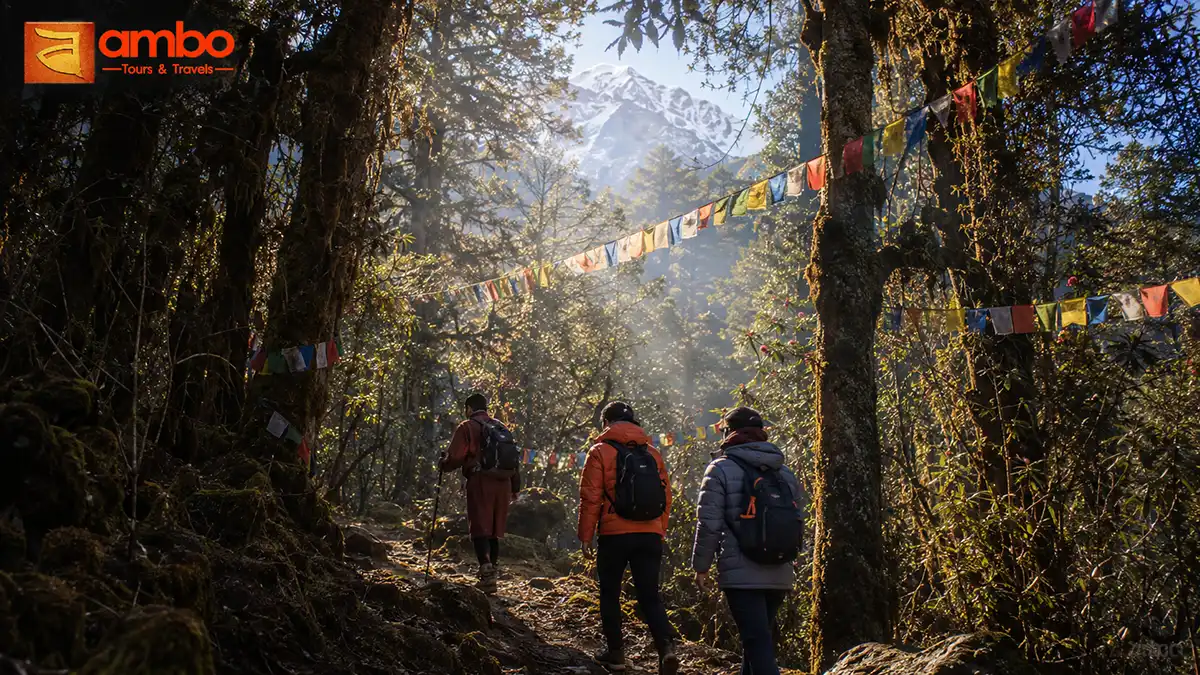
Bumthang Owl Trek — Ancient Forest, Sacred Monasteries & Central Bhutan
Paro · Bumthang · Trongsa · Punakha · Thimphu
Tour Information
- Named after the owls heard calling through ancient forest at night — one of Bhutan's most atmospheric short treks
- Drangela Pass (3,600m) with panoramic views of Gangkar Puensum (7,564m) — world's highest unclimbed peak
- Chuedak Monastery — 100+ stone carvings of Avalokiteshvara along the Royal Heritage Trail
- Dhur village — home of Khep and Brokpa nomadic communities in upper Bumthang valley
- Tharpaling Monastery — one of the most important Nyingma sites in central Bhutan
- Trongsa Dzong (1648) — the great fortress above the Black Mountain gorge
- Punakha Dzong at the confluence of Pho Chhu and Mo Chhu rivers
- Domestic flight Paro–Bumthang included (35 minutes over the Himalayan ranges)
- Tiger's Nest (Taktsang Monastery) on the final trekking day
The Bumthang Owl Trek is named after the owls heard calling through the forest at night — a detail that captures the spirit of this route perfectly. Three days of trekking through ancient blue pine, hemlock, and rhododendron forest above Bumthang valley connect the nomadic Khep and Brokpa community of Dhur village with the monasteries of Zambhalha, Chuedak, and Tharpaling along the Royal Heritage Trail. The highest point is Kitiphu Ridge at 3,870m, reached via Drangela Pass (3,600m) with panoramic views of Gangkar Puensum (7,564m) — the world's highest unclimbed peak.
The three-day trek is framed by a rich cultural journey through central and western Bhutan — a domestic flight to Bumthang, Jakar Dzong and the Bumthang valley, Trongsa Dzong above the Black Mountain gorge, Punakha Dzong at the river confluence, Dochula Pass, and Tiger's Nest in Paro on the final day. A domestic flight (Paro–Bumthang, approximately 35 minutes) is included in the package price.
This is the most accessible of Ambo Tours' multi-day trekking routes and the ideal introduction to Bhutanese highland terrain for first-time trekkers. Operated by Ambo Tours, DOT Licence No. 1053330, Thimphu.
Tour Pricing
12 Days Bhutan Journey — Cost
All prices in USD per personCost includes Sustainable Development Fee (SDF) of US $100 per person per night and Bhutan Visa Fee of US $40 per person. Entrance fees for monuments and festival visits are paid separately.
Detailed Itinerary
Your Bumthang Owl Trek Bhutan adventure starts with one of the world's most dramatic landings. As the plane banks sharply between Himalayan ridgelines into Paro International Airport, the peaks of Gangkar Puensum (7,564 m), Kanchenjunga, and on the clearest days even Everest line the horizon. The Ambo Tours guide and driver meet you at arrivals and transfer you to your hotel.
In the afternoon, begin your Bhutan sightseeing with a visit to Ta Dzong — an ancient watchtower now housing the National Museum of Bhutan, with galleries of thangka paintings, armour, and natural history that set the cultural scene beautifully. Walk the trail down to Paro Rinpung Dzong (built 1644 by Zhabdrung Ngawang Namgyal) — a fortress-monastery guarding the Paro Valley across the Pachhu River, its wooden galleries lined with murals depicting Bhutan Buddhist culture.
The evening is free to stroll through Paro town, browse the market, and ease into the pace of life in this kingdom. Your Ambo Tours team hosts a welcome dinner tonight. Dinner and overnight in Paro.
Tomorrow, a short domestic flight takes you east to Bumthang — the spiritual heart of Bhutan and start point of the Owl Trek.
A morning transfer to Paro International Airport puts you on a 35-minute Drukair flight east to Bathpalathang Domestic Airport in Bumthang (2,650 m) — a short-haul route that skims over forested ridgelines and glacial valleys in a way that no road journey can replicate. Your Ambo Tours driver meets you on the tarmac and transfers you to your hotel.
In the afternoon, begin exploring the enchanting Bumthang valley — the spiritual heartland of Bhutan Buddhist culture and home to some of the oldest sacred sites in the kingdom.
- Visit Jakar Dzong (constructed 1549) — the White Bird Castle perched on a hilltop overlooking the Chokhor Valley, one of the finest Bhutan dzong sites in the country.
- Discover the story of Fritz Maurer — the Swiss expat who introduced dairy farming, beekeeping, and smokeless wood stoves to Bhutan and whose legacy includes the country's only native beer, Red Panda, brewed right here in Bumthang. If lucky, join the current owner for a glass and a story.
In the evening, stroll the quiet streets of Bumthang town and absorb the unhurried pace of valley life. Dinner and overnight in Bumthang.
Tomorrow, the Bumthang Owl Trek officially begins — drive to the trailhead at Manchugang and enter the forests of the Khep and Brokpa nomads.
The Bumthang Owl Trek begins this morning. Your Ambo Tours vehicle drives to the trailhead at Manchugang, where boots meet trail for the first time. En route, pass through Dhur village (2,900 m) — the largest settlement in the Bumthang highlands, home to around 75 households and roughly 800 people from the nomadic Khep and Brokpa communities. For a longer cultural trek combining eastern Bhutan with the Brokpa communities, see our Merak Sakteng Trek — an 18-day expedition to the Sakteng Wildlife Sanctuary. Two distinct dialects are spoken here: standard Bumthang Kha and the ancient Brokke language of the highland nomads.
From Dhur, the trail climbs steadily upward through glorious forests of blue pine, hemlock, and juniper — some of the finest woodland scenery in eastern Bhutan. The ascent is gradual and the Bhutan landscape grows wilder with every hour of walking.
Arrive at camp at Schonath (3,450 m), surrounded by hemlock and juniper forest. As darkness falls, the haunting call of owls echoes through the canopy — the sound that gave this Bhutan trek its evocative name. Your Ambo Tours cook team will have a warm camp meal ready. Dinner and overnight at camp.
Tomorrow the trail pushes higher through rhododendron and bamboo forest toward Drangela Pass.
This morning the Bumthang Owl Trek enters its most scenic section. The trail climbs through lush forests of hemlock, fir, spruce, and multiple species of rhododendron — which burst into vivid bloom during April and May, carpeting the hillside in pink, white, and crimson. Bamboo forms the main undergrowth here, giving the forest a dense, primordial quality.
After around two hours of steady walking, you reach Drangela Pass (3,600 m) — a high point that opens into sweeping views of the valleys below on clear days. From here, your Ambo Tours guide points out the snow-capped outline of Gangkar Puensum (7,564 m) — Bhutan's highest mountain and the world's highest unclimbed peak — filling the northern horizon in a view that earns this pass its reputation.
Continue to the campsite on Kitiphu Ridge (3,870 m) — a high, open position that on clear evenings rewards with panoramic sunset views across the Bhutan mountain ranges. Dinner and overnight at camp.
Tomorrow, the final leg of the trek descends to the extraordinary monasteries of Tharpaling and Chuedak.
The final morning of the Bumthang Owl Trek is a descent through one of the most spiritually rich landscapes in eastern Bhutan. The trail drops toward a cluster of remarkable monasteries, each one a chapter in Bhutan Buddhist culture that your Ambo Tours guide brings alive with context and stories.
- Visit Zambhalha Monastery — a serene hermitage set among the forest.
- Explore Chuedak Monastery — home to over 100 stone carvings of Avalokiteshvara in the eleven-headed Chukchizhey form, a style of sacred art found nowhere else in Bhutan and one of the most significant Bhutan hidden gem religious sites on any Bhutan itinerary.
- Descend to Tharpaling Monastery, following the ancient Royal Heritage Trail between Trongsa and Bumthang — the same route used by pilgrims and kings for centuries. Explore our full Bhutan trekking guide to compare all routes, difficulty levels, and seasonal conditions across the kingdom. From the ridge, the best view of Jakar Dzong in the entire valley unfolds below you.
Your transport meets you at Tharpaling and drives you back to Bumthang town for a well-earned dinner and a real bed. Overnight in Bumthang.
Tomorrow, the road journey west begins — driving to the royal stronghold of Trongsa.
After the physical demands of the Bumthang Owl Trek, today offers a gentler pace — a scenic drive west to Trongsa (2,200 m) over Yotong La Pass (3,425 m), one of the most picturesque mountain crossings in central Bhutan.
En route, stop at the Yathra Weaving Centre in Chumig village — where Bumthap women weave yak and sheep wool into the beautifully patterned fabric called Yathra. These geometric-patterned textiles are among the finest examples of traditional Bhutan cultural tour craft, and watching the weavers work on traditional looms is a genuinely absorbing experience.
In Trongsa, two remarkable sites fill the afternoon:
- Trongsa Dzong (built 1648) — the largest fortress in Bhutan, commanding the Mangdichhu gorge with its distinctive yellow roof. Every King of Bhutan has served as Trongsa Penlop (Governor) before ascending to the throne, making this dzong the historical cradle of the Bhutan monarchy.
- Ta Dzong Trongsa — a five-storey ancient watchtower (built 1652) now housing a state-of-the-art royal heritage museum dedicated to the Wangchuck dynasty, with four observation points shaped like the Tiger, Lion, Garuda, and Dragon.
The evening is free to explore Trongsa town at leisure. Dinner and overnight in Trongsa.
Tomorrow, a long but rewarding drive continues west to Punakha, Bhutan's former capital.
Today's drive from Trongsa to Punakha (1,350 m) is one of the great road journeys of central Bhutan — five hours of mountain scenery, forest passes, and valley panoramas that most visitors to Bhutan only dream of seeing. Your Ambo Tours driver makes several worthwhile stops along the way.
- Stop at the viewpoint opposite Trongsa Dzong for a final photograph of the fortress against the gorge below.
- Walk around Chendebji Chorten — an 18th-century stupa modelled on the Boudhanath stupa in Kathmandu, with eyes painted at the four cardinal points. It is a peaceful, atmospheric stop set beside a stream.
- Pass Wangdue Phodrang Dzong (built 1638 by Zhabdrung Ngawang Namgyal) — currently under restoration after a devastating 2012 fire, but still impressive on its ridge above the confluence of two rivers.
- Visit Chimi Lhakhang (built 1499 by the Divine Madman, Lama Drukpa Kunley) — the famous fertility temple set on a round hillock near Sopsokha village, reached by a 20-minute walk through rice fields.
Arrive in Punakha in the afternoon. Dinner and overnight in Punakha.
Tomorrow brings a full day exploring the treasures of the Punakha valley.
Punakha is widely considered the most beautiful valley in western Bhutan — subtropical, warm, and laced with rivers — and today Ambo Tours gives you a full day to explore it properly.
- Hike to Khamsum Yulley Namgyal Chorten — a 100-ft temple built in 1994 by the Queen Mother, perched on a strategic ridge overlooking terraced farmland. Cross a suspension bridge over the Mochhu River and walk up through paddy fields for a 45-minute climb rewarded with sweeping valley views.
- Visit Punakha Dzong (built 1637 by Zhabdrung Ngawang Namgyal) — positioned at the confluence of the Pho Chhu (male) and Mo Chhu (female) rivers like an anchored ship. It is Bhutan's former capital and winter residence of Je Khenpo, and arguably the finest Bhutan dzong in the country. In spring, jacaranda trees drape the outer walls in purple bloom.
- Walk to Rinchengang village — a 20-minute uphill walk from the highway, known for its tradition of stone masonry dating back centuries.
- Visit Sangchen Dorji Lhuendrup Nunnery Buddhist College in Wolakha — built in 2008 on a spectacular hilltop for nuns to pursue advanced Bhutan Buddhist culture studies.
Dinner and overnight in Punakha.
Tomorrow, the scenic drive to Thimphu passes the famous 108 stupas at Dochula Pass.
The drive from Punakha to Thimphu (2,300 m) is a highlight of any Bhutan tour package. Your Ambo Tours driver stops first at Dochula Pass (3,050 m) — where 108 Druk Wangyal chortens ring a hilltop thick with prayer flags, and on clear mornings a full sweep of the Greater Himalayan range — including Gangkar Puensum (7,564 m) — lines the horizon. A series of 11 hidden meditation caves with painted murals of deities sits quietly nearby, used by Buddhists seeking stillness amid modern life.
Arrive in Thimphu — a capital unlike any other, built entirely in traditional Bhutanese architectural style and, famously, without a single traffic light. Two afternoon highlights:
- National Memorial Chorten (built 1974) — a central landmark of daily worship in the city, its golden spires always busy with elderly Bhutanese walking circumambulations.
- Buddha Dordenma Statue at Kuenselphodrang — at 51.5 metres, one of the world's largest bronze Buddha statues, gazing south over the Thimphu valley from a forested hilltop.
The evening is free to explore Thimphu's streets, markets, and restaurants at your own pace. Dinner and overnight in Thimphu.
Tomorrow, a beautiful hike through blue pine forest leads to the historic Cheri Monastery.
Leaving the city behind, today Ambo Tours takes you north of Thimphu for a rewarding hike to Cheri Monastery (2,850 m) — the oldest monastery in Bhutan, built in 1620 by Zhabdrung Ngawang Namgyal and the birthplace of Bhutan's first monk body. The trail winds for about an hour through blue pine, oak, and rhododendron forest, crossing a cantilever bridge vibrant with prayer flags above the rushing Thimphu Chhu.
The monastery is home to sacred relics and an active meditation centre — entering its prayer halls is a genuinely spiritual experience. Keep your eyes open for deer and mountain goats on the approach. A picnic lunch beside the river makes for a perfect mid-hike break.
In the afternoon, drive to Changlingmithang Sports Complex to watch a local archery match if one is in progress — Bhutan's national sport played with compound bows at targets 145 metres apart, accompanied by singing and ritual dances after each hit. It is one of the most entertaining spontaneous Bhutan cultural tour experiences you can have.
End the day with a late afternoon visit to Tashichho Dzong (first built 1216 AD, rebuilt 1641) — the royal secretariat and summer throne of Je Khenpo, at its most photogenic in the golden hour. Dinner and overnight in Thimphu.
Tomorrow, the tour's most famous day — the iconic hike to Tiger's Nest Monastery in Paro.
An early departure from Thimphu brings you to Paro in time for the finest hike in Bhutan. Taktsang Monastery (Tiger's Nest) clings to a sheer cliff face 900 metres above the Paro Valley floor at 3,120 m — a cluster of gilded temples that has become the defining image of Bhutan tourism worldwide. Guru Rinpoche is said to have flown here on the back of a flying tigress in the 8th century to subdue local demons.
The 11-km round-trip hike starts from Ramthangkha, climbing steadily through blue pine forest for around two hours. A small teahouse at the halfway point serves the most rewarding cup of tea you will ever drink, with the monastery framed perfectly above. Horse rides are available to the viewpoint for those who need them. Allow an extra hour to explore the monastery's inner sanctuaries — cameras must be left at the entrance gate.
On the descent, visit Kichu Lhakhang — one of Bhutan's oldest temples, built in the 7th century by Tibetan King Songtsen Gampo as part of 108 temples constructed across the Himalayan region to pin a mythological ogress to the earth. Dinner and overnight in Paro.
Tomorrow, your Bumthang Owl Trek Bhutan journey with Ambo Tours comes to a close.
Your Bumthang Owl Trek Bhutan journey with Ambo Tours comes to a close this morning. After breakfast, your guide and driver transfer you to Paro International Airport — and as the plane climbs steeply out of the valley, the ridgelines and prayer flags of Paro recede below you for the last time on this trip.
Twelve days have taken you from the spiritual highlands of Bumthang through nomadic Brokpa villages, ancient forest passes, monastery-studded ridges, the royal fortress of Trongsa, the river confluence beauty of Punakha Dzong, the meditative peace of Cheri Monastery, and finally to the cliff-face wonder of Tiger's Nest. Throughout it all, Bhutan's philosophy of Gross National Happiness (GNH) — its commitment to sustainable tourism, cultural preservation, and measured, mindful development — makes itself felt in ways that no other destination quite manages.
The entire Ambo Tours team — guides, drivers, and trek crew — wishes you Tashi Delek: farewell and good luck. We hope to welcome you back for another chapter of your Bhutan travel story.
Included / Excluded
- ✔All meals — breakfast, lunch, and dinner
- ✔Accommodation on twin / double sharing basis (single supplement extra)
- ✔All transportation within the kingdom including airport transfers
- ✔Sustainable Development Fee — Government tax (SDF)
- ✔Bhutan visa fee
- ✔English-speaking private local guide
- ✔Sightseeing as per itinerary
- ✔Bottled water throughout the journey
- ✖International flights to and from Paro (PBH)
- ✖Entrance fees for museums and monuments
- ✖Gratuities for guides and drivers
- ✖Travel insurance premiums
- ✖Payments for services provided on a personal basis
- ✖Cost for any services not mentioned under "Cost Includes"
- ✖Cost incurred due to mishaps, strikes, political unrest, etc.
- ✖Personal expenses — laundry, beverages, or personal services
Ambo Tours & the 1% Club
Every tour we run includes a contribution to a Bhutanese NGO of your choice — at no extra cost to you. We call this the 1% Club: a minimum of 1% of your trip's profit, or Nu 5,000, whichever is higher, donated on every single journey. You choose where it goes.
What is the Bumthang Owl Trek?
The Bumthang Owl Trek is a three-day wilderness walk through the ancient forest above Bumthang valley — the sacred heartland of central Bhutan. The route begins at Manchugang trailhead and climbs through dense blue pine, hemlock, and rhododendron forest past Dhur village, home of the Khep and Brokpa nomadic communities. The first camp at Schonath (3,450m) is where the trek takes its name — owls calling through the forest at night are an unmistakable part of the experience.
Day 2 crosses Drangela Pass (3,600m) with panoramic views of Gangkar Puensum (7,564m) before the trail descends toward the Royal Heritage Trail. Day 3 follows the ancient pilgrimage route past Zambhalha Monastery and the stone-carved facade of Chuedak Monastery to Tharpaling — one of the most important Nyingma sites in Bhutan.
The trek is framed by a complete cultural journey through central and western Bhutan — Jakar Dzong and Bumthang valley on arrival, Trongsa Dzong above the Black Mountain gorge, Punakha Dzong at the river confluence, Dochula Pass, Thimphu, and Tiger's Nest in Paro on the final touring day. A domestic flight from Paro to Bumthang is included in the price.
Altitude & Acclimatisation
The Bumthang Owl Trek is the lowest-altitude of all Ambo Tours' multi-day trekking routes. The highest point is Kitiphu Ridge camp at 3,870m — reached on Day 4 after crossing Drangela Pass (3,600m). The tour begins at Paro (2,250m) and spends Day 2 at Bumthang (2,650m) before the trek begins on Day 3, providing adequate acclimatisation before the higher camps.
Mild altitude symptoms (headache, fatigue) are possible at Kitiphu Ridge and on the pass crossing. These typically resolve quickly on descent. The entire trek is completed within three days and the highest camp is vacated on Day 5 morning — so sustained high-altitude exposure is minimal compared to the longer western routes.
The Bumthang Owl Trek is the recommended first Bhutan trek for travellers who have not previously trekked at altitude, and for those who want a taste of the highland wilderness without committing to a week or more above 3,500m.
Trek Route Map
The map below shows the three-day Bumthang Owl Trek route from the Manchugang trailhead through Dhur village, over Drangela Pass (3,600m) to Kitiphu Ridge camp (3,870m), and down the Royal Heritage Trail to Tharpaling Monastery.

What to Pack for the Bumthang Owl Trek
The Bumthang Owl Trek is a short route but the forest conditions and altitude range require the same core kit as any Bhutanese highland trek. Bumthang valley receives more precipitation than Paro and Thimphu — the forest can be wet and cool at any time of year.
Essential items:
- Warm insulating layer (fleece or light down) — Kitiphu Ridge camp at 3,870m is cold after sunset
- Waterproof outer shell jacket — Bumthang forest is frequently wet and misty
- Sturdy trekking boots — waterproof, with ankle support, fully broken in
- Trekking poles — recommended for the descent from Kitiphu Ridge on Day 5
- Thermal base layers — one set is sufficient for this short route
- Warm hat and gloves — for camp evenings above 3,400m
- Sunscreen SPF 50+ and sunglasses — still required at altitude even in overcast conditions
- Small daypack (20–25L) — main luggage travels separately
Sleeping bags, tents, and all camp equipment are provided by Ambo Tours. For a full packing reference, see our complete Bhutan packing guide.
Frequently Asked Questions
The trek takes its name from the owls heard calling through the forest after dark — a sound that becomes the defining auditory memory of the first night at Schonath camp (3,450m). The ancient blue pine and hemlock forest above Dhur village is home to several owl species including the collared owlet and brown wood owl. The name was given by the local guides who have led this route for generations and reflects the intimate, unhurried quality of this short but deeply atmospheric trek.
The Bumthang Owl Trek is rated Easy to Moderate and is the most accessible of Ambo Tours' multi-day trekking routes. The three days on foot are relatively short — 4–5 hours on Days 3 and 5, and just 3–4 hours on Day 4 (the pass day). The highest point is Kitiphu Ridge camp at 3,870m. No prior trekking experience is required. The trek is suitable for reasonably fit travellers who are comfortable with a full day of walking on forest and mountain trails.
Drangela Pass sits at 3,600m on the ridge above Bumthang valley and is the high point of the second trekking day. From the pass, on a clear day, Gangkar Puensum (7,564m) — the world's highest unclimbed peak — is visible to the north. The pass marks the watershed between the upper Bumthang valley and the forest drainage leading down to Tharpaling. The crossing takes approximately 2 hours from Schonath camp and is straightforward in good weather.
The Royal Heritage Trail is a network of ancient pilgrimage and trade routes connecting the sacred monasteries of the Bumthang valley. The Bumthang Owl Trek descends along one of its most significant sections — passing Zambhalha Monastery, Chuedak Monastery (with over 100 stone carvings of Avalokiteshvara), and arriving at Tharpaling, one of the most important Nyingma monasteries in Bhutan. The trail has been used by pilgrims, monks, and traders for centuries and remains largely unchanged.
Yes. The domestic flight from Paro to Bumthang (approximately 35 minutes on Druk Air or Bhutan Airlines) is included in the tour package price for all group sizes. The flight crosses the central Himalayan ranges and is itself a memorable experience. The return from Bumthang to Paro at the end of the trekking section is by road — a full day's drive through Trongsa and the Black Mountain region.
Spring (March to May) and autumn (September to November) are both excellent. Spring brings rhododendron blooms along the forest trail and the best chance of clear views of Gangkar Puensum from Drangela Pass. Autumn offers stable weather and cool, crisp conditions ideal for forest trekking. The route is possible in early winter (November to December) when the valley is quiet and frost covers the higher camps — though this requires an extra warm layer. It is not recommended during the monsoon (June to August).
Ready to Begin Your Journey?
Our Thimphu team responds within 24 hours. Tell us your dates and we will handle the rest.