Bhutan Itinerary 7 Days at a Glance
The best Bhutan itinerary for 7 days covers Thimphu, Punakha, Gangtey (the Phobjikha Valley) and Paro, and saves the Tiger’s Nest hike for Day 6, when you’ve acclimatised. It is six nights on the ground, with a private guide and driver, and every drive is two hours or less except the five-hour road from Gangtey back to Paro. Our version of this trip starts from USD 1,690 per person for groups of three or more, with the Sustainable Development Fee (SDF), visa fee, all meals, hotels, transport and a licensed guide included.
Here is the whole week in one table:
| Day | Route | Drive | Overnight | Altitude | Highlights |
|---|---|---|---|---|---|
| 1 | Arrive Paro, drive to Thimphu | 54 km, about 1 hr | Thimphu | 2,334 m | Tamchog Lhakhang stop, Buddha Dordenma, Takin Reserve |
| 2 | Thimphu | Local | Thimphu | 2,334 m | Tashichho Dzong, Folk Heritage Museum, Zorig Chusum, Changangkha |
| 3 | Thimphu to Punakha | 76 km, about 2 hrs | Punakha | 1,242 m | Dochula Pass, Punakha Dzong, Chimi Lhakhang, suspension bridge |
| 4 | Punakha to Gangtey | 75 km, about 2 hrs | Gangtey | 3,000 m | Gangtey Goenpa, Gangtey Nature Trail, Khewa Lhakhang |
| 5 | Gangtey to Paro | 185 km, about 5 hrs | Paro | 2,280 m | Kyichu Lhakhang, Rinpung Dzong, National Museum |
| 6 | Paro: Tiger’s Nest hike | 10 km round trip on foot, 4–6 hrs | Paro | Up to 3,120 m | Paro Taktsang (Tiger’s Nest) |
| 7 | Depart from Paro | To the airport | – | – | Final walk through Paro town |
Quick answers: Seven days is enough for the main western valleys. The SDF is USD 100 per person per night, so six nights is USD 600, and it is already included in our tour price. The hardest day is the Tiger’s Nest hike. Spring (March–May) and autumn (September–November) have the clearest skies. If you’d rather start in Paro, jump to Option B.
Tell us your dates and we’ll adjust this itinerary to fit them exactly →
Why 7 Days Is the Sweet Spot for a First Bhutan Trip
A week gives you just enough time to breathe. Unlike a hurried 4-night stopover, a 7 day Bhutan trip lets you pause at a farmhouse, watch monks debate in a courtyard, and wake up early for Tiger’s Nest without the panic of a packed schedule.
Bhutan is not a country you can rush. The roads are mountain roads, and the monasteries reward patience. Gross National Happiness — the country’s guiding philosophy — isn’t just a tourism slogan; it genuinely shapes the pace of daily life here. When you arrive, let that pace take over.
This is the route we run most often, and it is built around one idea: spend the first days at moderate altitude in Thimphu and Punakha, reach the high, cold valley of Gangtey once your body has adjusted, and do the biggest hike of the trip on Day 6. Our Bhutanese guides have 10+ years of experience on these roads, and we’ve shaped the plan around what first-timers say mattered most when they look back.
It is a starting point, not a template. Extend it by two days for Bumthang in central Bhutan, swap in a short trek, or shift the whole week around a festival date, and no two 7-day trips we’ve built look quite the same.
Day-by-Day: A Bhutan 7 Day Itinerary First-Time Visitors Will Love
Day 1: Arrive in Paro, Drive to Thimphu
Paro Airport (PBH) is Bhutan’s only international airport, and the landing alone is an experience: pilots thread between forested ridges before the runway appears. Your guide and driver meet you at arrivals, and after immigration formalities you drive 54 km (about an hour) along the Wang Chhu river to Thimphu.
On the way, you can stop at Tamchog Lhakhang, a 15th-century temple reached by a traditional iron chain bridge. In Thimphu, the Buddha Dordenma, a 51-metre gilded statue above the valley, is at its quietest in late afternoon, and the Motithang Takin Reserve is home to Bhutan’s odd and lovable national animal. Dinner introduces you to ema datshi, the national dish of chillies and cheese. Yes, it’s as good as it sounds. Thimphu sits at 2,334 m, so drink plenty of water and take the evening slowly.
Day 2: Thimphu, the Capital That Doesn’t Feel Like One
Thimphu is Bhutan’s capital and largest city, and it has no traffic lights. A police officer in a white booth directs the traffic at the main intersection, a detail that tells you a lot about the place.
Today is a full day in town. Tashichho Dzong is the seat of government and the throne room of the Je Khenpo, the chief abbot; your guide arranges the entry permit. The Folk Heritage Museum is a preserved three-storey rammed-earth farmhouse that shows rural Bhutanese life as it was lived. At the National Institute for Zorig Chusum, students spend years learning Bhutan’s 13 traditional arts, including thangka painting, woodcarving and weaving, and you can watch classes in session.
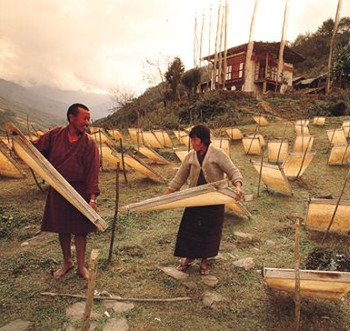
You can also try archery, Bhutan’s national sport, at Simply Bhutan, and visit Changangkha Lhakhang, a 15th-century temple on the ridge above town where parents bring newborns for a blessing. If you are in Thimphu at the weekend, the Weekend Market along the river is worth a long wander for vegetables, dried yak meat, textiles and conversation.
Day 3: Dochula Pass and Punakha, Bhutan’s Most Beautiful Valley
The drive east from Thimphu climbs through switchbacks to Dochula Pass at 3,100 metres, where 108 memorial chortens (stupas) stand against the skyline. On a clear morning the whole eastern Himalayan range spreads out behind them, with peaks including Gangkhar Puensum, the world’s highest unclimbed mountain. Bring a warm layer: the pass is cold even in spring.

From the pass the road drops sharply into a warm, subtropical valley. The 76 km drive takes about two hours. Punakha Dzong, built in 1637 at the confluence of the Pho Chhu and Mo Chhu rivers, is widely considered the most beautiful dzong in Bhutan, and the first king was crowned here in 1907. In spring the jacaranda trees in the courtyard bloom purple.

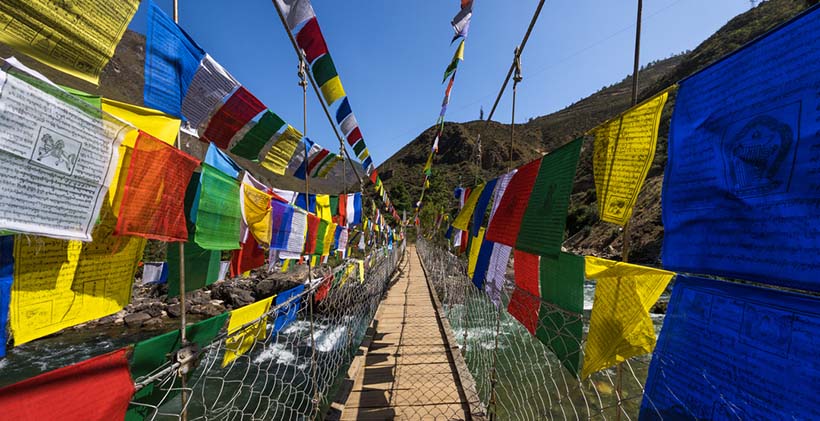
Walk through paddy fields to Chimi Lhakhang, the fertility temple of the Divine Madman, Drukpa Kunley, a 15th-century monk whose irreverent approach to Buddhism has become one of Bhutan’s most beloved stories. Then cross the Punakha Suspension Bridge, 160 metres of swaying planks strung with prayer flags above the river. This is the Bhutan most visitors don’t expect: warm, green and utterly peaceful.
Day 4: Punakha to Gangtey and the Phobjikha Valley
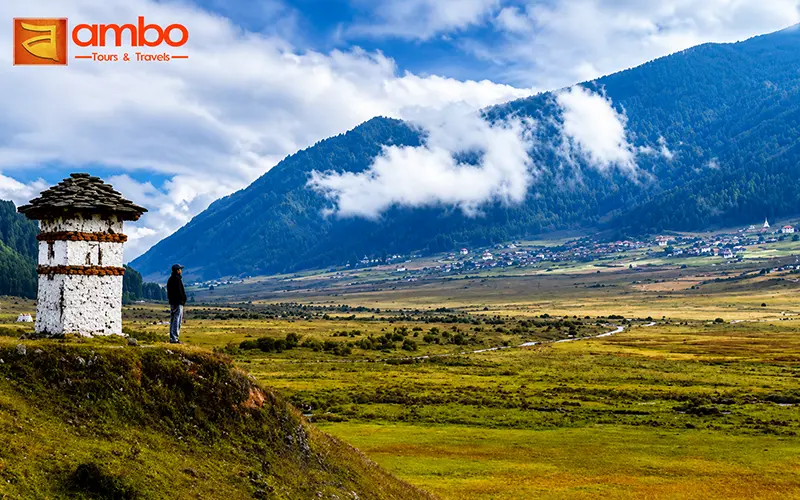
The road climbs through broadleaf forest past Wangdue Phodrang and over the Pelela Pass at 3,420 metres, the informal boundary between western and central Bhutan. The 75 km drive takes about two hours, and you arrive in a wide, high valley at 3,000 metres that slows people down on contact.
Gangtey Goenpa, founded in 1613, is the only Nyingmapa monastery in western Bhutan, and it sits on a low hill with views across the whole Phobjikha Valley. The Gangtey Nature Trail is an easy 2.5 km walk through marshland and community forest. Between October and March it is the best place in Bhutan to see the rare black-necked cranes that migrate here from the Tibetan Plateau; the valley can hold up to 600 of them each winter. Small Khewa Lhakhang on the valley floor is rarely visited and still has its original 17th-century murals. The valley holds the cold after sunset, so pack a warm layer for the evening.
Day 5: Gangtey to Paro
This is the longest drive of the week: 185 km, about five hours, back through Wangdue and Punakha and then west along the river and up the Tang Chhu gorge to Paro. The forests change character as the altitude shifts, and a mid-morning stop at a roadside tea house gets you fresh butter tea.
In Paro, the afternoon covers the valley’s oldest sites. Kyichu Lhakhang is one of the 108 temples that Emperor Songtsen Gampo is said to have built across the Himalayas in a single day in the 7th century. Rinpung Dzong, built in 1646, is Paro’s administrative and religious centre, with the covered wooden Nemi Zam bridge in front. The National Museum in the old Ta Dzong watchtower above it covers textiles, thangkas and natural history. Have an early night, because tomorrow’s hike starts at 7:30 am.
Day 6: Tiger’s Nest, the Hike Every Bhutan Visitor Remembers
No Bhutan itinerary 7 days is complete without Paro Taktsang. The monastery is built into a granite cliff at 3,120 metres, about 900 metres above the valley floor, on the spot where Guru Rinpoche is said to have meditated in the 8th century. The first structure on the cliff was raised in 1692.
The round trip is 10 km and takes 4–6 hours. Start by 7:30 am to beat both the crowds and the midday heat. The trail climbs from the car park at 2,450 m through blue pine forest hung with lichen and prayer flags. The first major viewpoint, about 90 minutes up, is the view in every photograph. From there the path passes a waterfall and then a steep staircase cut into the cliff.
Practical tips from our guides:
- Carry at least 1.5 litres of water. The tea house at the first viewpoint is the only resupply on the trail.
- Walking poles help a lot on the descent, and your guide can arrange them in Paro town the evening before.
- Horses are available for the first section, up to the first viewpoint, for an additional fee.
- The Tiger’s Nest entrance fee is included in the tour price.
- Remove your shoes before entering the temples, and note that photography is not permitted inside.
Ready to lock in this itinerary? Get this itinerary customised for you and we’ll reply within 24 hours. If you’d like Ambo Tours to handle every detail, see our 7-day Western Bhutan tour, with all inclusions listed.
Day 7: Departure from Paro
The last morning in Paro has its own quality. The mountains are clear at dawn, before cloud builds, and breakfast is unhurried. Depending on your flight time, you may have time for a final walk down Paro’s main street, which has sold the same things for decades: thangkas, wooden masks, incense, woven belts and Bhutanese stamps. A silk prayer flag costs less than a coffee and travels well.
Keep your passport and visa documents in your carry-on. Your guide accompanies you to Paro Airport for departure formalities, and the flight out banks sharply between the ridges for one last look at the valley. If you’re already thinking about coming back, consider the Bumthang Valley in central Bhutan or the remote Haa Valley.
Option B: Start in Paro Instead
Some travellers prefer to begin in Paro, do the Tiger’s Nest hike early, and end in Punakha. This version drops Gangtey and runs: three nights in Paro (arrival, the valley’s dzongs and museum, then Tiger’s Nest), two nights in Thimphu, one night in Punakha via Dochula Pass, and the drive back to Paro, about 3–3.5 hours of driving.
If your flight leaves on the afternoon of Day 7, that is six nights and USD 600 in SDF. If you fly out the next morning, add a seventh night in Paro and another USD 100. The trade-off is altitude and pacing: Tiger’s Nest comes earlier, before your body has adjusted, and you skip the quiet of Gangtey. We recommend Option A for first-timers and Option B if you are tight on time or have a flight window that favours it. Either version can be built to your dates.
Getting Between Destinations: Road Times and What to Expect
One thing no itinerary PDF tells you: the roads in Bhutan are part of the experience, not an inconvenience. Times below are driving time on our route, without photo stops.
| Leg | Distance | Drive time | What to expect |
|---|---|---|---|
| Paro to Thimphu (Day 1) | 54 km | About 1 hour | Paved and smooth, following the Wang Chhu river |
| Thimphu to Punakha via Dochula Pass (Day 3) | 76 km | About 2 hours | Climbs to 3,100 m then drops to 1,242 m. Switchbacks, so sit in front if you get motion sickness |
| Punakha to Gangtey via Pelela Pass (Day 4) | 75 km | About 2 hours | Climbs to 3,420 m and arrives at a cold valley at 3,000 m |
| Gangtey to Paro (Day 5) | 185 km | About 5 hours | The longest drive. Plan a tea stop on the way |
A note on mountain driving: all Ambo Tours journeys use private vehicles with experienced local drivers who know these roads in every season. During the monsoon (June–August), landslides can occasionally add time to a drive, and we plan your daily schedule around that if you travel then.
What Does a 7-Day Bhutan Trip Cost?
Bhutan’s pricing is straightforward once you know the parts. Our 7-day tour follows the route above and is priced per person, in US dollars, by group size:
| Travelling as | Price per person |
|---|---|
| Solo traveller | USD 2,240 |
| Two travellers | USD 1,830 |
| Three or more travellers | USD 1,690 |
Included: all meals, accommodation on a twin or double-sharing basis, all transport within Bhutan including airport transfers, the Sustainable Development Fee, the Bhutan visa fee, an English-speaking private guide, sightseeing as per the itinerary, entrance fees to all monuments and museums (including the Tiger’s Nest), and bottled water. A single-room supplement is extra.
Not included: international flights to and from Paro, tips for your guide and driver, travel insurance, and personal spending.
The SDF is USD 100 per person per night, so the six nights of this itinerary come to USD 600, already inside the prices above. If you add a night, add another USD 100. For the full breakdown by group size and season, see our Bhutan travel cost guide, or browse all of our Bhutan tour packages.
What to Pack for Each Day of Your 7-Day Bhutan Itinerary
Packing for Bhutan requires one unusual consideration: you will move between warm subtropical valleys and cold mountain passes, sometimes on the same day. Here is a practical breakdown.
Days 1–2 (Thimphu, 2,334 m)
Pack layers. Mornings and evenings are cool year-round, and afternoons can be warm in spring and autumn. A light down jacket or fleece is essential, along with comfortable walking shoes for dzong courtyards. Modest clothing is required for all dzong visits.
Day 3 (Dochula Pass and Punakha, 1,242 m)
Bring your warmest layer for Dochula Pass: even in spring it can be bitterly cold and windy at 3,100 m. By the time you reach Punakha you will likely be peeling it off again. Wear shoes that can handle slightly muddy paths on the walk to Chimi Lhakhang and the riverside.
Day 4 (Gangtey, 3,000 m)
Gangtey is the coldest night of the trip. Pack a warm layer for the evening, a hat and gloves outside summer, and shoes for a marshland walk.
Day 6 (Tiger’s Nest Hike)
This is the day to get your pack right:
- Sturdy, broken-in hiking shoes or trail runners (not flip-flops)
- At least 1.5 litres of water
- Snacks: energy bars, nuts, chocolate
- Sun protection (UV intensity increases with altitude)
- A small daypack, with your main luggage left at the hotel
- A light rain jacket (weather changes quickly at altitude)
- Walking poles if you’d like them (your guide can arrange these)
- Modest clothing: shoulders and knees must be covered inside the monastery
General Packing Rules for Bhutan
- Modest clothing is required for all dzong and monastery visits (no shorts, no sleeveless tops)
- A small padlock for your luggage is useful in shared guesthouse situations
- Bring a universal power adapter, as Bhutan’s sockets differ from most countries’
- Carry some cash. ATMs exist in Thimphu and Paro but can be unreliable in smaller towns
- Keep your passport and visa documents in your carry-on, not in checked luggage
Variations: Make This 7-Day Itinerary Yours
- Add two days for Bumthang. Central Bhutan is the natural extension for a 9-day trip.
- Add the Haa Valley. It makes a good day trip from Paro for travellers who want something less visited.
- Time it for a festival. Tshechu dates move every year with the lunar calendar. See our 2026 and 2027 festival calendars, or our guide to Bhutan’s festivals.
- Visit in crane season. Between late October and early March, black-necked cranes are in Phobjikha, which makes Gangtey the highlight of the week.
- Add a short walk. See our guide to Bhutan’s best trails and hikes, or if you want a night in a monastery, read about monastery overnight stays.
- Choose your hotels. Our guide to hotels and farmhouses in Bhutan explains the options in each valley.
Practical Information: Planning Your 7-Day Bhutan Trip
Visa and Entry
All international visitors except Indian nationals need a Bhutan visa, and it must be approved before you fly. You can apply online through the Department of Immigration’s e-visa portal, or a licensed tour operator, hotel or guide can apply for you. Most travellers let their operator do it as part of arranging the trip. Ambo Tours is licensed by the Department of Tourism of Bhutan, and we handle your visa paperwork end to end. You receive a visa clearance letter before departure, and you present it with your passport at immigration in Paro. US travellers can read our visa guide for US citizens, and everyone else our Bhutan visa and entry guide.
How to Get to Bhutan
Paro is served only by Druk Air and Bhutan Airlines. Common connection hubs include Delhi, Kolkata, Kathmandu, Bangkok, Singapore and Dhaka. Book early, because the aircraft are small and seats sell out. See our guide to flying to Bhutan, or our guide to travelling to Bhutan from the USA.
Best Time for a 7-Day Bhutan Trip
- Spring (March–May): Rhododendrons bloom, skies are clear, and festivals fall in this season
- Autumn (September–November): Best visibility, and the big Thimphu festival (dates change every year)
- Winter (December–February): Quiet and cold in the mountains, with beautiful low-season rates
- Monsoon (June–August): Lush green, fewer tourists, and mountain roads can close
Read our complete guide on the best time to visit Bhutan for a month-by-month comparison.
Cost and the Sustainable Development Fee
The SDF is USD 100 per person per night, a 50% discount on the standard USD 200 for tourists paying in US dollars. The Royal Government has set the discount for 1 September 2023 to 31 August 2027 and may end it after that date. Children under 6 pay no SDF, and children aged 6 to under 12 pay half. For this itinerary, six nights is USD 600 in SDF, already included in our tour price.
Frequently Asked Questions
Is 7 days enough for a first Bhutan trip?
Yes. A 7-day Bhutan itinerary covers the main western valleys (Thimphu, Punakha, Gangtey and Paro) at a comfortable pace, and it is the most popular length for first-time visitors. If you have more time, we suggest adding two days for Bumthang in central Bhutan.
How much does a 7-day Bhutan trip cost?
Our 7-day tour costs USD 2,240 for a solo traveller, USD 1,830 per person for two travellers, and USD 1,690 per person for groups of three or more. The price includes the Sustainable Development Fee, the visa fee, all meals, accommodation, transport, entrance fees to all monuments and museums, and a private guide. International flights, tips and insurance are extra.
How many nights is a 7-day Bhutan itinerary, and what is the SDF?
Seven days is six nights: Thimphu (2), Punakha (1), Gangtey (1) and Paro (2). At USD 100 per person per night, the SDF is USD 600, and it is included in our tour price. Each extra night adds USD 100.
Do I need a guide for a 7-day Bhutan trip?
Yes. We follow Bhutan’s rule that international visitors travel with a licensed Bhutanese guide, and rules can change, so confirm the current requirements with the Department of Tourism. On our trips, your guide is the reason the journey becomes more than sightseeing, and our guides have 10+ years of experience on this route.
When is the best time to do a 7-day Bhutan itinerary?
Spring (March to May) and autumn (September to November) offer the clearest skies and the best conditions for the Tiger’s Nest hike. Spring adds rhododendron bloom, and autumn brings the big Thimphu festival. Both are peak seasons, so book early. Between late October and early March you can also see black-necked cranes in Gangtey.
Should I start in Thimphu or Paro?
We recommend starting in Thimphu (Option A) for first-timers: you acclimatise in Thimphu and Punakha, reach the high valley of Gangtey on Day 4, and do the Tiger’s Nest hike on Day 6. Starting in Paro (Option B) works if you’re short on time, but it skips Gangtey and puts the big hike earlier in the trip.
What is the Bhutan visa process like?
You can apply online through the Department of Immigration’s e-visa portal, or a licensed tour operator, hotel or guide can apply on your behalf. Ambo Tours handles all visa paperwork. You receive a visa clearance letter before departure, and you show it with your passport at immigration in Paro.
How physically demanding is this 7-day itinerary?
The main challenge is the Tiger’s Nest hike on Day 6: a 10 km round trip that takes 4 to 6 hours with about 900 metres of climbing. The rest of the itinerary involves light walking. Horses are available for the first section, and we can adjust the pace for any fitness level.
Have more questions? Contact our Bhutan specialists — we reply within 24 hours.
Sources
- Department of Tourism, Royal Government of Bhutan, announcements — the 25 August 2023 press release on the SDF discount and children’s rates.
- Royal Bhutanese Embassy, New Delhi, Visa for Visiting Bhutan — tourists can apply online or through tour operators, hotels and guides.
Written by the Ambo Tours team in Thimphu and last reviewed in October 2026. Ambo Tours & Travels is licensed by the Department of Tourism of Bhutan. We’ve been serving travellers from around the world since 2019 — a 100% local Bhutanese team with deep roots in the places we show you.
Ready to make this yours? Tell us your travel dates and we’ll build a personalised version of this Bhutan itinerary 7 days around your group, budget and interests. No pressure, no templates — just a conversation with people who live here.
Ready to Experience Bhutan?
Tell us your dates and interests — our team in Thimphu will craft a personalised itinerary within 24 hours, at no cost.