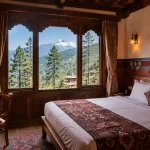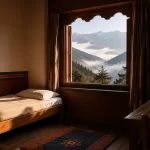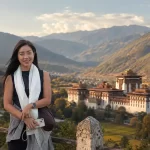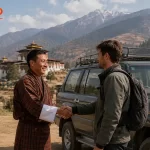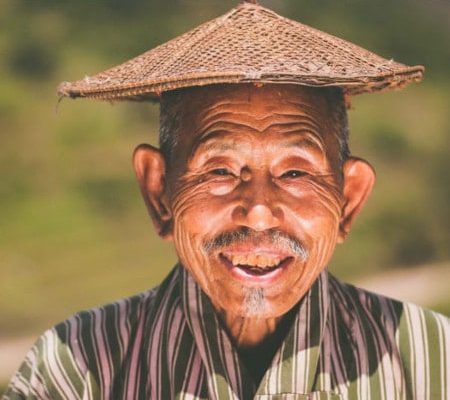
Bhutan is located in the Himalayan mountain range between India and China. The country roughly covers an area of 38,394 km2. The climate here is mostly pleasant and features a full three months of each season. The political system is a democratic monarchy, with democracy introduced in 2008. The country’s main sources of income are hydropower electricity and tourism. The country is renowned for its strong policies on conservation of nature.
The main religion followed in the country is Buddhism. Festivals in Bhutan are very colourful — masked men in colourful brocade perform dances and people from all walks of life attend. Bhutan measures its economy in terms of GNH, an indigenous concept discussed worldwide. The currency of Bhutan is the Ngultrum, which equates to the Indian Rupee. Architecturally, Bhutan boasts monolithic Dzongs (fortress-monasteries) painted white and red. Bhutan, the Land of Happiness, is known as one of the most unique kingdoms on earth.
The Land of Bhutan

Bhutan connects to the outside world through India by road, with three main land gateways: Phuentsholing, Gelephu, and Samdrup Jongkhar. The shortest route to the capital is via Phuentsholing, which takes approximately six hours. Roads cross dense forests and occasionally wind through small settlements — drivers describe the mountain roads as remarkable, and traffic rules are widely respected.
Bhutan has one international airport in Paro. Flights connect with major cities in neighbouring countries, operated by Druk Air and Bhutan Airlines. Paro is approximately 30–40 minutes from the capital, Thimphu.
Climate in Bhutan

The climate in Bhutan is moderate, though the southern regions get warmer in summer. Bhutan has four seasons, each spanning roughly three months. Excepting a few towns in the east (Bumthang) and Haa in the west, Bhutan sees relatively little snow. The capital typically receives one snowfall per year — and the first snowfall is a public holiday. The western region maintains comfortable conditions throughout the year, with temperatures dropping to around 0°C at night in winter.
The Political System in Bhutan

Bhutan remained largely closed to the outside world until the late 20th century, opening during the reign of the Third King. It is a democratic monarchy — the people elect the government, while the King serves as head of state. Bhutan became a democracy in 2008 when the Fourth King embraced the new form of governance, despite significant public reluctance to change. Up until 2008, the King, along with his cabinet of Ministers, governed the country.
Bhutan has a very close relationship with its neighbour India — a bond that has remained strong since Bhutan first opened to the outside world in the late 20th century.
Sources of Income

Bhutan’s primary source of income is hydropower electricity supplied to Indian cities. With abundant river systems feeding the Brahmaputra, Bhutan currently produces over 1,615 MW and has the potential to generate significantly more, according to the International Hydropower Association.
Tourism is the second major source of income. Bhutan follows a deliberate “High Value, Low Volume” policy. All international visitors pay a Sustainable Development Fee (SDF) of USD 100 per person per night, which directly funds free healthcare, free education, and environmental conservation across the country. Indian, Bangladeshi, and Maldivian nationals travel under a separate bilateral arrangement with a reduced rate.
Bhutan and Her Pledges

Bhutan is constitutionally required to maintain at least 65% forest cover at all times. Currently the figure exceeds 70%. Bhutan is the world’s only carbon-negative country and has pledged to remain so permanently — an extraordinary achievement for any nation, let alone one with a small economy and a population of under one million. Thanks to visionary leadership, the country has been able to honour these commitments.
Religion

The main religion practised in Bhutan is Vajrayana Buddhism, which arrived in the country in the 8th century and is the state religion. Among the population of approximately 800,000, around 23% identify as Hindu, with small Christian and Muslim communities making up the remainder. The forgiving lifestyle, the architecture, and the natural environment visitors experience in Bhutan are all deeply rooted in Buddhist culture.
Festivals in Bhutan

Festivals in Bhutan are vivid and deeply spiritual. Tshechus are the main festivals — the country observes around 20 each year. The Thimphu Tshechu and Paro Tshechu are the most attended by both locals and visitors. Tshechus take place on the 10th day of the Bhutanese lunar calendar and feature masked monks in colourful brocades performing sacred cham dances — a living form of scripture passed down through generations.
Locals attend with their entire family, carrying packed meals and flasks of Suja (butter tea), spending the full day at the Dzong. The festival culminates in the display of a thongdrel — a hand-stitched religious portrait believed to wash away the sins of anyone who sees it.
Gross National Happiness

What makes you happy? It is a question that resists a simple answer, because happiness means something different to every person. Countries around the world define progress in terms of economic growth, military strength, or political influence. Amidst all of this exists a country whose measure of progress is happiness itself.
In 1972, His Majesty the Fourth Druk Gyalpo, Jigme Singye Wangchuk, coined the term Gross National Happiness. Bhutan, since then, has pursued genuine wellbeing over every other conventional measure of development. Read more about GNH →
Bhutan and Money

The Bhutanese currency, the Ngultrum (BTN), was officially introduced in 1974 and is pegged at parity with the Indian Rupee. Denominations of 100, 500, and 1,000 are in widest circulation. Indian Rupees are accepted throughout Bhutan. Credit cards work at larger hotels in Thimphu and Paro — carry cash for markets, rural areas, and monasteries.
Architecture in Bhutan

Bhutanese architecture is unlike anything else in the Himalayas. The fortress-monasteries called Dzongs were built using massive boulders and timber — no nails, and yet many have stood for centuries. They are painted white and red with intricate murals depicting the teachings of Buddhist saints.
Bhutan also has countless chortens (stupas) — places of worship where locals circumambulate clockwise, chanting and praying. Traditional houses carry distinctive paintings of the Phallus, Garuda, and the eight auspicious symbols — visible on almost every village home in the country.
Conclusion
Bhutan offers something rare in modern travel: a place that has chosen, deliberately, to measure its success differently. From the dzongs and the dances to the mountain passes and the philosophy of GNH, every part of a journey here carries meaning.
If Bhutan’s philosophy of happiness has caught your curiosity, the best way to experience it is to go. Our team in Thimphu plans private cultural journeys from USD 990 per person — explore our cultural tours →
Ready to Experience Bhutan?
Tell us your dates and interests — our team in Thimphu will craft a personalised itinerary within 24 hours, at no cost.