Tangbi Mani Festival Tour — Bumthang Valley, Trongsa & Bhutan's Sacred Heartland
Paro · Punakha · Bumthang · Trongsa · Phobjikha · Thimphu
Tour Information
- Attend the Tangbi Mani Festival at Tangbi Monastery, Bumthang — including the rare Mewang sacred fire blessing ceremony
- Explore Bumthang's ancient temples — Kurjey Lhakhang, Jambay Lhakhang, Tamshing Lhakhang and Jakar Dzong
- Visit Membartsho (Burning Lake) in Tang Valley — one of Bhutan's most sacred pilgrimage sites
- Hike to Taktsang Monastery (Tiger's Nest) — 900 m above Paro Valley through blue pine forest
- Visit Trongsa Dzong — the largest dzong in Bhutan and ancestral seat of the royal dynasty
- Cross Pele La Pass (3,420 m) on the Black Mountain range — the boundary between western and central Bhutan
- Visit Punakha Dzong — the Palace of Great Happiness, built in 1637 at the confluence of two rivers
- Walk Phobjikha Valley and visit Gangtey Goenpa — the only Nyingmapa monastery in western Bhutan
- See Simtokha Dzong — the oldest surviving dzong in Bhutan, built in 1627
- Fully private and inclusive: SDF, visa, licensed guide, transport, accommodation and all meals
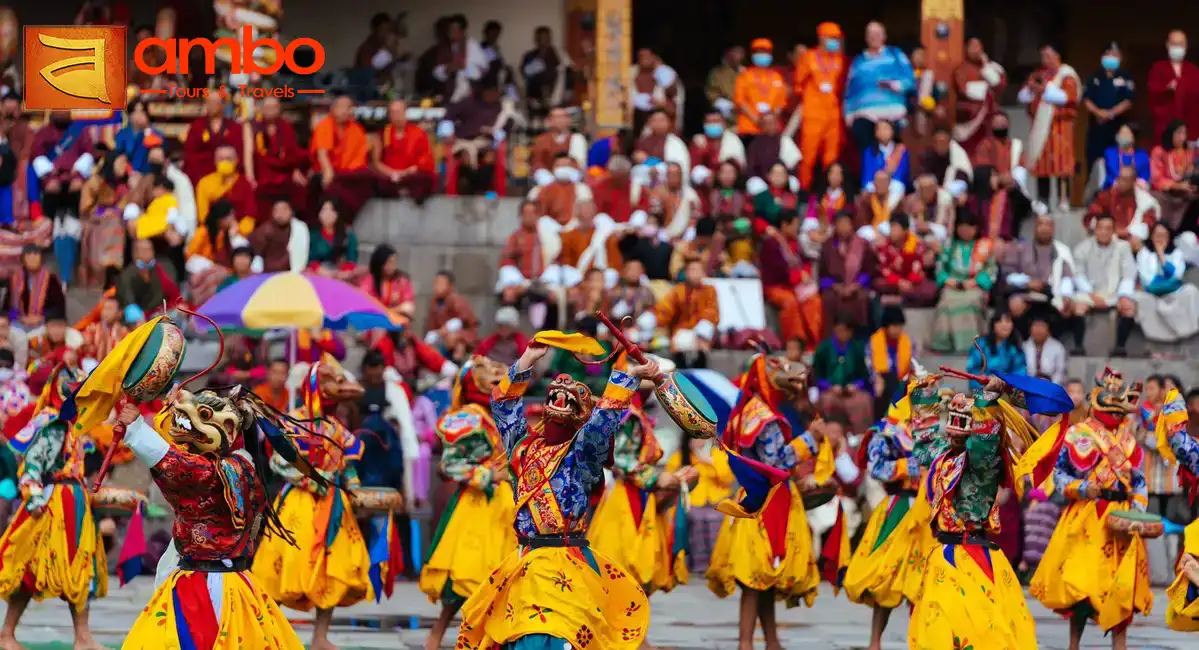
The Tangbi Mani Festival is one of Bhutan's most spiritually distinctive celebrations — held at Tangbi Monastery in Bumthang valley, in the open grounds rather than inside a dzong courtyard. Its centrepiece is the Mewang fire blessing ceremony, where participants jump through sacred fire three times to receive purification and blessings for the year ahead. Masked cham dances and folk performances fill the rest of the festival day, drawing communities from across Bumthang valley together.
This 10-day private tour is built around the festival but takes you far beyond it. You arrive in Paro for the Tiger's Nest hike, cross to Punakha for the finest dzong in Bhutan, then drive deep into the centre of the country via the towering Trongsa Dzong — ancestral seat of the royal dynasty — into Bumthang's sacred valleys. After the festival and a full day exploring Bumthang's ancient temples, you cross to Phobjikha Valley for the black-necked cranes and Gangtey Goenpa, then return via Simtokha Dzong and Thimphu before a final night in Paro.
Every detail is arranged by Ambo Tours' licensed team in Thimphu — permits, accommodation, guide, transport, and all meals throughout.
Tour Pricing
10 Days Bhutan Journey — Cost
All prices in USD per personCost includes Sustainable Development Fee (SDF) of US $100 per person per night and Bhutan Visa Fee of US $40 per person. Entrance fees for monuments and festival visits are paid separately.
Detailed Itinerary
The flight into Paro ranks among the most spectacular mountain arrivals in commercial aviation. Peaks shift and multiply outside the window as the plane descends through the valley. Your Ambo Tours guide meets you at arrivals and gets the Tangbi Mani Festival Bhutan tour underway with an afternoon of Paro sightseeing.
- Visit Ta Dzong — the National Museum of Bhutan. The galleries hold religious relics, ancient artworks, and handicrafts spanning centuries of Bhutanese history. It is the best single introduction to the kingdom's cultural past.
- Walk down to Rinpung Dzong (Fortress of the Heap of Jewels). Inside, look for the famous painting of the great saint Milarepa — a master of meditation whom the Bhutanese believe attained full enlightenment within a single lifetime. The dzong serves as both a monastery and the district administrative centre of Paro.
- Cross the traditional cantilever wooden bridge still in active use below the dzong — a short and beautiful walk that few visitors take time for.
Tip: Paro sits at 2,250 m. Take the first afternoon gently and drink plenty of water. Dinner and overnight in Paro.
Tomorrow brings the finest hike in Bhutan — the climb to Tiger's Nest Monastery above the valley floor.
Start early this morning. The trail to Taktsang Monastery (Tiger's Nest) is broad and steady, climbing through blue pine forest for one and a half to two hours before the monastery appears — perched on a sheer cliff face 900 metres above the Paro Valley floor. Guru Rinpoche flew to this cave on the back of a tigress in the 8th century to bring the teachings of Buddhist Dharma to Bhutan. The sight of the monastery from the ridge is extraordinary.
A teahouse at the midpoint serves a well-earned lunch with the monastery framed perfectly above. Take an extra hour inside the inner sanctuaries — cameras must be left at the entrance, and the quiet inside is unlike anywhere else.
- In the afternoon, drive to the ruins of Drugyal Dzong — built in 1644 by Zhabdrung Ngawang Namgyal to mark his victory over invading Tibetan forces. On clear days, the towering peak of Mount Jhomolhari (7,314 m) forms a stunning backdrop behind the ruins.
- Visit Kichu Lhakhang — a 7th-century temple built by the Tibetan king Songtsen Gampo as one of 108 temples constructed across the Himalayan region in a single day. Its design closely resembles the Jokhang temple in Lhasa.
Tip: Begin the Tiger's Nest hike no later than 7 am — this avoids midday heat and afternoon cloud. Dinner and overnight in Paro.
Tomorrow the road crosses Dochula Pass and drops into the warm valley of Punakha.
The drive from Paro to Punakha crosses Dochula Pass (3,100 m) — one of the finest viewpoints in western Bhutan. On clear mornings, the full sweep of the Himalayan range stretches across the horizon. In late April and early May, vast rhododendron forests around the pass bloom in vivid colour, covering the hillsides in pink, white, and crimson.
Arrive in Punakha — the ancient capital of Bhutan — and visit two significant sites in the afternoon:
- Punakha Dzong (Palace of Great Happiness, built 1637 by the Zhabdrung) — positioned at the confluence of the Pho Chhu and Mo Chhu rivers, this is the winter headquarters of the Je Khenpo and hundreds of monks who move here each season from Thimphu. The three-storey main temple features four intricately embossed entrance pillars crafted from cypress and decorated in gold and silver. Bhutan's first king was crowned here in 1907.
- Chimi Lhakhang — the temple of Drukpa Kuenley, the Divine Madman. He rejected orthodox religious convention and taught that faith is an inner feeling — not a matter of monastic ordination. The temple is also a symbol of fertility, and many childless couples visit here seeking his blessing.
Dinner and overnight in Punakha.
Tomorrow, the long drive east to Bumthang crosses two mountain passes and passes through the royal fortress of Trongsa.
Today is the longest drive of the tour — and one of the most scenically rewarding. The road climbs back over Dochula Pass, then rises again to Pele La Pass (3,420 m) on the Black Mountain range. This pass marks the traditional boundary between western and central Bhutan. The landscape shifts dramatically as you cross it.
En route, stop at Chendebji Chorten — an 18th-century stupa beside the road, built in the Nepalese style with eyes painted at the four cardinal points. It marks the spot where an evil spirit was subdued, and the stream setting makes it a peaceful rest stop.
As the road curves toward Trongsa, the enormous Trongsa Dzong appears across a deep canyon — signalling your approach to the ancestral home of Bhutan's ruling dynasty from a dramatic distance. After lunch:
- Visit Trongsa Dzong — the largest dzong in Bhutan. Every King has served as Trongsa Penlop before ascending the throne. The views from its walls stretch for miles across the surrounding valleys.
- Visit Ta Dzong museum — housing an exceptional collection of historical artefacts and objects belonging to the Royal Family.
Continue east to Bumthang (2,600 m) — a valley of barley fields, apple groves, and ancient monasteries beneath the Himalayan wall. Dinner and overnight in Bumthang.
Tomorrow — the Tangbi Mani Festival Bhutan opens with the sacred Mewang fire blessing ceremony.
This is the day the entire tour has been building toward. The Tangbi Mani Festival Bhutan opens at Tangbi Monastery — and unlike the grand tshechu festivals held inside dzong courtyards, this celebration takes place in the open grounds of the monastery, giving the whole event an immediate, unmediated quality that very few visitors to Bhutan ever experience.
The heart of the festival is the Mewang ceremony — a purification ritual performed by lay monks around an open fire in the open ground. Every attendee jumps over the flame three times. Bhutanese people believe this act washes away sins and misfortunes for the entire year ahead. The atmosphere is joyful, communal, and deeply sincere. Your Ambo Tours guide explains each ritual clearly and helps you participate respectfully.
- Watch the masked cham dances performed in the enclosed temple courtyard — monks in elaborate silk brocade costumes and lacquered masks re-enacting scenes from Buddhist scripture.
- Observe the folk dances performed by local community members — a living expression of Bumthang valley tradition that no staged cultural show can replicate.
- Take part in the Mewang fire jump with local families — one of the most joyful and inclusive festival moments on any Bhutan cultural tour.
In the afternoon, visit Kurjey Lhakhang — one of the most sacred sites in the kingdom, where Guru Rinpoche meditated in a rock cave whose body-print is still preserved in the stone today.
Tip: Wear modest, respectful clothing. The festival ground is outdoors — carry sunscreen and a warm layer for the evening. Dinner and overnight in Bumthang.
Tomorrow, a full day exploring the ancient temples and monasteries of Bumthang valley.
Bumthang holds more sacred sites per square kilometre than almost anywhere else in Bhutan. Today Ambo Tours takes you through four of its finest — each one a different chapter in the spiritual history of the kingdom.
- Jambay Lhakhang — one of the oldest temples in Bhutan, built in the 7th century by Tibetan King Songtsen Gampo. It dates to the very origins of Buddhism in Bhutan and is among the most historically significant sites in the country.
- Jakar Dzong (the Castle of the White Bird) — the administrative and religious centre of Bumthang, perched on a hilltop with sweeping views over the Chokhor Valley.
- Tamshing Lhakhang — founded in 1501 by the great treasure-revealer Pema Lingpa. This is the most important Nyingma temple in Bhutan. Its ancient murals and the famous chain-mail coat of Pema Lingpa — which devotees carry on their backs as a purification act — make it essential Bhutan Buddhist culture sightseeing.
- Tang Rimochen Lhakhang (14th century) — built as a place where Guru Rinpoche meditated, deep in the Tang Valley.
- Membartsho (Burning Lake) — a sacred gorge where the great Terton Pema Lingpa discovered dharma treasures hidden by Guru Rinpoche in the 15th century. He dived into the pool holding a burning butter lamp and surfaced with the treasures intact. The site is a remarkable place for quiet reflection.
Dinner and overnight in Bumthang.
Tomorrow, an early start for the scenic drive west through Trongsa to the crane sanctuary at Gangtey and Phobjikha Valley.
Start early today. The drive west from Bumthang to Gangtey takes around six hours — but the journey itself is part of the experience. The road passes farmhouses where local farmers wear the traditional woven bamboo hats of central Bhutan. Temples appear on hilltops. The landscape shifts from highland barley fields to open moorland as the route climbs toward the pass.
The wide, picturesque Phobjikha Valley (3,000 m) is one of Bhutan's few glacial valleys. It is the chosen winter home of the endangered black-necked crane, which migrates here from the Tibetan plateau each year between November and March. Hundreds of cranes rest in the wetlands on the valley floor — one of the finest wildlife encounters available on any Bhutan sightseeing itinerary.
- Visit Gangtey Gompa — the only Nyingmapa monastery in western Bhutan, founded in 1613. Its extensive complex of prayer halls, meditation centres, and monks' quarters overlooks the entire glacial valley below.
- Walk the Phobjikha Valley floor in the late afternoon — a quiet and beautiful wetland trail with cranes feeding on either side of the path.
Dinner and overnight in Phobjikha.
Tomorrow, the drive back to Thimphu passes through Simtokha Dzong — the oldest fortress in Bhutan.
The drive from Gangtey back to Thimphu takes around six hours on the mountain highway. En route, stop at Simtokha Dzong — built in 1627 and the oldest surviving dzong in Bhutan. It now houses the Institute for Language and Culture Studies, where students study Dzongkha, Bhutan's national language, and traditional Bhutanese arts. The dzong predates all other fortresses in the country and remains a quietly significant site on any serious Bhutan cultural tour.
Arrive in Thimphu in the afternoon and check in to your hotel. The rest of the day is free — your Ambo Tours guide can suggest a walk along the clock tower square, a visit to the craft market, or simply an evening meal at a local Thimphu restaurant serving traditional Bhutanese dishes like ema datshi (chilli and cheese).
Dinner and overnight in Thimphu.
Tomorrow brings a full day of Thimphu sightseeing before the final drive to Paro.
A full morning in Thimphu covers the capital's finest cultural and religious landmarks before the short afternoon drive to Paro.
- Buddha Dordenma at Kuenselphodrang — a 51.5-metre bronze and gilded statue of Shakyamuni Buddha, one of the largest in the world. It sits on a forested hilltop with sweeping views over the Thimphu valley. Inside the throne base, a meditation hall holds 125,000 smaller bronze Buddha statues.
- National Memorial Chorten — built at the initiative of the third King as protection against the negative effects of modernisation and as a monument to world peace. The Queen Mother completed it as a memorial stupa after the third King passed away in 1972. It remains the most active daily worship site in Thimphu.
- Changangkha Temple — a 12th-century hilltop monastery with panoramic views over the city. It is still active as a place of blessing for newborns — one of the most human and moving sites in Thimphu.
- National Library — housing Bhutanese scriptures and manuscripts dating back to the 8th century, a remarkable collection of Bhutan Buddhist culture in written form.
In the late afternoon, drive to Paro (2,250 m) for the final night of the tour. Dinner and overnight in Paro.
Tomorrow, your Tangbi Mani Festival Bhutan journey with Ambo Tours comes to a close.
Your Tangbi Mani Festival Bhutan tour with Ambo Tours comes to a close after breakfast. Your guide and driver transfer you to Paro International Airport as per your flight schedule. As the plane climbs between the ridgelines one last time, the Paro valley and its prayer flags recede below.
Ten days have covered the full western and central arc of Bhutan. The Tiger's Nest climb above Paro, the river-confluence grandeur of Punakha Dzong, the long mountain road to Bumthang, the Mewang fire jump at the Tangbi Mani Festival, the ancient murals of Tamshing Lhakhang, the Burning Lake of Tang Valley, the crane sanctuary at Phobjikha, and the oldest dzong in the country at Simtokha — each day has added a layer that most visitors to Bhutan never reach.
Bhutan runs on Gross National Happiness (GNH) rather than GDP — a philosophy of measured, sustainable development that keeps the kingdom's culture and environment intact for future generations. Ambo Tours is proud to be part of that system. The entire team wishes you safe travels and hopes to welcome you back to the Land of the Thunder Dragon. Tashi Delek!
Included / Excluded
- ✔All meals — breakfast, lunch, and dinner
- ✔Accommodation on twin / double sharing basis (single supplement extra)
- ✔All transportation within the kingdom including airport transfers
- ✔Sustainable Development Fee — Government tax (SDF)
- ✔Bhutan visa fee
- ✔English-speaking private local guide
- ✔Sightseeing as per itinerary
- ✔Bottled water throughout the journey
- ✖International flights to and from Paro (PBH)
- ✖Entrance fees for museums and monuments
- ✖Gratuities for guides and drivers
- ✖Travel insurance premiums
- ✖Payments for services provided on a personal basis
- ✖Cost for any services not mentioned under "Cost Includes"
- ✖Cost incurred due to mishaps, strikes, political unrest, etc.
- ✖Personal expenses — laundry, beverages, or personal services
Ambo Tours & the 1% Club
Every tour we run includes a contribution to a Bhutanese NGO of your choice — at no extra cost to you. We call this the 1% Club: a minimum of 1% of your trip's profit, or Nu 5,000, whichever is higher, donated on every single journey. You choose where it goes.
About the Tangbi Mani Festival
The Tangbi Mani Festival is held annually at Tangbi Monastery in Bumthang's Chokhor Valley — one of Bhutan's most sacred and historically significant valleys. Unlike Bhutan's larger tshechu festivals, which take place inside the enclosed courtyards of dzongs, the Tangbi Mani occupies the open grounds of the monastery, giving it a distinctly different atmosphere: intimate, communal, and deeply participatory.
The festival's centrepiece is the Mewang fire blessing ceremony — a rare ritual in which lay monks conduct a sacred fire blessing and participants jump through the flames three times to receive purification and good fortune for the year ahead. It is one of the most unusual and memorable ritual experiences available at any festival in the Himalayan region. Masked cham dances in the temple courtyard follow the ceremony, with monks in elaborate costumes re-enacting chapters of Buddhist scripture. Folk dances performed by Bumthang valley communities complete the programme.
For an overview of Bhutan's full festival calendar and how to plan around it, see our complete guide to Bhutan festivals. For best season guidance, visit our best time to visit Bhutan guide.
Bumthang — Bhutan's Sacred Heartland
Bumthang comprises four connected valleys — Chokhor, Tang, Ura, and Chhume — collectively forming the spiritual and cultural heart of Bhutan. The valleys are home to some of the oldest and most sacred temples in the country, several predating the formal establishment of Buddhism in Bhutan by centuries.
Kurjey Lhakhang marks the cave where Guru Rinpoche meditated in the 8th century — one of the most sacred sites in the entire kingdom. Tamshing Lhakhang, founded in 1501 by Terton Pemalingpa, contains ancient murals considered among the finest in Bhutan. Jambay Lhakhang is one of 108 temples erected by Tibetan King Songtsen Gampo in the 7th century. And Membartsho — the Burning Lake — in Tang Valley is a sacred pilgrimage gorge where the same Terton Pemalingpa retrieved hidden religious treasures from the water in the 15th century.
Beyond its temples, Bumthang is known for its apple orchards, buckwheat farms, artisan cheese dairies, and the Bumthang Brewery. The pace is noticeably slower than western Bhutan. For a full destination guide, see our Bumthang travel guide.
Trongsa Dzong & the Road to Central Bhutan
The drive from Punakha to Bumthang on Day 4 is one of the great road journeys of Bhutan — 220 kilometres across the Black Mountain range via Pele La Pass at 3,420 metres, taking approximately 8 hours. It is also one of the most rewarding: the landscape shifts dramatically from the subtropical warmth of Punakha's river valley through montane forest, across the high pass, and down into the pine-clad valleys of central Bhutan.
The day's defining stop is Trongsa Dzong — the largest dzong in Bhutan, built on a dramatic spur above a deep gorge and commanding views of the surrounding valleys for miles in every direction. Trongsa is the ancestral seat of Bhutan's royal dynasty: every King of Bhutan has governed Trongsa before ascending to the throne, a tradition maintained to this day. The dzong's 22 temples and chapels sprawl across multiple levels, connected by covered walkways. The adjacent Ta Dzong museum houses royal family artifacts and traditional armour.
Chendebji Chorten, passed en route, is an 18th-century Nepalese-style stupa in an unusually open riverside setting — a peaceful stop on a long driving day. For more on Bhutan's travel costs including SDF rates, see our cost of travelling to Bhutan guide.
Itinerary Map
Map coming soon.
Frequently Asked Questions
Ready to Begin Your Journey?
Our Thimphu team responds within 24 hours. Tell us your dates and we will handle the rest.