Wangdue Tshechu Festival Tour — Wangdue Phodrang, Punakha & Western Bhutan
Paro · Thimphu · Punakha · Gangtey
Tour Information
- Attend two full days of the Wangdue Tshechu — sacred cham mask dances, Atsara jesters and the ceremonial thongdrel display at Wangdue Phodrang
- Witness the thongdrel — ceremonial display of a massive appliqué thangka, a moment of deep spiritual significance
- Evening hike to Khamsum Yulley Namgyal Choling Monastery above Punakha's rice fields at golden hour
- Walk to Rinchengang village — a traditional stone-masonry settlement opposite Wangdue Phodrang Dzong
- Visit Punakha Dzong — the Palace of Great Happiness, built in 1637 at the confluence of two rivers
- Cross Dochula Pass (3,050m) with 108 memorial chortens and panoramic Himalayan views
- Hike to Cheri Monastery (2,850m) — birthplace of Bhutan's first formal monk body, founded 1620
- Hike to Taktsang Monastery (Tiger's Nest) — 900m above Paro Valley through blue pine forest
- Stop at Tamchog Lhakhang — 15th-century iron-bridge monastery built by Thang Tong Gyalpo
- Fully private and inclusive: SDF, visa, licensed guide, transport, accommodation and all meals
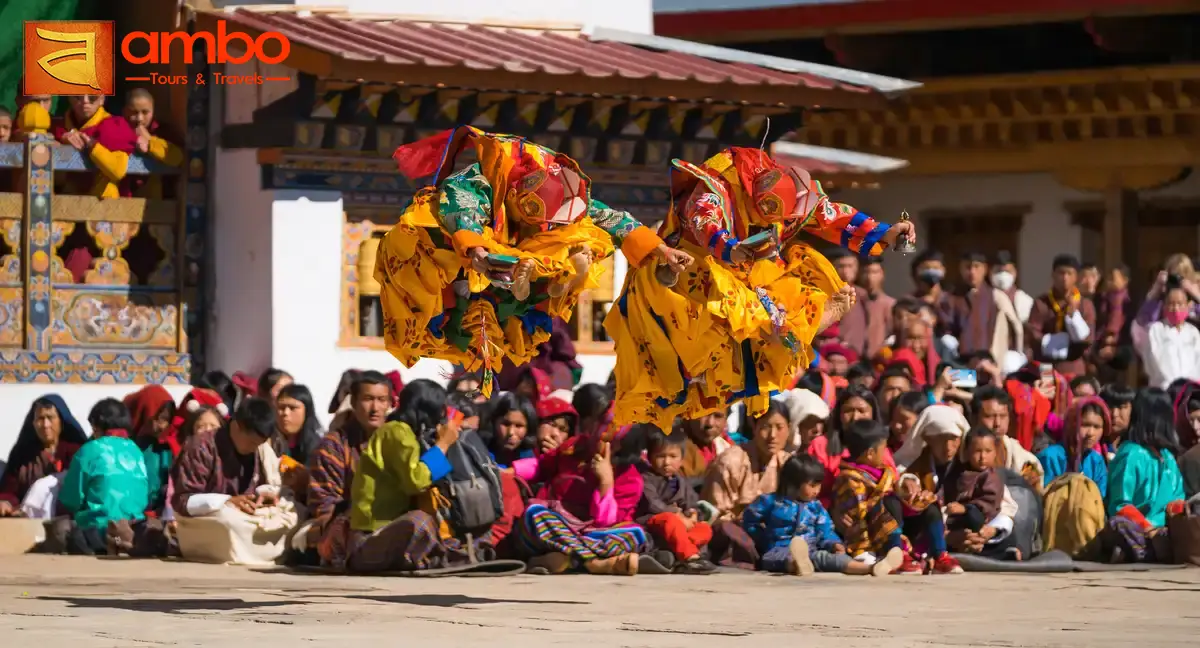
The Wangdue Tshechu is one of western Bhutan's most sacred and visually spectacular annual festivals — held at Wangdue Phodrang over two full days of sacred cham mask dances, Atsara jester performances, and the ceremonial display of the thongdrel, a massive appliqué thangka whose appearance is considered a moment of profound spiritual merit for all who witness it. The festival draws devotees from across the district — farmers, nomads, monks, and schoolchildren — in their finest silks and kiras.
This 8-day private tour is built around both festival days. The journey takes you from Paro to Thimphu for two days of capital culture including a hike to Cheri Monastery, across to Punakha via Dochula Pass and Chimi Lhakhang, into Wangdue Phodrang for the festival with an evening hike to Khamsum Yulley Namgyal Choling Monastery, and back via Paro for the Tiger's Nest hike before departure.
Every detail is arranged by Ambo Tours' licensed team in Thimphu — permits, accommodation, guide, transport, and all meals throughout.
Tour Pricing
8 Days Bhutan Journey — Cost
All prices in USD per personCost includes Sustainable Development Fee (SDF) of US $100 per person per night and Bhutan Visa Fee of US $40 per person. Entrance fees for monuments and festival visits are paid separately.
Detailed Itinerary
Your Wangdue Tshechu Festival Bhutan journey begins the moment the plane descends between Himalayan ridgelines into Paro International Airport — one of the most dramatic landings in commercial aviation. The Ambo Tours guide and driver meet you at arrivals and begin the scenic drive east toward Thimphu.
On the way, make a stop at Tamchog Lhakhang — a private monastery built in the 15th century by the extraordinary engineer-saint Thang Tong Gyalpo, popularly known as Lama Chazampa. He built 108 iron-chain suspension bridges across Tibet and Bhutan — eight of them in Bhutan alone — and this monastery sits beside one of his most famous surviving bridges. It is a Bhutan hidden gem that most itineraries skip entirely.
Arrive in Thimphu (2,300 m) and check in to your hotel. In the late afternoon, visit Tashichho Dzong — the seat of Bhutan's national government and central monastic body, and one of the most photographed Bhutan dzong sites in the country, especially beautiful in the golden hour light. Dinner and overnight in Thimphu.
Tomorrow brings a full day of Thimphu sightseeing — from the world's tallest Buddha statue to one of Bhutan's last surviving nunneries.
Thimphu rewards a full day of slow exploration, and today Ambo Tours takes you through the capital's most significant cultural landmarks — each one a window into Bhutan Buddhist culture and the philosophy of Gross National Happiness (GNH) that defines life in this kingdom.
- National Postal Museum — a genuine Bhutan hidden gem where you can have your own portrait printed onto an official Bhutanese postage stamp to take home.
- Memorial Chorten (built 1974) — a landmark stupa erected in honour of the third King of Bhutan, always busy with elderly Bhutanese walking morning circumambulations with prayer beads.
- Buddha Dordenma at Kuenselphodrang — at 51.5 metres, one of the world's tallest seated Buddha statues, gazing south over the Thimphu valley from a forested hilltop.
- Changangkha Lhakhang — the oldest monastery in Thimphu valley, built in the 13th century by Lama Phajo Drugom Shigpo on a commanding ridge with panoramic city views.
- Takin Preserve Centre — home to Bhutan's national animal, a distinctive bovine-goat hybrid that the Bhutanese believe was created by the Divine Madman, Drukpa Kuenley.
- Sangaygang Viewpoint — the best hilltop panorama over Thimphu and the valley below.
- Dupthop Lhakhang — one of the few surviving active nunneries in Bhutan, a quieter and more reflective stop that makes this Bhutan trip feel genuinely different.
In the afternoon, hike to Cheri Monastery (2,850 m) — built in 1620 by Zhabdrung Ngawang Namgyal and the birthplace of Bhutan's first formal monk body, set 18 km north of Thimphu through blue pine and oak forest. The evening is free for shopping and photography in Thimphu town. Dinner and overnight in Thimphu.
Tomorrow the road drops to the subtropical warmth of Punakha, passing the 108 chortens of Dochula Pass.
The drive from Thimphu to Punakha (1,350 m) is one of the most celebrated road journeys in the Himalayas. Your Ambo Tours driver makes three worthwhile stops before you reach the valley.
- Dochula Pass (3,050 m) — 108 Druk Wangyal chortens crown a hilltop wrapped in prayer flags, with a panoramic sweep of the Greater Himalayan range on clear mornings. The annual Druk Wangyal festival is held here each December, making it one of the most significant festival grounds in western Bhutan tourism.
- Royal Botanical Park — a protected nature reserve rich in monal and blood pheasants, musk deer, red panda, and 46 species of rhododendron. The colourful rhododendron festival draws Bhutan sightseeing visitors each spring, when the hillside erupts in colour.
- Chimi Lhakhang (built 1499 by Lama Drukpa Kuenley, the Divine Madman) — a fertility temple set on a round hillock near Sopsokha village, reached by a 20-minute walk through rice paddies. Childless couples from across Bhutan visit seeking blessings.
After lunch, explore Punakha itself:
- Punakha Dzong (built 1637 by Zhabdrung Ngawang Namgyal) — Bhutan's former capital and the winter residence of Je Khenpo, dramatically positioned at the confluence of the Pho Chhu and Mo Chhu rivers. The first National Assembly of Bhutan convened here in 1952.
- Walk across the longest suspension bridge in Bhutan — spanning the Pho Chhu river — for a perspective of the dzong no photograph fully captures.
Dinner and overnight in Punakha.
Tomorrow, the Wangdue Tshechu Festival Bhutan begins — one of the most visually extraordinary events on any Bhutan cultural tour.
This is the day your Wangdue Tshechu Festival Bhutan journey has been building toward. Ambo Tours brings you to Wangdue Phodrang early, taking your position in the festival courtyard as the first monks appear in their elaborate silk brocade costumes and lacquered masks. The Wangdue Tshechu is one of the most atmospheric religious festivals in western Bhutan — a full day of sacred cham mask dances that re-enact scenes from scripture and the life of Guru Rinpoche, the Indian master who brought Bhutan Buddhist culture to the Himalayan kingdom.
Throughout the day, your Ambo Tours guide explains the spiritual meaning behind each dance — the Black Hat Dance, the Dance of the Lords of the Cremation Grounds, and the appearance of the Atsara jesters who keep the crowd laughing between solemn performances. Receiving a blessing from the presiding lama is one of the most meaningful experiences on this Bhutan trip.
Tip: Wear layers — festival grounds can be cool in the shade and warm in the sun. Modest, respectful dress is required inside the dzong courtyard.
In the evening, hike to Khamsum Yulley Namgyal Choling Monastery — a 45-minute climb across a suspension bridge and through forested hillside, rewarded with sweeping views of the Punakha valley turning golden at dusk. Dinner and overnight in Punakha.
Tomorrow brings the second and final day of the Wangdue Tshechu — including the revered evening of Rinchengang village.
Return to Wangdue Phodrang for the second and final day of the Wangdue Tshechu Festival Bhutan. The energy in the courtyard builds to its crescendo as devotees pour in from villages across the district — farmers, nomads, monks, and schoolchildren, all dressed in their finest silks and kiras. The festival ground is a living portrait of Bhutan Buddhist culture at its most unfiltered.
The closing ceremony includes the thongdrel — the ceremonial display of a massive appliqué thangka silk that blesses all who behold it. Witnessing it is considered a moment of profound spiritual merit, and your Ambo Tours guide ensures you are positioned correctly to see it fully.
Tip: The best time to visit Bhutan for the Wangdue Tshechu is autumn — skies are clear, the air is crisp, and the festival coincides with the post-monsoon harvest season when the valley is at its most beautiful. Carry your camera but be respectful of worshippers during moments of prayer.
In the evening, walk to Rinchengang village — a traditional settlement opposite Wangdue Phodrang Dzong, known for centuries for its skill in traditional stone masonry. The walk takes about 20 minutes uphill from the highway and offers a quietly authentic glimpse of rural Bhutan away from the festival crowds. Dinner and overnight in Punakha.
Tomorrow, the drive west to Paro passes through the restored Wangdue Phodrang Dzong and the valley's most photogenic viewpoints.
The morning drive from Punakha to Paro retraces the western highway through some of Bhutan's most dramatic river valley scenery. Your first stop is Wangdue Phodrang Dzong — originally built in 1638 by Zhabdrung Ngawang Namgyal and badly damaged by fire in 2012, this fortress has since been painstakingly restored and stands once again as one of the most architecturally striking Bhutan dzong sites in the country.
Arrive in Paro in the early afternoon for a focused round of sightseeing:
- Ta Dzong — an ancient circular watchtower now housing the National Museum of Bhutan, with galleries of thangka paintings, armour, and natural history that put the week's cultural experiences in broader context.
- Rinpung Dzong (built 1646 by Zhabdrung Ngawang Namgyal) — a fortress-monastery guarding the entrance to Paro Valley across the Pachhu River, its wooden-gallery courtyard lined with vivid murals. Some scenes of the film The Little Buddha were shot here.
The evening is free to explore Paro town — browse the painted shopfronts for hand-woven textiles, wooden bowls, and incense to take home. Dinner and overnight in Paro.
Tomorrow, the most iconic hike in Bhutan — the climb to Tiger's Nest Monastery.
No Bhutan tour package is complete without this day. The morning hike to Taktsang Monastery (Tiger's Nest) is the defining image of Bhutan tourism worldwide — a cluster of gilded temples clinging to a sheer 900-metre cliff face above Paro Valley, built in 1684 by Gyaltse Tenzin Rabgay. Guru Rinpoche is believed to have flown to this sacred cave on the back of a tigress in the 8th century, and the site has been a pilgrimage destination ever since.
The hike is an 11-km round trip starting from Ramthangkha, climbing steadily through blue pine forest for around two hours. A teahouse at the halfway point offers the most rewarding cup of tea you will drink all week, with the monastery perfectly framed above. Allow an extra hour inside the inner sanctuaries — cameras must be left at the entrance gate. Horse rides are available to the viewpoint for those who need them.
- In the afternoon, visit Drugyal Dzong — an ancient defence fortress built in 1647 by Zhabdrung Ngawang Namgyal to repel Tibetan invasion. Now a picturesque ruin, it frames a stunning view of Jhomolhari peak on clear days — one of the finest Bhutan mountain panoramas in Paro district.
- Visit Kichu Lhakhang (built 659 AD by Tibetan King Srongtsen Gampo) — one of the oldest temples in Bhutan and one of 108 built across the Himalayan region in a single day to pin a mythological ogress to the earth. It is a place of extraordinary stillness and Bhutan Buddhist culture.
The evening is free for a final stroll through Paro town and last-minute shopping. Dinner and overnight in Paro.
Tomorrow, your Wangdue Tshechu Festival Bhutan journey with Ambo Tours comes to a close.
Your Wangdue Tshechu Festival Bhutan tour with Ambo Tours ends this morning. After breakfast, your guide and driver transfer you to Paro International Airport — and as the plane climbs steeply between the ridgelines for the last time, the painted farmhouses and prayer flags of the Paro valley recede below.
Eight days have covered the full western arc of Bhutan: the iron-bridge monastery of Tamchog, the hilltop nunneries and giant Buddha of Thimphu, the rhododendron forests of Dochula Pass, the river-confluence majesty of Punakha Dzong, two unforgettable days at the Wangdue Tshechu, and finally the cliff-face wonder of Tiger's Nest. Throughout it all, Bhutan's commitment to sustainable tourism and Gross National Happiness (GNH) — a philosophy that values cultural preservation and environmental protection over mass-market growth — makes itself felt in everything you see.
The entire Ambo Tours team wishes you safe travels. We hope to welcome you back to the Land of the Thunder Dragon for your next Bhutan adventure.
Included / Excluded
- ✔All meals — breakfast, lunch, and dinner
- ✔Accommodation on twin / double sharing basis (single supplement extra)
- ✔All transportation within the kingdom including airport transfers
- ✔Sustainable Development Fee — Government tax (SDF)
- ✔Bhutan visa fee
- ✔English-speaking private local guide
- ✔Sightseeing as per itinerary
- ✔Bottled water throughout the journey
- ✖International flights to and from Paro (PBH)
- ✖Entrance fees for museums and monuments
- ✖Gratuities for guides and drivers
- ✖Travel insurance premiums
- ✖Payments for services provided on a personal basis
- ✖Cost for any services not mentioned under "Cost Includes"
- ✖Cost incurred due to mishaps, strikes, political unrest, etc.
- ✖Personal expenses — laundry, beverages, or personal services
Ambo Tours & the 1% Club
Every tour we run includes a contribution to a Bhutanese NGO of your choice — at no extra cost to you. We call this the 1% Club: a minimum of 1% of your trip's profit, or Nu 5,000, whichever is higher, donated on every single journey. You choose where it goes.
About the Wangdue Tshechu
The Wangdue Tshechu is one of western Bhutan's most sacred annual festivals — held at Wangdue Phodrang over two full days of ceremonial performance and religious observance. Like all Bhutanese tshechus, it centres on sacred cham mask dances performed by monks in elaborate silk brocade costumes and lacquered masks, each dance re-enacting scenes from Buddhist scripture or episodes from the life of Guru Rinpoche, the Indian master who brought Vajrayana Buddhism to Bhutan in the 8th century.
The festival's most spiritually significant moment is the thongdrel — the ceremonial display of a massive appliqué thangka silk. Thongdrels are among the most sacred objects in Bhutan: their display is brief, often only at dawn, and it is believed that all who behold them receive profound blessings. Atsara jesters provide comedic counterpoint between the solemn dances, maintaining a tradition of humour as spiritual teaching that runs through all Bhutanese tshechus. A blessing from the presiding lama closes the programme each day.
For an overview of all Bhutan's major festivals and how to plan your visit around them, see our complete guide to Bhutan festivals. For best season guidance, visit our best time to visit Bhutan guide.
Wangdue Phodrang — The Eagle's Nest Dzong
Wangdue Phodrang Dzong was originally built in 1638 by Zhabdrung Ngawang Namgyal — the same statesman-monk who unified Bhutan — on a dramatic spur at the confluence of the Puna Tsang Chhu and Tang Chhu rivers. The positioning is deliberate: the dzong commands views of approaching routes from multiple valleys and served as one of the most strategically important fortresses in western Bhutan for centuries.
The dzong was badly damaged by fire in 2012 but has since been painstakingly restored using traditional Bhutanese construction methods — timber joinery, rammed earth walls, and painted interiors executed by artisans trained at the Zorig Chusum Institute. The restoration is one of the most significant conservation projects in Bhutan's recent history.
Opposite the dzong, a short uphill walk leads to Rinchengang village — a traditional settlement known for centuries for its skill in stone masonry. The village's craftsmen built many of the dzong's stone walls and continue traditional construction work across the region. The walk takes about 20 minutes from the highway and offers an authentic glimpse of rural Bhutan away from the festival crowds. For more on Punakha and the surrounding valley, see our Punakha destination guide.
Thimphu — Capital Culture & Cheri Monastery
Two days in Thimphu give this tour a depth of capital culture that shorter itineraries miss. Beyond the standard sights — Buddha Dordenma, Memorial Chorten, Changangkha Lhakhang, and the Takin Preserve — this itinerary adds two less-visited stops that consistently stand out for travellers.
The National Postal Museum is one of Bhutan's most genuinely surprising attractions: a small museum dedicated to Bhutan's famous stamps (the country pioneered 3D lenticular and steel-foil stamps in the 1970s) where visitors can have their own portrait printed onto an official Bhutanese postage stamp to take home. And on Day 2, an afternoon hike leads to Cheri Monastery at 2,850 metres — built in 1620 by Zhabdrung Ngawang Namgyal, 18 kilometres north of Thimphu through blue pine and oak forest. Cheri is the birthplace of Bhutan's first formal monk body and remains one of the most spiritually significant sites in the Thimphu valley, visited by very few tourists.
For a full guide to the capital, see our complete Thimphu guide. For travel cost planning including SDF, see our cost of travelling to Bhutan guide.
Itinerary Map
Map coming soon.
Frequently Asked Questions
Ready to Begin Your Journey?
Our Thimphu team responds within 24 hours. Tell us your dates and we will handle the rest.