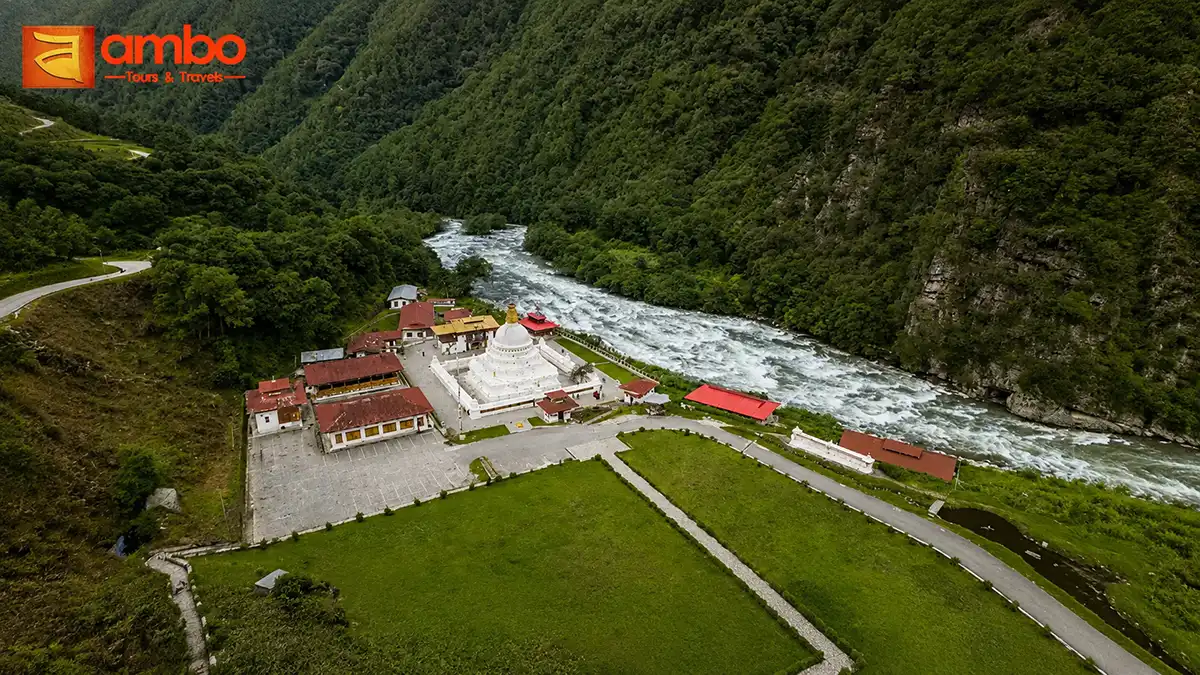
Chorten Kora Festival Tour — Eastern Bhutan Expedition, 14 Days
Paro · Thimphu · Gangtey · Bumthang · Mongar · Trashiyangtse
Tour Information
- Chorten Kora Festival — Dakpa tribal pilgrims from Arunachal Pradesh circumambulating the great white stupa
- Chorten Kora stupa — one of the most sacred sites in eastern Bhutan, sanctified by Guru Rinpoche
- Bumdebling wildlife sanctuary — one of only two black-necked crane wintering grounds in Bhutan
- Thrumshingla Pass (3,800m) — the highest pass on the Lateral Highway through forest and cloud
- Bumthang valley — Jakar Dzong, Jambay Lhakhang, Kurjey, Tamshing ancient temples
- Trongsa Dzong — the royal fortress commanding the geographic heart of Bhutan
- Mongar and the eastern Bhutan gorge landscape — waterfalls and diverse flora
- Domestic flight Bumthang–Paro — 35-minute return over the Himalayan foothills
- Fully private — guide, vehicle and itinerary exclusively yours throughout
The Chorten Kora Festival Tour Bhutan is the most immersive journey into eastern Bhutan available — a 14-day private expedition that culminates at one of the most extraordinary and least-known religious celebrations in the Himalayan world: the Chorten Kora Festival at the magnificent white stupa on the banks of the Kholong Chhu river in Trashiyangtse, deep in eastern Bhutan.
What makes this festival uniquely powerful is the annual arrival of the Dakpa tribe from Arunachal Pradesh, India — families who endure days of arduous mountain travel to circumambulate the Chorten Kora stupa, a tradition maintained for over a millennium since Guru Rinpoche sanctified this site in the 8th century. The encounter between these cross-border pilgrims, the local Trashiyangtse community, and international visitors is found nowhere else in the Bhutanese festival calendar.
The route traverses the full width of the kingdom — Gangtey, Trongsa, Bumthang, the extraordinary Thrumshingla Pass at 3,800m, the hydroelectric gorges of Mongar, and Bumdebling (one of only two crane wintering grounds in Bhutan) — before three nights centred on the Chorten Kora Festival. This is not a western Bhutan highlights tour. It is an expedition into a different Bhutan entirely. Operated by Ambo Tours, DOT Licence No. 1053330, Thimphu.
Tour Pricing
14 Days Bhutan Journey — Cost
All prices in USD per personCost includes Sustainable Development Fee (SDF) of US $100 per person per night and Bhutan Visa Fee of US $40 per person. Entrance fees for monuments and festival visits are paid separately.
Detailed Itinerary
Your Chorten Kora Festival Bhutan journey begins with one of the world's most dramatic commercial landings. The plane banks sharply between Himalayan ridgelines into Paro International Airport — green mountains, prayer flags, and fresh mountain air greet you immediately. The Ambo Tours representative meets you at arrivals and transfers you west to Thimphu (2,350 m), the capital of Bhutan, where you will stay for two nights.
The rest of the day is intentionally free — take a gentle walk along Thimphu's clock tower square, browse the nearby craft shops, or simply sit by the Wang Chhu river and allow the altitude and the quiet pace of Bhutanese life to settle over you. Acclimatisation on arrival day is always worthwhile, particularly before the long drives east that lie ahead.
Tip: Drink plenty of water, eat lightly, and avoid strenuous activity on Day 1. Dinner and overnight in Thimphu.
Tomorrow brings a full day of Thimphu sightseeing — monasteries, museums, painting schools, and one of Bhutan's oldest dzongs.
Today Ambo Tours takes you through the finest cultural sites of Thimphu — a capital unlike any other, built entirely in traditional Bhutanese architectural style and operating without a single traffic light. Each stop adds a layer of context that enriches everything you will encounter on this Bhutan cultural tour as the journey moves east.
- National Memorial Chorten — a prominent city landmark built in memory of the third King of Bhutan, His Majesty Jigme Dorji Wangchuck, and one of the most active daily worship sites in the kingdom. Elderly Bhutanese walk morning circumambulations here in an unbroken daily tradition.
- Changangkha Monastery — a medieval hilltop temple with commanding views over Thimphu valley, built in the 13th century and still active as a site of blessing for newborns across the city.
- Folk Heritage Museum — a reconstructed traditional Bhutanese farmhouse showcasing the artefacts and tools of rural Bhutanese households across the valleys, offering an intimate window into the country's agricultural past.
- National Library — housing ancient manuscripts and scriptures in classical Dzongkha and Sanskrit, a treasure house for anyone interested in the depth of Bhutan Buddhist culture.
- Zorig Chusum Painting School — watch apprentice artists practise thangka painting, sculpture, and embroidery under the National Institute for Bhutan's 13 traditional arts and crafts.
In the afternoon, drive to Simtokha Dzong — the oldest fortress in Bhutan, built in 1629 by Zhabdrung Ngawang Namgyal, predating the better-known dzongs of Paro and Punakha. Its stone walls house a school for traditional Dzongkha studies. Alternatively visit the National Textile Museum, whose collection spans royal garments, regional weaving traditions, and centuries of Bhutanese silk craft. Dinner and overnight in Thimphu.
Tomorrow, the long drive east begins — through Dochula Pass, Wangdue Phodrang, and into the glacial crane valley of Gangtey.
The journey east from Thimphu begins in earnest today — and the first stop sets the tone magnificently. Dochula Pass (3,050 m) carries 108 memorial chortens on a hilltop wrapped in prayer flags, and on clear mornings the full sweep of the eastern Himalayan range fills the horizon — including a rare and distant view of Gasa Dzong nestled in the valley far to the north. Your Ambo Tours guide points out the named peaks on clear days.
After the pass, descend to Wangdue Phodrang for a post-lunch visit to Wangdue Phodrang Dzong — built in 1638 by Zhabdrung Ngawang Namgyal and badly damaged by fire in 2012, now carefully restored. It occupies one of the most commanding hilltop positions of any Bhutan dzong in the country, overlooking the confluence of two rivers.
Continue east to Gangtey in Phobjikha Valley (3,000 m) — a glacial bowl that serves as one of the two primary winter roosting grounds of the endangered black-necked crane. Hundreds of cranes arrive from Tibet in September and October and depart between February and March. The highway through the valley offers dramatic photographic vistas at every turn. Dinner and overnight in Gangtey.
Tomorrow, a morning at Gangtey Gompa monastery before the long drive to Trongsa through the highland heartland of Bhutan.
The morning begins in Phobjikha Valley with a visit to the picturesque Gangtey Gompa — a Nyingma monastery founded in 1613, its extensive complex of prayer halls, monks' quarters, and meditation centres overlooking the wide green expanse of the glacial valley below. The Bhutan mountain ranges of the Black Mountains form a dramatic backdrop on the western horizon. Take time to walk the valley floor and look for cranes in the wetlands if the season is right.
After lunch, the drive continues east through the spectacular Pelela Pass (3,300 m) — the traditional geographic dividing line between western and central Bhutan, and a landscape of open moorland and prayer flags at the summit. The road descends steeply through forest toward Trongsa.
En route, stop at Chendebji Chorten — an 18th-century stupa set beside a mountain stream just below the road, built by the Tibetan Lama Shida in the style of Kathmandu's Boudhanath, with eyes painted at the four cardinal points. It marks the spot where an evil spirit was subdued, and the riverside setting makes it a peaceful stop to stretch legs and breathe. Dinner and overnight in Trongsa.
Tomorrow, two of Trongsa's finest sites before the drive to the spiritual heartland of Bumthang.
The morning belongs to Trongsa (2,200 m) — the ancestral seat of Bhutan's royal dynasty and one of the most historically significant towns in the kingdom. Two sites fill the morning with the weight of Bhutanese history:
- Trongsa Dzong — the largest fortress in Bhutan, built in 1647, backing against the mountain on a narrow spur above the Mangde River gorge. The first two hereditary Kings of Bhutan ruled the country from this very dzong, making it the cradle of the Wangchuck dynasty. Every King has served as Trongsa Penlop (Governor) before ascending the throne.
- Ta Dzong Royal Museum — the ancient watchtower of Trongsa Dzong, now housing 224 artefacts of the royal dynasty including the Raven Crown worn by the first King in 1907, with four observation points shaped as the Tiger, Lion, Garuda, and Dragon.
After lunch, the drive east to Bumthang (2,600 m) passes the Yathra Weaving Factory at Chumey village — where Bumthap weavers produce yathra textiles in bold geometric patterns unique to this valley, using yak and sheep wool on traditional looms. Watching the weavers work is a genuine Bhutan cultural tour highlight.
Arrive in Bumthang — the most beautiful valley and cultural heartland of the kingdom — in time for a gentle evening exploration of the delightful valley surroundings. Dinner and overnight in Bumthang.
Tomorrow, the legendary monasteries and temples of Bumthang valley fill a full day of spiritual Bhutan sightseeing.
Bumthang is not simply a destination — it is the spiritual heartland of Bhutan, a valley where the oldest temples in the kingdom stand alongside living communities whose traditions remain entirely intact. Today Ambo Tours dedicates a full day to four of its most significant sacred sites.
- Jakar Dzong (the Castle of the White Bird) — the administrative and religious centre of Bumthang, perched on a hilltop with sweeping views over the Chokhor Valley and its surrounding ridgelines.
- Jambay Lhakhang — one of the oldest temples in Bhutan, built in the 7th century by Tibetan King Songtsen Gampo as part of 108 temples constructed across the Himalayan region in a single day to pin a mythological earth-demon. It is a site of extraordinary antiquity and living Bhutan Buddhist culture.
- Kurjey Lhakhang — a three-temple complex built in 1652 and named after the body imprint of Guru Rinpoche preserved in the rock face of the oldest temple. Guru Rinpoche, who introduced Buddhism to Bhutan, meditated in this cave — making Kurjey one of the most sacred pilgrimage sites in the entire kingdom.
- Tamshing Lhakhang — built in 1501 and widely regarded as the most important Nyingma temple in Bhutan. Founded by the great treasure-revealer Pema Lingpa, it houses ancient murals and the famous chain-mail coat worn by Pema Lingpa, which devotees carry on their backs as an act of purification.
If time permits, visit the Swiss Cheese Factory and Dairy Farm in Bumthang — a living legacy of the Swiss development worker Fritz Maurer, who introduced dairy farming, beekeeping, and smokeless stoves to the valley, and whose family still produces the country's finest artisan cheese. Dinner and overnight in Bumthang.
Tomorrow, the longest drive of the tour — crossing the highest point on Bhutan's lateral road at Thrumshingla Pass to reach Mongar in eastern Bhutan.
Today is the longest drive of the tour and one of the most scenically extraordinary road journeys in all of Bhutan. The route east from Bumthang climbs to the highest point on Bhutan's lateral highway — Thrumshingla Pass (3,800 m) — before a long, dramatic descent into the subtropical eastern lowlands. Your Ambo Tours driver makes several worthwhile stops along the way.
- Ura village — a traditional highland settlement with closely packed stone houses and a medieval village layout that feels unchanged for centuries.
- Ura Shelthangla viewpoint — where on a clear day the outline of Gangkar Puensum (7,570 m), Bhutan's highest peak and the world's highest unclimbed mountain, fills the northern horizon in one of the most breathtaking Bhutan mountain panoramas of the entire journey.
- Sengor village and Namling — passing through dramatic landscapes of cascading waterfalls, dense cloud forest, and extraordinary biodiversity as the road descends steeply from the high pass.
- Lingmethang (700 m) — the lowest point of the drive, where the Kurichu River is crossed near the largest hydroelectric power station in eastern Bhutan, a sign of the region's quiet development.
Arrive in Mongar (1,600 m) in the evening — a small, friendly district town with a dramatically positioned dzong. The warm, subtropical air at this altitude after the cold of Bumthang and Thrumshingla is a welcome change. Dinner and overnight in Mongar.
Tomorrow, a quick visit to Mongar Dzong before the drive north toward Trashiyangtse — and the Chorten Kora Festival Bhutan.
After a quick morning visit to Mongar Dzong — compact but commanding above the town — the drive north to Trashiyangtse (1,850 m) passes through some of eastern Bhutan's most dramatic and least-visited terrain. The route crosses Korila Pass (2,450 m) before descending through the famous hairpin bends of Yadi, where the road switchbacks steeply through subtropical forest.
En route, a temple perched on a steep hill above its village comes into view — this is the most important monastery in eastern Bhutan and the birthplace of the Drametse Nga Chham, the famous masked drum dance that UNESCO has recognised as a masterpiece of intangible cultural heritage.
Stop at Trashigang Dzong before lunch — a beautiful fortress above the confluence of two rivers, one of the finest Bhutan dzong sites in eastern Bhutan and the administrative hub of the region's largest district.
Continue to Trashiyangtse — a relatively new district that separated from Trashigang in the 1990s, set in a quiet valley near the Indian border. This is your base for the next three nights, with the Chorten Kora Festival Bhutan beginning tomorrow. Dinner and overnight in Trashiyangtse.
Tomorrow — the sacred Chorten Kora Festival opens on the banks of the Kholong Chhu river.
This is the day your Chorten Kora Festival Bhutan journey has been building toward. The Chorten Kora Festival is one of the most remarkable and least-commercially known sacred festivals in the entire Himalayan world — and Ambo Tours brings you to it before it becomes widely discovered.
What makes this festival uniquely powerful is the arrival of the Dakpa tribe from neighbouring Arunachal Pradesh in India — entire families who endure days of arduous foot travel through rugged mountain terrain to reach the Chorten Kora stupa and walk its sacred circumambulation path. Some scholars believe this pilgrimage tradition has continued for more than a millennium, beginning shortly after Guru Padmasambhava — the founding father of Himalayan Buddhism — sanctified this site in the 8th century.
- Stand at the dazzling white Chorten Kora stupa on the Kholong Chhu riverbank and watch as Dakpa pilgrims in traditional dress arrive from across the Indian border to walk the circumambulation path — prayer flags, butter lamps, and the murmur of ancient mantras filling the air.
- Observe the sacred religious ceremonies and masked performances led by the monks of the local monastery.
- Your Ambo Tours guide provides the cultural and historical context that transforms the spectacle into a deeply personal encounter with living Bhutan Buddhist culture.
Tip: Arrive early to secure a good position. Dress modestly and respectfully. The festival atmosphere is warm and welcoming to respectful visitors. Dinner and overnight in Trashiyangtse.
Tomorrow morning, a visit to the crane sanctuary at Bumdeling before returning for more festival celebrations.
This morning your Ambo Tours guide takes you to Bumdeling — a beautiful open plain alongside the Kholong Chhu River and one of only two winter roosting grounds of the endangered black-necked crane in Bhutan. Hundreds of cranes migrate here from Tibet each autumn, arriving in September and October and departing between February and March. The Bumdeling Wildlife Sanctuary protects this habitat and the surrounding forest, making this one of the finest wildlife encounters on any Bhutan itinerary.
Return to Trashiyangtse for lunch, then spend the afternoon on two significant cultural sites:
- New Trashiyangtse Dzong — the administrative centre of this young district, set in the quiet valley with a distinctly different character from the older dzongs of western Bhutan.
- Institute for Zorig Chusum — a school for Bhutan's 13 traditional arts and crafts, where students train in thangka painting, wood carving, lacquerwork, and sculpture. Watching the students work is a window into the meticulous transmission of Bhutan Buddhist culture from one generation to the next.
In the late afternoon, return to the Chorten Kora stupa on the riverbank for the ongoing festival ceremonies as the sun sets over the Kholong Chhu. Dinner and overnight in Trashiyangtse.
Tomorrow, the long drive south returns through Trashigang and Mongar.
The drive south from Trashiyangtse back through Trashigang and on to Mongar retraces the spectacular eastern highway — and in the opposite direction, the views reveal new angles of the gorges, waterfalls, and forested ridgelines that characterise this remote corner of Bhutan.
Pass again through Trashigang town for a brief stop, with the dzong above the river junction offering a different quality of light in the afternoon than it did on the drive north. The mood on this day is reflective — the Chorten Kora Festival Bhutan experience sits fresh in memory as the valley of eastern Bhutan scrolls by.
Your Ambo Tours driver makes the journey as comfortable as possible with stops for tea and views. Arrive in Mongar in the early evening. Dinner and overnight in Mongar.
Tomorrow, the drive west to Bumthang for one final night in the spiritual heartland.
The drive west from Mongar back up to Bumthang reverses the dramatic descent of Day 7 — climbing back through subtropical forest, past the Kurichu River crossing at Lingmethang, up through the cloud forest of the Thrumshingla range, and over the pass at 3,800 m before descending into the familiar broad meadows of the Bumthang valley.
The return drive feels different from the outward journey — the eastern Bhutan experience is now behind you, and the cultural richness of Bumthang sits ahead with fresh eyes. Take time on the road to absorb the Bhutan landscape at its most varied: from warm subtropical riverbank at 700 m to cold alpine grassland at 3,800 m within a single day's drive.
Arrive in Bumthang in the evening for a final overnight in the valley that anchors the middle of this Bhutan tour package. Dinner and overnight in Bumthang.
Tomorrow, a domestic flight returns you to Paro for the final night of the tour.
A short domestic flight from Bathpalathang Airport in Bumthang to Paro covers in 35 minutes what the road would take the better part of a day — and the aerial view of forested ridgelines, glacial valleys, and the distinctive shape of the Paro Valley opening below is a spectacular final perspective on the Bhutan landscape you have been travelling through for nearly two weeks.
Your Ambo Tours driver meets you at Paro International Airport and transfers you to your hotel. The rest of the afternoon is free — walk along the Paro town main street, browse the painted shopfronts for hand-woven textiles, incense, wooden crafts, and Bhutanese stamps to take home, or simply sit by the Paro Chhu river and let the quiet of this valley settle over you one last time.
If energy and time allow, the Ambo Tours guide can arrange a short walk across to Rinpung Dzong in the late afternoon — its wooden-gallery courtyard and Bhutan Buddhist culture murals are particularly atmospheric as the light softens toward evening. Dinner and overnight in Paro.
Tomorrow, your Chorten Kora Festival Bhutan journey with Ambo Tours comes to a close.
Your Chorten Kora Festival Bhutan tour with Ambo Tours comes to a close after an early breakfast. Your guide and driver transfer you to Paro International Airport as per your flight schedule — and as the plane climbs steeply between the ridgelines one final time, the prayer flags and terraced farmhouses of the Paro valley recede below.
Fourteen days have traced the full breadth of Bhutan — from the capital Thimphu and its oldest dzong at Simtokha, through the glacial crane valley of Gangtey, the royal fortress of Trongsa, the ancient temples of Bumthang, across the highest road pass in the country at Thrumshingla, through the subtropical gorges of Mongar, and deep into eastern Bhutan for the extraordinary encounter with the Chorten Kora Festival and the Dakpa pilgrims of Arunachal Pradesh at Trashiyangtse. Along the way, the black-necked cranes of Phobjikha and Bumdeling, the Drametse monastery of the famous masked drum dance, and the living craft traditions of the Zorig Chusum Institute added layers that no standard western Bhutan itinerary can offer.
Bhutan's commitment to sustainable tourism, Gross National Happiness (GNH), and the careful preservation of its living Bhutan Buddhist culture makes every journey here feel like something worth protecting — and worth returning to. The entire Ambo Tours team thanks you for travelling with us. We hope to welcome you back to the Land of the Thunder Dragon.
Included / Excluded
- ✔All meals — breakfast, lunch, and dinner
- ✔Accommodation on twin / double sharing basis (single supplement extra)
- ✔All transportation within the kingdom including airport transfers
- ✔Sustainable Development Fee — Government tax (SDF)
- ✔Bhutan visa fee
- ✔English-speaking private local guide
- ✔Sightseeing as per itinerary
- ✔Bottled water throughout the journey
- ✖International flights to and from Paro (PBH)
- ✖Entrance fees for museums and monuments
- ✖Gratuities for guides and drivers
- ✖Travel insurance premiums
- ✖Payments for services provided on a personal basis
- ✖Cost for any services not mentioned under "Cost Includes"
- ✖Cost incurred due to mishaps, strikes, political unrest, etc.
- ✖Personal expenses — laundry, beverages, or personal services
Ambo Tours & the 1% Club
Every tour we run includes a contribution to a Bhutanese NGO of your choice — at no extra cost to you. We call this the 1% Club: a minimum of 1% of your trip's profit, or Nu 5,000, whichever is higher, donated on every single journey. You choose where it goes.
About the Chorten Kora Festival
The Chorten Kora Festival is held annually at Chorten Kora — a large white stupa on the banks of the Kholong Chhu river in Trashiyangtse, one of the easternmost districts of Bhutan. The stupa is modelled on the great Boudhanath stupa in Nepal and is one of the most sacred sites in eastern Bhutan, believed to have been blessed by Guru Rinpoche during his 8th-century journey through the region.
What makes this festival entirely unique in Bhutan is the participation of the Dakpa people — a community from the Tawang district of Arunachal Pradesh, India — who cross the Himalayan border annually on foot to circumambulate the stupa. This cross-border pilgrimage tradition is believed to have been maintained continuously for over a thousand years. The meeting of Bhutanese pilgrims, Dakpa arrivals, monks, and international visitors at Chorten Kora creates one of the most extraordinary cultural encounters in the Himalayan world.
For the broader context of Bhutan's festival culture, see our complete guide to Bhutan festivals.
Festival Dates & Schedule
The Chorten Kora Festival is held twice each spring. The first circumambulation (Tshezom) falls on the 15th day of the first Bhutanese lunar month (typically late February). The second (Doksum) falls approximately two weeks later (typically mid-March) and marks the arrival of the Dakpa pilgrims from Arunachal Pradesh.
This itinerary: Three nights in Trashiyangtse (Days 9–11) cover the festival days, Bumdebling crane sanctuary, and the Trashiyangtse valley. Your Ambo Tours guide will confirm which festival event falls within your travel window.
February–March in eastern Bhutan: Late winter/early spring conditions. Mornings are cold, days are clear and crisp. Rhododendrons may be beginning to bloom on the high passes. Pack warm layers for mornings and evenings; comfortable layers for daytime walking.
Contact Ambo Tours to confirm festival dates. See the Bhutan festival calendar.
What to Expect
The Dakpa arrival — if you attend the Doksum (Dakpa) circumambulation, you will witness the arrival of pilgrims who have walked for several days through mountain passes carrying their possessions. The circumambulation of the stupa with these pilgrims — some in traditional dress, some chanting, many bearing offerings — is unlike anything in the main Bhutan tourist circuit.
Chorten Kora stupa — the stupa itself is large, white, and beautifully proportioned, standing directly beside the Kholong Chhu river. Prayer flags stretch from the stupa to surrounding trees. The circumambulation path runs along the riverbank — one of the most pleasant walks of the entire tour.
Bumdebling cranes — Day 10 visits Bumdebling Wildlife Sanctuary, where black-necked cranes winter on the river flats. The sanctuary is less visited and more intimate than Phobjikha, and the crane habitat here — river gravel bars and agricultural fields rather than a high alpine wetland — is quite different. The RSPN maintains an information point near the village.
Practical notes: Long driving days (Days 7 and 8 are 7–8 hours each). Roads are good but winding. Take motion sickness medication if needed. For cultural preparation see our Bhutan culture guide and our best time to visit Bhutan page.
Itinerary Map
Map coming soon.
Frequently Asked Questions
The Chorten Kora Festival is held annually in spring at Chorten Kora stupa in Trashiyangtse, eastern Bhutan. The festival is distinctive for the arrival of the Dakpa people — a community from Arunachal Pradesh, India — who cross the Himalayan border on foot to circumambulate the stupa, maintaining a tradition of cross-border pilgrimage that some scholars trace back over a millennium. The festival actually occurs twice within two weeks: first for the Bhutanese community (Tshezom), then for the Dakpa pilgrims (Doksum). See our complete Bhutan festivals guide.
The Chorten Kora Festival has two circumambulation events separated by approximately two weeks. The first (Tshezom) is the Bhutanese community circumambulation. The second (Doksum) marks the arrival of the Dakpa pilgrims from Arunachal Pradesh. This tour is timed for whichever event falls in the confirmed travel window — your Ambo Tours guide will confirm which event you will attend. Attending the Dakpa arrival (Doksum) is particularly extraordinary due to the cross-cultural pilgrimage element.
Eastern Bhutan is the least-visited and most authentic region of the kingdom. The road from Bumthang to Mongar crosses the Thrumshingla Pass at 3,800m through dense conifer forest, often above the cloud line. Mongar is a small, bustling eastern town with a dramatically positioned dzong on a ridge. From Mongar, the road to Trashiyangtse passes through deep river gorges. The driving distances are long (Days 7 and 8 are 7–8 hour drives) but the landscapes are extraordinary and unlike anything on the western circuit. Your Ambo Tours driver is experienced on these roads.
Yes — Bumdebling Wildlife Sanctuary in Trashiyangtse is one of only two winter roosting grounds for black-necked cranes in Bhutan (the other is Phobjikha Valley). The cranes winter here from November to February. The Chorten Kora Festival falls in spring (February–March), meaning the cranes are typically still present in late February but have departed by late March. Your guide will advise on current crane presence. Day 10 of this itinerary is dedicated to Bumdebling and the Zorig Chusum crafts institute in Trashiyangtse.
This tour is timed for the Chorten Kora Festival in late February or early March — the spring festival season. Spring is a beautiful time in Bhutan: rhododendrons bloom on the high passes, the mountain air is clear, and the Himalayan views from Thrumshingla are at their sharpest before the pre-monsoon haze builds. For the full seasonal picture see our best time to visit Bhutan guide.
Ready to Begin Your Journey?
Our Thimphu team responds within 24 hours. Tell us your dates and we will handle the rest.