Tamshing Tshechu Festival Tour — Bumthang, Phobjikha Valley & Western Bhutan
Paro · Thimphu · Punakha · Phobjikha · Trongsa · Bumthang
Tour Information
- Attend two full days of the Tamshing Tshechu (Tamshing Phala Choepa) at Tamshing Lhakhang, Bumthang — founded 1501 by Pema Lingpa
- Carry the chain-mail coat of Pema Lingpa on your back — a unique purification blessing found only at this festival
- Visit Membartsho (Burning Lake) — where Terton Pema Lingpa retrieved hidden dharma treasures from the river gorge
- Tour the Bumthang Brewery — one of Bhutan's most enjoyable hidden gems, producing craft beer in the heart of the sacred valley
- Walk Phobjikha Valley wetlands and observe endangered black-necked cranes at Gangtey Gompa
- Visit Trongsa Dzong — the largest dzong in Bhutan and ancestral seat of the royal dynasty
- Cross Pele La Pass (3,390m) — the traditional boundary between western and central Bhutan
- Visit Punakha Dzong — the Palace of Great Happiness, built in 1637 at the confluence of two rivers
- Hike to Taktsang Monastery (Tiger's Nest) — 900m above Paro Valley, followed by a traditional hot stone bath
- Fully private and inclusive: SDF, visa, licensed guide, transport, accommodation and all meals
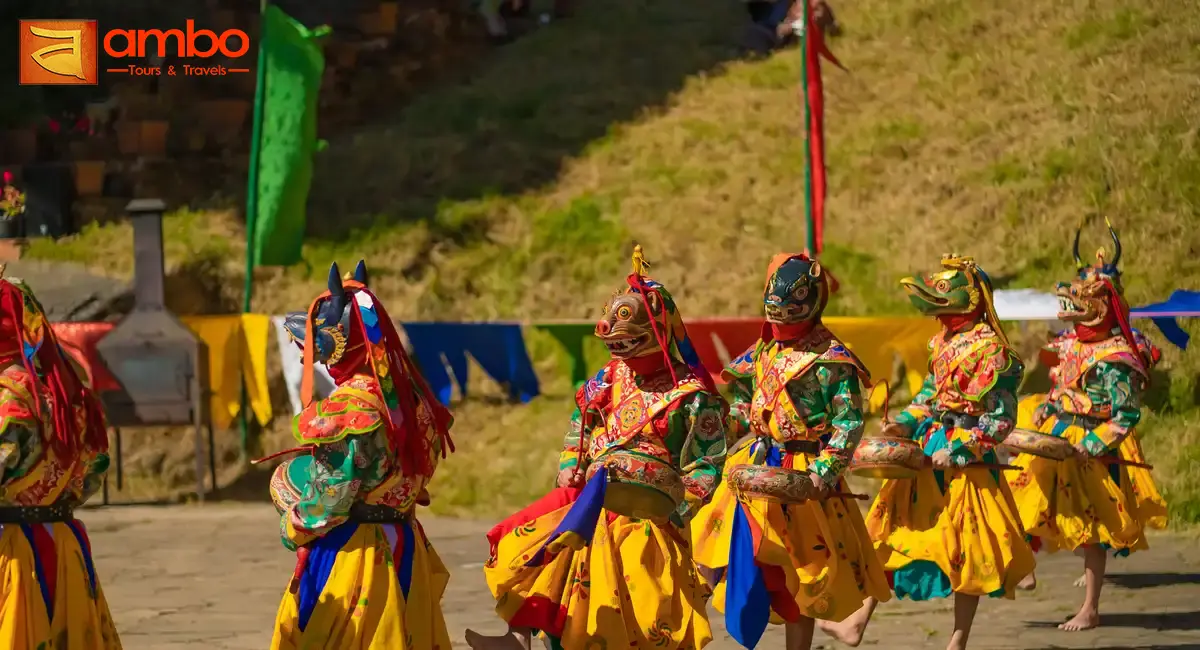
The Tamshing Tshechu — formally the Tamshing Phala Choepa — is one of the most intimate and spiritually concentrated festivals in Bhutan, held at Tamshing Lhakhang in Bumthang valley. Founded in 1501 by the great treasure-revealer Pema Lingpa, Tamshing is among the oldest and most revered monasteries in the kingdom. The festival's sacred cham mask dances are accompanied by a unique blessing: devotees carry the chain-mail coat of Pema Lingpa himself on their backs as an act of purification — an experience found nowhere else in Bhutan.
This 10-day private tour is built around two full festival days in Bumthang. The journey takes you from Thimphu's capital culture through Punakha's river valley, across to the glacial crane sanctuary of Phobjikha Valley, over Pele La Pass to Trongsa Dzong and into Bumthang for the festival. After two days at Tamshing Lhakhang — including a morning excursion to the Burning Lake and Bumthang Brewery — a domestic flight returns you to Paro for the Tiger's Nest hike and a traditional hot stone bath before departure. The domestic flight from Bumthang to Paro is booked separately and not included in the tour price.
Every detail is arranged by Ambo Tours' licensed team in Thimphu — permits, accommodation, guide, transport, and all meals throughout.
Tour Pricing
10 Days Bhutan Journey — Cost
All prices in USD per personCost includes Sustainable Development Fee (SDF) of US $100 per person per night and Bhutan Visa Fee of US $40 per person. Entrance fees for monuments and festival visits are paid separately.
Detailed Itinerary
Your Tamshing Tshechu Festival Bhutan journey begins with one of commercial aviation's most dramatic arrivals. The plane banks sharply between Himalayan ridgelines into Paro International Airport — green mountains, prayer flags, and crisp mountain air greet you immediately. The Ambo Tours guide and driver meet you at arrivals and begin the drive east toward Thimphu, Bhutan's capital.
On the way, stop at Tamchog Lhakhang — a private monastery built by the extraordinary engineer-saint Thang Tong Gyalpo, who arrived in Bhutan in 1433 searching for iron ore and went on to build 108 iron-chain suspension bridges across Tibet and Bhutan, eight of them in Bhutan alone. The monastery stands beside one of his most celebrated surviving bridges — a Bhutan hidden gem that most itineraries skip entirely.
Arrive in Thimphu (2,250 m) and check in to your hotel. Three afternoon highlights set the scene:
- Buddha Dordenma at Kuenselphodrang — a 51.5-metre bronze and gilded statue of Shakyamuni Buddha, one of the largest in the world, with a sweeping panorama of Thimphu valley from the hilltop base.
- National Memorial Chorten — built in honour of the third King of Bhutan, His Majesty King Jigme Dorji Wangchuck, and one of the most active daily worship sites in the city.
- Tashichho Dzong — the Fortress of the Glorious Religion, housing the throne room of the King and the offices of the national government, at its most photogenic in the late afternoon light.
Dinner and overnight in Thimphu.
Tomorrow brings a full day of deeper Thimphu sightseeing — traditional arts, ancient nunneries, and the weekend farmers' market.
Today Ambo Tours takes you deeper into Thimphu — beyond the headline landmarks and into the workshops, libraries, and markets that reveal the living texture of Bhutan Buddhist culture and the daily rhythms of the capital.
- Takin Preserve at Motithang — home to the Takin, Bhutan's national animal, said to have been created by the Divine Madman Drukpa Kunley through his Tantric powers. This bovine-goat hybrid is found nowhere else on earth.
- Dupthop Lhakhang — one of the few surviving active nunneries in Bhutan, offering a contemplative counterpoint to the grand government buildings elsewhere in the city.
- National Library — a treasure house of ancient Bhutanese texts, scriptures, and manuscripts that provides context for everything you will encounter at the Tamshing Tshechu Festival later in the week.
- Zorig Chusum Institute (Painting School) — the national institute for Bhutan's 13 traditional arts, where apprentice artists practise thangka painting, wood carving, embroidery, and sculpture. Watching the painters work on sacred Buddhist scrolls in real time is one of the finest Bhutan cultural tour moments in Thimphu.
- Folk Heritage Museum — a reconstructed traditional Bhutanese farmhouse that brings the rural past of the country to life through artefacts, tools, and domestic objects from across the valleys.
- National Postal Museum — where you can have your own portrait printed onto an official Bhutanese postage stamp in under five minutes — a personalised souvenir found nowhere else on any Bhutan trip.
- Centenary Farmers' Market (open on weekends) — Thimphu's most vibrant open-air market, selling dried chillies, homemade ara (rice wine), fresh farm produce, and handmade textiles from across the country.
Dinner and overnight in Thimphu.
Tomorrow, the road descends to the subtropical warmth of Punakha via the 108 chortens of Dochula Pass.
The drive from Thimphu to Punakha (1,310 m) is one of the most celebrated short journeys in the Himalayas. Your Ambo Tours driver stops first at Dochula Pass (3,116 m) — where 108 Druk Wangyal chortens crown a hilltop wrapped in prayer flags, and on clear mornings the full sweep of the Greater Himalayan range fills the sky. It is one of the most photographed viewpoints in all of Bhutan tourism.
Continue to the Royal Botanical Park at Lamperi — a protected nature reserve on the road toward Punakha, rich in 46 species of rhododendron, monal and blood pheasants, musk deer, red panda, and leopard. The colourful rhododendron festival draws Bhutan sightseeing visitors each spring when the hillside erupts in bloom.
On reaching the valley, take the 20-minute walk through rice paddies to Chimi Lhakhang — the famous fertility temple built in 1499 by Lama Drukpa Kuenley, the Divine Madman, set on a round hillock above Sopsokha village. Childless couples from across Bhutan visit here seeking blessings.
In the afternoon:
- Visit Punakha Dzong (built 1637 by Zhabdrung Ngawang Namgyal) — Bhutan's former capital, positioned at the confluence of the Pho Chhu and Mo Chhu rivers. War materials captured during battles with Tibetan forces are still preserved inside. Punakha served as the capital of Bhutan until 1955.
- Walk across the longest suspension bridge in Bhutan (160 m) over the Pho Chhu river — an exhilarating crossing with sweeping views of the dzong, valley, and river below.
Dinner and overnight in Punakha.
Tomorrow, the road climbs north to the glacial crane sanctuary of Gangtey and Phobjikha Valley.
The drive north from Punakha through the Wangdue Phodrang district winds past lush rice fields, small roadside settlements, and local farmers tending crops before opening into the wide glacial bowl of Phobjikha Valley — one of the most serene landscapes in all of Bhutan. The valley is the protected winter home of the endangered black-necked crane, which migrates here from the Central Asiatic Plateau each autumn to escape its harsh winters.
- Visit Gangtey Gompa (founded 1613) — a Nyingma monastery affiliated with Tamshing Lhakhang in Bumthang, the very site of the Tamshing Tshechu Festival Bhutan you will witness later this week. Exploring this monastery first gives valuable context to the Tamshing connection.
- Walk the Phobjikha Valley floor watching for black-necked cranes, especially in early morning or late afternoon when the birds feed on the wetland edges.
- Visit the Black-Necked Crane Information Centre — operated under the Royal Society for the Protection of Nature, equipped with high-power telescopes and spotting scopes for close-up crane observation.
Tonight, your Ambo Tours team arranges a traditional Bhutanese farmhouse stay in Phobjikha — sleeping in a genuine farming household, eating home-cooked meals from fresh local ingredients, and experiencing the hospitality of a valley community far from the tourist trail. Overnight in Gangtey.
Tomorrow, the drive east crosses Pele La Pass into central Bhutan and the royal fortress town of Trongsa.
Today crosses the natural geographic heart of Bhutan — the drive over Pele La Pass (3,390 m), the traditional boundary between western and central Bhutan, with views of black-necked cranes in the wetlands below on clear mornings. The landscape shifts dramatically as you descend east, the valleys narrowing and the dzongs growing larger.
Stop in Trongsa for two significant sites:
- Trongsa Dzong — the most impressive fortress in Bhutan, built in 1647, commanding the gorge of the Mangde River from a narrow spur backed against the mountain. The first two hereditary Kings of Bhutan ruled the country from this dzong, making it the ancestral seat of the Wangchuck royal dynasty and an essential stop on any Bhutan cultural tour.
- Ta Dzong Royal Museum — the former watchtower of Trongsa Dzong, now a state-of-the-art museum displaying 224 artefacts of the Wangchuck dynasty including the Raven Crown worn by the first King in 1907.
Continue east to Bumthang (2,800 m) — the spiritual heartland of Bhutan, a valley of ancient temples, nomadic communities, and lingering tales of Guru Rinpoche and the great treasure-revealers. Check in and rest well tonight. Dinner and overnight in Bumthang.
Tomorrow, the Tamshing Tshechu Festival Bhutan begins — along with a morning of Bumthang valley's most sacred sites.
The spiritual heartland of Bhutan comes alive today. Bumthang is not simply a destination — it is a living repository of Bhutan Buddhist culture, where the oldest temples in the kingdom stand alongside nomadic communities that have changed little for centuries. Your Ambo Tours guide begins the morning with two of Bumthang's most significant sacred sites before the festival opens.
- Jakar Dzong (the Castle of the White Bird) — the administrative and religious centre of Bumthang, perched on a hilltop with breathtaking views over the Chokhor Valley. Its serene courtyards and vivid murals set the cultural tone for the day.
- Kurjey Lhakhang — one of Bhutan's most sacred Bhutan monastery complexes, housing the body imprint of Guru Rinpoche in the rock face of its oldest temple (1652). Three temples make up the complex, and the site draws pilgrims from across the country year-round.
In the afternoon, the Tamshing Tshechu Festival Bhutan — formally the Tamshing Phala Choepa — opens at Tamshing Lhakhang, founded in 1501 by the great treasure-revealer Pema Lingpa. This is one of the oldest and most revered monasteries in Bumthang, and its annual festival is among the most intimate in the country.
- Watch monks perform sacred cham mask dances in elaborate silk brocade costumes — each dance re-enacting chapters of Buddhist scripture and the deeds of Guru Rinpoche.
- Receive blessings from the monastery's ancient relics, including the chain-mail coat said to have been worn by Pema Lingpa himself — devotees carry it on their backs as an act of purification.
- Engage with local families who have travelled from across the valley for the festival — your guide bridges the conversation and cultural context.
Tip: Dress modestly and respectfully. Bumthang mornings are cool — carry a warm layer even in autumn. Dinner and overnight in Bumthang.
Tomorrow brings the grand finale of the Tamshing Tshechu, alongside the Burning Lake and Bumthang's famous brewery.
The final day of the Tamshing Tshechu Festival Bhutan opens with a morning excursion to two of Bumthang's most distinctive sites before returning for the festival's grand conclusion.
- Membartsho (The Burning Lake) — a sacred river gorge five minutes' walk from the road, where the great Terton Pema Lingpa discovered dharma treasures hidden by Guru Rinpoche in the 14th century. He famously dived into the pool holding a burning butter lamp and surfaced with the treasures intact — a story that defines the spiritual identity of Bumthang valley and appears in every serious Bhutan travel guide.
- Bumthang Brewery — one of Bhutan's most surprising and enjoyable Bhutan hidden gem stops. The brewery produces craft beers including the popular Bhutanese wheat beer, and visitors can tour the facility, learn about the local brewing process, and sample the range. A genuinely different experience on a Bhutan cultural tour.
- Jambay Lhakhang — one of the oldest temples in Bhutan, believed to have been built in the 7th century by the Tibetan King Songtsen Gampo. The temple hosts its own major annual festival, the Jambay Lhakhang Drup, and its sacred relics and murals make it essential Bhutan sightseeing in Bumthang.
Return to Tamshing Lhakhang in the afternoon for the festival's closing performances — the final cham dances are the most elaborate and most attended, with the courtyard packed with devotees in their finest silk kiras and ghos. The Ambo Tours guide positions you for the best view of both the dances and the captivated crowd. Dinner and overnight in Bumthang.
Tomorrow, a domestic flight returns you to Paro for the final chapter of this Bhutan tour package.
After the intensity and richness of the Tamshing Tshechu Festival Bhutan, the short domestic flight from Bumthang back to Paro offers a moment of peaceful transition — watching the forested ridgelines and glacial valleys of central Bhutan scroll beneath the wings before the familiar Paro Valley opens below. Your Ambo Tours guide meets you at the airport and checks you into your hotel.
The afternoon covers three of Paro's most significant cultural sites:
- Rinpung Dzong (Heap of Jewels, built 1646 by Zhabdrung Ngawang Namgyal) — a commanding fortress-monastery above the Paro Valley, serving as the centre of administrative and religious authority for the district. Its wooden-gallery courtyard is lined with some of the finest Bhutan Buddhist culture murals in the country.
- Ta Dzong National Museum (built 1656, renovated 1968) — an ancient watchtower now housing galleries of fine arts, bronzes, textiles, jewellery, stuffed wildlife, and Bhutan's celebrated stamp collection, including 3-D, silk, embossed, and the iconic triangular yeti stamp.
- Drugyal Dzong — built by Zhabdrung Ngawang Namgyal in 1644 to commemorate Bhutan's victory over Tibetan invaders, now a picturesque ruin with views of Jhomolhari peak on clear days.
The evening is free to explore Paro town for shopping and photography — painted shopfronts sell hand-woven textiles, incense, and wooden crafts. Dinner and overnight in Paro.
Tomorrow, the most iconic hike in Bhutan — the morning climb to Tiger's Nest Monastery.
No Bhutan tour package reaches its conclusion without this day. The hike to Taktsang Monastery (Tiger's Nest) at 3,120 m is the defining image of Bhutan tourism worldwide — gilded temples clinging to a sheer cliff face 900 metres above the Paro Valley floor, reached by a trail through ancient blue pine forest. Guru Rinpoche, the founding father of the Bhutanese form of Mahayana Buddhism, is believed to have arrived here on the back of a flying tigress in the 8th century, meditating in a cave at this very site. The main monastery complex was severely damaged by fire in 1998 and then painstakingly restored to its full former glory over many years.
- The hike is approximately two hours to the monastery — a rewarding climb through pine forest with a teahouse halfway offering the most dramatic view of the monastery above.
- Allow an extra hour inside the inner sanctuaries — cameras must be left at the entrance gate, and the stillness within is extraordinary after the exertion of the climb.
- Horse rides are available to the viewpoint for those who prefer a gentler pace on the lower section.
On returning to the base, your Ambo Tours team arranges a traditional Bhutanese cuisine lunch in a forest setting — a celebration of local flavours including ema datshi (chilli and cheese), red rice, and seasonal vegetables, surrounded by the tranquillity of the Paro valley forest.
In the evening, experience a traditional Bhutanese hot stone bath — river stones heated in a fire and rolled into a wooden tub of herbal water infused with local medicinal plants. Practised for centuries as both leisure and natural therapy, it is the perfect recovery after the climb. Stroll through Paro town afterward for last-minute handicraft shopping. Dinner and overnight in Paro.
Tomorrow, your Tamshing Tshechu Festival Bhutan journey with Ambo Tours comes to a close.
Your Tamshing Tshechu Festival Bhutan journey with Ambo Tours comes to a close after an early breakfast. Your guide and driver transfer you to Paro International Airport as per your flight schedule — and as the plane climbs steeply between the ridgelines, the prayer flags and painted farmhouses of the Paro valley recede below for the last time on this trip.
Ten days have traced a wide arc through the very best of Bhutan: the thangka painters and farmers' market of Thimphu, the confluence beauty of Punakha Dzong, the crane sanctuary of Phobjikha Valley, the royal fortress of Trongsa, the sacred cham dances of the Tamshing Phala Choepa at Tamshing Lhakhang, the Burning Lake of Bumthang, and the cliff-face wonder of Tiger's Nest as the final unforgettable chapter. The Tamshing Tshechu in particular — smaller, more intimate, and more spiritually concentrated than the larger Paro or Thimphu festivals — is an encounter with Bhutan Buddhist culture at its most genuine.
Bhutan's commitment to sustainable tourism, Gross National Happiness (GNH), and the careful preservation of its living cultural traditions makes this kingdom unlike any other destination on earth. The entire Ambo Tours team thanks you for travelling with us. We hope to welcome you back to the Land of the Thunder Dragon soon.
Included / Excluded
- ✔All meals — breakfast, lunch, and dinner
- ✔Accommodation on twin / double sharing basis (single supplement extra)
- ✔All transportation within the kingdom including airport transfers
- ✔Sustainable Development Fee — Government tax (SDF)
- ✔Bhutan visa fee
- ✔English-speaking private local guide
- ✔Sightseeing as per itinerary
- ✔Bottled water throughout the journey
- ✖International flights to and from Paro (PBH)
- ✖Entrance fees for museums and monuments
- ✖Gratuities for guides and drivers
- ✖Travel insurance premiums
- ✖Payments for services provided on a personal basis
- ✖Cost for any services not mentioned under "Cost Includes"
- ✖Cost incurred due to mishaps, strikes, political unrest, etc.
- ✖Personal expenses — laundry, beverages, or personal services
Ambo Tours & the 1% Club
Every tour we run includes a contribution to a Bhutanese NGO of your choice — at no extra cost to you. We call this the 1% Club: a minimum of 1% of your trip's profit, or Nu 5,000, whichever is higher, donated on every single journey. You choose where it goes.
About the Tamshing Tshechu
The Tamshing Tshechu — formally the Tamshing Phala Choepa — is held annually at Tamshing Lhakhang, founded in 1501 by the great treasure-revealer Pema Lingpa in Bumthang's Chokhor Valley. Unlike Bhutan's larger dzong-based tshechus, the Tamshing festival is intimate and community-centred — the monastery courtyard is small, the crowds are local, and the atmosphere is one of genuine devotion rather than spectacle.
The festival's sacred cham mask dances are performed by monks in elaborate silk brocade costumes, each dance re-enacting chapters of Buddhist scripture and the deeds of Guru Rinpoche. What makes the Tamshing Tshechu uniquely significant is the blessing with Pema Lingpa's chain-mail coat — an ancient relic housed at the monastery which devotees carry on their backs as an act of purification. This blessing is found at no other festival in Bhutan.
The closing ceremonies include the most elaborate cham performances of the two-day programme, with the courtyard packed with devotees in their finest silk kiras and ghos. For an overview of all Bhutan's major festivals, see our complete guide to Bhutan festivals. For best season guidance, visit our best time to visit Bhutan guide.
Tamshing Lhakhang & Bumthang Valley
Tamshing Lhakhang sits in Bumthang's Chokhor Valley — the spiritual heartland of Bhutan, home to some of the oldest and most sacred temples in the kingdom. Founded by Pema Lingpa in 1501, the monastery's interior houses ancient murals painted by the saint himself, considered among the finest examples of early Bhutanese religious art. A sister monastery — Gangtey Gompa in Phobjikha Valley — was founded by Pema Lingpa's grandson in 1613, making the Phobjikha stop on Day 4 of this tour a meaningful prelude to the Tamshing festival.
Bumthang's other sacred sites form an essential part of this tour: Kurjey Lhakhang where Guru Rinpoche's body-print is preserved in the rock face, Jambay Lhakhang built in the 7th century, and Membartsho (Burning Lake) in Tang Valley where Pema Lingpa famously retrieved hidden dharma treasures from the water holding a burning butter lamp. The valley also harbours the Bumthang Brewery — one of Bhutan's most enjoyable surprises, producing craft beer including a popular wheat beer in the heart of this sacred landscape.
For a full destination guide, see our Bumthang travel guide.
Trongsa & the Road to Bumthang
The overland journey from Phobjikha Valley to Bumthang on Day 5 crosses the geographic heart of Bhutan via Pele La Pass at 3,390 metres — the traditional boundary between western and central Bhutan. The landscape shifts dramatically as you cross: the broad valleys of western Bhutan give way to narrower gorges, denser forest, and a noticeably different light as you move east.
Trongsa Dzong, built in 1647, is the most impressive fortress in Bhutan — positioned on a dramatic spur above the Mangde River gorge, it commands views of approaching routes from multiple valleys. The first two hereditary Kings of Bhutan ruled from this dzong, making it the ancestral seat of the Wangchuck royal dynasty. Its 22 temples and chapels sprawl across multiple levels connected by covered walkways. The adjacent Ta Dzong Royal Museum displays 224 artefacts of the Wangchuck dynasty, including the Raven Crown worn by the first King in 1907.
For a full overview of planning your Bhutan journey including visa and SDF costs, see our Bhutan travel guide. For cost breakdown, see our cost of travelling to Bhutan guide.
Itinerary Map
Map coming soon.
Frequently Asked Questions
Ready to Begin Your Journey?
Our Thimphu team responds within 24 hours. Tell us your dates and we will handle the rest.