Part of our complete guide to monasteries in Bhutan.
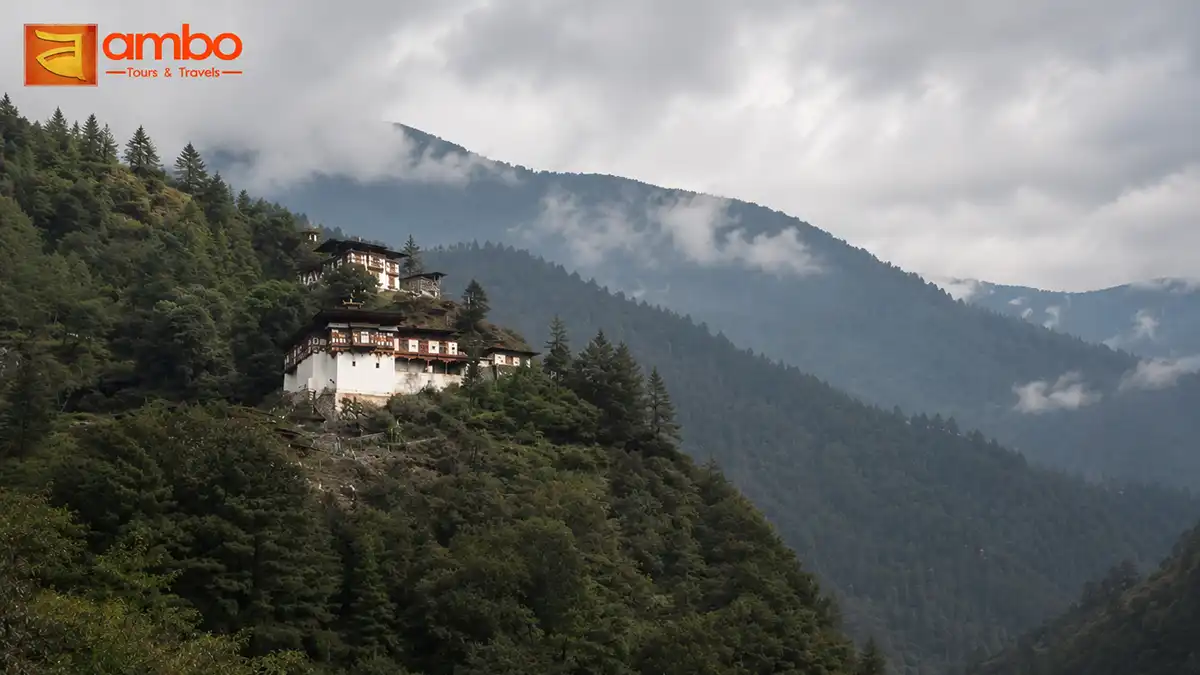
At the northern head of the Thimphu Valley, two monasteries sit facing each other across the Wang Chhu river — Tango and Cheri. Together they hold some of the deepest history in Bhutan: one carries a vivid founding legend involving a horse-headed deity engulfed in flames, and the other is where the founder of the Bhutanese nation himself began the work that would eventually unify the country. Most visitors hike to both in a single outing, and understanding what each one actually represents transforms the walk from a pleasant forest trail into something considerably more significant.
Tango Monastery: The Horse Head Legend
Origins and the Legend Behind the Name
Tango Monastery’s story begins in the 12th century, when the lama Phajo Drugom Zhigpo — a pivotal figure who first brought the Drukpa Kagyu lineage to Bhutan — first established a meditation site here. According to tradition, a lama meditating at this location heard the echo of a horse’s neigh coming from the direction of the surrounding cliffs. As he looked toward the sound, the rock face itself is said to have transformed into the wrathful deity Tandin — known in Sanskrit as Hayagriva, the horse-headed protector — consumed in flames. It was prophesied that a monastery would be built on this exact spot, dedicated to meditation, prayer, and to Hayagriva himself.
This is the origin of the name “Tango,” which translates literally as “horse head” — a direct reference to the vision at the heart of the site’s founding.
From Meditation Site to Buddhist University
The monastery was rebuilt into its current form in 1688 by Gyalse Tenzin Rabgye, the 4th Druk Desi — the same ruler responsible for building Tiger’s Nest four years later, in 1692. Tango has since grown into one of the most important religious institutions in Bhutan, functioning today as a full Buddhist university with a resident community of close to 300 monk scholars. Perhaps its most significant role in Bhutanese religious life: the great majority of the country’s Je Khenpos — Bhutan’s Chief Abbots, the highest religious authority in the land — have passed through a rigorous nine-year training program here. In a very real sense, Tango has shaped the leadership of Bhutanese Buddhism for centuries.
Cheri Monastery: The First Seat of a Nation’s Founder
A Site Already Sacred Before Zhabdrung Arrived
Cheri’s significance predates its formal founding by centuries. Tradition holds that Guru Rinpoche himself visited Chagri Mountain — the “Iron Hill” on which Cheri sits — in the 8th century, and prophesied that a monastery would one day be founded here, becoming Bhutan’s first religious community. The 13th-century master Phajo Drugom Zhigpo, the same lama associated with Tango’s founding, is also said to have visited and blessed the site.
Zhabdrung Ngawang Namgyal Arrives
The pivotal moment came in 1620, when Zhabdrung Ngawang Namgyal — the Tibetan lama who would go on to unify Bhutan as a single nation-state — founded Cheri Monastery, also known as Chagri Dorjeden. This is a detail worth sitting with: before Zhabdrung built a single dzong — before Punakha, before Paro’s Rinpung Dzong, before any of the fortress-monasteries that define Bhutan’s landscape today — he built Cheri. It was here, not in a grand fortress, that the transformation of Bhutan actually began.
Zhabdrung had arrived in Bhutan four years earlier, in 1616, fleeing a succession dispute in Tibet over his own recognition as the reincarnation of a previous Drukpa Kagyu master. His early years in Bhutan were genuinely dangerous — he survived Tibetan raids near Paro and, according to tradition, an arrow that narrowly missed him while traveling on horseback near Thimphu. He eventually settled in the northern Thimphu Valley, already having spent considerable time meditating at the adjacent Tango Monastery, and chose the site across the river to build his own monastic headquarters.
Construction ran from 1620 to 1623. During this period, tragedy and devotion intertwined: Zhabdrung’s father died in Tibet in 1619, and his followers secretly smuggled his remains across the border to Bhutan. After elaborate funerary rites, Zhabdrung had his father’s ashes enshrined in a richly decorated silver chorten inside Cheri’s upper chambers — a reliquary that remains one of the monastery’s most sacred features today.
Zhabdrung himself spent over three years in strict retreat at Cheri. In 1623, with the monastery complete, he formally established the first organized Drukpa Kagyu monastic order in Bhutan here — a founding community of 30 monks, built on the same constitutional framework he’d developed at Ralung Monastery in Tibet. This was the true starting point of the centralized religious and political structure that would eventually become the Bhutanese state.
A Living Tradition, Still Practiced Today
Cheri’s role as a serious retreat center never faded. To this day, graduates of Dordey Tashithang Buddhist University and monks of Bhutan’s Central Monastic Body undertake the same demanding practice Zhabdrung himself completed here: three years, three months, and three days of strict solitary retreat. Few places in Bhutan offer as direct and unbroken a thread back to the country’s founding moment as this.
Hiking to Tango and Cheri
Both monasteries are reached from a shared starting point at Dodena, roughly 15 kilometres north of Thimphu, via a scenic drive along the Wang Chhu river.
To Cheri: the trail crosses a traditional wooden bridge over the Wang Chhu, strung with prayer flags, before climbing uphill through forest. The hike takes roughly 45 minutes to 1.5 hours one way, and while not technically difficult, several sections are genuinely steep and require a reasonable level of stamina.
To Tango: the trail climbs for about an hour through a forest of rhododendron, turning a vivid violet and crimson when in bloom. Many visitors extend the walk further along what’s known as the Drolay loop, passing the Drolay Goemba meditation centre and eventually reaching a vantage point with sweeping views back across to Cheri Monastery, the surrounding mountain ranges, and the city of Thimphu spread out below.
Because the two monasteries sit on opposite sides of the same valley, many travelers combine both into a single, fuller day out — though each hike can just as easily be done independently if time is limited.
Practical Tips
- Both hikes involve genuine elevation gain and steep sections — wear proper hiking shoes and budget realistic time for each.
- Spring (rhododendron bloom) and autumn offer the clearest views and most comfortable hiking conditions.
- Modest dress is expected inside both monasteries, as at any active religious site in Bhutan.
- Tango remains a functioning Buddhist university — visitors should be mindful of ongoing study and practice happening around them.
- A licensed Bhutanese guide is mandatory for all travel in Bhutan and is especially valuable at these two sites, where the real reward is understanding the layered history rather than simply viewing the architecture.
Frequently Asked Questions
Why is Tango Monastery called “horse head”?
According to legend, a lama meditating near the site heard a horse’s neigh, and the surrounding cliffs transformed into the wrathful, horse-headed deity Hayagriva (Tandin) engulfed in flames — leading to a prophecy that a monastery would be built here, and giving the site its name.
Why is Cheri Monastery historically significant?
Cheri was the first monastery built in Bhutan by Zhabdrung Ngawang Namgyal, founder of the unified Bhutanese state, in 1620 — before he constructed any of the country’s famous dzongs. It marks the true starting point of Bhutan’s centralized religious and political structure.
How long does it take to hike to Tango and Cheri?
Each hike takes roughly 45 minutes to 1.5 hours one way from the shared Dodena trailhead. Many travelers combine both monasteries into a single fuller day, though each can be visited independently.
Is Tango Monastery still an active religious institution?
Yes — Tango functions today as a Buddhist university with close to 300 resident monk scholars, and the majority of Bhutan’s Je Khenpos (Chief Abbots) have trained there through its nine-year program.
Tango and Cheri are two of many sacred sites covered in our complete guide to monasteries in Bhutan. Planning a Thimphu visit? See our cultural tour packages that include stops in the capital.
Ready to Experience Bhutan?
Tell us your dates and interests — our team in Thimphu will craft a personalised itinerary within 24 hours, at no cost.