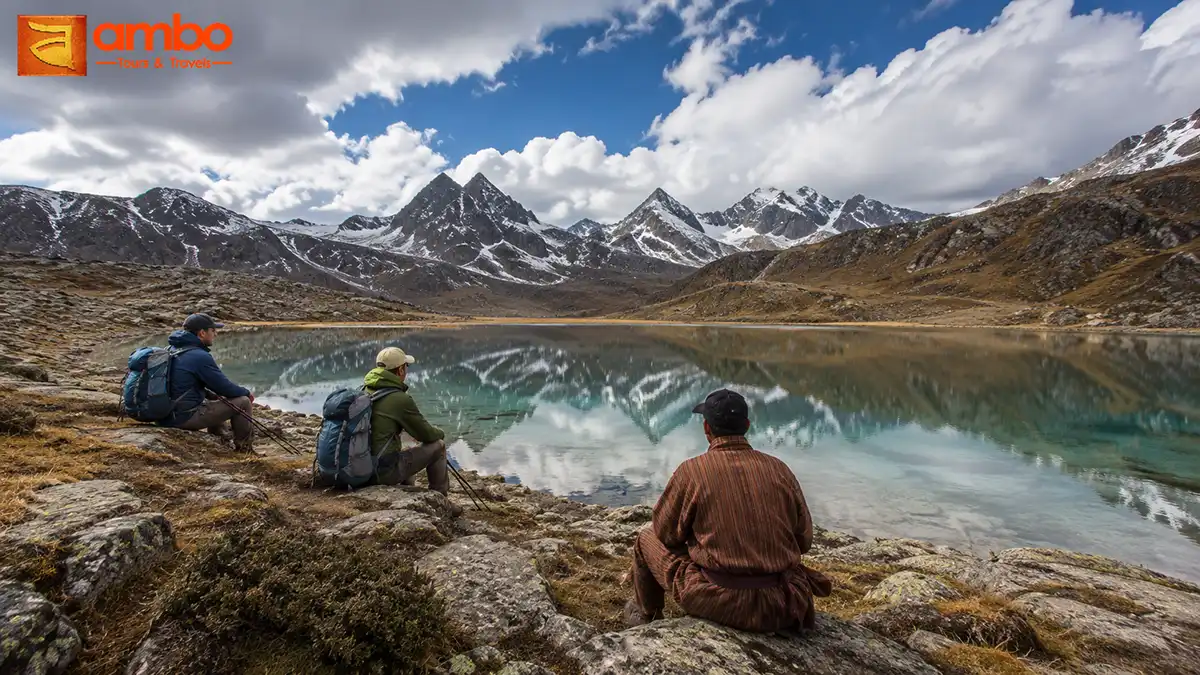
Dagala Thousand Lakes Trek — Sacred Alpine Lakes Above the Thimphu Valley
Paro · Dagala Range · Thimphu · Punakha
Tour Information
- Utsho Lake (4,250m) — sacred glacial lake in the heart of the Dagala Range
- Labajong La Pass (4,400m) — the highest point of the trek with views across the Dagala Range
- Optional Jomo Peak lower summit (4,530m) via Setsho Lake — views of Kanchenjunga and Chomolhari
- Talakha Monastery overnight — one of the most atmospheric camps in western Bhutan
- Talakha Peak (4,300m) — panoramic views over the entire Thimphu valley
- Ancient ruined dzong on the ridge — a watchtower between Wangduephodrang and Thimphu districts
- Wataching yak herders' camp (4,100m) — nomadic highland life at the start of the high route
- Punakha Dzong at the confluence of Mo Chu and Pho Chu rivers
- Tiger's Nest (Taktsang Monastery) on Day 2 before the trek begins
The Dagala Thousand Lakes Trek takes its name from the chain of sacred glacial lakes scattered across the Dagala Range above Thimphu — alpine lakes at 4,000m and above, crystal clear, rarely visited, and regarded as the abodes of protective deities. Five days of trekking from the Genekha trailhead (2,800m) through yak herder camps, over four high passes, and past Utsho Lake (4,250m) reach the trek's high point at Labajong La Pass (4,400m) before a final traverse across Talakha Peak (4,300m) to the overnight at Talakha Monastery.
An optional hike from Labatama valley ascends the lower summit of Jomo Peak (4,530m) via Setsho Lake for close-range views of Kanchenjunga and Chomolhari — the highest point accessible on the route.
The five-day trek is framed by a complete cultural journey: Tiger's Nest and Paro valley on arrival, a full day of Thimphu cultural sightseeing, Punakha Dzong via Dochula Pass, and the Khamsum Yulley Namgyal Chorten hike along the Mo Chu river. The descent from Talakha Monastery arrives above Thimphu with one of the most dramatic views of the capital available from any trekking route in Bhutan. Operated by Ambo Tours, DOT Licence No. 1053330, Thimphu.
Tour Pricing
13 Days Bhutan Journey — Cost
All prices in USD per personCost includes Sustainable Development Fee (SDF) of US $100 per person per night and Bhutan Visa Fee of US $40 per person. Entrance fees for monuments and festival visits are paid separately.
Detailed Itinerary
Welcome to Paro, the gateway to the Land of the Thunder Dragon. Your Bhutan travel adventure begins the moment your flight descends through a dramatic corridor of snow-capped peaks — widely regarded as one of the most breathtaking mountain landings in the world. A representative from your Bhutan tour package will greet you warmly at the airport exit, ready to begin your unforgettable Bhutan holiday.
After a hearty welcome lunch featuring local ema datshi (chili and cheese stew), Bhutan's beloved national dish, set out for your first taste of Bhutan sightseeing in the Paro valley.
- Ta Dzong Museum: Perched above the valley, this former watchtower turned national museum houses centuries of religious relics, Bhutanese art, thangka paintings, and handicrafts — a perfect orientation into Bhutan Buddhist culture and history.
- Rinpung Dzong (Paro Dzong): One of the most iconic Bhutan dzong structures in the country, this 17th-century fortress-monastery guards the valley with quiet authority. Admire the celebrated painting of the great saint Milarepa and soak in the monastery's serene courtyard atmosphere.
Practical tip: Dress modestly when visiting dzongs and monasteries — covered shoulders and knees are required. The valley sits at approximately 2,200m, so take it easy on your first day to begin acclimatizing.
This evening, settle into your hotel in Paro and reflect on your first impressions of Bhutan tourism at its most authentic. Tomorrow, one of the most iconic hikes in all of Asia awaits — the legendary Taktsang Monastery.
No Bhutan itinerary is complete without the crown jewel of Bhutan tourism — the awe-inspiring hike to Taktsang Monastery, universally known as Tiger's Nest. Cling to the misty hillside nearly 900 metres above the Paro valley floor, this sacred monastery is one of the most photographed and spiritually significant sites in all of Asia.
The uphill hike takes approximately 1.5 to 2 hours at a comfortable pace through fragrant pine and oak forest, rewarding hikers at every switchback with increasingly dramatic views. For those unable to hike, horses can be arranged to the cafeteria viewpoint halfway up.
- Tiger's Nest (Taktsang Monastery): According to legend, Guru Rinpoche flew here on the back of a tigress in the 8th century, meditating for three months in a cave before bringing the teachings of Bhutan Buddhist culture and the Dharma to Bhutan. The monastery complex, rebuilt after a 1998 fire, clings impossibly to sheer granite cliffs — a vision that never fails to stop visitors in their tracks.
- Drukgyel Dzong: In the afternoon, drive to the northern end of the Paro valley to visit this dramatically ruined Bhutan dzong, originally built in 1644 to commemorate Bhutan's victory over invading Tibetan forces. On a clear day, the sacred peak of Mount Jomolhari (7,314m) forms a breathtaking backdrop — one of the finest Bhutan mountain vistas anywhere in the valley.
Practical tip: Start the Tiger's Nest hike early (before 8am) to beat the crowds and catch the monastery bathed in morning light. Carry at least 1.5 litres of water, wear layered clothing, and bring trekking poles if available. The best time to visit Bhutan for this hike is spring (March–May) and autumn (September–November).
End the evening with a warm bowl of thukpa (noodle soup) at your hotel in Paro. Tomorrow, your Bhutan trip transitions from sightseeing to spectacular trekking as you head into the mountains toward Gur.
The wild, pristine heart of the Bhutan landscape opens up today as your Bhutan tour package transitions into an exhilarating multi-day trek. Leaving the comfort of Paro behind, you drive to the trailhead village of Genekha (2,800m), perched above Thimphu on a forested ridge — already a world away from the valley floor. For another short trek above Thimphu's neighbouring valley, see our Druk Path Trek — a 4-day trail from Paro to Thimphu through high lakes and forest.
After crossing a wooden bridge over the Wang Chu (Thimphu River), the trail climbs steadily through ancient oak forest, rich with birdsong and draped in lichen. The forest gradually transitions into silver birch and towering bamboo groves as you gain altitude, with occasional rocky outcrops offering natural resting platforms and teasing views of the peaks above.
- Wang Chu River crossing: A picturesque start to the trek, with the rushing glacial river framed by dense sub-tropical forest.
- Oak and bamboo forest trail: One of Bhutan's most beautiful and underrated Bhutan hidden gem walking routes — serene, shaded, and rich in wildlife.
- Gur Camp (3,350m): Your overnight meadow campsite, ringed by trees and open to a sky full of stars on clear nights.
Practical tip: Altitude begins to be a consideration from today. Drink plenty of water, avoid alcohol on your first night at altitude, and eat a warm, carbohydrate-rich dinner. Your cook will typically prepare hearty camp meals — don't miss the dal bhat (lentil rice), a staple of trekking cuisine in the Himalayas.
This is sustainable tourism Bhutan at its finest — small-footprint camping in pristine wilderness. Tomorrow the trail rises into the alpine zone, with open ridgelines and the first sweeping Bhutan mountain panoramas of the trek.
Rising above the treeline today, your Bhutan itinerary enters some of the most spectacular alpine terrain in the entire Himalayan kingdom. The trail climbs steadily from Gur through open hillsides draped in rhododendron — forests that explode in vivid pink, red, and white bloom each spring, making this one of the most visually rewarding treks in all of Bhutan tourism.
The first significant waypoint is the optional rest camp at Gibze Kebze (3,710m). Although only a couple of hours from camp, the 360m height gain is felt in the lungs — a reminder to pace yourself wisely on this Bhutan trip.
- Gibze Kebze (3,710m): A potential acclimatization stop for those feeling the altitude, set in open alpine terrain with broad valley views.
- Pagalabsta La Pass (4,170m): For those acclimatizing well, the route crests this dramatic high pass with commanding views of the mighty Dagala Range — a jaw-dropping Bhutan mountain panorama.
- Wataching (4,100m): A traditional stone yak herders' hut and your remote campsite for the night, offering a genuine glimpse into nomadic highland life in Bhutan.
Practical tip: At 4,100m, temperatures drop sharply after sunset — pack a warm sleeping bag rated to at least -10°C. Symptoms of altitude sickness include headache, nausea, and fatigue; if symptoms are severe, descend immediately. The best time to visit Bhutan for high-altitude treks is April–June and September–October.
Camp dinner tonight may feature suja — traditional Bhutanese butter tea — a warming and energizing ritual at altitude. Tomorrow, the terrain becomes more rugged and even more rewarding as you head toward the legendary Utsho Lake.
Today's stage on your Bhutan travel adventure leads through some of the most dramatic and spiritual high-altitude terrain in the kingdom. Leaving Wataching, the trail weaves across several ridges before entering the broad, sweeping valley of Labatama — a remote highland plateau dotted with ancient yak herders' stone huts and grazed by shaggy yaks that have roamed these meadows for centuries.
The visual and cultural highlight of the day is the approach to Utsho Lake (4,250m), a stunningly beautiful glacial lake renowned throughout Bhutan tourism circles for its elusive golden trout and crystalline waters reflecting the towering ridgelines above.
- Labatama valley: A Bhutan hidden gem — few international trekkers ever reach this remote pastoral landscape, making it one of the most authentic Bhutan landscape experiences available.
- Utsho Lake (4,250m): Sacred and serene, this glacial lake is a highlight of any Bhutan itinerary at this altitude. Fishing is strictly regulated in keeping with sustainable tourism Bhutan principles.
- Jomo Peak (optional): Energetic trekkers can attempt the climb via Setsho Lake to the summit of Jomo — revered as a female protective deity. In clear weather, views of Kanchenjunga and Chomolhari are extraordinary. Out of cultural respect, most groups stop at the lower peak (4,530m) as locals consider the summit sacred.
Practical tip: If attempting Jomo, start early in the morning before clouds build. Burn juniper as an offering at the cairn — your guide will carry some — as this is a deeply meaningful gesture to local herding communities who rely on the deity's protection for their livestock.
Tonight's campsite beneath dramatic cliff faces near the lake is among the most atmospheric on the entire trek. Tomorrow brings a long but rewarding crossing as you push toward Panka.
One of the most physically demanding yet visually spectacular days of your Bhutan trip begins as you leave Labatama and tackle the formidable Labajong La Pass (4,400m) — one of the highest points on the entire route and a true test of Himalayan trekking endurance.
The long ascent to the pass rewards every hard-earned step with an ever-expanding canvas of Bhutan mountain scenery. At the top, a cluster of colourful prayer flags marks the summit, their mantras releasing into the thin mountain air — a moment of deep spiritual resonance that encapsulates the essence of Bhutan Buddhist culture.
- Labajong La Pass (4,400m): The high point of the trek. Take a 30-minute detour to the nearby viewpoint for some of the most expansive panoramas of the entire Bhutan landscape — well worth the extra effort for photography and memory alike.
- Descent to Panka: The trail drops through open alpine terrain before entering sheltered valleys. Depending on water availability (which can vary pre and post monsoon), your camp location may shift slightly — your experienced guide will select the best option.
Practical tip: High passes in Bhutan can experience sudden weather changes even in peak season. Always carry a waterproof jacket, warm mid-layer, and sun protection — UV radiation is intense at altitude. Stay well hydrated throughout the crossing.
This is truly sustainable tourism Bhutan at its most immersive — trekking through landscapes that few outsiders ever witness, entirely off the mainstream Bhutan tour package circuit. Tonight, recover around the campfire with a warm meal and well-earned rest. Tomorrow's dawn will reveal some of the finest Himalayan peak views of the entire journey.
Rise before the sun today — if the skies are clear, you will be rewarded with one of the finest mountain mornings anywhere in Bhutan travel. From Panka, the early light illuminates an extraordinary roll call of Himalayan giants: Kanchenjunga, Chomolhari, and the shark-fin silhouette of Jichu Drake rise in sequence above the horizon, a sight that crystallises why this trek belongs on every serious Bhutan itinerary.
The trail threads through dense rhododendron forest — a haven for Himalayan pheasants, Bhutan's national bird — before cresting the distinctive cairns at Chole La Pass (4,100m).
- Chole La Pass (4,100m): Enormous stone cairns and fluttering prayer flags mark this storied high pass, which commands sweeping views of the surrounding ridges and valleys.
- Kiwi Chowa (4,030m): A brief descent to this highland hollow before the trail continues to a four-way junction at 3,960m — a natural crossroads of ancient mountain paths.
- Ancient ruined dzong: The remnants of a historic Bhutan dzong used to monitor movement between Wangduephodrang and Thimphu districts — a poignant Bhutan hidden gem for history lovers.
- Talakha Peak (4,300m): A final ridge climb delivers sensational views over the entire Thimphu valley, with Himalayan peaks visible in all directions on clear days.
- Talakha Monastery: The trek's spiritual climax — a remote Bhutan monastery whose shy monks, panoramic terrace, and legendary outdoor stone bathtub make for the most memorable overnight of the journey. Explore our full Bhutan trekking guide to compare all routes, difficulty ratings, and seasonal conditions across the kingdom.
Practical tip: The descent from Talakha Peak into the monastery involves some steep sections through mixed fir, juniper, and bamboo forest — trekking poles are strongly recommended. Dress modestly and ask permission before photographing the monks or monastery interiors.
Tomorrow morning, a gentle final hour of walking brings your trek to its triumphant conclusion as you descend into Thimphu, the capital of the Kingdom of Bhutan.
After the raw, elemental beauty of the mountains, there is something deeply satisfying about the final walk down from Talakha Monastery to the road — a gentle hour-long descent through apple orchards and terraced farmland that eases you gracefully back toward civilization. Within minutes of reaching the road, you are driving into Thimphu, the world's only national capital without a single traffic light — and one of the most fascinating small capitals anywhere on earth.
After checking into your hotel, a warm shower, and a restorative lunch, the afternoon opens up for Bhutan sightseeing in a city that balances ancient tradition with careful modernity.
- National Memorial Chorten: Completed by the Royal Queen Mother as a memorial stupa to the beloved Third King, this gleaming white chorten is the spiritual heart of modern Thimphu, where elderly Bhutanese circumambulate daily with prayer wheels spinning.
- Changangkha Temple: Dating to the 12th century, this hilltop Bhutan monastery overlooks the valley and remains one of the most beloved pilgrimage sites for local families seeking blessings for newborn children.
- Zilukha Nunnery: Home to Thimphu's community of Buddhist nuns, this peaceful institution offers a moving glimpse into the role of women in Bhutan Buddhist culture.
Practical tip: After several days at altitude, Thimphu (2,334m) will feel wonderfully comfortable. Treat yourself to a traditional Bhutanese hot stone bath at your hotel if offered — a restorative cultural experience using river-heated stones and local medicinal herbs. Try phaksha paa (pork with red chilies) for dinner — a Thimphu favourite.
Tomorrow brings a full day of cultural immersion in Thimphu, including a visit to one of Asia's most extraordinary royal dzongs and a fascinating range of Bhutan cultural tour experiences.
A full day of rich Bhutan cultural tour exploration awaits in Thimphu — a city unlike any other in Asia, where gross national happiness (GNH) is enshrined as a governing principle and where traditional dress is worn proudly in offices, schools, and royal palaces. This is Bhutan travel at its most intellectually rewarding.
- School for Arts and Crafts (Zorig Chusum): Watch young Bhutanese artisans master the 13 traditional arts, from thangka painting and wood carving to weaving and lacquerware — a living repository of national cultural heritage.
- National Library: Housing rare Bhutanese manuscripts and Buddhist scriptures dating back to the 8th century, this treasure trove is essential for understanding the depth of Bhutan Buddhist culture.
- Traditional Paper Factory: See how Deh-sho — traditional Bhutanese paper — is hand-crafted from the bark of the daphne bush using centuries-old techniques, a genuine Bhutan hidden gem for curious travellers.
- Folk Heritage Museum: An intricately reconstructed medieval Bhutanese farmhouse that brings the rhythms of traditional rural life vividly to life — one of the most immersive stops on any Bhutan itinerary.
- Tashichhodzong: The majestic whitewashed fortress of the 'Glorious Religion' houses His Majesty's secretariat, key government ministries, and the central monk body — an active Bhutan dzong of enormous national significance.
- Takin Preserve: Don't miss the nursing pen for the Takin, Bhutan's endearingly bizarre national animal — a creature so strange that local legend attributes its creation to the Divine Madman himself.
Optional: Hike 45 minutes to Tango and Cheri Monasteries — two of the oldest Bhutan monastery complexes in the Thimphu region, set in pristine forest above the city. If visiting on a weekend, the vibrant Thimphu Weekend Market is a sensory feast of local produce, dried foods, and handicrafts.
Practical tip: Try a traditional Bhutanese lunch at a local restaurant — order ema datshi, kewa datshi (potato and cheese), and jasha maru (spiced chicken stew). This is the soul food of Bhutan tourism.
Tomorrow, the iconic Dochula Pass and the ancient capital of Punakha await — a drive that ranks among the most scenic in all of Asia.
The drive from Thimphu to Punakha is one of the most celebrated journeys in all of Bhutan travel — a winding mountain road that crests the magnificent Dochula Pass (3,100m) before plunging into the sub-tropical warmth of the ancient Punakha valley. Allow time at the pass; this is one of the finest viewpoints in the entire kingdom.
At Dochula Pass, 108 memorial chortens — built by Her Majesty the Queen Mother — stand sentinel in neat rows beneath fluttering prayer flags. On a clear morning, the entire eastern Himalayan horizon unfolds: a serrated wall of snow-capped peaks stretching across the skyline, including Gangkhar Puensum, the world's highest unclimbed mountain. In late April and early May, the surrounding forests erupt in rhododendron bloom — a signature spectacle of Bhutan landscape photography.
Descending into Punakha, the air grows warmer and the terraced rice fields shimmer green along the valley floor — a world apart from the alpine cold of the passes above.
- Punakha Dzong — 'Palace of Great Happiness': Built in 1637 at the confluence of the Mo Chu and Pho Chu rivers, this is widely regarded as the most beautiful Bhutan dzong in the country. Its three-storey main temple, with four gold-and-silver embossed cypress pillars, is a masterwork of traditional Bhutanese architecture. Bhutan's first king was crowned here in 1907.
- Chimi Lhakhang (Temple of Fertility): A delightful afternoon walk through golden rice paddies leads to the charming temple of Drukpa Kunley, the Divine Madman, renowned throughout Bhutan Buddhist culture for his irreverent teachings. Couples seeking blessings for fertility make pilgrimages here from across Bhutan and beyond.
Practical tip: The best time to visit Bhutan's Punakha valley is February–March (when jacaranda trees bloom around the dzong) and October–November. Pack lighter clothing — Punakha is significantly warmer than Thimphu year-round. Try red rice with your dinner tonight — grown in the Punakha valley and a staple of local cuisine.
Tomorrow, a riverside hike to a hilltop chorten and a picnic lunch along the Mo Chu river make for one of the most peaceful and picturesque mornings of your entire Bhutan holiday.
Begin your final morning in the Punakha valley with one of the most rewarding short hikes of your entire Bhutan itinerary — a walk through emerald rice fields and terraced farmland to the hilltop Khamsum Yueley Namgyal Chorten, built by Her Majesty Queen Ashi Tshering Yangdon Wangchuck as a monument to peace and protection.
The trail starts at Yabesa village on the bank of the Mo Chu river, climbing through working rice paddies where farmers still till their fields in the traditional way. The chorten, perched dramatically on a forested ridge high above the river, houses a magnificent collection of Nyingmapa tradition religious paintings — a stunning and rarely-visited Bhutan monastery art experience that most Bhutan tour package itineraries overlook entirely.
- Khamsum Yueley Namgyal Chorten: Four storeys of intricate religious artwork and architecture, offering sweeping views over the Punakha valley from its highest terrace — a true Bhutan hidden gem.
- Riverside Picnic Lunch: Enjoy a leisurely picnic on the banks of the Mo Chu before a pleasant walk back through farmland to Punakha Dzong — a perfect final farewell to one of the most beautiful valleys in Bhutan travel.
- Thimphu Handicraft Stores: On arrival back in the capital, browse curated stores for authentic Bhutanese souvenirs — hand-woven textiles, wood carvings, bronze statues, and Bhutanese stamps make for meaningful keepsakes of your Bhutan trip.
Practical tip: When shopping for handicrafts in Thimphu, look for the government-approved quality mark to ensure you are purchasing authentic Bhutanese products. Avoid buying antiques or items of religious significance, which are protected under Bhutan cultural heritage laws.
Tonight is your last full evening in Thimphu. Treat yourself to a farewell dinner at one of the capital's finest restaurants — perhaps try suja butter tea and a dessert of dresi (sweet saffron rice) to close this extraordinary Bhutan holiday on a memorably local note. Tomorrow is a relaxed day before your return to Paro.
The penultimate day of your Bhutan holiday offers the most precious of all travel luxuries — time. Whether you choose to linger over a long breakfast in Thimphu, revisit a favourite neighbourhood, or depart early to maximise your final hours in the beautiful Paro valley, this day belongs entirely to you.
For those departing early, the drive back to Paro follows the Wang Chu river through a verdant gorge — a consistently scenic stretch of road that never seems to lose its magic, no matter how many times it is driven. The Paro valley, with its broad floodplain, whitewashed farmhouses, and the ever-present silhouette of Paro Dzong reflected in the river, welcomes you back like an old friend.
- Free morning in Thimphu: Options include a final visit to the weekend market, a riverside walk along the Wang Chu promenade, or simply relaxing at your hotel with Bhutanese butter tea and the morning newspaper.
- Paro valley exploration: Return to Paro with time to revisit favourite spots, explore the town's local craft shops, or simply walk through the valley farmland as the afternoon light turns golden on the surrounding peaks.
- Sunset at Paro Dzong: Few Bhutan sightseeing experiences rival watching the last light of day fall on the ancient walls of Rinpung Dzong — bring your camera.
Practical tip: If you have any remaining Bhutanese Ngultrum, spend it on local snacks, stamps, or handicrafts — the currency cannot easily be exchanged outside Bhutan. Pack all trekking gear carefully to protect fragile souvenirs for the journey home.
This evening, raise a glass of ara — traditional Bhutanese grain spirit — or warm suja to an extraordinary journey. Your final morning in the Land of the Thunder Dragon arrives tomorrow, but the memories of this Bhutan trip will last a lifetime.
All great Bhutan travel journeys must come to their close, but the departure from Paro is itself a final gift. After a leisurely breakfast at your hotel — perhaps one last serving of ema datshi and red rice to sustain the spirit — you make your way to Paro International Airport for your onward flight.
As your plane climbs steeply from the valley and banks over the peaks, the Bhutan landscape unfolds one final time through the window: the silver thread of the Wang Chu river, the ancient rooftops of Rinpung Dzong, the forested ridgelines where you trekked for days, and somewhere above the clouds, the sacred summit of Jomolhari — permanent, serene, and as magnificent as on the day you arrived.
This 13-day Bhutan tour package has taken you from the iconic heights of Tiger's Nest to the tranquil banks of the Mo Chu; from the royal grandeur of Punakha Dzong to the wild alpine silence of Utsho Lake; from the cultural richness of Thimphu's temples and museums to the spiritual peace of Talakha Monastery at dawn.
- Bhutan permit and visa reminder: Ensure all Bhutan permit documentation and receipts are retained for your records. The daily Bhutan visa and Sustainable Development Fee paid as part of your Bhutan holiday directly supports the kingdom's extraordinary model of sustainable tourism Bhutan — a system that prioritises wellbeing, culture, and environment above mass tourism.
Practical tip: Paro Airport has limited retail options post-security — any final souvenir shopping is best done in town the evening before departure. Arrive at the airport at least two hours before your scheduled departure time.
Tashi Delek — may good fortune follow you wherever your travels lead next. Bhutan does not merely change your plans; it changes your perspective. We hope to welcome you back to the Land of the Thunder Dragon very soon.
Included / Excluded
- ✔All meals — breakfast, lunch, and dinner
- ✔Accommodation on twin / double sharing basis (single supplement extra)
- ✔All transportation within the kingdom including airport transfers
- ✔Sustainable Development Fee — Government tax (SDF)
- ✔Bhutan visa fee
- ✔English-speaking private local guide
- ✔Sightseeing as per itinerary
- ✔Bottled water throughout the journey
- ✖International flights to and from Paro (PBH)
- ✖Entrance fees for museums and monuments
- ✖Gratuities for guides and drivers
- ✖Travel insurance premiums
- ✖Payments for services provided on a personal basis
- ✖Cost for any services not mentioned under "Cost Includes"
- ✖Cost incurred due to mishaps, strikes, political unrest, etc.
- ✖Personal expenses — laundry, beverages, or personal services
Ambo Tours & the 1% Club
Every tour we run includes a contribution to a Bhutanese NGO of your choice — at no extra cost to you. We call this the 1% Club: a minimum of 1% of your trip's profit, or Nu 5,000, whichever is higher, donated on every single journey. You choose where it goes.
What is the Dagala Thousand Lakes Trek?
The Dagala Thousand Lakes Trek is a five-day high-altitude wilderness traverse through the Dagala Range above Thimphu valley — a chain of sacred glacial lakes, high passes, yak herder camps, and ancient pilgrimage routes that most visitors to Bhutan never see. The route begins at the Genekha trailhead (2,800m) above Thimphu and climbs through oak and bamboo forest into open alpine terrain, reaching the sacred Utsho Lake (4,250m) on Day 3 and the trek's high point at Labajong La Pass (4,400m) on Day 4.
The Dagala Range sits directly above the Thimphu valley — close enough that the capital is visible from the upper ridges, yet remote enough that the trails are shared almost entirely with yak herders and local pilgrims. The final day traverses Talakha Peak (4,300m) with panoramic views of Thimphu below, descending to an overnight at Talakha Monastery before a short drive into the city the following morning.
The 13-day tour frames the trek with Tiger's Nest on Day 2, a full-day Thimphu cultural tour, Punakha Dzong via Dochula Pass, and the Khamsum Yulley Namgyal Chorten hike along the Mo Chu river — covering the full breadth of western Bhutan's wilderness and culture in a single journey.
Altitude & Acclimatisation
The Dagala Thousand Lakes Trek reaches 4,400m at Labajong La Pass — with an optional extension to 4,530m on the Jomo Peak side trip. The itinerary manages altitude carefully: two days at Paro (2,280m) before the trek begins, a gradual first camp at Gur (3,350m), and a natural acclimatisation step at the Gibze Kebze resting point (3,710m) on Day 4 before reaching Wataching (4,100m).
Days 4–7 are spent consistently above 4,000m — the sustained high-altitude section of the route. Mild altitude symptoms (headache, reduced appetite, disrupted sleep) are common and expected at Wataching and Labatama camps. The optional Jomo Peak hike to 4,530m should only be attempted by those who feel strong after sleeping at Wataching.
Your guide monitors the group throughout and carries basic altitude medication. The descent from Labajong La to Panka on Day 6 provides relief, and the Talakha Monastery camp (3,700m) on Day 7 is lower than the previous three nights. The final day descent to Thimphu (2,334m) completes a well-managed altitude arc.
Trek Route Map
The map below shows the five-day Dagala Thousand Lakes Trek route from the Genekha trailhead (2,800m) through Wataching, Utsho Lake, Labajong La Pass (4,400m), Panka, and Talakha Monastery to Thimphu (2,334m), with the optional Jomo Peak route marked.

What to Pack for the Dagala Thousand Lakes Trek
The Dagala Range receives more precipitation than the western trekking routes and can be cold and wet at any time of year above 4,000m. Days 4–7 are spent above 4,000m with no descent option until Talakha — pack accordingly.
Essential items:
- Down jacket or high-loft fleece — mandatory at Wataching (4,100m) and Labatama (4,250m). Temperatures drop well below freezing after sunset.
- Waterproof outer shell jacket and trousers — the Dagala Range is wetter than western Bhutan; expect rain and possible snow on the passes in unsettled weather
- Sturdy trekking boots — waterproof, ankle support, fully broken in before departure
- Trekking poles — essential for Labajong La descent and the Talakha Peak traverse
- Thermal base layers — minimum two sets for five days
- Warm hat and gloves — mandatory at 4,000m+ camps
- Gaiters — recommended for the passes, especially in early spring
- Sunscreen SPF 50+ and UV sunglasses — UV intensity is severe above 4,000m
- Personal altitude medication if prescribed — consult your doctor before booking
- Small daypack (20–25L) — main gear travels by pack horse
Sleeping bags, tents, and all camp equipment are provided. For a full packing reference, see our complete Bhutan packing guide.
Frequently Asked Questions
The Dagala Thousand Lakes refers to the concentration of sacred glacial lakes scattered across the Dagala Range above Thimphu valley at altitudes between 4,000m and 4,500m. The lakes — including Utsho Lake (4,250m) and Setsho Lake near the Jomo Peak approach — are regarded in Bhutanese Buddhist tradition as the abodes of protective deities and are sites of pilgrimage for local communities. Most are unnamed on maps and rarely visited by outsiders. The exact number of lakes in the range is not known — the name Dagala Thousand Lakes reflects their abundance rather than a precise count.
The Dagala Thousand Lakes Trek is rated Easy to Moderate despite reaching 4,400m. The five trekking days are not unusually long — 4–6 hours per day — and the terrain is open alpine rather than technical. The most demanding day is Day 6, crossing Labajong La Pass (4,400m) with 5–6 hours of walking. The optional Jomo Peak hike on Day 5 adds a strenuous 2–3 hour ascent to 4,530m. Prior trekking experience is helpful but not required. The key challenge is sustained time above 4,000m across Days 4–7.
Spring (April to June) and autumn (September to November) are both excellent. Spring brings the best chance of seeing the Dagala lakes fully thawed and reflecting the surrounding peaks, and rhododendron blooms along the lower sections of the trail. Autumn offers the clearest visibility from the passes and Talakha Peak. The route is not possible during the monsoon (July to August) due to wet trails, poor visibility, and leeches at lower elevations. Early spring (March) can still have snow on the upper passes — experienced trekkers find the conditions dramatic but demanding.
Talakha Monastery is an active religious community on the ridge above Thimphu at approximately 3,700m — one of the most dramatically situated monasteries in western Bhutan. The final day of the Dagala Trek traverses Talakha Peak (4,300m) before descending to the monastery for an overnight stay. From the monastery ridge, the entire Thimphu valley is visible below — a remarkable arrival into the capital that most visitors never experience. The monastery complex is small but active, and trekkers often encounter resident monks during the evening.
From the Labatama valley camp on Day 5, an optional side trip ascends to the lower summit of Jomo Peak (4,530m) via Setsho Lake. The climb takes 2–3 hours from camp and offers close-range views of Kanchenjunga (8,586m) and Chomolhari (7,314m) on a clear day — a panorama unavailable from any point on the main trek route. The descent returns to camp before the main trek continues. The hike is genuinely optional and is recommended only for those who slept well at Wataching camp (4,100m) and feel strong on the morning of Day 5.
Both treks traverse the ridges above the Paro-Thimphu corridor and are rated Easy to Moderate. The Druk Path Trek runs from Paro to Thimphu in 4–5 days at a maximum altitude of approximately 4,200m, passing several high lakes. The Dagala Trek departs from the Thimphu side, reaches higher altitude (4,400m at Labajong La), spends more days in the alpine lake zone, and ends with an extraordinary monastery overnight above Thimphu. The Dagala route is slightly longer, more remote, and less commonly trekked — which most trekkers consider an advantage.
Ready to Begin Your Journey?
Our Thimphu team responds within 24 hours. Tell us your dates and we will handle the rest.