Part of our USA and Bhutan connection hub.
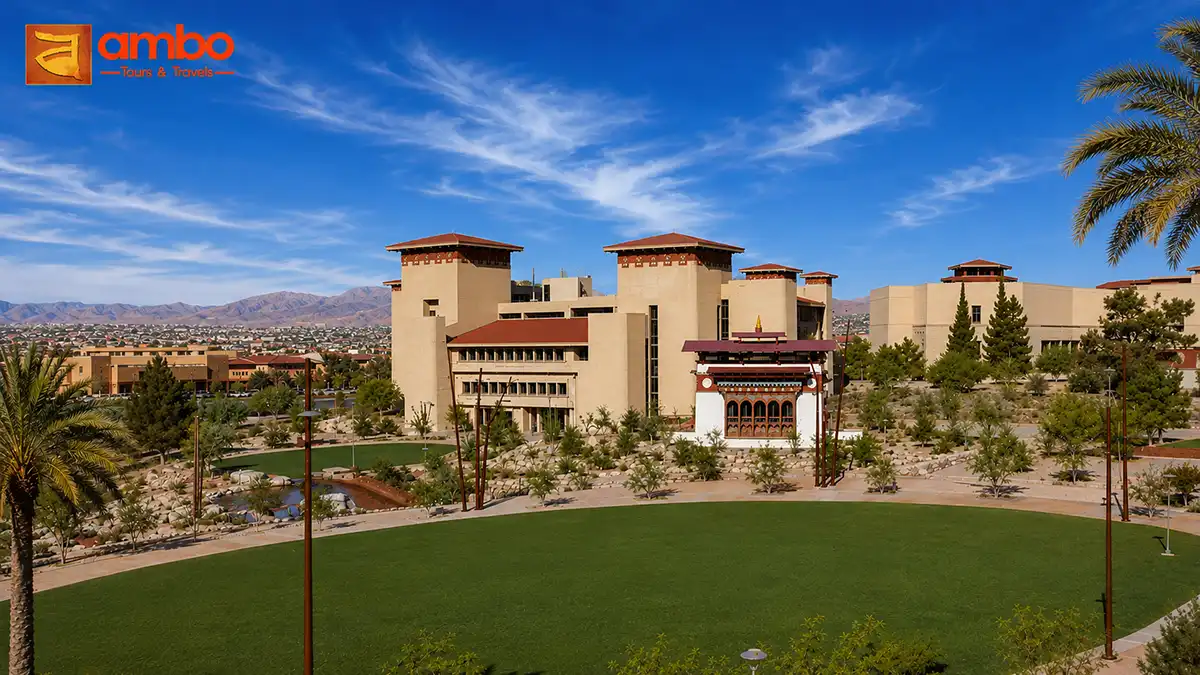
Walk onto the campus of the University of Texas at El Paso, and something feels immediately, unmistakably off — in the best possible way. Massive sloping walls. High inset windows. Overhanging roofs and decorative bands of brickwork. It looks, unmistakably, like a Bhutanese dzong. That’s because it is one, in spirit — almost all of the buildings on campus follow a style that began in 1917, making UTEP one of the best-known examples anywhere of a university built in the architectural language of the Himalayan kingdom.
A Fire, a Magazine, and a Bold Idea
The story begins with disaster. In 1916, a fire destroyed the original main building of what was then the School of Mines, and the school had to be rebuilt on a new site on a mountainside in El Paso. The task fell to Dean Steve Worrell — but it was his wife, Kathleen Worrell, who changed the course of the university’s identity forever.
Kathleen Worrell, a travel writer herself and a devoted reader of National Geographic, had seen photographs of Bhutan in the April 1914 issue, in an article titled “Castles in the Air” by the British political officer John Claude White. It is widely described as the first set of Bhutan photographs published in the United States, and UTEP’s own history notes the magazine had around 330,000 readers that year. Noticing the similarity between mountainous Bhutan and the school’s new site in the Franklin Mountains, she suggested rebuilding in the style of Bhutan’s dzongs, the fortress-monasteries that define the kingdom’s skyline. By UTEP’s account, the legend goes that she convinced her husband, and Dean Worrell then convinced the faculty.
Building “Bhutanese Revival”
Local architects Charles Gibson and George Robertson made preliminary sketches based on the National Geographic photographs, but the contract for the first buildings — Old Main, the Geology Building, Graham Hall and Quinn Hall, all erected in 1917 — went to the El Paso firm Trost & Trost. The Society of Architectural Historians describes Old Main as an example of Trost & Trost’s Bhutanese interpretation: battered, stucco-covered walls that slope inward as they rise, a shallow hipped roof with wide eaves, a band of ornamental brickwork linking the windows, and projecting window frames. The style came to be known as “Bhutanese Revival.”
The idea proved far more than a one-off gesture. Buildings through about 1950 followed the style, and Texas Highways reports that Kathleen Worrell’s idea is reflected in almost all of the buildings at UTEP today. The Christian Science Monitor has described UTEP as the only place in the Western Hemisphere to have reproduced Bhutan’s architecture.
From Architectural Inspiration to Genuine Friendship
What began as one woman’s creative response to a magazine article grew into a real relationship between UTEP and the Kingdom of Bhutan. In the late 1960s, UTEP’s Dale Walker, who edited the university magazine, wrote to Bhutan’s queen about the campus’s Bhutanese-inspired architecture. UTEP says that letter began an official relationship between the university and the Bhutanese royal family, and the first student from Bhutan enrolled a few years later. The ties have since grown to include research and study abroad, and UTEP held a week of Bhutan Days celebrations in April 2026.
In 2008, Bhutan was a featured culture at the Smithsonian Folklife Festival on the National Mall in Washington, D.C., where Bhutanese craftsmen assembled a lhakhang. Bhutan then gifted it to UTEP — UTEP says the only condition was that it go to its campus — and it was reassembled in the center of campus. Although “lhakhang” translates as “temple,” Texas Highways notes that the structure is not a place of worship. The University Library holds more Bhutanese objects, including an archery bow and a brightly painted target, and Texas Highways describes the campus and its collection as one of the largest concentrations of Bhutanese artistic expression outside Bhutan.
A Living Debate Over Preservation
The story isn’t purely historical — it’s still unfolding. In August 2024, the University of Texas System Board of Regents unanimously approved a new 10-year master plan for UTEP. At the time, a representative of the UTEP Heritage Commission said the plan calls for demolishing several historically significant Bhutanese Revival buildings, naming Vowell, Benedict and Worrell halls among them. The plan has become a source of controversy within the UTEP community and among preservationists, and Texas Architect magazine has covered the debate. Plans can change, so check UTEP for the latest. It’s a reminder that this piece of cross-cultural history is something people are actively discussing today, not simply a curiosity from the past.
Why This Story Matters
For a country as remote and historically closed to outsiders as Bhutan, it’s genuinely remarkable that one of its most distinctive architectural traditions found a second home on a university campus in the American Southwest. It’s a story that captures something true about both places: Bhutan’s architecture has always had the power to move people who encounter it, even from nothing more than a photograph in a magazine.
Frequently Asked Questions
Why is UTEP’s campus built in Bhutanese architectural style?
After a fire destroyed the School of Mines’ original main building in 1916, Kathleen Worrell, wife of Dean Steve Worrell, suggested rebuilding in the style of Bhutanese dzongs after seeing photographs in an April 1914 National Geographic article and noticing the similarity between Bhutan’s mountains and the new campus site.
Who designed UTEP’s first Bhutanese-style buildings?
Local architects Charles Gibson and George Robertson made preliminary sketches from the National Geographic photographs, but the contract for the first four buildings (Old Main, the Geology Building, Graham Hall and Quinn Hall), all erected in 1917, went to the El Paso firm Trost & Trost.
Does UTEP have an actual Bhutanese building on campus?
Yes. UTEP has a lhakhang, a small temple-style building first assembled by Bhutanese craftsmen at the 2008 Smithsonian Folklife Festival, then gifted by Bhutan and reassembled in the center of campus. It is not a place of worship.
How many buildings at UTEP are built in this style?
Almost all of them. The first four buildings went up in 1917, buildings through about 1950 followed the style, and newer construction has continued to borrow elements of it.
Are UTEP’s historic Bhutanese buildings at risk today?
Some may be. A 10-year campus master plan approved in August 2024 calls for demolishing several historic Bhutanese Revival buildings, according to a UTEP Heritage Commission representative, and it has prompted debate among preservationists and the UTEP community. Plans can change, so check UTEP for the latest.
Sources
- The University of Texas at El Paso, UTEP’s own page on its Bhutan connection — the 1914 magazine, the Worrells, and the late-1960s letter that began the official relationship.
- SAH Archipedia, University of Texas at El Paso (Texas School of Mines and Metallurgy) — the first four buildings, the architects, and a description of Old Main.
- Texas Highways, “El Paso has a fascinating connection with a small Himalayan country” — the campus today, the lhakhang, and the library’s collection.
- Texas Highways, February 2023 issue, page 61 (UNT Portal to Texas History) — the 1914 photographs and the lhakhang not being a place of worship.
- KVIA, “UTEP celebrates relationship with Bhutan with weeklong activities” (2026) — Bhutan Days, the 2008 gift, and research and study-abroad ties.
- The Christian Science Monitor, “Surprising echoes of Bhutan in Texas” (2009).
- KVIA, “Some historic Bhutanese Revival UTEP buildings could soon be gone” (2024) — the regents’ approval of the master plan.
- Texas Architect, “Bhutanese heritage in the Chihuahuan Desert: uncertainty surrounds UTEP master plan” (2025) — the preservation debate.
This is one of several real connections between the two countries — explore more on our USA and Bhutan hub page, or see the full practical guide to traveling to Bhutan from the USA.
Ready to Experience Bhutan?
Tell us your dates and interests — our team in Thimphu will craft a personalised itinerary within 24 hours, at no cost.