Masagang Base Camp Trek — To the Foot of Bhutan's Unclimbed Giants
Paro · Gasa · Laya · Lungu · Nulithang · Punakha · Thimphu
Tour Information
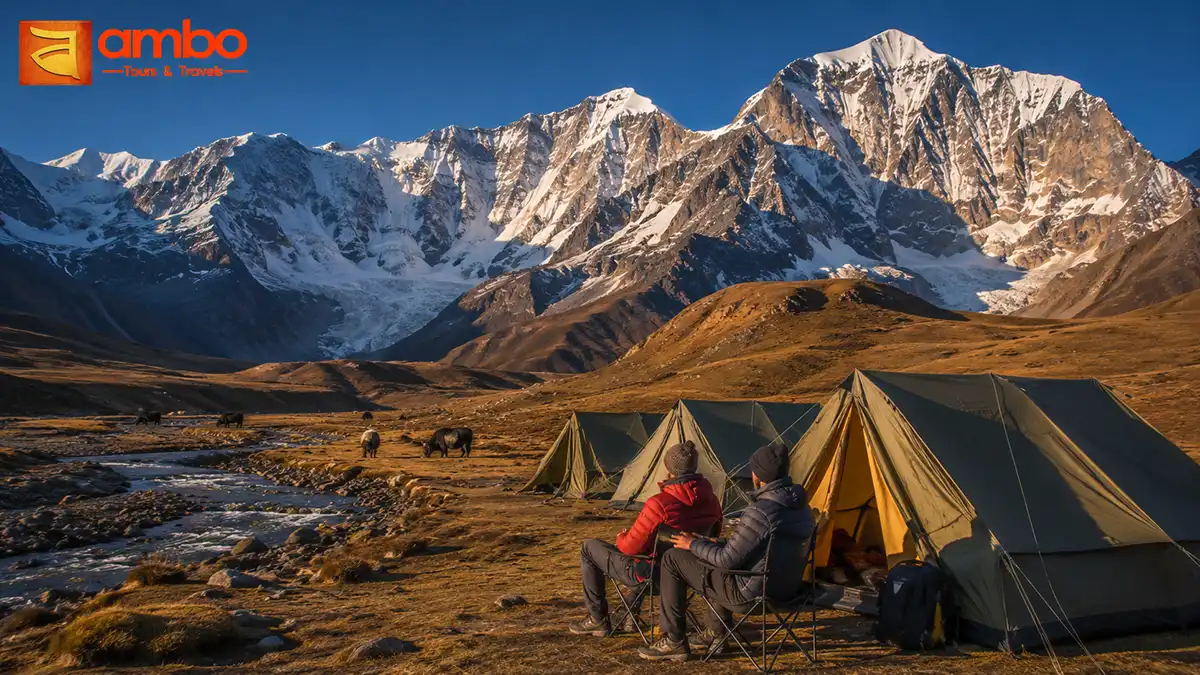
- Nulithang Base Camp (4,140m) — direct views of the unclimbed north face of Masagang (7,194m) and Tsenda Kang (7,000m)
- Optional Chethola Viewpoint (5,010m) — close-range views of the Masagang glacier
- Laya village (3,800m) — Layap people, conical bamboo hats and yak-herding culture
- Lungu village — a rarely-visited highland settlement above Laya
- Overnight at Dochula Pass (3,010m) — sunrise views of the northern peaks
- Gasa Tshachu Hot Springs — natural thermal pools, twice on the route
- Gasa Dzong — 17th-century fortress-monastery in the northern highlands
- Punakha Dzong at the confluence of Pho Chhu and Mo Chhu rivers
- Fully private and guided — dedicated cook team throughout
The Masagang Base Camp Trek is one of the least-travelled high-altitude routes in Bhutan — a compact 11-day expedition that penetrates the remote northern highlands of the Gasa district to reach Nulithang (Somji) camp at 4,140m, directly beneath the towering north faces of Masagang (7,194m) and Tsenda Kang (7,000m). Both peaks remain unclimbed.
The route passes through Laya village — home of the Layap people and their distinctive conical bamboo hats — before ascending to Lungu village and the base camp. A full rest day at Nulithang offers three optional hikes, including the Chethola Viewpoint at 5,010m with close-range views of the Masagang glacier and Kang Bum. The descent returns to Gasa Hot Springs before a cultural drive through Punakha Dzong and Thimphu.
The expedition begins with Tiger's Nest in Paro and an overnight at Dochula Pass — one of the most atmospheric hotel stays in Bhutan, with sunrise views of Masagang itself visible from the pass on clear mornings. Operated by Ambo Tours, DOT Licence No. 1053330, Thimphu.
Tour Pricing
11 Days Bhutan Journey — Cost
All prices in USD per personCost includes Sustainable Development Fee (SDF) of US $100 per person per night and Bhutan Visa Fee of US $40 per person. Entrance fees for monuments and festival visits are paid separately.
Detailed Itinerary
Your Masagang Base Camp Trek Bhutan adventure begins with the world's most spectacular commercial landing. The plane threads between Himalayan ridgelines into Paro International Airport — a runway famed as one of the most technically demanding approaches in global aviation. Your Ambo Tours guide meets you at arrivals with a warm welcome.
Depending on your arrival time, the afternoon covers three Paro highlights:
- Paro Airport Viewpoint — a hillside perch from which you can watch planes navigating the narrow valley on final approach, one of aviation's great spectacles.
- Rinpung Dzong (Fortress of the Heap of Jewels) — the fortress-monastery where Bernard Bertolucci filmed scenes of Little Buddha, its wooden-gallery courtyard lined with vivid Buddhist murals.
- Paro town walk — a lively street of painted shopfronts, craft shops, cafés, and local market stalls that gives an immediate sense of Bhutanese daily life.
Tip: Rest well tonight. Tomorrow's hike to Tiger's Nest and the overnight at altitude begin the acclimatisation sequence for the trek ahead. Dinner and overnight in Paro.
Tomorrow — the iconic hike to Tiger's Nest Monastery, followed by an overnight at Dochula Pass (3,010 m) to begin altitude preparation.
Today serves double duty — the finest acclimatisation hike in Bhutan plus a high-altitude overnight that prepares your body for the serious trekking ahead. Start early with the climb to Taktsang Monastery (Tiger's Nest) at 3,015 m — perched on a sheer cliff face 900 metres above the Paro Valley floor. For even better altitude preparation, your Ambo Tours guide leads you above the main temple to Zangtopelri Lhakhang at 3,350 m — a less-visited upper chapel that rewards the extra climb with superior views and genuine seclusion.
After descending, drive east with a stop at Tachog Lhakhang — a private monastery above the Paro River, reached by one of Bhutan's last original iron-chain suspension bridges built by the legendary saint Thang Tong Gyalpo in the 15th century.
Continue to Dochula Pass (3,010 m) for overnight. On clear evenings, the panorama of snow-capped Himalayan peaks includes Gangkar Puensum (7,570 m) — the world's highest unclimbed mountain — and the outline of Masagang (7,194 m) itself, the peak you will stand beneath in just a few days. Sleeping at this altitude tonight gives your body a head start. Dinner and overnight in hotel at Dochula Pass.
Tomorrow, wake early for sunrise on the peaks before the drive to Gasa via Punakha.
Wake early. The sunrise from Dochula Pass on a clear morning is extraordinary — the 108 chortens glow in the first light as the full Himalayan range sharpens on the horizon. After breakfast and photographs, begin the descent toward Wangdue Phodrang district.
Stop at Thinleygang village for a hike to Laptsakha and a visit to Chandana Lhakhang — a temple associated with the Divine Madman Drukpa Kuenley, whose irreverent teachings and phallic symbolism dot the village walls throughout this valley.
Take lunch in Punakha, then drive north toward Gasa. If time permits, stop for the hike to Khamsum Yulley Namgyal Choling Monastery — a charming hilltop temple with stunning views over the Punakha rice fields and river below.
The road north follows the Mo Chhu River upstream through increasingly dense forest, climbing gradually into the northern highlands. Arrive at Gasa Hot Springs (Gasa Tshachu) in the evening — therapeutic mineral pools of sulfurous hot water set in a forest clearing beside the river. Soaking here is the ideal way to prepare body and muscles before the trek begins tomorrow. Dinner and overnight camping at the hot springs or in simple local guesthouse facilities.
Tomorrow, visit Gasa Dzong then drive north to the trailhead for the Masagang Base Camp Trek.
Take the morning at a leisurely pace. After breakfast, drive into Gasa town and visit Gasa Dzong — a monumental 17th-century fortress perched on a hilltop above the valley, once the front-line defence against Tibetan invasions from the north. Its hilltop position commands sweeping views across the Mo Chhu gorge and the northern highlands beyond. A few small chapels inside are worth exploring.
After the dzong, your Ambo Tours driver takes the rough road north from Gasa through mixed forest — a track still being extended and destined eventually to reach Laya and Lungu. The drive is bumpy and dramatic in equal measure. Arrive at Taktse Makha (3,450 m) — the current road head near the military camp — in the afternoon.
This is your final night before serious trekking begins. Rest here. Check your boots, walking poles, and layers. The altitude is already significant — 3,450 m is higher than most peaks in the Alps. Your Ambo Tours crew will have camp established and a warm meal ready. Dinner and overnight at camp, Taktse Makha.
Tomorrow — the longest trekking day of the expedition: climbing to Laya village and on to Lungu.
Today is the longest and most culturally rich day of the Masagang Base Camp Trek Bhutan. First, present trekking permits at the military camp checkpost at Taktse Makha — army checkpoints at this altitude are a reminder of your proximity to the Chinese-Tibetan border to the north.
The trail climbs approximately 300 metres to Laya village (3,800 m) — the second-highest permanent settlement in Bhutan and home to the Layap people, one of Bhutan's most distinctive highland communities. For a longer expedition that spends more time in Laya and continues north through four high passes, see our Laya-Gasa Trek — an 18-day journey to the Gasa Hot Springs. Layap women are immediately recognisable by their conical bamboo antenna hats decorated with coloured fabric spikes — a design originally built to channel monsoon rainfall away from the face. The community has become increasingly prosperous through the harvesting of yartsagunbu (cordyceps fungus), which fetches extraordinary prices in Chinese medicine markets.
- Visit the Laya village temple.
- Observe traditional yak-herding practices and the distinctive handwoven textiles of the Layap women.
- Walk slowly and breathe deeply — the altitude effects are noticeable at 3,800 m.
After lunch in Laya, descend and then climb again to the smaller settlement of Lungu village (3,740 m) — far less visited than Laya and home to a similarly distinctive Layap community. Stop here at the last small grocery store for a couple of days before heading into the truly remote terrain beyond. Dinner and overnight at camp in Lungu.
Tomorrow, the trail pushes east and north toward Nulithang and the base of Masagang.
This is the day the entire trek has been building toward. The trail from Lungu heads east with a gentle ascent, offering a bird's-eye perspective back over the village and down to the Taktse Makha military camp far below. The path connects to the main trail leading north toward Masagang.
Hike through a scattering of highland hamlets and past the ruins of an old military camp, crossing a clear mountain stream before the terrain opens dramatically. Then — suddenly — the view that defines the Masagang Base Camp Trek Bhutan reveals itself: the towering north face of Tsenda Kang (7,000 m) on the right and the summit pyramid of Masagang (7,194 m) on the left, rising above the valley in a panorama that stops conversation.
This is Somji camp — also called Masagang Base Camp. Smaller groups camp here directly. Larger groups continue 30 minutes downhill to Nulithang (4,140 m), a more spacious campsite in the valley below. Explore our full Bhutan trekking guide to compare all routes, permits, and seasonal conditions across the kingdom. Your Ambo Tours crew will have tents pitched and a warm camp dinner ready as the last light touches the summit of Tsenda Kang in golden alpenglow. Dinner and overnight at Nulithang.
Tomorrow is a full exploration day at base camp — three possible day hikes, ranging from moderate to very demanding.
This is the mountain day of the Masagang Base Camp Trek Bhutan. Spend a full day exploring the extraordinary high-altitude surroundings of Nulithang — three options suit different energy levels and ambitions.
- Option 1 — Chethola Viewpoint (5,010 m): The most demanding and most rewarding option. A steep 3–4 hour climb from Somji with no formal trail — ascend the hill to the right, gaining 870 metres of altitude. The summit delivers an uninterrupted close-up view of Masagang and a full 360-degree panorama of the surrounding high peaks. Descend the same way. Suitable only for those who feel strong and show no altitude sickness symptoms.
- Option 2 — Yak Herders' Ridge and Glacier Valley: A gentler two-hour climb up the hill above Somji to a yak herder's campsite with clear views of Masagang, Tsenda Kang, and Kang Bum. From here, continue down into the valley beneath the Masagang glacier — rhododendrons line the slopes, an ice lake feeds the stream, and the scale of the surrounding peaks is humbling. Allow four hours total. The trail is sometimes faint — advance carefully.
- Option 3 — Phongme Valley Round Trip: An eight-hour circuit hiking north of Nulithang to the ruined castle or monastery at Phongme, returning by the opposite bank of the river. Gentler climbing with pleasant valley and mountain views. Good for those acclimatising rather than pushing altitude.
Whichever option you choose, the evening light on the Masagang summit from camp is a moment that belongs to a category no photograph fully captures. Dinner and overnight at Nulithang.
Tomorrow, the long descent begins — back to Taktse Makha and the vehicle to Gasa.
Start early today. The trail retraces the route from Nulithang back toward Taktse Makha — but instead of climbing back up to Lungu village, the direct path descends straight to the Taktse Makha military camp. This shorter route saves time and energy. Present permits at the checkpoint once more before boarding your vehicle.
The bumpy jeep road south returns you to Gasa and on to the Gasa Hot Springs (Gasa Tshachu) by the afternoon — a perfect conclusion to the trek. The sulfurous mineral pools sit in a natural forest setting beside the Mo Chhu River. Lower yourself in and feel the aches of five trekking days dissolve in the warm water. Your Ambo Tours cook team and trekking crew join the celebration — this is the end of the high-altitude section of the journey.
Dinner and overnight camping at the hot springs or in the simple local guesthouse. Dinner and overnight at Gasa Hot Springs.
Tomorrow, drive south to Punakha for a comfortable hotel, the magnificent Punakha Dzong, and the longest suspension bridge in Bhutan.
The morning drive south from Gasa follows the Mo Chhu River downstream through the same dense forest that flanked the outward journey — warmer, greener, and more subtropical with every kilometre of descending altitude. Arrive in Punakha (1,350 m) and check in to a proper hotel — the first real bed since before the trek.
Two afternoon visits make the most of Punakha's extraordinary heritage:
- Punakha Dzong (Palace of Great Happiness, built 1637 by Zhabdrung Ngawang Namgyal) — positioned at the confluence of the Pho Chhu and Mo Chhu rivers, this is Bhutan's most intricately decorated fortress and the former winter seat of the kingdom's rulers. The three-storey main temple with its four embossed cypress entrance pillars decorated in gold and silver is a masterpiece of traditional Bhutanese architecture. After the stark grandeur of Nulithang base camp, the warmth and colour of Punakha Dzong hits with particular force.
- Longest suspension bridge in Bhutan (160 m) — a crossing over the Pho Chhu river that rewards the mild adrenaline with sweeping views of the dzong, the river confluence, and the valley beyond.
Dinner and overnight in Punakha.
Tomorrow — the drive to Thimphu via Chimi Lhakhang, ending with an evening walk through the capital.
The morning begins with a walk to Chimi Lhakhang — the fertility temple of the 15th-century saint Drukpa Kuenley, known as the Divine Madman. He taught Buddhism through singing, drinking, and wilfully scandalous behaviour — rejecting orthodox monastery life in favour of direct engagement with ordinary people. The path to the temple passes through villages adorned with phallic symbols painted on exterior walls, a cheerful commemoration of the saint's teaching style. Childless couples visit from across Bhutan and beyond to seek his blessing.
Drive to Thimphu (2,350 m) for the afternoon and evening. Two stops round out the capital experience:
- Buddha Dordenma at Kuenselphodrang — a 51.5-metre bronze and gilded Buddha statue overlooking the valley from a forested hilltop, one of the largest in the world.
- Clock Tower Square and Norzin Lam — Thimphu's social centre, where locals gather around the clock tower, browse the handicraft market for Bhutanese souvenirs, and watch the lone traffic officer direct vehicles at the main junction. Thimphu is the only capital city on earth with no traffic lights.
Your Ambo Tours guide suggests a final evening drink at one of Thimphu's rooftop bars to celebrate the conclusion of the trek — a well-earned toast. Dinner and overnight in Thimphu.
Tomorrow — drive to Paro for departure from Bhutan.
Your Masagang Base Camp Trek Bhutan expedition with Ambo Tours comes to a close this morning. After breakfast, the drive from Thimphu to Paro takes just one hour — a journey that feels almost impossibly short compared to the distances your legs have covered over the past week. Your guide and driver transfer you to Paro International Airport with time to spare.
Eleven days have taken you from the painted shopfronts of Paro town to the base of one of the great unclimbed Himalayan peaks — past the iron-chain bridge of Thang Tong Gyalpo, the sunrise chortens of Dochula, the Divine Madman's fertility temple, the Mo Chhu gorge, the bamboo-hat women of Laya and Lungu, the military checkpoints of the northern highlands, and finally to the extraordinary campsite at Nulithang where Masagang (7,194 m) and Tsenda Kang (7,000 m) fill the sky. The Gasa Hot Springs bookended the trek perfectly.
Bhutan's commitment to sustainable tourism, Gross National Happiness (GNH), and the low-impact preservation of its highland communities and natural landscapes makes every trek here feel like something worth protecting. The entire Ambo Tours team thanks you for travelling with us and hopes to welcome you back to the Land of the Thunder Dragon.
Included / Excluded
- ✔All meals — breakfast, lunch, and dinner
- ✔Accommodation on twin / double sharing basis (single supplement extra)
- ✔All transportation within the kingdom including airport transfers
- ✔Sustainable Development Fee — Government tax (SDF)
- ✔Bhutan visa fee
- ✔English-speaking private local guide
- ✔Sightseeing as per itinerary
- ✔Bottled water throughout the journey
- ✖International flights to and from Paro (PBH)
- ✖Entrance fees for museums and monuments
- ✖Gratuities for guides and drivers
- ✖Travel insurance premiums
- ✖Payments for services provided on a personal basis
- ✖Cost for any services not mentioned under "Cost Includes"
- ✖Cost incurred due to mishaps, strikes, political unrest, etc.
- ✖Personal expenses — laundry, beverages, or personal services
Ambo Tours & the 1% Club
Every tour we run includes a contribution to a Bhutanese NGO of your choice — at no extra cost to you. We call this the 1% Club: a minimum of 1% of your trip's profit, or Nu 5,000, whichever is higher, donated on every single journey. You choose where it goes.
What is the Masagang Base Camp Trek?
The Masagang Base Camp Trek is a compact high-altitude expedition to the foot of two of Bhutan's most dramatic unclimbed peaks — Masagang (7,194m) and Tsenda Kang (7,000m) — in the remote Gasa district of northern Bhutan. The four-day trekking section travels north from Taktse Makha through Laya village and Lungu to Nulithang camp (Somji) at 4,140m, where the full north face of Masagang rises directly above the campsite.
Mountaineering above 6,000m is prohibited in Bhutan — these peaks will never be climbed. Nulithang is as close as any person can legally stand to the summit of Masagang, which makes the base camp experience genuinely rare. A full rest day with three optional hikes — including the Chethola Viewpoint at 5,010m — allows the mountain to be explored at altitude without the risks of a technical ascent.
The wider 11-day itinerary combines the trek with an overnight at Dochula Pass, Gasa Hot Springs, Laya village and the Layap people, Punakha Dzong, and Tiger's Nest in Paro — giving the full range of northern Bhutan's wilderness and cultural depth in a single journey.
Altitude & Acclimatisation
The Masagang Base Camp Trek reaches 4,140m at Nulithang camp — and 5,010m on the optional Chethola Viewpoint hike. The itinerary is structured to allow gradual acclimatisation before the highest camps: the first two days in Paro (2,300m) and Dochula Pass (3,010m) provide early altitude exposure, and the drive to Taktse Makha (3,450m) on Day 4 is a further step before trekking begins.
The ascent from Taktse Makha to Lungu (3,740m) on Day 5 is the most demanding day in terms of altitude gain — 1,000m of ascent over 15km. Most trekkers feel the altitude at Lungu and Nulithang in the form of mild headache or reduced appetite. These symptoms typically resolve with rest and hydration. The rest day at Nulithang on Day 7 is also an acclimatisation day — lighter activity at high altitude before the descent begins on Day 8.
The optional Chethola Viewpoint hike to 5,010m should only be attempted by those who have slept well at Nulithang and feel strong. Your guide will assess conditions and fitness on the morning of Day 7 before recommending an option.
Trek Route Map
The map below shows the Masagang Base Camp Trek route from Taktse Makha through Laya village and Lungu to Nulithang Base Camp (4,140m), with the optional Chethola Viewpoint marked at 5,010m.

What to Pack for the Masagang Base Camp Trek
The northern Bhutan highlands above Gasa are remote and cold. The Nulithang camp at 4,140m drops well below freezing after sunset even in the peak seasons of spring and autumn. The optional Chethola hike to 5,010m requires full mountain gear.
Essential items:
- Down jacket — mandatory at Lungu (3,740m) and Nulithang (4,140m). A warm down jacket, not a light fleece.
- Waterproof outer shell jacket and trousers — northern Bhutan can receive snowfall at any time of year above 4,000m
- Sturdy trekking boots — waterproof, with ankle support, fully broken in. River crossings on Day 5 may require gaiters.
- Trekking poles — essential for the 1,000m ascent on Day 5 and the descent on Day 8
- Thermal base layers — minimum two sets
- Warm hat, balaclava, and gloves — mandatory at Nulithang and on the Chethola hike
- Gaiters — recommended, especially in spring when snow may still cover the higher approach
- Sunscreen SPF 50+ and UV glacier glasses — essential at 4,000m+
- Personal altitude medication if prescribed — consult your doctor before booking
- Small daypack (20–25L) — main luggage travels by vehicle to Gasa
Sleeping bags, tents, and all camp equipment are provided. For a full packing reference, see our complete Bhutan packing guide.
Frequently Asked Questions
Masagang is a peak of 7,194m in the Gasa district of northern Bhutan, on the border with Tibet. It is one of Bhutan's highest unclimbed peaks — mountaineering above 6,000m is prohibited in Bhutan as a matter of national policy, preserving these peaks in their sacred, unascended state. Masagang is flanked by Tsenda Kang (7,000m) and Kang Bum. From Nulithang camp at 4,140m, the full north face of Masagang is visible at close range — a sight available to only a small number of trekkers each year.
The Masagang Base Camp Trek is rated Easy to Moderate. The trekking section spans four days with a maximum camp altitude of 4,140m at Nulithang. The longest day (Day 5) covers 15km with 1,000m of ascent from Taktse Makha through Laya to Lungu. The optional Chethola Viewpoint hike on Day 7 reaches 5,010m and is strenuous — it is genuinely optional and most trekkers find the Yak Herders' Ridge alternative equally rewarding. No prior high-altitude trekking experience is required for the main route.
Dochula Pass at 3,010m is one of the most atmospheric places to spend a night in Bhutan — the 108 memorial chortens are illuminated after dark, and on clear mornings the northern peaks including Masagang (7,194m) and Gangkar Puensum (7,570m) are visible from the pass before the cloud builds. Staying overnight rather than passing through in a vehicle gives you the sunrise that most visitors never see. It also breaks the long drive from Paro to Gasa into two comfortable days.
Spring (April to June) and autumn (September to November) are both excellent. Spring offers the clearest views of Masagang before the monsoon cloud builds, and the Layap people are often in Laya during the yartsagunbu (caterpillar fungus) harvest season in May and June. Autumn brings stable weather and crystal-clear mountain visibility. The route is not possible during the monsoon (July to August) due to flooded river crossings and poor mountain visibility.
The rest day at Nulithang Base Camp (Day 7) offers three options depending on fitness and conditions. Option 1 is the Chethola Viewpoint at 5,010m — a steep 3–4 hour climb directly above camp with close-range views of the Masagang glacier and Kang Bum peak. Option 2 is the Yak Herders' Ridge and Glacier Valley — a 2-hour moderate walk with panoramic views of the entire peak group. Option 3 is the Phongme Valley Round Trip — an 8-hour circuit to ruined castle and monastery remains at Phongme. Your guide will advise on conditions on the morning of Day 7.
Yes — for reasonably fit first-time trekkers, the Masagang Base Camp Trek is one of the most rewarding introductions to high-altitude Bhutan. The trekking days are relatively short (11–15km), the maximum camp altitude of 4,140m is well within the range of most healthy adults with adequate acclimatisation, and the cultural richness of Laya village and the mountain drama of Nulithang camp make every day worthwhile. The Bumthang Owl Trek is the only route we consider more accessible for complete beginners.
Ready to Begin Your Journey?
Our Thimphu team responds within 24 hours. Tell us your dates and we will handle the rest.